London’s street food markets connect the capital’s long commercial history with its modern multicultural food culture. Markets have supplied London with food for centuries, while contemporary street-food stalls have transformed historic trading spaces, railway arches, public streets, and former industrial sites into places for eating, social exchange, and small-business activity.
- Why are London’s street food markets historically important?
- How did London’s food market tradition develop?
- Which London street food market has the deepest history?
- Which London street food markets best demonstrate multicultural food culture?
- Which markets best combine historic architecture with street food?
- Which street food markets are strongest for weekday and lunchtime eating?
- How have railways, canals, and urban growth shaped London food markets?
- How do London’s street food markets support small businesses and local communities?
- How should visitors understand authenticity at London’s street food markets?
- What is the long-term historical significance of London’s street food markets?
- Frequently Asked Question
The term “street food market” describes a market where prepared food is sold for immediate consumption from temporary or semi-permanent stalls, kiosks, trailers, counters, or food businesses. London’s current street-food culture includes British, Indian, Middle Eastern, African, Caribbean, East Asian, European, Latin American, and other culinary traditions.
The historical foundations are older than the modern street-food movement. Borough Market traces food trading around London Bridge to at least 1014. Greenwich Market developed from earlier regulated trading arrangements and formally opened in 1737. Berwick Street Market was founded in 1778. Broadway Market dates from about 1890. Camden Market began in 1974 with 16 stalls. These different origins show how London’s food markets developed through changing transport systems, migration, regulation, urban growth, and consumer demand.
Why are London’s street food markets historically important?
London’s street food markets are historically important because they continue a centuries-old system of public food trading while reflecting migration, urbanisation, transport development, entrepreneurship, and changing eating habits across the capital’s communities.
Markets formed an essential part of London’s urban economy because they connected producers, wholesalers, retailers, traders, and consumers. Before modern supermarkets and large-scale food distribution, markets were central locations for buying meat, fish, vegetables, fruit, grain, dairy products, and prepared foods.
The relationship between markets and transport was particularly important. London’s expanding population created greater demand for reliable food distribution. Roads, rivers, canals, railways, and later motor transport changed the speed and scale at which food entered the city.
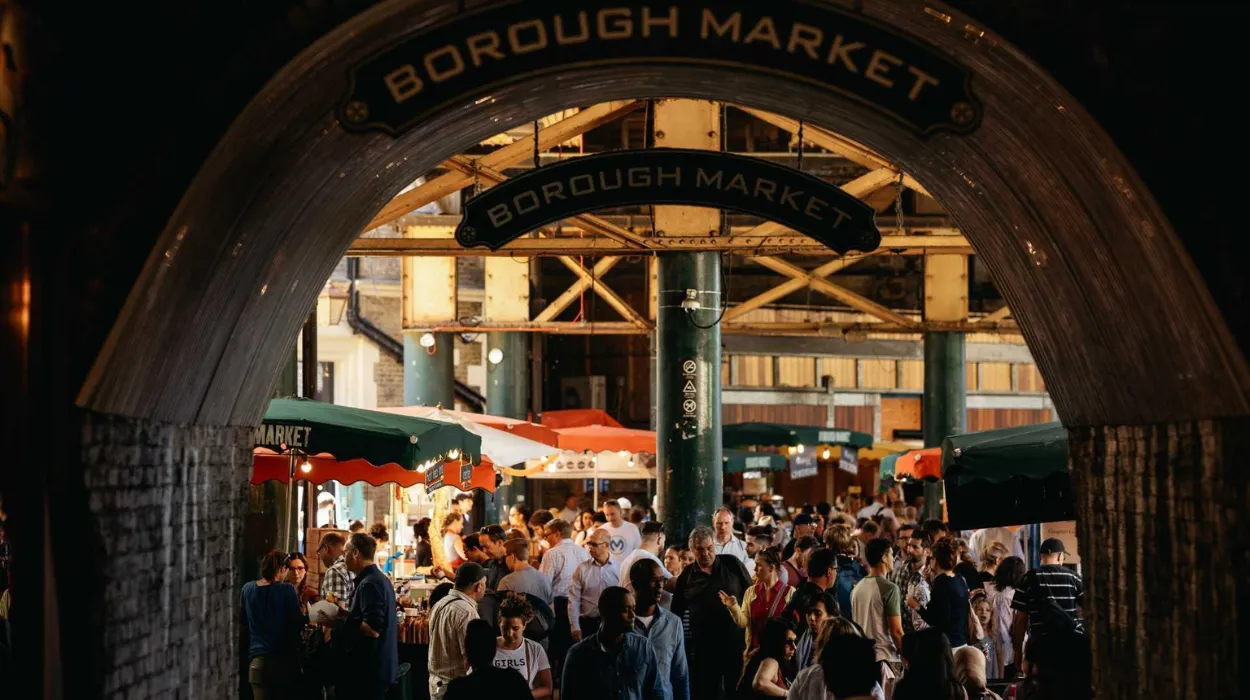
Borough Market provides one of the clearest examples. During the nineteenth century, railway expansion helped transform it into a major fruit and vegetable wholesale centre. A railway viaduct crossed the market in 1862, strengthening its connection with national produce networks.
Smithfield demonstrates another stage of this development. The City of London records livestock and meat trading on the site for more than 1,000 years. The present East and West Market Buildings were completed in 1868 after legislation authorised a purpose-built metropolitan meat market.
Modern street food operates within a different commercial system. Traders prepare food in licensed premises, mobile units, market kitchens, stalls, or permanent market spaces. The emphasis has shifted from supplying raw provisions for household consumption to providing prepared meals and snacks for immediate eating.
London City Hall identifies markets as important places for employment, trade, leisure, entrepreneurship, community activity, and high-street vitality. Its market policy also recognises markets as low-cost and comparatively low-risk environments where new businesses can test products and develop commercial experience.
How did London’s food market tradition develop?
London’s food market tradition developed from medieval provisioning centres into regulated Victorian markets and later multicultural food destinations, with Borough Market, Greenwich Market, Berwick Street Market, Broadway Market, and Camden Market representing different stages of this long commercial evolution.
Medieval London depended on markets because food distribution was closely tied to physical trading places. Borough Market’s documented history reaches back to the early eleventh century. By the thirteenth century, traders associated with the London Bridge market had been relocated toward what is now Borough High Street.
Government regulation shaped where markets could operate. In the 1270s, the City of London restricted its citizens from buying food at the Southwark market and prevented traders from establishing stalls directly on London Bridge. These restrictions demonstrate how commercial control, congestion, and municipal authority influenced food distribution.
Borough Market was relocated in 1756 after Parliament responded to severe congestion around the road leading to London Bridge. Local parishioners secured land away from the main road and established a market that remains at the present site. The market’s legal history therefore connects food retail with public administration and community ownership.
Greenwich Market developed under a different institutional structure. Market activity in Greenwich existed by the fourteenth century, while a Royal Charter granted in 1700 established a regulated market framework. The current market formally opened on 3 September 1737, with 60 stallholders selling products including meat, fruit, and vegetables.
Berwick Street Market in Soho was founded in 1778. Westminster City Council identifies it as one of London’s oldest markets and records its continuing role as a food destination offering fruit, vegetables, dairy products, coffee, and international takeaway foods.
Broadway Market represents the Victorian expansion of east London’s market culture. Hackney’s market strategy dates its foundation to about 1890 and records its historic emphasis on food products alongside artisan and handmade goods.
Camden represents a later transformation. Its Saturday market opened on 30 March 1974 with only 16 traders selling antiques, jewellery, arts, and crafts. Food became an increasingly important part of the destination as Camden developed into a major cultural and commercial district.
This timeline demonstrates that London’s market culture was never static. Each period produced different relationships between food, transport, regulation, neighbourhoods, commerce, and public space.
Which London street food market has the deepest history?
Borough Market has the deepest documented food-market history among London’s major contemporary food destinations, with trading around London Bridge recorded by 1014 and the present market established in 1756 after Parliament ordered the earlier market relocated.
Borough Market is located on Southwark Street near London Bridge. Its historical importance comes from continuity rather than a single surviving medieval building. The market has repeatedly changed its physical form and commercial function while retaining its role as a food-trading institution.
The earliest phase developed around the southern end of London Bridge. Traders supplied food to a growing population, while the bridge served as an essential route between the City of London and Southwark.
The market’s location became commercially valuable but also created congestion. Livestock and produce entering the area contributed to problems on the approach to London Bridge. Parliament therefore legislated in 1754 to close the old market, with the change taking effect in 1756.
Local residents responded by raising funds to establish a replacement market away from the main road. The community raised £6,000 through annuities to purchase land known as The Triangle. A further £2,000 was later authorised for expansion and a market house.
The nineteenth century brought another major transformation. London’s population increased rapidly, and railway infrastructure expanded the movement of agricultural produce. Borough became a major wholesale centre for fruit and vegetables. Its commercial importance therefore resulted from both local demand and national transport networks.
The wholesale role weakened during the twentieth century as supermarkets and changing food-distribution systems reduced demand for traditional wholesale markets. Borough subsequently reinvented itself as a retail food destination. A significant turning point came in 1998, when the market began rebuilding its identity around high-quality food following the success of a Food Lovers’ Fair.
Today, Borough Market combines fresh produce, artisan products, prepared food, restaurants, and international cuisine. Its charitable trust structure remains connected to the community ownership arrangements created in the eighteenth century.
For history enthusiasts, Borough demonstrates how an ancient market can adapt without abandoning its institutional identity.
Which London street food markets best demonstrate multicultural food culture?
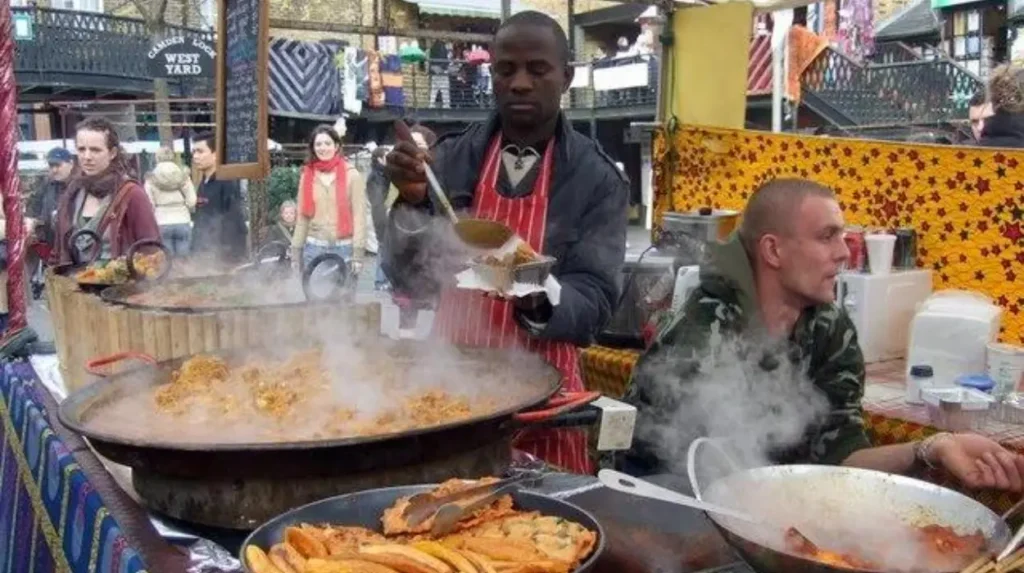
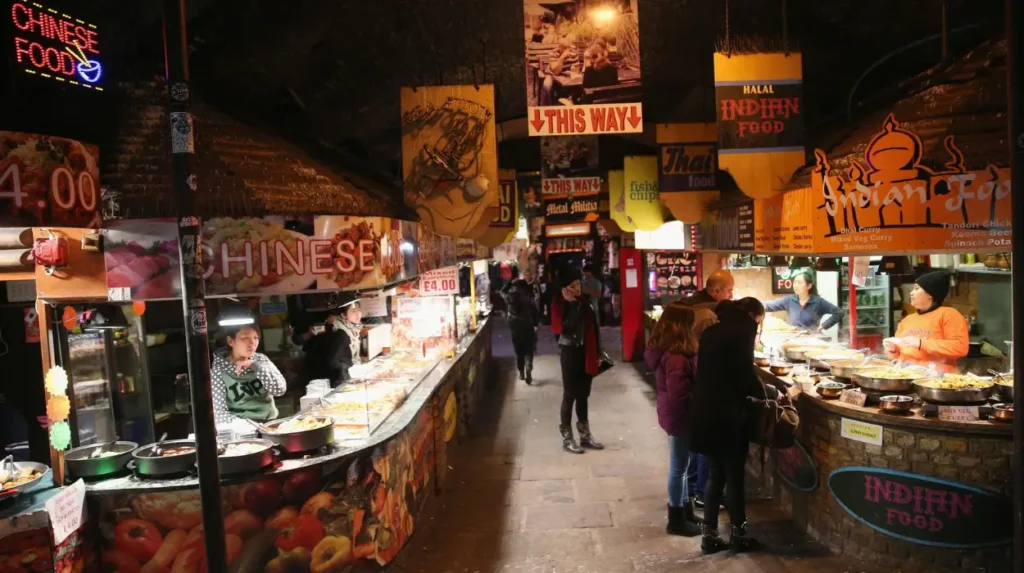
Borough Market, Camden Market, Broadway Market, Maltby Street Market, Greenwich Market, and Southbank Centre Food Market demonstrate London’s multicultural food culture through stalls and traders representing British, European, Asian, African, Middle Eastern, Caribbean, and Latin American culinary traditions.
London’s multicultural food culture developed through migration, international trade, imperial connections, post-war immigration, global travel, and later international entrepreneurship. Markets provide visible spaces where these influences become part of everyday urban commerce.
Borough Market presents an established combination of British produce and international prepared food. Current listings include Indian curry, British pies, Spanish paella, Levantine dishes, bao, pasta, and other international offerings.
Camden Market developed into an international food destination within a neighbourhood already shaped by industrial and cultural change. The area’s nineteenth-century industrial history included distilleries and warehouses connected with gin production. The market itself began in 1974 and later expanded into a major centre for independent businesses and international food traders.
Broadway Market reflects Hackney’s multicultural identity through food businesses and Saturday market stalls. Its historical commercial function has expanded beyond conventional provisions into prepared food, cafés, restaurants, and independent food businesses along the street. Visit London describes the current market as a Saturday destination with dozens of temporary stalls and more than 70 food shops, cafés, pubs, beer gardens, and restaurants lining the street.
Maltby Street Market developed beneath nineteenth-century railway arches in Bermondsey. Its current food offer includes dishes associated with Ethiopian cuisine, Venezuelan arepas, French-style pastries, and other international influences.
Southbank Centre Food Market provides another modern example. Current London tourism information describes Friday and Saturday food trading featuring international dishes, including Ethiopian vegan stews and Polish deli foods.
Greenwich Market combines historic market infrastructure with contemporary international food. Its location within the Maritime Greenwich World Heritage Site adds an important heritage dimension to the food experience.
These markets demonstrate that authenticity in London does not depend on a single national cuisine. It is also expressed through specialist preparation, family businesses, regional recipes, imported ingredients, and communities maintaining culinary traditions within a changing city.
Which markets best combine historic architecture with street food?
Borough Market, Maltby Street Market, Greenwich Market, and Camden Market combine food trading with distinctive historic settings, including railway infrastructure, eighteenth-century market traditions, canal-side industrial buildings, and the preserved urban fabric of long-established London districts.
Architecture provides evidence of how London’s food economy changed over time. Markets occupied spaces that connected directly with transport, manufacturing, housing, and commercial streets.
Maltby Street Market is particularly associated with railway architecture. The market operates beneath nineteenth-century railway arches in Bermondsey. These structures were created as part of the infrastructure that expanded London’s railway network and transformed urban transport during the Victorian period. Today, the arches accommodate food businesses and permanent shops alongside market trading.
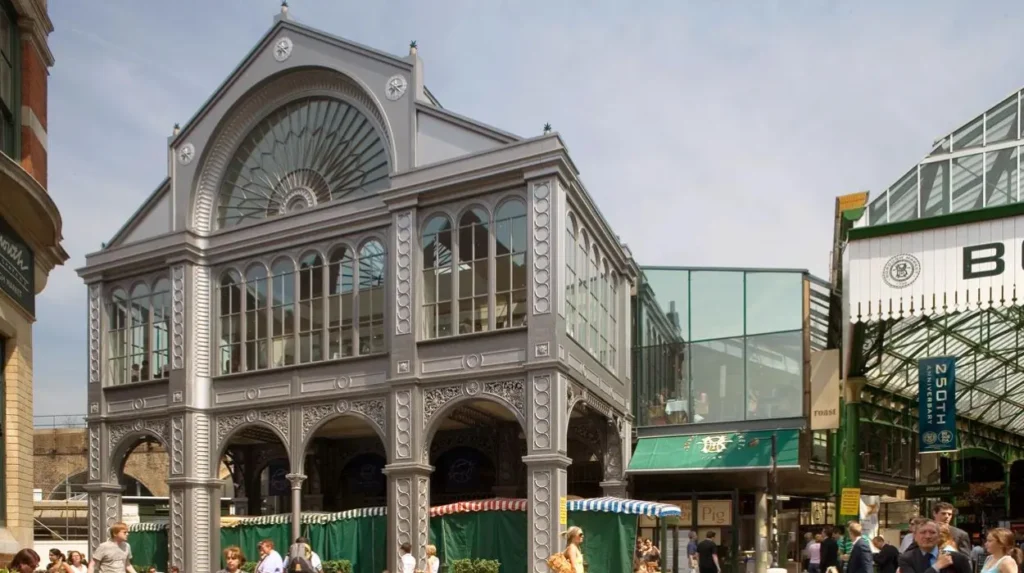
Borough Market also contains architectural evidence of successive phases of redevelopment. Railway infrastructure crossed the market in 1862, reinforcing its role as a wholesale food centre. The market’s present appearance includes structures from different periods, demonstrating that heritage sites often contain layers of construction rather than a single preserved historical moment.
An unusual example is Borough’s Floral Hall portico. The structure originally formed part of the Covent Garden Piazza and was incorporated into Borough Market during redevelopment in the early twenty-first century. Borough Market records the portico’s installation in 2003 after it was salvaged during the redevelopment of the Royal Opera House.
Camden Market is associated with the Regent’s Canal and the industrial buildings around Camden Lock. The area’s nineteenth-century industrial activity included warehouses and distilleries. The market emerged much later, beginning in a former timber-yard environment in 1974.
Greenwich Market occupies a historically significant setting within Maritime Greenwich. The market is part of a district associated with the Old Royal Naval College, the Royal Observatory, and Britain’s maritime history. Its market tradition therefore exists within a wider heritage landscape.
These architectural settings help explain why London’s street food markets function as cultural heritage destinations as well as eating places.
To experience this historic market culture in person today, consult our comprehensive [The Evolution of London’s Market Culture From Medieval Trading to Modern Tourism] for itineraries and visiting parameters.
Which street food markets are strongest for weekday and lunchtime eating?
Berwick Street Market, Broadway Market, Borough Market, and selected central London markets provide strong lunchtime food destinations, with market activity shaped by nearby offices, residents, visitors, transport stations, and established weekday trading patterns.
Berwick Street Market is particularly significant for weekday food culture. Westminster City Council states that it operates Monday to Saturday from 8am to 6pm and serves as Soho’s main lunchtime food destination. Its commodities include fruit, vegetables, flowers, coffee, dairy products, and international takeaway foods.
The market’s location explains its lunchtime importance. Soho contains dense commercial, entertainment, hospitality, residential, and office activity. Westminster’s market handbook records more than 80,000 office workers within a five-minute walk, creating a substantial daytime customer base.
Borough Market operates within another high-footfall environment. London Bridge connects the market with national rail services, Underground services, offices, residential areas, cultural attractions, and the wider South Bank area.
Broadway Market has a different rhythm. Its strongest traditional market activity is associated with Saturday trading, while permanent food businesses along Broadway extend the area’s food economy beyond market hours. Hackney’s historical market strategy estimated annualised footfall at approximately 1 million based on 2012 figures, demonstrating its substantial visitor and local catchment at that time.
Southbank Centre Food Market also operates as a recurring food destination linked to cultural and riverside activity. Its combination of prepared food and central location places it within London’s wider visitor economy.
Market opening patterns change, and individual traders operate different schedules. Visitors should therefore verify current trading arrangements through the relevant market before travelling.
How have railways, canals, and urban growth shaped London food markets?
Railways, canals, roads, and population growth transformed London food markets by increasing the speed of food distribution, connecting markets with regional suppliers, creating industrial trading districts, and converting former transport infrastructure into modern commercial food destinations.
Transport was fundamental to the development of London’s food economy. Markets required reliable movement of perishable goods, including meat, fish, fruit, vegetables, and dairy products.
The nineteenth-century railway revolution had a particularly strong effect. Borough Market’s 1862 railway viaduct helped turn the market into a major fruit and vegetable wholesale centre. Railways connected London with agricultural production areas across Britain and reduced the logistical barriers associated with long-distance food transport.
Smithfield provides an even clearer example of purpose-built transport integration. Its East and West Market Buildings were constructed above railway lines after legislation in 1860 authorised the new market. The buildings opened in 1868 and allowed meat to arrive directly at the market by rail.
Canals played another role. Camden Lock formed part of the Regent’s Canal system and was associated with the movement of industrial goods. The surrounding warehouses and yards later became part of the physical environment used by Camden Market.
Maltby Street demonstrates the later cultural reuse of railway infrastructure. The nineteenth-century arches that once served transport functions now accommodate food businesses, retail units, and market activity.
Population growth created the demand that made these transport connections commercially valuable. Victorian London expanded rapidly, increasing consumption and requiring larger and more organised food-distribution systems.
Modern street food reverses part of this historical process. Instead of moving large quantities of raw food into wholesale markets for later distribution, traders often bring prepared meals directly to consumers. The physical market remains, but the economic function changes from wholesale provisioning to direct consumption and small-business retail.
How do London’s street food markets support small businesses and local communities?
London’s street food markets support small businesses by providing physical trading space, direct customer access, entrepreneurial opportunities, and community interaction, while established markets preserve neighbourhood identities and provide commercial platforms for independent food producers and traders.
Markets have long functioned as entry points into urban commerce. London City Hall describes markets as incubators for new businesses because they provide comparatively low-cost and low-risk environments for self-employment, experimentation, and entry-level employment.
This role is particularly important for food businesses. A trader can test a menu, develop a customer base, establish pricing, refine production processes, and build brand recognition through market trading before expanding into a permanent restaurant or shop.
Camden Market illustrates the scale of this entrepreneurial environment. Its original 1974 market contained only 16 stalls. The destination subsequently expanded into a large collection of independent businesses, demonstrating how market infrastructure can support long-term commercial development.
Borough Market operates under a charitable trust structure. Its stated responsibilities include benefiting traders, neighbours, shoppers, and the wider community. The market also supports community projects and food-education initiatives.
Community ownership has deep historical roots at Borough. The 1756 settlement established the relocated market for the use and benefit of the parish community. That legal history remains central to the market’s modern identity.
Markets also preserve social knowledge. Food preparation techniques, recipes, ingredient preferences, trading practices, and business traditions pass between generations and communities through everyday commercial activity.
For genealogical researchers, markets provide useful historical context because they reveal where people worked, traded, lived, and interacted. Market streets often formed part of the occupational geography of working-class London, immigrant neighbourhoods, commercial districts, and transport corridors.
For educators, markets provide practical examples of urban history. A single market can demonstrate industrialisation, migration, municipal regulation, transport development, architecture, entrepreneurship, and changes in consumer behaviour.
How should visitors understand authenticity at London’s street food markets?
Authenticity at London’s street food markets is best understood through documented ingredients, regional cooking traditions, trader histories, preparation methods, cultural continuity, and the relationship between food businesses and London’s diverse communities rather than through a single definition of traditional cuisine.
Authenticity is a complex historical concept because cuisines change as people migrate, ingredients become available, and cooking practices adapt to new environments.
London’s markets show this process clearly. International dishes are prepared within a British urban environment using combinations of imported and locally sourced ingredients. Some recipes preserve regional traditions, while others reflect adaptation to London customers and market conditions.
Borough Market’s current food offer demonstrates this diversity through British and international products. Visit London lists Indian curry, British pies, Spanish paella, and other prepared foods among its market offer.
Maltby Street Market similarly demonstrates international culinary representation through Ethiopian food, Venezuelan arepas, French-style pastries, and other offerings.
Broadway Market connects food with Hackney’s wider multicultural identity. Its historical role as a food market has expanded into a contemporary mix of food shops, cafés, restaurants, and temporary market stalls.
The most historically useful approach is therefore to examine provenance. Questions about who operates a stall, where a recipe originates, which ingredients are used, how preparation is conducted, and how long a food tradition has existed provide stronger evidence than labels such as “authentic” used without explanation.
Markets also demonstrate cultural exchange. A London food market is not simply a collection of imported cuisines. It is a place where international culinary traditions become part of London’s evolving food history.
What is the long-term historical significance of London’s street food markets?
London’s street food markets preserve commercial traditions while adapting to new economic conditions, migration patterns, transport systems, and consumer behaviour, making them important records of how London continues to transform its food economy and public urban spaces.
The long-term significance of London’s markets lies in their ability to adapt. Borough survived changes from medieval retailing to eighteenth-century relocation, nineteenth-century wholesale trade, twentieth-century supermarket competition, and twenty-first-century specialist food retail.
Other markets demonstrate different forms of adaptation. Greenwich retains its eighteenth-century regulated market tradition within a World Heritage Site. Berwick Street continues a market founded in 1778 while serving a modern Soho workforce. Broadway Market retains a market tradition dating from approximately 1890 while supporting contemporary food businesses. Camden developed from 16 stalls in 1974 into a major independent retail and food destination.
Market preservation therefore does not simply mean maintaining old buildings. It involves maintaining commercial functions, public access, community connections, trading opportunities, and historical identity.
London City Hall recognises the pressures facing markets from technological, social, and economic change. Its market policies emphasise the need to support markets because they contribute to employment, local trade, community life, and high-street vitality.
The future historical record will include both ancient markets and recently established food destinations. Markets such as Borough and Greenwich document centuries of continuity. Camden and Maltby Street document the reuse of industrial spaces. Broadway and Berwick Street document the continuing importance of street-based commerce.
The most important feature is continuity through change. London’s markets have repeatedly adjusted their products, structures, trading systems, and audiences while retaining their role as places where food and people meet.
For visitors, the best-known destinations include Borough Market for historical depth and international food, Camden Market for its modern multicultural food culture, Broadway Market for east London’s long market tradition, Maltby Street Market for food beneath railway arches, Greenwich Market for food within a major heritage landscape, Berwick Street Market for historic central London lunchtime trading, and Southbank Centre Food Market for contemporary riverside street food. Current London tourism information also identifies Mercato Metropolitano as a major food destination with more than 40 vendors operating from a former paper factory and offering cuisines including Italian, German, Vietnamese, and Japanese food.
Together, these markets demonstrate that London’s street food culture is not separate from the city’s history. It is a modern expression of a much older urban system based on public markets, food distribution, migration, entrepreneurship, transport, and community life.
Their continued existence provides historians, educators, cultural tourists, and local researchers with physical places where the economic and social history of London remains visible. Their stalls change, their traders evolve, and their menus respond to contemporary demand, but the underlying function remains recognisable: Londoners and visitors gather in shared public spaces to trade, eat, work, and participate in the city’s continuing food history.
Frequently Asked Question
What are the best street food markets in London?
The best-known street food markets include Borough Market, Camden Market, Broadway Market, Maltby Street Market, Greenwich Market, Berwick Street Market, and Southbank Centre Food Market. They offer British and international cuisines in historic and modern settings.