London’s market culture is one of the city’s longest-running commercial traditions. Markets have operated in London since Roman times, developed formal privileges during the medieval period, expanded with industrialisation, and adapted to modern retail, leisure, food culture, and tourism.
- How did London’s market culture begin?
- What role did Roman markets play in London’s development?
- How did medieval market rights change London trade?
- Why did medieval London develop specialised markets?
- How did London markets change during the early modern period?
- How did the Industrial Revolution transform London markets?
- Why is Victorian market architecture important to London’s history?
- How did twentieth-century retail change London’s market culture?
- How did migration shape modern London markets?
- Why are London markets important to modern tourism?
- How are historic London markets being preserved today?
- What does the future of London’s market culture depend on?
- Frequently Asked Question
The history of London markets reflects the wider development of the capital. Changes in population, transport, government regulation, architecture, immigration, technology, public health, and consumer behaviour repeatedly reshaped where and how Londoners bought and sold goods.
The market was never simply a place for buying products. It was also a regulated economic institution, a meeting point, an employment centre, a source of food supply, and an important part of the physical structure of London.
Today, historic markets such as Leadenhall Market, Borough Market, Billingsgate, Smithfield, Portobello Road Market, Camden Market, Brick Lane Market, and Columbia Road Flower Market demonstrate different stages of this long development. Some retain historic buildings. Others preserve trading traditions through changing products and communities.
How did London’s market culture begin?
London’s market culture began with organised trade in Roman Londinium, developed through medieval chartered markets, expanded during industrialisation, and became a major visitor attraction. Markets changed location, regulation, architecture, products, and audiences while retaining their central role in urban commerce.
Roman Londinium was established shortly after the Roman conquest of Britain in the first century AD. Its location beside the River Thames provided access to river transport, roads, warehouses, and commercial connections across Britain and the wider Roman Empire.
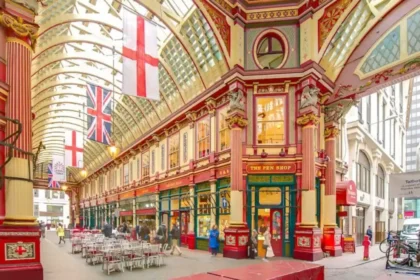
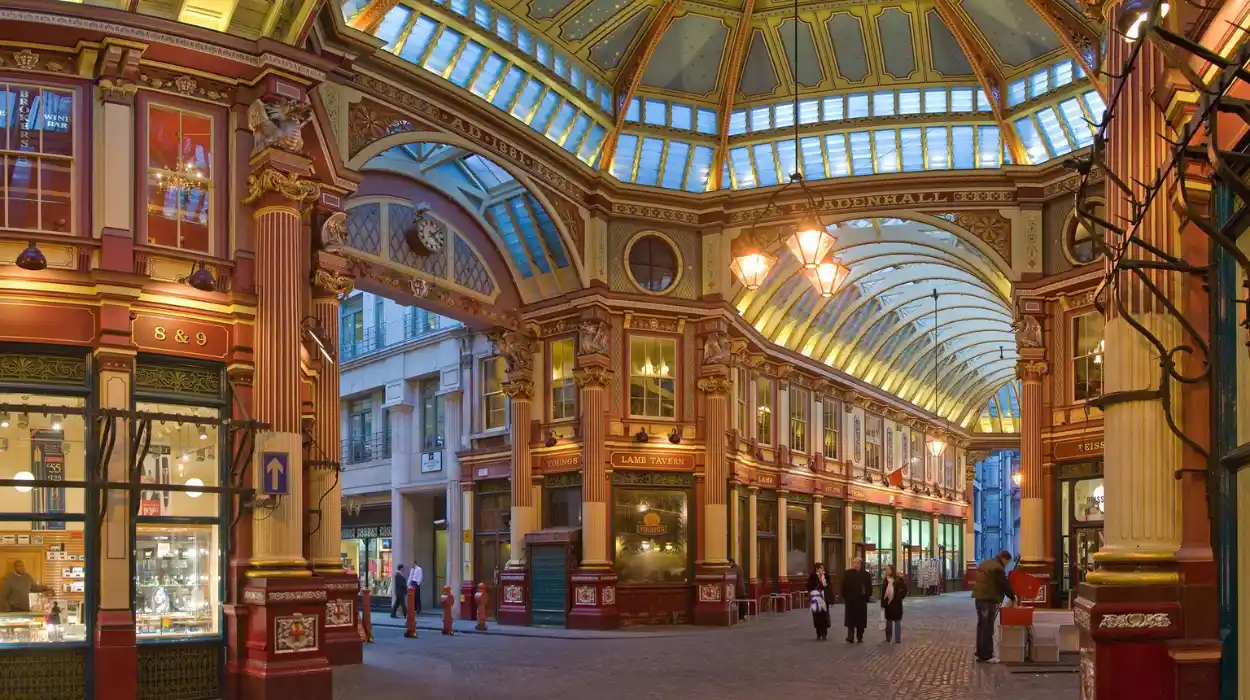
The Roman forum formed an important centre for commercial and civic activity. London City Hall research identifies the Roman forum as being roughly on the site of modern Leadenhall Market. This provides an important archaeological connection between ancient commercial activity and a modern London market location.
Roman markets operated within a wider economic system. Goods arriving by river and road entered an urban distribution network serving residents, soldiers, administrators, and merchants.
The decline of Roman administration during the fifth century disrupted this system, but commercial activity did not disappear permanently. London later developed into a medieval trading centre with its own system of market rights, tolls, regulation, and specialised trading locations.
What role did Roman markets play in London’s development?
Roman London established the first major commercial framework through its forum, waterfront trade, roads, warehouses, and regulated exchange. Archaeological evidence places the forum near modern Leadenhall Market, demonstrating that centralised trading spaces existed long before medieval market charters and privileges.
The Roman forum was more than a shopping area. Forums combined commercial, administrative, political, and social functions. Its location demonstrates the importance of organised central space within Roman Londinium.
Archaeological research into Roman London has identified commercial buildings, streets, waterfront structures, imported goods, pottery, coins, and evidence of craft production. These discoveries show that Londinium participated in long-distance trade.
The River Thames was especially important. Water transport moved heavy commodities more efficiently than overland transport. Wharves and waterfront facilities connected London with other parts of Britain and continental Europe.
The commercial geography established during Roman occupation influenced later urban development. Medieval London did not reproduce Roman markets exactly, but the continued importance of the City and Thames corridor created a strong geographical foundation for later trading activity.
Leadenhall is therefore historically significant because its modern market occupies an area associated with commercial activity over a much longer period than the Victorian market structure suggests.
How did medieval market rights change London trade?
Medieval markets were controlled through royal and municipal privileges that regulated where goods were sold, who could trade, and which tolls applied. Edward III’s 1327 charter confirmed London’s market authority, while Billingsgate, Cheapside, Smithfield, and Leadenhall developed distinct specialised functions.
Medieval market culture depended heavily on legal authority. A market was not simply an open space where anyone could establish a stall. Market rights were granted by the Crown or other recognised authorities.
The City of London developed strong control over commercial activity. A major example is the charter granted by Edward III in 1327. The charter prohibited rival markets from operating within 6⅔ miles of the City. The distance reflected the medieval expectation that a person could travel to a market, sell goods, and return within a day.
Market rights also created revenue through tolls and customs. In 1400, Henry IV granted London citizens the right to collect tolls and customs at Billingsgate, Cheapside, and Smithfield.
These arrangements gave the City Corporation a direct economic interest in market regulation. Officials could control trading locations, collect charges, maintain market infrastructure, and protect established commercial privileges.
The system also shaped competition. Traders operating outside authorised markets faced restrictions, while recognised markets gained institutional protection.
This legal framework became a foundation for London’s market culture because commercial geography was connected directly to political authority.
Why did medieval London develop specialised markets?
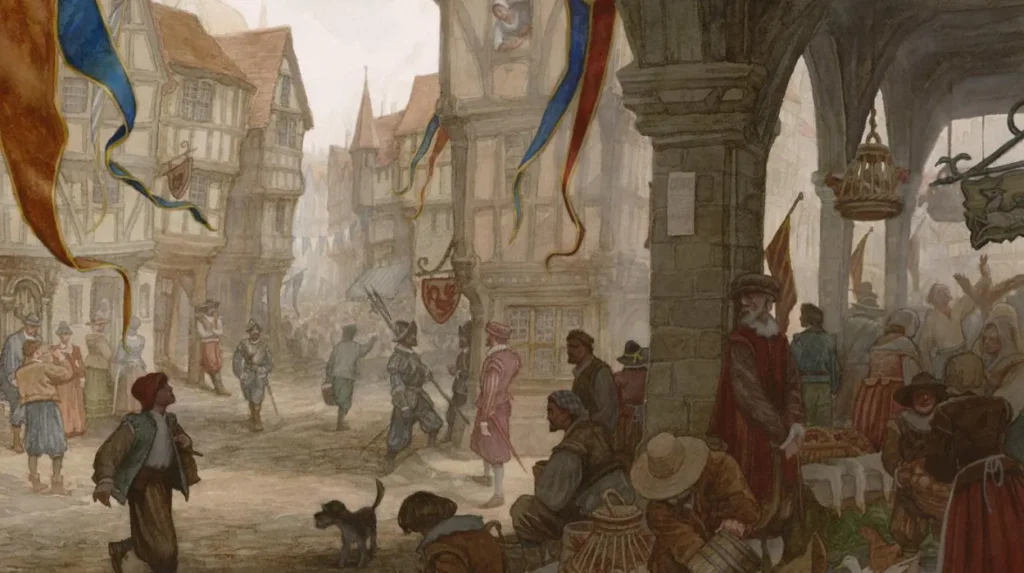
Medieval London separated trading activities across locations because regulation, transport, sanitation, and product handling required different spaces. Billingsgate handled fish, Smithfield livestock, Cheapside poultry, and Leadenhall foodstuffs, creating a practical commercial geography within the expanding City and its growing suburbs.
Different products required different forms of handling and transportation. Livestock required open areas. Fish depended on river access. Poultry and foodstuffs required accessible retail spaces. Grain required storage facilities.
Smithfield developed as an important livestock trading area. A description recorded in 1174 by William Fitzstephen referred to the area as a place where horses, pigs, cattle, and other goods were sold.
Billingsgate developed beside the Thames and became London’s principal fish market. Its waterfront position allowed fish and other goods to enter the City efficiently.
Cheapside became associated with poultry and other retail activity. Leadenhall also became increasingly important. A market was recorded there in 1321, and traders from outside the City began operating stalls as trading activity expanded beyond the established poultry market at Cheapside.
By the fifteenth century, Leadenhall had developed into a general food market. The City acquired the manor in 1411, and a market complex was developed during the fifteenth century. The rebuilt complex was used for poultry, victuals, grain, eggs, butter, cheese, and other food commodities.
This division of commercial functions created an interconnected market system rather than a single marketplace.
How did London markets change during the early modern period?
London’s markets expanded during the early modern period as population, overseas trade, migration, and consumption increased. Markets remained regulated institutions, but their commercial functions became more specialised, while new retail spaces developed beyond the medieval City and along major roads.
London experienced substantial demographic and economic expansion between the sixteenth and eighteenth centuries. The capital increasingly connected domestic production with international commerce.
Markets responded to rising demand for food, clothing, household goods, livestock, fuel, and imported commodities. The expansion of the urban population increased pressure on established trading spaces.
The Great Fire of London in 1666 destroyed large sections of the City. Reconstruction under figures such as Christopher Wren altered the architectural environment, although existing commercial traditions continued.
The rebuilding process also reinforced the importance of streets, squares, warehouses, churches, commercial buildings, and market spaces within the City.
Leadenhall survived as a continuing commercial institution and later developed the architectural form associated with its Victorian market buildings.
The growth of Westminster, Southwark, East London, and other districts also expanded the geography of retail trade. Markets increasingly operated outside the medieval core.
London’s market culture therefore became less concentrated. Commercial activity spread through an expanding metropolitan area while the City retained important wholesale and specialist functions.
How did the Industrial Revolution transform London markets?
The Industrial Revolution transformed London’s markets through population growth, railway transport, refrigeration, purpose-built buildings, and stronger public-health regulation. Smithfield demonstrates this transition clearly, with new market halls constructed above railway lines and supplied by a national railway transport network nationwide.
Nineteenth-century London created unprecedented pressure on food distribution. Rapid population growth required reliable supplies of meat, fish, fruit, vegetables, grain, and other commodities.
Transport technology changed the market system. Railways connected London with agricultural regions across Britain. Market buildings could therefore receive large quantities of food from distant producers.
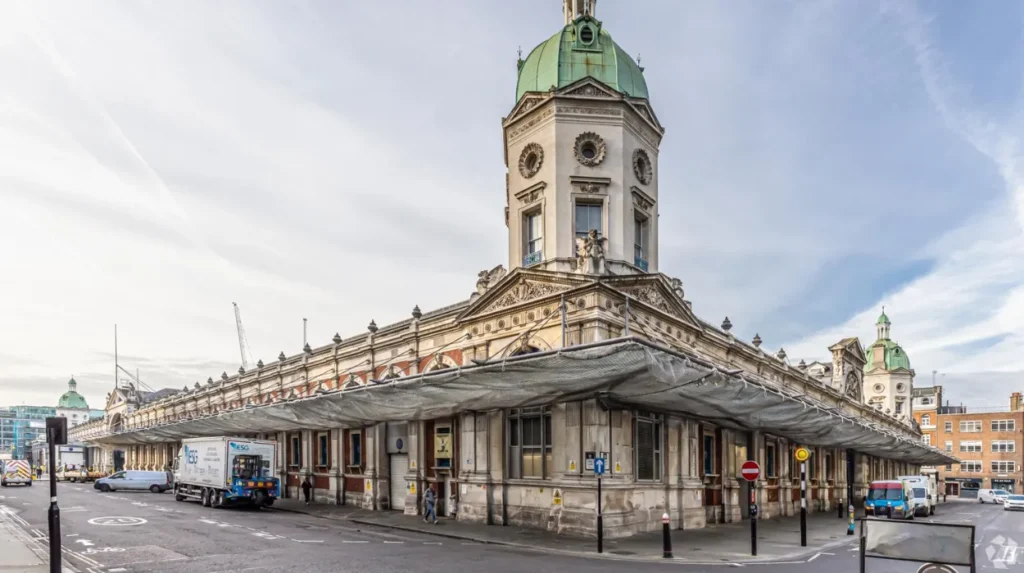
Smithfield provides one of the clearest examples. The live cattle market was relocated in 1852 under the Smithfield Market Removal Act. In 1860, Parliament authorised new metropolitan meat and poultry market buildings. Construction began in 1866, and the principal East and West Market Buildings were completed in November 1868.
The buildings were designed by City Architect Sir Horace Jones. They were constructed above newly developed railway connections, allowing meat to reach the market directly by rail. The construction cost was £993,816.
The transformation was not simply architectural. It represented a change from traditional open trading spaces toward regulated, mechanised, transport-connected wholesale distribution.
Public-health concerns also became increasingly important. Large markets required improved drainage, ventilation, cleaning, inspection, and food-handling standards.
Industrial London therefore created the modern wholesale market as a specialised logistical institution.
Why is Victorian market architecture important to London’s history?
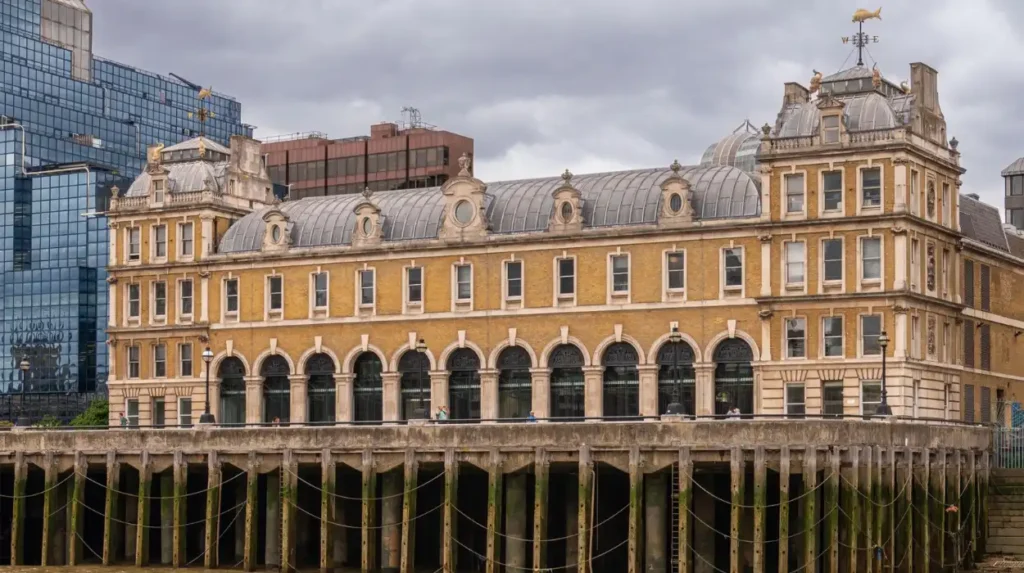
Victorian market architecture turned trading into a highly engineered urban activity. Iron roofs, large halls, railway connections, ventilation, drainage, and regulated access addressed the logistical demands of a growing metropolis. Smithfield, Covent Garden, Leadenhall, and Billingsgate illustrate this architectural transformation.
Victorian market buildings combined commercial requirements with architectural ambition. Large covered spaces protected goods and traders from weather while providing controlled environments for high-volume transactions.
Smithfield’s buildings demonstrate this approach. The East and West Market Buildings were completed in 1868, while the Poultry Market opened in 1875. The General Market followed in 1883, and the Annexe Market opened in 1888.
The Western Buildings at Smithfield provide another important example. Historic England records the construction of the General Market, triangular block, Annexe Market, and Red House Cold Store between 1879 and 1899. These structures primarily served the meat and poultry trade until the twentieth-century closure of the markets.
Refrigerated storage was another major innovation. The Red House Cold Store reflected the growing importance of temperature-controlled food distribution.
Victorian architecture therefore responded to practical commercial pressures. Structural engineering, railway technology, cold storage, sanitation, and market regulation operated together.
Leadenhall Market also demonstrates the Victorian transformation of an older trading institution. The medieval market survived, but its architectural expression changed dramatically as nineteenth-century London modernised its commercial infrastructure.
How did twentieth-century retail change London’s market culture?
Twentieth-century London changed market culture through supermarkets, motor transport, wholesale consolidation, redevelopment, and changing shopping habits. Some historic wholesale markets declined or relocated, while street markets adapted by serving neighbourhood communities, specialist products, second-hand goods, food, and leisure activities locally.
The twentieth century introduced new competition for traditional markets. Supermarkets provided fixed opening hours, standardised products, extensive ranges, and increasingly efficient distribution systems.
Motor transport also altered wholesale logistics. Goods no longer depended exclusively on market locations connected directly to railways or rivers.
Some wholesale markets declined because their historic sites no longer matched modern distribution requirements. Others relocated to larger sites outside the traditional central districts.
Smithfield remained a major wholesale market and is the only wholesale market still operating on its original site within the Square Mile. The City of London states that livestock and meat have been traded there for more than 1,000 years.
Its operating pattern also demonstrates the specialised nature of wholesale markets. Most stalls historically operated during very early morning hours, with the busiest period between 3am and 6am.
At the same time, street markets developed new identities. Markets selling clothing, antiques, flowers, international food, household goods, and second-hand products became important neighbourhood institutions.
This adaptation allowed market culture to survive even as the traditional wholesale system changed.
How did migration shape modern London markets?
London’s post-war migration transformed the cultural and commercial character of many markets. Traders and customers from different parts of Europe, Asia, Africa, the Caribbean, and the Middle East introduced new foods, products, languages, and commercial traditions.
Markets became important spaces for migrant entrepreneurship. A market stall offered a relatively accessible route into self-employment compared with the capital required for a permanent shop.
City Hall describes markets as low-cost and low-risk spaces for new businesses, including opportunities to test ideas and develop employment routes.
This economic function also created cultural continuity. Food markets became places where communities could access ingredients associated with particular cuisines and traditions.
Brick Lane provides a clear example of the relationship between migration, commerce, and neighbourhood identity. Its market environment developed alongside changing communities and became associated with food, vintage goods, fashion, art, and cultural tourism.
Other markets developed their own specialist identities. Portobello Road became strongly associated with antiques and vintage goods. Columbia Road became associated with flowers. Camden developed a large leisure-oriented market environment.
The result was a more diverse market culture in which historical trading structures supported new commercial identities.
Why are London markets important to modern tourism?
Modern London markets function as commercial spaces, community institutions, cultural heritage sites, and tourism destinations. City Hall identifies more than 300 public, private, and community-managed markets, while strategic markets such as Borough, Camden, Brick Lane, and Portobello Road attract visitors.
Tourism changed the meaning of the London market. Markets that originally served local consumers increasingly became destinations for visitors seeking food, architecture, shopping, cultural diversity, and historical context.
London City Hall identifies markets as important places for employment, trade, leisure, community interaction, and local identity. Its 2025 statement recorded more than 300 public, private, and community-managed markets across London.
The London Plan identifies Borough, Camden, Portobello Road, Columbia Road, and other markets as strategically important attractions for Londoners and visitors.
Tourism also changes the economic relationship between markets and their neighbourhoods. Visitors create additional footfall and demand, while traders gain access to wider audiences.
For history enthusiasts, the market provides a direct connection between urban heritage and everyday commerce. Unlike a museum display, an operating market retains active commercial functions.
To experience this historic market culture in person today, consult our comprehensive [Top Street Food Markets in London Every Food Lover Should Visit for Authentic Flavors] for itineraries and visiting parameters.
Market tourism therefore connects London’s commercial history with contemporary cultural consumption.
How are historic London markets being preserved today?
Preserving London’s market culture requires historic buildings, trader continuity, public access, local identity, and viable commercial use. Current planning and regeneration policies recognise markets as cultural and economic assets, while investment determines whether historic trading traditions remain active and viable.
Preservation in London operates on several levels. Historic buildings require architectural conservation. Market traders require viable commercial conditions. Local communities require continued access. Visitors require safe and accessible public spaces.
Historic England’s research into Smithfield demonstrates the importance of documenting market buildings as heritage assets. Its research covers structures constructed during the late nineteenth century and records their historical relationship with the Central Markets.
Planning policy also recognises the broader cultural importance of markets. The London Plan states that markets contribute to economic, social, and cultural life and help provide opportunities for business start-ups.
City Hall similarly describes markets as part of London’s history and character. Its market policy recognises the pressures created by technological change, changing shopping behaviour, and economic conditions.
Preservation therefore does not mean freezing a market in a historic form. A functioning market requires adaptation.
The most durable form of market heritage is active heritage. A building survives as a commercial environment, traders continue working, products change with demand, and local communities retain a reason to use the space.
What does the future of London’s market culture depend on?
London’s market culture depends on the relationship between heritage, commerce, community use, planning, and tourism. Markets must remain economically functional while retaining distinctive identities and historic connections.
Technology has changed consumer behaviour. Online shopping, digital payments, delivery services, social media promotion, and changing working patterns influence how consumers discover and purchase products.
Markets have responded by developing food experiences, specialist retail, cultural programming, independent businesses, and visitor-focused environments. These changes extend the historical pattern of adaptation rather than ending it.
City Hall established the London Markets Board in 2017 to support markets and strengthen their contribution to high streets and town centres. At that time, City Hall reported more than 250 street markets and noted an increase from 162 in 2010.
London’s market sector also remains economically significant because markets support employment and provide accessible routes into entrepreneurship. City Hall describes them as original business incubators because traders can test products and business models with lower initial costs.
The future historical importance of London markets will therefore depend on whether modern commercial adaptation preserves their social and cultural functions.
The evolution from Roman forum to medieval chartered market, Victorian wholesale hall, twentieth-century street market, and twenty-first-century visitor destination demonstrates a continuous process of transformation.
London’s markets survived because they changed while retaining their fundamental purpose: connecting people, products, businesses, and places through organised exchange.
That continuity makes market culture an important part of London’s urban history. The surviving buildings, street layouts, trading traditions, specialist markets, and active stalls provide physical evidence of how the capital has responded to population growth, technological change, migration, industrialisation, regulation, and tourism.
For educators and heritage researchers, markets provide a practical framework for understanding London’s economic development. For cultural tourists, they provide access to living heritage. For local communities, they remain commercial and social institutions.
The history of London’s markets is therefore not only a record of buying and selling. It is a record of how the capital organised space, regulated commerce, supplied food, absorbed migration, developed transport, adapted architecture, and responded to changing consumer behaviour.
From medieval trading privileges to modern tourism, London’s market culture remains an active part of the city’s identity and an enduring link between its commercial past and urban present.
Frequently Asked Question
What is the history of London’s market culture?
London’s market culture developed from Roman commercial centres and medieval chartered markets into Victorian wholesale markets, neighbourhood street markets, and modern tourism destinations such as Smithfield, Leadenhall, Borough, and Camden.