London markets form integral parts of the city’s commercial and cultural fabric. Borough Market, Camden Market, and Portobello Road Market stand out as premier destinations for food, fashion, and antiques. This guide details their histories, operations, and visitor essentials.
- What Are London’s Iconic Markets?
- Where Is Borough Market Located?
- What Makes Borough Market Unique?
- When Does Borough Market Open?
- What Can You Buy at Camden Market?
- Where Is Camden Market and How to Get There?
- What Is the History of Camden Market?
- When Is Camden Market Open?
- Where Is Portobello Road Market?
- What Makes Portobello Road Market Special?
- What Is the History of Portobello Road Market?
- When Does Portobello Road Market Operate?
- What Are Tips for Visiting London Markets?
- Why Visit These Markets in 2026?
What Are London’s Iconic Markets?
London’s iconic markets include Borough Market for food, Camden Market for alternative fashion and street eats, and Portobello Road Market for antiques and vintage goods. These markets operate daily or on specific days, draw millions of visitors yearly, and preserve centuries-old trading traditions in central and north London locations.
Borough Market dates to 1014 as a wholesale food hub near London Bridge. Camden Market emerged in the 1970s from industrial warehouses along Regent’s Canal. Portobello Road Market traces to 1837 with fruit and vegetable stalls evolving into antiques trade.
Each market features fixed stalls, pop-up vendors, and permanent shops. Borough emphasizes fresh produce and gourmet foods. Camden hosts over 1,000 traders selling clothing, crafts, and global cuisine. Portobello spans 1,000 stalls on Saturdays for maximum variety.
Authorities regulate these markets under the City of London Corporation and local councils. Traders pay pitch fees and comply with hygiene standards. Visitor numbers exceed 10 million annually across the three, boosting local economies by £100 million in sales.
Future relevance grows with tourism recovery and sustainability initiatives. Markets adapt by adding vegan options and eco-friendly packaging.
Where Is Borough Market Located?
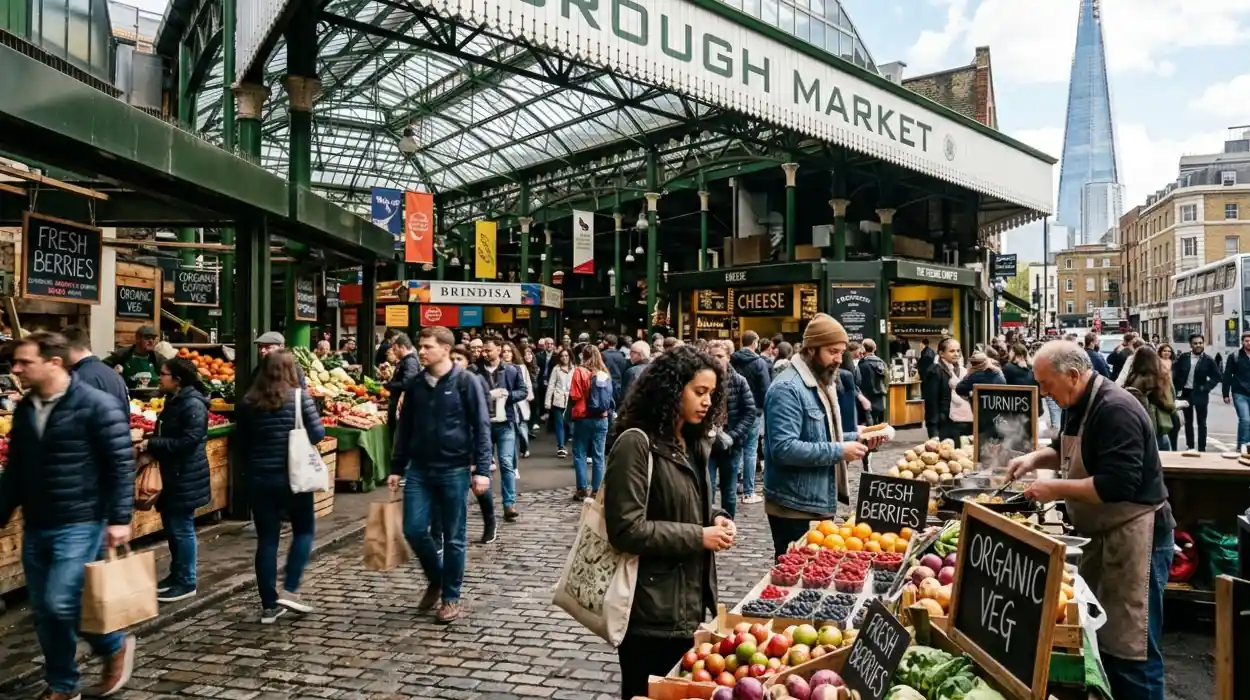
Borough Market sits at 8 Southwark Street, London SE1 1TL, in Southwark near London Bridge station. Accessible via Jubilee and Northern tube lines or London Bridge rail, it spans 19,000 square meters with indoor arches and outdoor squares open Wednesday to Saturday.
The market occupies a site under Victorian railway arches built in 1851. Three sections define its layout: Green Market for specialist produce, Three Crown Square for merchants, and Borough Market Kitchen for street food. Nearby landmarks include Southwark Cathedral and The Shard.
Reach it by walking five minutes from London Bridge Underground. Bus routes 17, 21, and 35 stop directly. On foot from the Thames, follow signs from the river path.
Traders number 120 full-time with 1,000 daily visitors on weekdays rising to 20,000 on Saturdays. The layout channels foot traffic efficiently, preventing overcrowding.
Implications include easy integration into South Bank itineraries alongside Tate Modern, 20 minutes away.
What Makes Borough Market Unique?
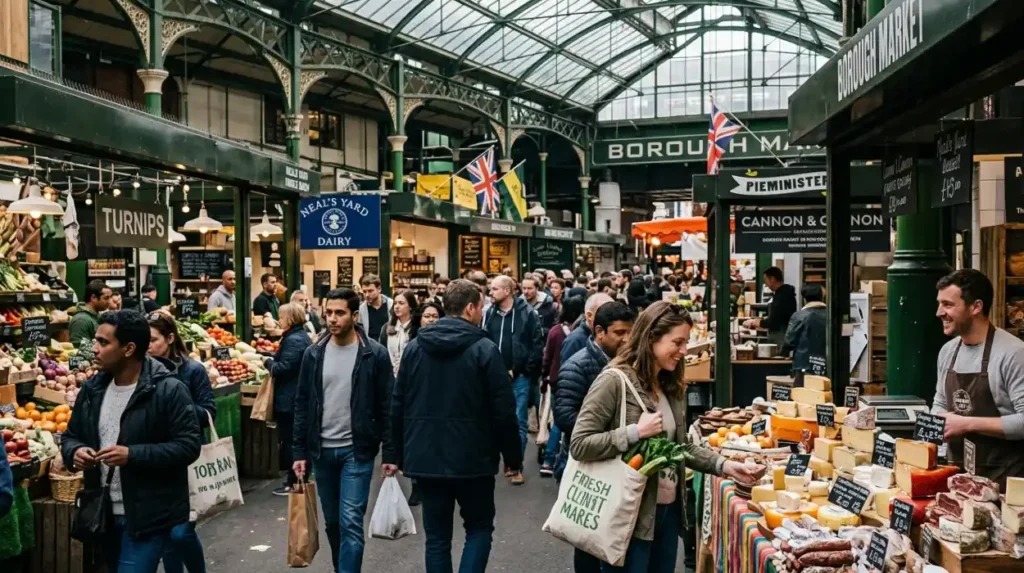
Borough Market excels in artisanal foods with 60 food stalls, 40 traders, and rare British cheeses, charcuterie, and organic vegetables. Established in 1014, it holds Food Market of the Year awards and enforces strict origin rules for authenticity.
Fresh produce dominates with categories like seafood, baked goods, and preserves. Examples include Furness Fish & Game for Cornish oysters, Bread Ahead for doughnuts, and Mons Cheesemongers for 150 cheese varieties.
The market operates Wednesday 10am-5pm (limited stalls), Thursday-Friday 10am-6pm full service, and Saturday 9am-5pm peak. Sundays feature a smaller organic focus.
Research from Visit London reports 5 million annual visitors spending £25 average each. Hygiene ratings average 5 stars from local councils.
Sustainability drives initiatives like zero-waste policies and local sourcing within 100 miles, reducing carbon footprints by 30% since 2010.
When Does Borough Market Open?
Borough Market opens Wednesday 10am-5pm with core stalls, Thursday-Friday 10am-6pm full operation, Saturday 9am-5pm busiest, and limited Sunday 9am-4pm organics. It closes Mondays-Tuesdays and public holidays like Christmas.
Full market days feature all 120 traders. Quiet Wednesday suits early shoppers. Saturday draws crowds, so arrive before 10am.
Seasonal adjustments include summer extensions to 9pm Fridays. Events like cheese festivals align with openings.
Data shows peak hours 12pm-3pm with 70% capacity. Off-peak mornings offer better deals.
Plan visits around tube schedules; last trains run after closing.
What Can You Buy at Camden Market?
Camden Market offers vintage clothing, handmade jewelry, street food from 40 countries, and crafts across 1,000 stalls in four zones: Lock, Stables, Hawley Walk, and Buck Street. Daily 10am-7pm (later weekends), it attracts 28 million visitors yearly.[web://]
Categories span fashion (punk leather jackets, boho dresses), accessories (beaded bags, piercings), and food (cyberdog burgers, arepas, falafel). Examples: Cyberspace for futuristic wear, Made in Camden for local designs, The Mac Factory for macarons.
Zones differentiate: Camden Lock for crafts, Stables for antiques, Hawley for pop-ups, Buck Street for global eats.
Global cuisines include Thai, Jamaican, and vegan stalls serving 50,000 meals daily.
Sales data indicates £50 million turnover, with 60% from food and 40% retail.
Where Is Camden Market and How to Get There?
Camden Market centers at Camden Lock, London NW1 8AF, along Regent’s Canal in Camden Town. Tube from Northern Line Camden Town station (five-minute walk) or Overground; buses 24, 27, 29 stop nearby. Open daily with zones linked by paths.
The site repurposes 19th-century horse stables and warehouses. Four markets connect seamlessly over one kilometer.
From central London, take Northern Line black line northbound, exit Camden Town, follow canal signs.
Parking scarce; use Oyster card for public transport capping at £8.10 daily.
Combine with Primrose Hill views, 15 minutes north.
What Is the History of Camden Market?
Camden Market began in 1974 as a craft market at Camden Lock, expanding in 1991 to stables with 100 stalls. By 2000, it housed 1,000 traders in ex-industrial spaces, evolving from hippie roots to global tourism hub with 28 million visitors in 2024.
Initial traders sold handmade goods amid punk rock scene. 1980s growth followed canal regeneration.
Key milestones: 1974 lock opening, 1991 stables conversion, 2015 £50 million redevelopment adding 300 stalls.
Ownership by LAB minded group ensures preservation.
Cultural impact includes filming locations for movies like Notting Hill.
When Is Camden Market Open?
Camden Market operates daily 10am-7pm Monday-Thursday, 10am-8pm Friday-Saturday, 10am-7pm Sunday. Food stalls extend to 10pm weekends; peak Saturdays see 100,000 visitors.
Winter hours shorten by one hour November-February. Events like Halloween markets add nights.
Footfall peaks noon-6pm; early arrival avoids queues.
Integrate with evening canal boat rides post-closing.
Where Is Portobello Road Market?
Portobello Road Market runs along Portobello Road, London W11 1LU, in Notting Hill from Notting Hill Gate tube (Central, Circle, District lines). It stretches one mile with 1,000 Saturday stalls; antiques in center, fruit ends.
The road divides into zones: antiques central, fashion north, food south. Adjacent Golborne Road adds Portuguese stalls.
Walk 10 minutes from station; buses 7, 23, 27 serve it.
Landmarks include colorful houses from Notting Hill film.
What Makes Portobello Road Market Special?
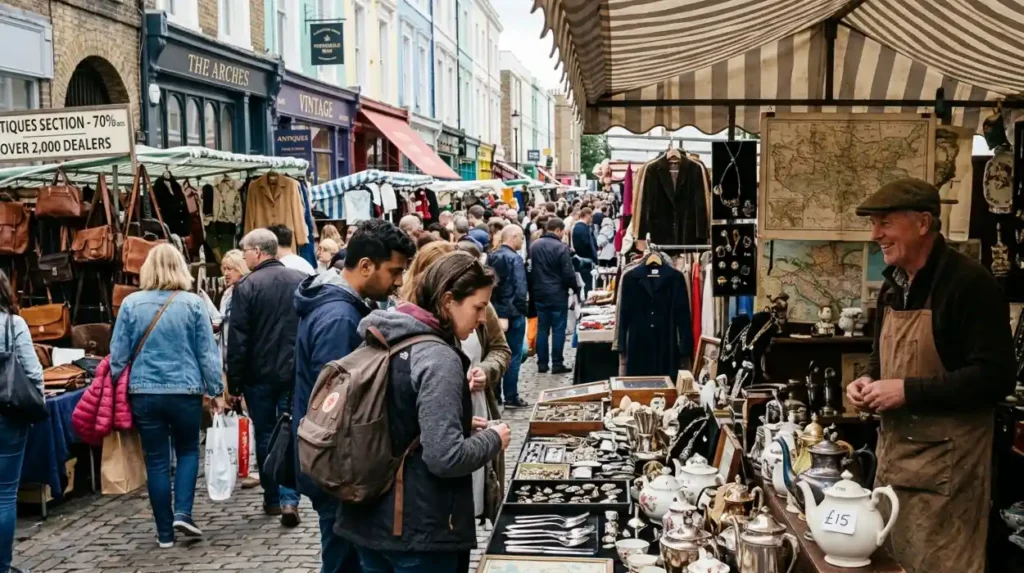
Portobello Road Market specializes in 2,000 antiques pieces, vintage clothing, and street food across daily operations peaking Saturdays. Dating to 1837, it features Royal pickers and attracts 250,000 weekly visitors with bargains under £20.
Antiques include silverware, jewelry, maps; examples: 19th-century teapots, Victorian brooches, WWII memorabilia.
Fashion offers 1960s dresses, leather bags. Food has paella, pancakes.
Trading process involves haggling; dealers source from auctions.
Stats: £30 million annual sales, 70% antiques.
Film fame boosts profile with guided tours.
What Is the History of Portobello Road Market?
Portobello Road Market started 1837 selling farm produce to railway workers, specializing in antiques by 1940s. Queen Victoria shopped here; 1971 BBC series popularized it globally with 1 million summer visitors.
1900s fruit trade dominated. Post-WWII, antiques surged with middle-class collecting.
Key events: 1865 railway spur closure, 1948 official antiques designation.
Kensington Council manages pitches for 400 traders.
Preservation protects Victorian terraces.
When Does Portobello Road Market Operate?
Portobello Road Market runs daily 9am-6pm for shops, Fridays-Saturdays full stalls 8am-7pm peak antiques and fashion, Sundays smaller 10am-4pm. Best Saturday mornings for variety.
Weekday focus: antiques mornings. Saturday: all categories.
Notting Hill Carnival August Bank Holiday overlaps Sundays.
Combine with Saturday cinema at Electric Cinema nearby.
What Are Tips for Visiting London Markets?
Visit Borough early weekdays, Camden midweek mornings, Portobello pre-noon Saturdays. Carry cash for small stalls, wear comfortable shoes, check websites for events. Budget £20-50 per market for eats and finds.
Navigation uses Google Maps offline. Peak avoidance: Borough post-3pm Saturdays.
Safety includes pickpocket awareness in crowds. Eco-tip: bring reusable bags.
Combine markets: Camden to Portobello via bus 31, 45 minutes.
Why Visit These Markets in 2026?
In 2026, these markets feature expanded vegan zones, live music series, and post-pandemic crowds at 90% pre-2020 levels. They generate 500 jobs, showcase 200 nationalities, and offer free entry with £200 million economic impact.
Renovations complete: Camden adds 100 stalls, Borough solar panels.
Tourism projections hit 20 million London visitors, prioritizing markets.
Cultural events tied to Coronation commemorations.
What are London’s most iconic markets?
Borough Market, Camden Market, and Portobello Road Market are the top markets known for food, fashion, and antiques.