The Blackpool Air Show is a major free annual public aviation event held on the seafront of Blackpool, Lancashire, originating from the historic Blackpool Aviation Week of October 1909, which was recognized by the Aero Club of Great Britain as the nation’s first official air show.
- What historical milestones define the evolution of the Blackpool Air Show?
- Which aircraft and flying teams headline the Blackpool Air Show program?
- How is the Blackpool Air Show organized and executed logistically?
- What economic impact does the Blackpool Air Show generate for the region?
- What are the safety protocols and environmental considerations for modern air shows?
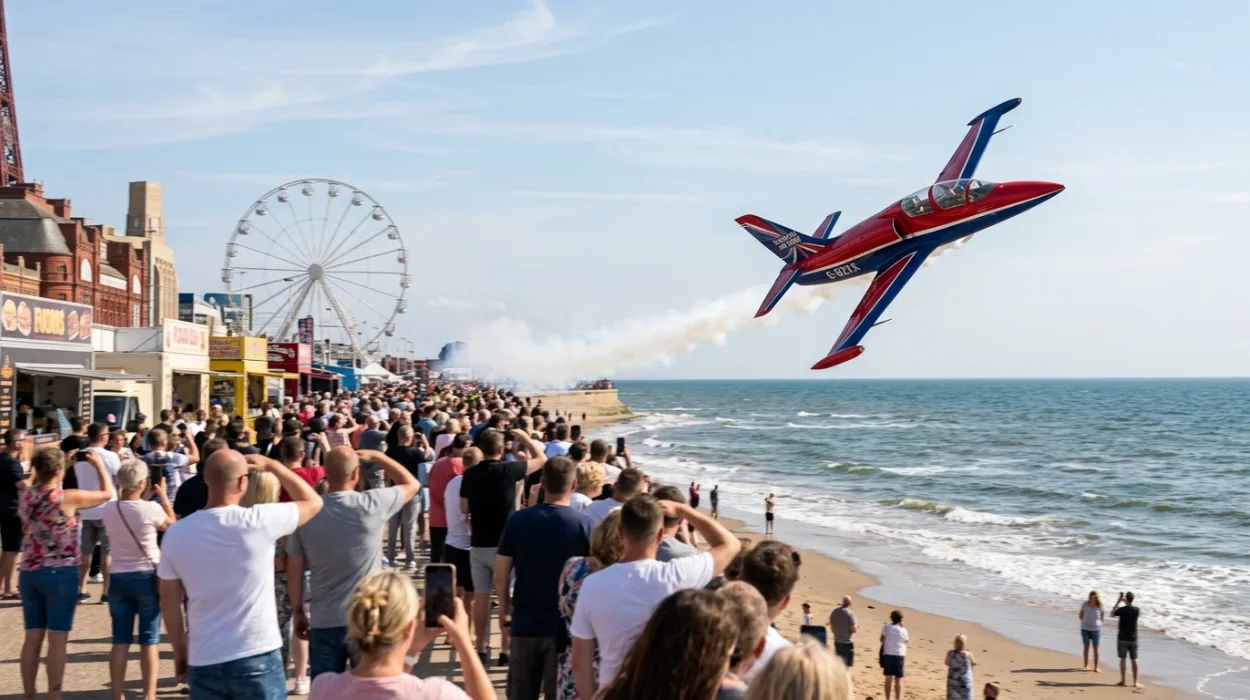
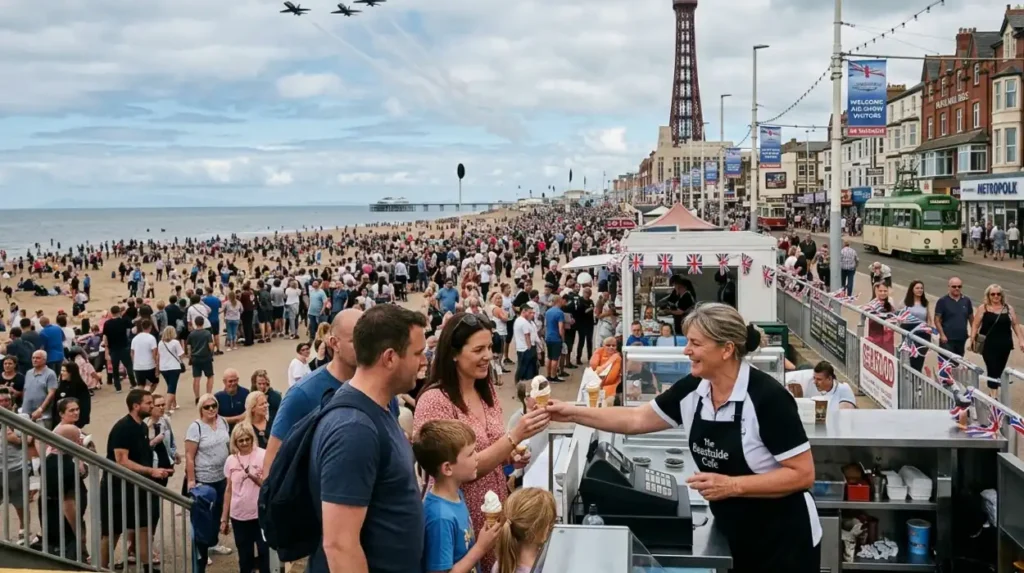
Extra London News presents this exhaustive analysis of an event that has shaped British aviation entertainment for over a century. The modern Blackpool Air Show takes place along the picturesque Golden Mile, utilizing the world-famous Blackpool Tower and the expansive Irish Sea coastline as a dramatic natural amphitheater. The primary flight box is situated between North Pier and Central Pier on the Tower Festival Headland, drawing hundreds of thousands of spectators to the Lancashire coast.
The roots of this spectacle stretch back to October 1909, an era defined by rapid technological leaps following the Wright brothers’ motorized flight and Louis Blériot’s momentous crossing of the English Channel. Prompted by media pioneers like Lord Northcliffe of the Daily Mail, the Blackpool Corporation collaborated with the Lancashire Aero Club to lease land at Squires Gate from a local golf course. Organizing committees amassed over six thousand pounds in prize money—an astronomical sum at the time—to entice pioneering aviators.
Over the decades, the event transitioned from early experimental biplanes to modern supersonic military jets and precision aerobatic teams. Today, the coordination is handled collectively by Blackpool Council and regional tourism partners to provide an accessible, family-friendly aerospace exhibition. By maintaining free public access, the showcase democratizes access to elite aviation spectacles, ensuring millions of visitors can witness high-performance flight mechanics up close.
What historical milestones define the evolution of the Blackpool Air Show?
The history of the Blackpool Air Show spans 117 years of technological disruption, evolving from primitive 1909 aviation weeks featuring fragile wooden-and-fabric gliders into a multi-day modern showcase of supersonic military might and precision formation flying.
During the inaugural October 1909 Blackpool Aviation Week, aviation pioneers pushed the absolute limits of early internal combustion engines and aerodynamic theory. Famous early aeronauts gathered to compete for endurance and altitude prizes, operating fragile monoplanes and biplanes that struggled against unpredictable coastal winds. These early machines typically utilized lightweight wooden frames covered in treated fabric, powered by low-horsepower engines that restricted flights to low altitudes and brief durations.
As aviation technology accelerated through the First and Second World Wars, the character of the exhibition shifted toward military defense capabilities and industrial manufacturing prowess. Post-war iterations began integrating jet propulsion technology, radar-guided tracking, and advanced stunt flying formats. By the late 20th century, the event solidified its modern two-day summer format, anchoring itself as a vital economic engine for the North West of England.
Throughout its long timeline, the festival has mirrored the geopolitical and industrial shifts of British aerospace. Historic military aircraft, such as the Avro Lancaster bomber, Supermarine Spitfire, and Hawker Hurricane fighters of the Royal Air Force Battle of Britain Memorial Flight, regularly fly alongside state-of-the-art modern multirole combat aircraft. This chronological continuity bridges the gap between early experimental flight and contemporary aeronautical engineering.
Which aircraft and flying teams headline the Blackpool Air Show program?
The Blackpool Air Show features a diverse flying program comprising elite military demonstration teams, vintage warbirds, civilian stunt pilots, and specialized rotorcraft, highlighted by regular appearances from the Royal Air Force Red Arrows, the Eurofighter Typhoon, and the Battle of Britain Memorial Flight.
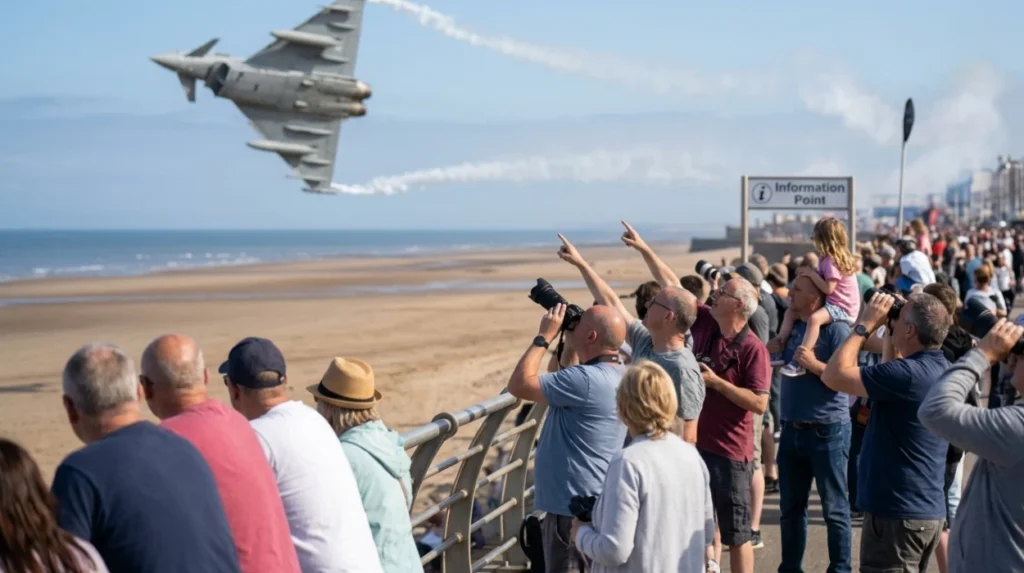
The aerial roster is meticulously curated to balance historical heritage with modern tactical aviation capabilities. Military entries typically showcase the Royal Air Force (RAF) aerobatic team, the Red Arrows, operating BAE Systems Hawk fast jets known for their trademark red, white, and blue smoke trails. Another staple of the modern lineup is the RAF Eurofighter Typhoon display team, a twin-engine, canard-delta wing multirole fighter that demonstrates extreme thrust-to-weight ratios and high-alpha slow-speed handling directly over the Irish Sea.
In addition to high-speed jet formations, the schedule incorporates classic historic aircraft designed to preserve aviation heritage. The RAF Battle of Britain Memorial Flight frequently deploys operational World War II survivors, including the iconic Rolls-Royce Merlin-engined Supermarine Spitfire, the Hawker Hurricane, and the Avro Lancaster heavy bomber. These piston-driven aircraft provide a distinct acoustic signature and visual contrast to modern jet technology.
Civilian performers add variety through high-adrenaline stunt flying disciplines. Traditional acts include daredevil wing walkers strapped to the upper wings of biplanes, precision formation flying teams, and barnstorming stunt pilots. Rotorcraft displays, such as the tactical demonstrations executed by the Boeing Chinook heavy-lift helicopter or agile gyrocopters like the Calidus, showcase vertical flight capabilities and exceptional maneuverability in maritime wind conditions.
How is the Blackpool Air Show organized and executed logistically?
The Blackpool Air Show is executed through a complex logistical framework managed by Blackpool Council, aviation safety regulators like the Civil Aviation Authority, emergency services, and local transport networks to safely handle hundreds of thousands of visitors within a compact urban coastal environment.
Logistical planning for the weekend event begins months in advance, requiring rigorous airspace restrictions enforced by the Civil Aviation Authority (CAA). A temporary restricted airspace zone (TRA) is established over the Blackpool coastline to separate display aircraft from commercial air traffic, private drones, and unauthorized maritime vessels. Flight directors coordinate precise schedules down to the minute, accounting for variable coastal weather patterns, cloud ceilings, and wind vectors that dictate flight safety thresholds.
On the ground, crowd management requires extensive municipal coordination along the Tower Festival Headland and promenade. Temporary pedestrian zones, crowd control barriers, and viewing hubs are installed between North Pier and Central Pier to accommodate peak density crowds. Public safety infrastructure involves deploying metropolitan police, private security personnel, and first aid stations throughout the Airshow Village on the headland.
Transportation networks face extraordinary strain during the event window, requiring multi-agency collaboration between rail operators, bus providers, and municipal parking authorities. Park-and-ride schemes, increased tram frequencies operated by Blackpool Transport, and dynamic traffic management systems mitigate congestion on arterial routes such as the M55 motorway. Clear communication channels ensure real-time updates are broadcast to attendees regarding venue capacity, accessibility corridors, and schedule adjustments.
What economic impact does the Blackpool Air Show generate for the region?
The Blackpool Air Show serves as a primary catalyst for the local visitor economy, driving millions of pounds in direct consumer spending, boosting hotel occupancy rates, and supporting thousands of tourism and hospitality jobs across the Fylde coast.
As a cornerstone of Blackpool’s free events portfolio, the air show plays a pivotal role in the resort’s broader economic metrics. Independent tourism evaluations, such as the Scarborough Tourism Economic Activity Monitor (STEAM) reports, consistently highlight that large-scale summer events drive substantial spikes in regional footfall and length-of-stay metrics. In periods where annual visitor numbers to Blackpool have exceeded 20 to 21 million tourists, peak weekend events like the air show account for multi-million-pound injections into the local hospitality sector.
Local businesses—ranging from hotels, guesthouses, and restaurants to amusement operators and retailers—experience near-capacity demand during the air show weekend. This surge in trade extends the seasonal employment window for hospitality workers, contributing to a tourism workforce that supports over 23,000 local jobs. Furthermore, the event acts as a high-visibility marketing vehicle, reinforcing Blackpool’s status as a top domestic destination and encouraging repeat visits that transition smoothly into the autumn Illuminations season.
The economic footprint reaches beyond direct ticketless spending, influencing regional transport revenue and municipal investment strategies. Coordinated funding partnerships between Blackpool Council, Merlin Entertainments, and the Blackpool Tourism Business Improvement District (TBID) leverage the air show’s popularity to secure long-term capital improvements for the town’s tourism infrastructure.
What are the safety protocols and environmental considerations for modern air shows?
Modern air shows operate under stringent safety regulations enforced by national aviation authorities, incorporating rigorous pilot briefings, pre-flight aircraft inspections, crowd separation lines, and environmental mitigation strategies to protect spectators and local marine ecosystems.
Safety management at the Blackpool Air Show adheres to the strict regulatory framework established by the UK Civil Aviation Authority (CAA). Following international aviation safety reviews, display flying rules dictate strict horizontal and vertical separation distances between performing aircraft and public viewing areas. Pilots must execute predefined display lines parallel to the coastline, ensuring that aircraft flight paths never direct energy or potential hazard vectors toward congested crowds on the promenade.
Emergency response planning forms an integrated component of event execution. Multi-agency contingency plans involve the Royal National Lifeboat Institution (RNLI), local coastguard units, fire services, and specialized aviation rescue teams stationed on land and water. These units maintain constant communication readiness to respond immediately to any maritime or terrestrial incidents within the operational zone.
Environmental sustainability is an increasingly vital consideration for contemporary aviation events. Organizers and military display teams actively evaluate carbon offset initiatives, fuel efficiency standards, and noise abatement procedures. Flight schedules are optimized to minimize acoustic disruption to local residential areas and coastal wildlife habitats, balancing the cultural and economic value of the entertainment with ecological responsibility.
When was the first Blackpool Air Show held?
The origins of the Blackpool Air Show date back to October 1909, when Blackpool Aviation Week took place at Squires Gate. It is widely associated with the beginnings of organised aviation displays in Britain.