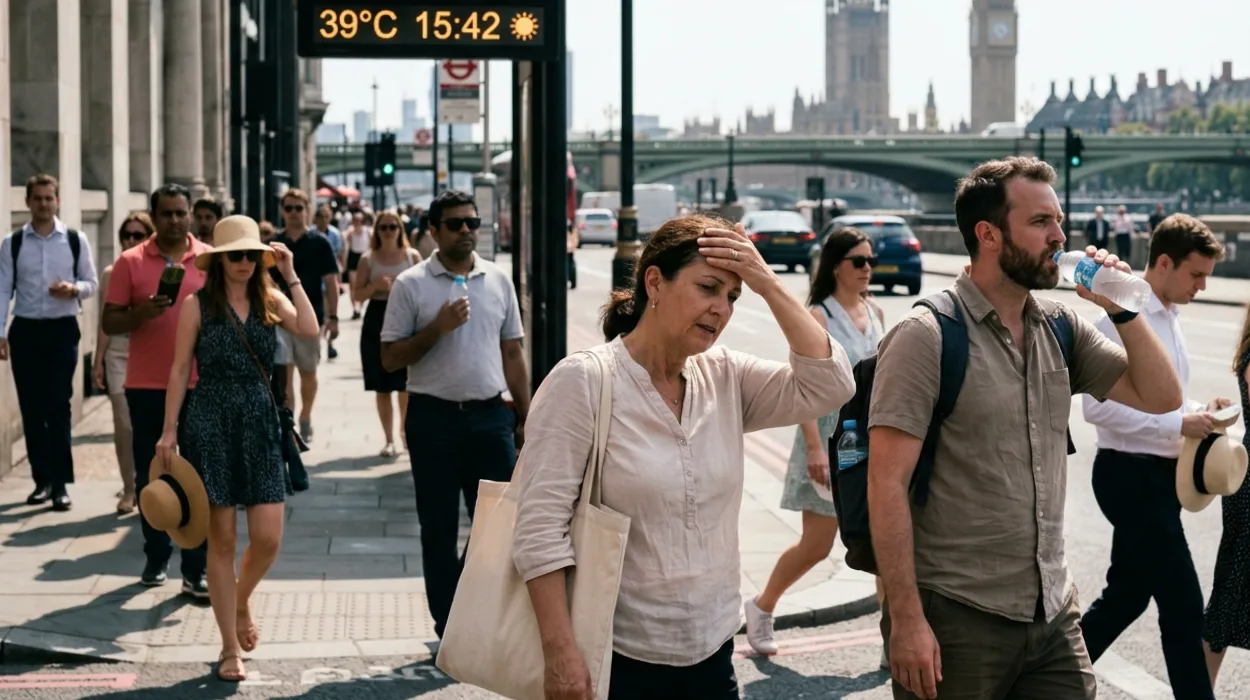
Extra London News presents an authoritative overview of extreme heatwave weather forecasts, analyzing meteorological definitions, historical benchmarks, urban climate mechanics, and public health implications across the United Kingdom.
- What is an official meteorological heatwave forecast and how do temperature thresholds operate across different UK regions?
- How have historical London heatwaves evolved in frequency, intensity, and duration over the past century?
- What physical and atmospheric mechanisms cause severe heatwaves in urban environments like Greater London?
- What specific health impacts and excess mortality rates are associated with prolonged high-temperature forecasts?
- How do extreme heatwave forecasts disrupt critical urban infrastructure, transport networks, and utility supplies?
- What strategic adaptation frameworks and municipal policies are being implemented to mitigate London’s rising heat risks?
What is an official meteorological heatwave forecast and how do temperature thresholds operate across different UK regions?
A meteorological heatwave forecast predicts an extended period of excessively hot weather defined by the United Kingdom Met Office as a location-specific threshold where daily maximum temperatures reach or exceed values between 25°C and 28°C for at least three consecutive days.
The Met Office establishes county-specific criteria to account for regional climate variations across the United Kingdom. For Greater London and the surrounding Home Counties, the qualifying threshold is set at 28°C, while other northern or western regions trigger alerts at lower thresholds such as 25°C or 26°C.
Forecasters utilize numerical weather prediction models, including the Met Office Unified Model and the European Centre for Medium-Range Weather Forecasts systems, to project high-pressure blocking patterns. These high-pressure systems cause atmospheric subsidence, sinking air that compresses and warms while clearing cloud cover. This dynamic allows uninterrupted solar radiation to heat the ground surface over multiple diurnal cycles.
Data from the Met Office indicates that these conditions are increasingly accompanied by elevated tropical night temperatures, where minimum nocturnal values fail to drop below 20°C in dense urban zones. This lack of nighttime cooling prevents human bodies and built infrastructure from shedding accumulated thermal energy.
How have historical London heatwaves evolved in frequency, intensity, and duration over the past century?
Historical climate records managed by the Met Office demonstrate a profound intensification of London heatwaves, shifting from rare meteorological anomalies during the twentieth century to recurrent, high-intensity events exceeding 40°C in the twenty-first century.
During the twentieth century, notable hot summers occurred in 1976 and 1995, characterized by sustained dry spells and maximum temperatures that rarely breached 35°C in the capital. The meteorological landscape changed permanently on 19 July 2022, when the United Kingdom recorded a temperature exceeding 40°C for the first time in history. Coningsby in Lincolnshire reached 40.3°C, while Heathrow Airport in London registered 40.2°C, prompting the Met Office to issue its first-ever Red Extreme Heat Warning.
This upward trajectory persisted into subsequent years. In May 2026, London established an all-time May record temperature of 35.1°C at Kew Gardens, surpassing historical benchmarks set over a century prior.
Research published by climate institutions confirms that the frequency of these extreme events has accelerated. London experienced four official heatwaves in 2025 alone, accompanied by more than 120 urban and suburban wildfires. These figures contrast sharply with historical decadal averages, proving that baseline summer temperatures in southeastern England are rising at rates significantly higher than the global land average.
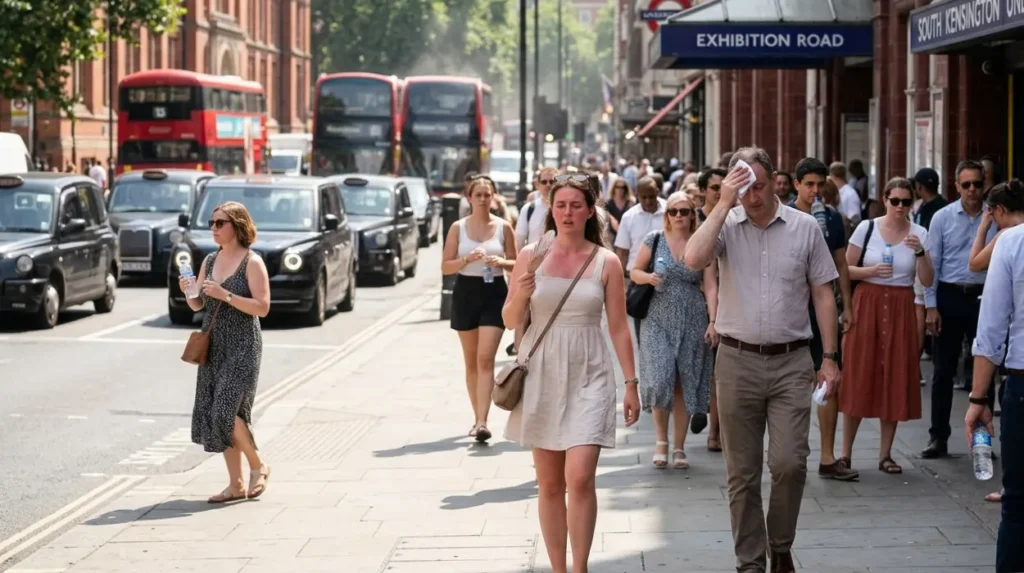
What physical and atmospheric mechanisms cause severe heatwaves in urban environments like Greater London?
Severe urban heatwaves are driven by a combination of large-scale synoptic high-pressure anticyclones and the localized Urban Heat Island effect, which traps solar radiation within high-density asphalt and concrete infrastructure.
The primary macro-scale driver is an atmospheric blocking pattern, wherein a persistent high-pressure ridge diverts the jet stream northward and locks a dome of stable, hot air over Western Europe and the British Isles. Beneath this dome, clear skies maximize incoming shortwave solar radiation.
At the micro-scale, Greater London acts as a localized heat sink due to the Urban Heat Island effect. Densely packed artificial surfaces—such as asphalt roads, brick buildings, and concrete pavements—possess high thermal admittance, meaning they absorb and store vast quantities of daytime solar energy. During the evening, this stored energy is slowly re-radiated as longwave thermal radiation.
Furthermore, anthropogenic heat emissions from commercial air conditioning units, vehicular combustion engines, and industrial processes add continuous thermal waste into the urban canopy layer. The relative lack of mature vegetation and permeable green spaces in central London prevents effective cooling via natural evapotranspiration, compounding the severity of the daytime heat stress forecast.
What specific health impacts and excess mortality rates are associated with prolonged high-temperature forecasts?
Prolonged high-temperature forecasts trigger severe physiological strain, resulting in thousands of excess heat-attributable deaths, exacerbated cardiovascular and respiratory illnesses, and unprecedented surges in emergency healthcare utilization.
The human body regulates core temperature through vasodilation and eccrine sweating, processes that place immense strain on the cardiovascular system as the heart pumps increased blood volumes to the skin for cooling. When ambient temperatures remain elevated alongside high relative humidity, sweat evaporation fails, leading to heat exhaustion, heatstroke, electrolyte imbalances, and acute kidney injury.
Epidemiological studies jointly conducted by the Met Office, Imperial College London, and the London School of Hygiene and Tropical Medicine quantify these human costs. The extreme heat events of 2022 resulted in an estimated 2,800 excess deaths across the United Kingdom. Subsequent prolonged heat spikes, such as the multi-phase heatwaves of 2026, generated thousands of additional fatalities nationwide.
In London specifically, hot weather drives nearly 4,000 additional emergency hospital attendances each summer. Vulnerable demographic cohorts—including adults aged 65 and older, infants, individuals with pre-existing chronic cardiopulmonary diseases, and economically disadvantaged populations living in poorly insulated housing—face disproportionately higher rates of morbidity and mortality during these meteorological events.

How do extreme heatwave forecasts disrupt critical urban infrastructure, transport networks, and utility supplies?
Extreme heatwave forecasts cause widespread failure across urban infrastructure by warping steel rail tracks, melting road surfaces, overloading electrical grids, and depleting public water reserves through severe seasonal droughts.
Transport systems experience immediate structural degradation when ambient temperatures soar. Steel railway lines exposed to direct solar radiation can reach temperatures up to 20°C higher than the surrounding air, inducing lateral buckling risks that force Network Rail to implement emergency speed restrictions or halt services across commuter lines into London terminals. Road networks suffer from asphalt softening and rutting under heavy vehicular loads.
Utility networks face parallel crises. Electrical transmission lines experience reduced capacity due to thermal resistance, while simultaneous spikes in residential and commercial air conditioning demand strain electrical sub-stations.
Concurrently, prolonged high temperatures accelerate soil moisture evaporation, frequently culminating in severe hydrological drought. The Environment Agency and the Met Office reported that southern England experienced its driest July on record, with cumulative rainfall dropping to historical lows. This lack of precipitation triggers widespread hosepipe bans affecting millions of residents, threatens agricultural crop yields, and strains regional reservoir storage capacities managed by utility providers such as Thames Water.
What strategic adaptation frameworks and municipal policies are being implemented to mitigate London’s rising heat risks?
Municipal adaptation frameworks, spearheaded by initiatives like the London Climate Resilience Review and the Heat Ready London municipal plan, focus on expanding urban green cover, retrofitting buildings, and establishing emergency public cooling networks.
The Greater London Authority has systematically scaled up its climate adaptation policies to counter the accelerating frequency of extreme thermal forecasts. Central to this strategy is the expansion of urban forestry and green infrastructure. The municipal administration has funded the planting of over 640,000 trees since 2016 to increase natural shade canopy and lower surface albedo across vulnerable boroughs.
To address the built environment, municipal audits indicate that approximately one million homes in London, alongside 1,361 schools, 60 hospitals, and 351 care homes, currently face high risks of internal overheating due to legacy architectural designs prioritizing heat retention rather than dissipation. Policy frameworks now mandate strict passive cooling standards, double or triple glazing, external shading louvers, and enhanced natural ventilation in new residential and commercial developments.
Additionally, the city maintains an active network of public water refill stations, thousands of free hydration points, and designated cool spaces in public buildings to protect transient populations and rough sleepers during active Red Heat-Health Alerts.
What temperature is considered a heatwave in the UK?
A UK heatwave is defined using location-specific Met Office thresholds. Depending on the region, temperatures generally need to reach around 25°C to 28°C or higher for at least three consecutive days.