
The emergence of an explosive diarrhea parasite outbreak poses significant challenges to urban public health systems, municipal infrastructure, and metropolitan food supply chains. This analysis by Extra London News evaluates the biological mechanisms, transmission vectors, historical precedents, and epidemiological response protocols associated with waterborne and foodborne protozoan parasites that colonize the human intestinal tract, with a specific focus on the unique risks facing the Greater London area.
- What Is an Explosive Diarrhea Parasite Outbreak?
- Which Parasites Cause Waterborne and Foodborne Diarrhea Outbreaks?
- How Do Parasitic Diarrhea Outbreaks Spread and Replicate?
- What Are the Main Symptoms of an Intestinal Parasite Infection?
- How Do Public Health Officials Investigate and Contain Outbreaks?
- What Medical Treatments Are Available for Parasitic Infections?
- How Can Individuals Prevent Contracting a Foodborne Parasite?
- What Is the Future Impact of Climate Change on Parasite Outbreaks?
What Is an Explosive Diarrhea Parasite Outbreak?
An explosive diarrhea parasite outbreak is a sudden spike in gastrointestinal illnesses within a specific population, caused by protozoan parasites contaminating water or food. These microscopic organisms colonize the human small intestine, inducing rapid, forceful, and severe watery stools.
Classification and Biological Profile
Microscopic protozoan parasites cause prolonged gastrointestinal infections in humans. Unlike viral or bacterial pathogens, these single-celled eukaryotic organisms possess a protective outer shell called an oocyst. The oocyst stage allows the pathogen to survive outside a host environment for multiple months. The outer wall exhibits high resistance to environmental stressors, temperature fluctuations, and standard chemical disinfectants. In dense urban centers like London, these resilient pathogens can spread rapidly through shared facilities and interconnected water distribution systems.
Mechanism of Intestinal Colonization
Ingestion of the infectious oocyst initiates the disease process. The acidic environment of the human stomach induces excystation, a biological process where the parasite emerges from its protective shell. The freed organisms, known as sporozoites, migrate to the epithelial cells lining the small intestine. The parasites attach to the microvilli, disrupting the cellular structure and impairing the fluid absorption capacity of the bowel. This localized cellular destruction leads to hypersecretion of water and electrolytes into the intestinal lumen, causing severe watery stools that require urgent medical evaluation by local London NHS trusts.
Which Parasites Cause Waterborne and Foodborne Diarrhea Outbreaks?
Three primary protozoan parasites cause widespread outbreaks of severe watery diarrhea globally: Cryptosporidium parvum, Cyclospora cayetanensis, and Giardia duodenalis. These distinct pathogens utilize different environmental niches, exhibit varying incubation periods, and require specific diagnostic methods to confirm human infection.
Cryptosporidium Species
Cryptosporidium parvum and Cryptosporidium hominis are the two main species responsible for human cryptosporidiosis. The oocysts of these species measure between four and six micrometers in diameter. This small size permits them to bypass standard sand filtration systems utilized in municipal water treatment facilities. Furthermore, Cryptosporidium exhibits an extreme tolerance to chlorine disinfection, remaining viable in chlorinated swimming pool water for up to seven days. The United Kingdom Health Security Agency (UKHSA) recorded 5,708 laboratory-confirmed cases of cryptosporidiosis in England during 2024. A notable outbreak occurred in May 2024 in Brixham, South Devon, prompting public health officials in London to review local water filtration protocols. A similar incident occurred in 2025 in a London borough when a contaminated public splash park triggered localized cases among children.
Cyclospora cayetanensis
Cyclospora cayetanensis is a larger, spherical protozoan measuring between eight and ten micrometers. This parasite causes cyclosporiasis, an intestinal illness characterized by remitting and relapsing diarrhea. Cyclospora requires a period outside the human host to mature. Freshly shed oocysts in human feces are unsporulated, meaning they are not immediately infectious. The oocysts require one to two weeks in warm, humid environmental conditions to undergo sporulation and become dangerous to consumers. Consequently, direct person-to-person transmission does not occur. In July 2026, global health agencies monitored significant Cyclospora outbreaks tied to imported fresh produce examples, including fresh raspberries, fresh basil, fresh cilantro, and pre-packaged salad mixes distributed to supermarkets across London.
Giardia duodenalis
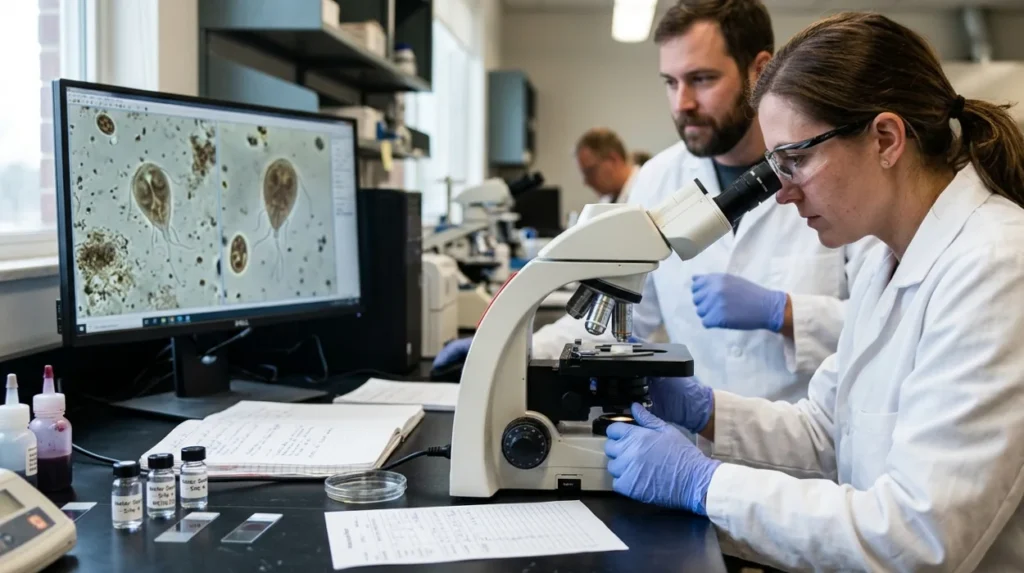
Giardia duodenalis, also classified as Giardia lamblia or Giardia intestinalis, is a flagellated protozoan that causes giardiasis. The parasite exists in two forms: the hardy, infectious cyst and the motile, replicating trophozoite. Trophozoites possess a ventral sucking disk that anchors the organism firmly to the mucosal lining of the duodenum and jejunum. This physical barrier prevents the absorption of fats and fat-soluble vitamins, resulting in malabsorptive, foul-smelling, and greasy diarrhea. Giardia cysts survive efficiently in cold wilderness water sources, making wild rivers, wilderness lakes, and untreated rural wells primary transmission vectors for London residents returning from domestic or international travel.
How Do Parasitic Diarrhea Outbreaks Spread and Replicate?
Parasitic diarrhea outbreaks spread exclusively via the fecal-oral route through two primary transmission vectors: contaminated municipal drinking water and tainted agricultural produce. The high stability of oocysts allows them to persist in agricultural soils, irrigation networks, and public water distribution systems.
Waterborne Transmission Networks
Waterborne transmission occurs when agricultural runoff, failing sewage infrastructure, or wildlife feces introduce oocysts into municipal water supplies. Heavy rainfall events often wash animal waste from livestock pastures into open reservoirs. If a water treatment facility relies solely on chlorination without advanced filtration or ultraviolet (UV) irradiation, the oocysts pass through the treatment barrier alive. Consumers then ingest the active parasites through tap water, ice cubes, or commercially prepared beverages. In a metropolis like London, a single point-source contamination at a water treatment plant could potentially expose hundreds of thousands of households across multiple boroughs simultaneously.
Foodborne Transmission Vectors
Foodborne transmission typically stems from agricultural practices in regions where the parasites are endemic. Farmers utilizing untreated surface water or sewage-contaminated water for crop irrigation spray oocysts directly onto the surfaces of leafy greens and berries. The physical structure of certain crops, such as the textured surface of raspberries or the tightly folded leaves of cilantro, protects the oocysts from mechanical washing. When food distributors transport these raw agricultural goods across international borders, the contaminated produce introduces the parasite into distant consumer markets, including restaurants and food markets throughout London.
What Are the Main Symptoms of an Intestinal Parasite Infection?
The main symptoms of an intestinal parasite infection include frequent and explosive watery diarrhea, severe abdominal cramps, bloating, nausea, and profound fatigue. These clinical signs develop after an incubation period ranging from two days to two weeks following ingestion.
Gastrointestinal Manifestations
The primary clinical hallmark of these infections is loud, watery, and sudden bowel movements. Patients report passing stools five to twenty times per day. The sudden influx of fluid into the colon causes visible abdominal distension, painful muscle cramps, and excessive flatulence. Trophozoite replication and oocyst shedding alter the local microbiome, causing secondary malabsorption. This malabsorption results in rapid weight loss, which frequently exceeds five kilograms during a prolonged infection cycle, causing thousands of patients to seek advice from London pharmacists and general practitioners.
Systemic and Chronic Symptoms
While these parasites do not enter the bloodstream, they trigger a systemic inflammatory response. Patients exhibit a low-grade fever below 38.3 degrees Celsius, persistent nausea, occasional vomiting, and generalized muscle aches. The most debilitating non-intestinal symptom is prolonged fatigue. This exhaustion persists for multiple weeks after the diarrhea subsides. In immunocompromised individuals, such as patients with advanced HIV or those undergoing chemotherapy at major London hospitals, the infection transforms into a permanent, life-threatening condition that causes chronic dehydration and severe malnutrition.
How Do Public Health Officials Investigate and Contain Outbreaks?
Public health officials contain outbreaks by using a three-stage epidemiological framework: syndromic surveillance to identify case clusters, molecular testing to isolate specific parasite strains, and environmental tracing to locate and shut down the point source of contamination.
Epidemiological Traceback Operations
When local medical providers note a sudden increase in patients reporting severe gastrointestinal distress, epidemiologists conduct detailed questionnaires. Investigators interview affected individuals regarding their food consumption history, travel destinations, and tap water exposure over the preceding fourteen days. Public health agencies look for common denominators among the collected responses, tracking down the exact grocery stores, restaurants, or water zones shared by the sick individuals across different London councils.
Laboratory Confirmation Methods
Standard bacterial stool cultures do not detect protozoan parasites. Microscopic identification requires specialized procedures, such as the modified acid-fast staining method, which stains Cryptosporidium and Cyclospora oocysts bright red against a blue background. Modern London laboratories rely heavily on Polymerase Chain Reaction (PCR) assays. These molecular tests amplify the DNA of the parasite, allowing scientists to identify the specific genetic strain within hours. Genetic sequencing helps investigators confirm whether disparate cases across the city belong to a single, interconnected outbreak.
What Medical Treatments Are Available for Parasitic Infections?
Medical treatments for parasitic infections focus on target-specific antimicrobial medications to eradicate the organism and aggressive oral or intravenous fluid therapy to counteract dehydration. The selection of the therapeutic agent depends strictly on the specific parasite species identified.
Target-Specific Antimicrobial Therapy
Physicians treat confirmed cases using specific prescription regimens based on laboratory findings:
- Trimethoprim-sulfamethoxazole: This combination antibiotic, commonly known as Bactrim or Co-trimoxazole, is the primary treatment for Cyclospora cayetanensis. The standard adult dosage consists of one double-strength tablet taken twice daily for seven to ten days.
- Nitazoxanide: This broad-spectrum antiprotozoal drug is the approved treatment for Cryptosporidium infections in immunocompetent adults and children. The typical adult dose is 500 milligrams administered orally every twelve hours for three consecutive days.
- Metronidazole or Tinidazole: These nitroimidazole compounds treat Giardia duodenalis by disrupting the DNA helical structure of the trophozoites.
Rehydration Protocols
Because patients lose liters of fluid daily through explosive diarrhea, maintaining electrolyte balance remains a critical clinical priority. Healthcare providers recommend oral rehydration salts (ORS) containing precise ratios of glucose, sodium, and potassium. The glucose molecules actively stimulate the sodium-glucose cotransport mechanism in the intestinal wall, forcing the body to absorb water even when the mucosa is inflamed. If a patient cannot retain oral fluids due to severe nausea, clinicians at London emergency departments initiate intravenous administration of isotonic fluids, such as Normal Saline or Lactated Ringer’s solution.

How Can Individuals Prevent Contracting a Foodborne Parasite?
Individuals prevent foodborne parasite infections by practicing strict hand hygiene with soap and water, washing raw agricultural produce with diluted vinegar solutions, and heating food or water to an internal temperature of at least 70 degrees Celsius.
Limitations of Chemical Sanitizers
Alcohol-based hand gels and sanitizers do not destroy protozoan oocysts. The tough protein shell of the oocyst resists alcohol denaturation. Individuals must wash their hands vigorously with liquid soap and warm running water for a minimum of twenty seconds after using toilets, changing diapers, or handling animals, a critical habit for commuters using the London Underground network.
Food Preparation Safeguards
Consumers must wash all fresh vegetables and fruits under running water before preparation. Submerging produce in a vinegar solution containing three parts water and one part acetic acid helps loosen the physical grip of oocysts from plant leaves, allowing them to be rinsed away easily. For absolute safety during an active outbreak in the local community, individuals must cook their vegetables completely. Heating food or boiling water to an internal temperature of 70 degrees Celsius (158 degrees Fahrenheit) kills all protozoan parasites instantly by disrupting their cellular membranes.
What Is the Future Impact of Climate Change on Parasite Outbreaks?
The future impact of climate change includes an increase in the frequency and geographical distribution of parasite outbreaks due to rising ambient temperatures and erratic precipitation patterns. These changing weather profiles alter the survival dynamics of oocysts in surface waters.
Thermal Tolerance and Survival Windows
Protozoan parasites like Cyclospora cayetanensis thrive in warm, humid climates. As global average temperatures rise, the seasonal window for optimal oocyst sporulation extends. In temperate zones, including the UK, the historical transmission season, which typically ran from May 1 to August 31, is expanding into early spring and late autumn. This shifting climate allows the parasite to establish permanent endemic populations in geographic zones where it previously could not survive the winter season.
Extreme Precipitation and Infrastructure Stress
Increased frequencies of extreme weather events, such as intense downpours and flash floods, stress municipal sewage and water treatment infrastructures. When a deluge delivers multiple inches of rain within a few hours, stormwater networks often overflow into clean drinking water reservoirs, such as those supplying the Greater London area. This sudden influx of raw runoff carries high concentrations of agricultural parasites directly into treatment pathways, increasing the probability of filter breakthrough events. Public health departments globally must upgrade water purification infrastructures by integrating ultraviolet irradiation and ozone disinfection systems to safeguard communities against these climate-driven biological threats.
Extra London News will continue to monitor updates from global public health agencies and provide verified scientific guidance on emerging infectious disease events.
What causes an explosive diarrhea parasite outbreak?
An explosive diarrhea parasite outbreak occurs when microscopic protozoan parasites contaminate food or drinking water. People become infected after swallowing the parasites, which multiply in the small intestine and cause severe watery diarrhea.