Westminster is one of the most historically significant districts in London. It contains the political, religious, royal, architectural, and ceremonial institutions that shaped England and later the United Kingdom.
- What makes Westminster historically important?
- What should first-time visitors see at Westminster Abbey?
- Why should visitors explore the Palace of Westminster and Westminster Hall?
- What can visitors learn from the Jewel Tower?
- How does Whitehall explain Westminster’s political history?
- What is the history of St James’s Park?
- Why is Westminster Cathedral important for understanding modern Westminster?
- How can visitors understand Westminster’s historical timeline?
- What historical evidence can visitors still see in Westminster today?
- How should first-time visitors explore Westminster’s historic heart?
- Frequently Asked Question
For first-time visitors, Westminster provides an unusually concentrated historical landscape. Westminster Abbey stands beside the Palace of Westminster. Whitehall connects Parliament with the former royal centre at St James’s. St James’s Park preserves a royal landscape created during the Tudor period. Westminster Cathedral represents the later development of Roman Catholicism in England and Wales.
The district also contains surviving medieval structures, Victorian architecture, royal residences, government buildings, memorials, ceremonial avenues, and archaeological evidence. Its importance extends beyond individual attractions because the buildings form a connected historical environment.
The name Westminster derives from the distinction between the western minster at Westminster and the eastern minster represented by St Paul’s in the City of London. A Benedictine monastery existed at Westminster by about 960, while Edward the Confessor established a major royal palace and rebuilt the monastery in the 11th century.
The historical development of Westminster can therefore be understood through several connected phases: Anglo-Saxon royal foundations, Norman monarchy, medieval Parliament, Tudor royal government, Stuart political conflict, Georgian administration, Victorian reconstruction, and the modern constitutional state.
For visitors, this chronology explains why Westminster contains such a dense concentration of historic buildings. The area was not planned as a tourist quarter. It developed because successive governments, monarchs, religious institutions, and civic authorities repeatedly used the same strategic location beside the River Thames.
What makes Westminster historically important?
Westminster is historically important because it combines England’s royal, parliamentary, religious, and governmental development in one district, preserving landmarks associated with coronations, Parliament, monarchy, medieval administration, Victorian reconstruction, and modern national government.
Westminster’s importance begins with its position beside the Thames. The river provided transport, communication, and access to the royal centre. Edward the Confessor established his principal palace at Westminster in the 1040s and expanded the nearby Benedictine monastery. The rebuilt church was consecrated in 1065.
William the Conqueror was crowned at Westminster Abbey on Christmas Day in 1066. This established Westminster as a central location for English royal coronation ceremonies. Westminster Abbey has remained the coronation church since that event. King Charles III became the 40th reigning monarch crowned there in May 2023.
The political role of Westminster developed alongside the royal role. The Palace of Westminster housed royal government and eventually became the permanent home of Parliament after Henry VIII abandoned the palace as a royal residence following a fire in 1512.
The medieval palace was largely destroyed by the catastrophic fire of 16 October 1834. Westminster Hall, parts of St Stephen’s complex, and the Jewel Tower survived. Parliament subsequently commissioned a new palace designed primarily by Charles Barry, with Augustus Welby Pugin responsible for much of its Gothic architectural detail and interior design.
This sequence explains the district’s unusual mixture of architectural periods. Medieval masonry survives beside Gothic Revival architecture. Tudor royal associations remain close to Victorian government buildings. Religious institutions from different periods occupy neighbouring streets.
Westminster is therefore best understood as a historical landscape rather than a collection of isolated attractions.
What should first-time visitors see at Westminster Abbey?
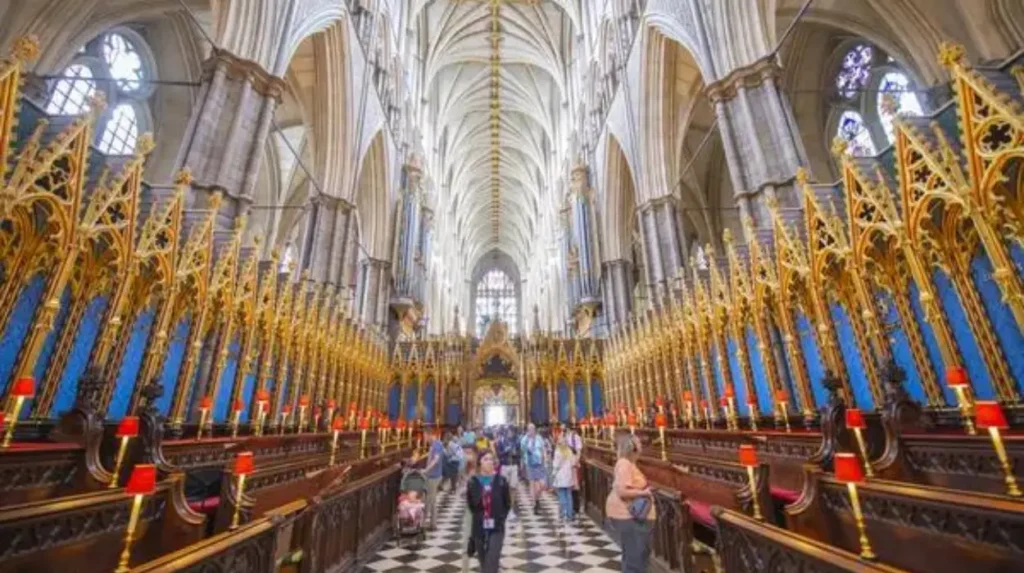
First-time visitors should see Westminster Abbey for its medieval architecture, royal coronation history, monarchs’ tombs, Edward the Confessor’s shrine, Poets’ Corner, royal chapels, memorials, and continuing role as a working church and Royal Peculiar.
Westminster Abbey is formally the Collegiate Church of St Peter, Westminster. It is a Royal Peculiar, meaning that it operates outside the normal jurisdiction of a diocesan bishop and is directly associated with the Sovereign. It is also a functioning place of Christian worship.
The present Gothic church largely dates from the rebuilding initiated by Henry III in 1245. Henry III replaced substantial parts of Edward the Confessor’s Norman church with a Gothic structure designed to provide an appropriate setting for royal ceremony and the shrine of Edward the Confessor.
The Abbey’s most important historical function is its coronation tradition. William the Conqueror’s coronation in 1066 established the precedent. The ceremony has continued at Westminster Abbey for successive British monarchs, with Edward V and Edward VIII being the two exceptions among monarchs who did not undergo coronation there.
The shrine of Edward the Confessor remains one of the central historical features. Edward died in January 1066 and was buried in his newly completed church. His later shrine became a focus for royal burials and devotional activity.
The Abbey also contains royal tombs. Thirty monarchs are buried there, including Edward the Confessor, Henry III, Edward I, Edward III, Richard II, Henry V, Henry VII, Elizabeth I, and Mary I.
The Lady Chapel provides important evidence of late medieval royal architecture. Henry VII built the chapel for his own burial, and it later became the burial place of monarchs including Elizabeth I and Mary I.
Poets’ Corner adds a literary dimension to the building. The Abbey contains memorials to writers, scientists, musicians, statesmen, and other prominent figures. This demonstrates how the institution developed from a royal and religious centre into a national place of commemoration.
The Abbey also preserves archaeological evidence of earlier buildings. The Pyx Chamber and parts of the undercroft survive from Edward the Confessor’s church. These remains provide physical evidence of Westminster’s pre-Gothic history.
Visitors interested in historical research should also note the Abbey’s library and muniment collections. The institution preserves books, manuscripts, archival material, photographs, and other records that support research into Westminster’s religious and institutional history.
Why should visitors explore the Palace of Westminster and Westminster Hall?
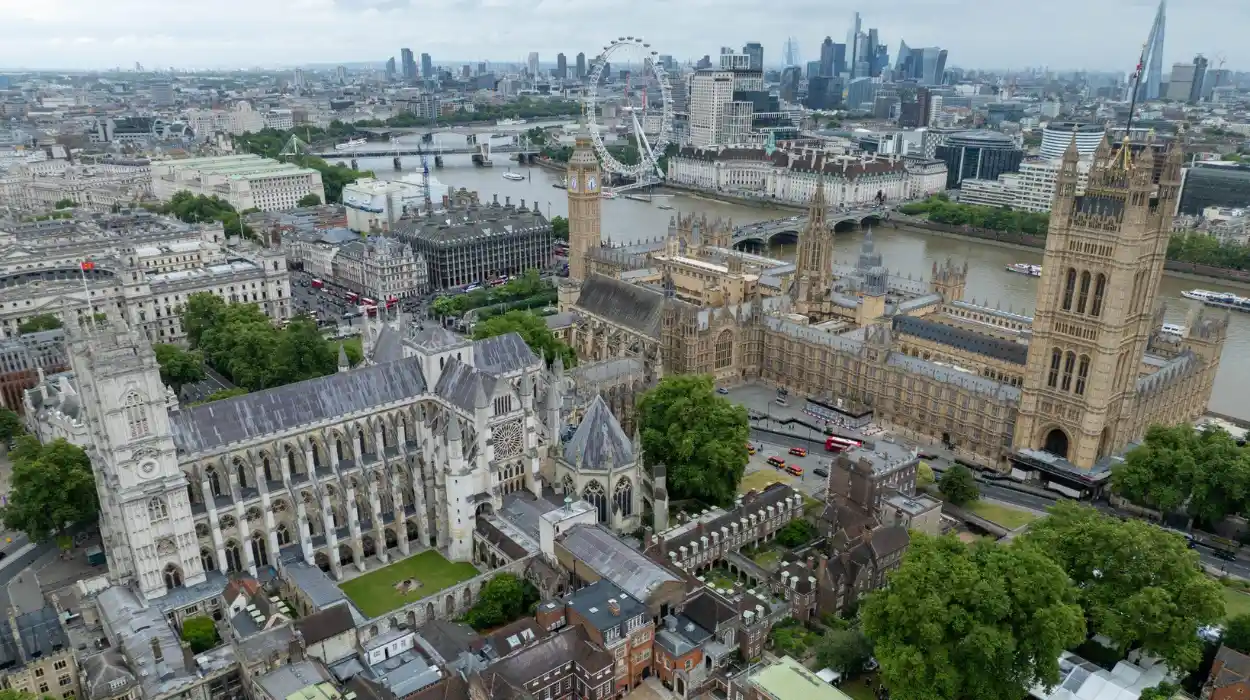
The Palace of Westminster represents the development of British parliamentary government, while Westminster Hall preserves one of the oldest surviving parts of the medieval palace and provides direct architectural evidence of Westminster’s political history.
The Palace of Westminster is commonly called the Houses of Parliament. Its present appearance dates primarily from the 19th-century rebuilding that followed the 1834 fire.
The medieval palace had served multiple functions. It was a royal residence, administrative centre, judicial location, and parliamentary meeting place. Westminster Hall, completed under William II in 1097, became one of the principal surviving structures from that medieval complex.
The palace suffered repeated fires before 1834. Major fires occurred in 1263, 1298, and 1512. The 1512 fire destroyed much of the residential section and contributed to Henry VIII’s decision to move the royal household to Whitehall Palace.
The final major disaster occurred on 16 October 1834. Two underfloor stoves used to burn old Exchequer tally sticks overheated and ignited material in the Lords Chamber. The resulting fire destroyed most of the old palace.
Westminster Hall survived because of several factors, including its massive medieval walls, the direction of the wind, and efforts to protect its roof from the flames.
The rebuilding programme began after an architectural competition in 1835. Charles Barry won the competition with a Gothic Revival design. Augustus Welby Pugin played a major role in the architectural detailing, interiors, furniture, decorative schemes, and elevations.
Construction began with the laying of the first stone in 1840. The Lords’ Chamber was completed in 1847, the Commons’ Chamber in 1852, the Clock Tower and its famous bell were completed during the following decade, and the rebuilding programme was substantially completed by 1870.
The Palace therefore represents more than Victorian architecture. It demonstrates how Britain reconstructed a central political institution after a national architectural disaster.
Westminster Hall is particularly significant because its survival provides a direct link between the modern Parliament and the medieval royal palace. Its vast hammer-beam roof, medieval masonry, later interventions, and parliamentary associations make it one of the district’s most important historical structures.
The Palace is also part of the Westminster World Heritage Site, recognised internationally for its architectural and historical significance.
What can visitors learn from the Jewel Tower?
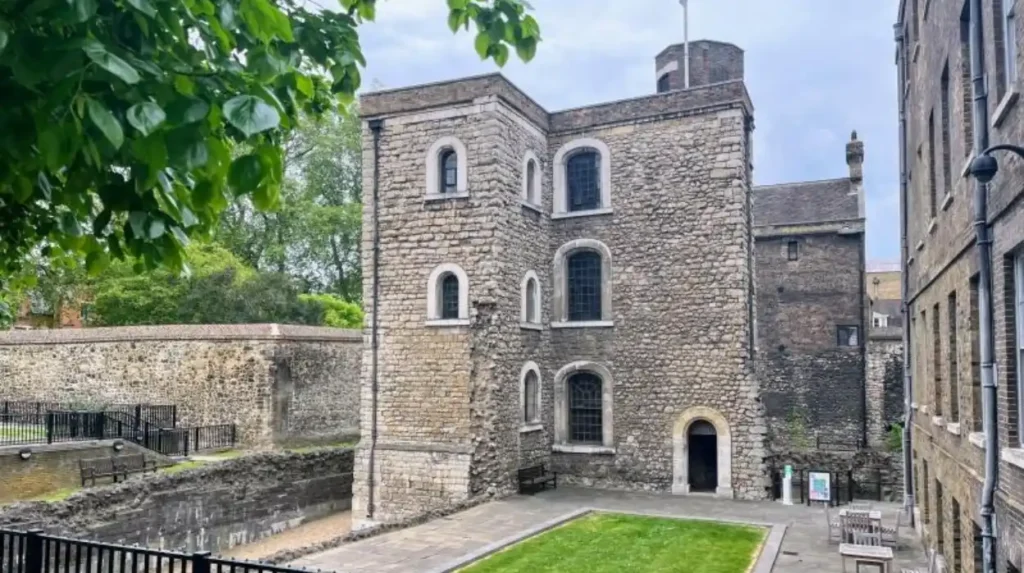
The Jewel Tower preserves a rare fragment of the medieval Palace of Westminster and reveals how one building changed from royal treasury to parliamentary archive and later weights-and-measures facility across approximately 650 years.
The Jewel Tower stands close to Westminster Abbey and the Houses of Parliament. English Heritage identifies it as one of the few surviving buildings from the medieval Palace of Westminster.
The tower was constructed in 1365–1366 during the reign of Edward III. It originally served as a secure repository for royal possessions, including silver plate, precious goods, and textiles belonging to the royal household.
Its design reflects its security function. The building stood beside a moat and had restricted external openings. The upper floor contained particularly secure storage arrangements, including double doors. Its ground-floor room retains an important 14th-century ribbed vault with sculpted bosses.
The tower’s historical importance increased after its royal function declined. By 1600, it was being used to store parliamentary records, including Acts of Parliament, journals, and minutes associated with the House of Lords. Fire protection became increasingly important because these records represented institutional memory.
The 1834 fire demonstrated the value of this location. The Jewel Tower survived because it stood apart from the main palace complex. Parliamentary records stored there were protected while much of the old palace was destroyed.
The building later acquired another institutional function. From 1869 to 1938, it was used by the Board of Trade Standards Department for testing weights and measures. The tower therefore became associated with the standardisation of measurements used across Britain and the British Empire.
Archaeological investigation provides additional evidence. More than 400 recorded archaeological objects have been associated with excavations around the Jewel Tower, including post-medieval artefacts recovered from the former moat.
The medieval moat itself was rediscovered and investigated during restoration and landscaping works in the 20th century. These archaeological interventions transformed public understanding of the tower’s original setting.
The Jewel Tower demonstrates how Westminster’s buildings changed function without losing their institutional significance. Royal administration, parliamentary record keeping, national standards, and heritage preservation all appear within the history of one small medieval structure.
How does Whitehall explain Westminster’s political history?
Whitehall explains Westminster’s political history through its concentration of government departments, royal associations, ceremonial routes, memorials, and surviving architectural evidence from the Tudor period through the development of the modern British state.
Whitehall runs south from the area around Trafalgar Square toward Parliament Square. Its historical importance developed after Henry VIII acquired York Place, the former residence of Cardinal Thomas Wolsey, and transformed it into Whitehall Palace.
The 1512 fire at Westminster helped shift the centre of royal residential activity toward Whitehall. Henry VIII increasingly used Whitehall Palace as his principal London residence.
Whitehall subsequently became closely associated with royal government. The palace complex expanded and contained residences, offices, ceremonial spaces, and administrative facilities.
Much of the old palace disappeared through rebuilding and later development. However, the Banqueting House survives as an important architectural remnant of the former Whitehall Palace complex. Designed by Inigo Jones and completed in 1622, it represents the introduction of Italianate classical architecture into an important royal setting.
The Banqueting House also has a major constitutional association. King Charles I was executed outside the building in 1649 following the English Civil War and the trial of the king.
The area later became increasingly dominated by government administration. Government departments occupied buildings along Whitehall, turning the street into one of Britain’s most recognisable administrative corridors.
The Cenotaph stands on Whitehall as the national memorial to the British and Commonwealth dead of the First World War and subsequent conflicts. Edwin Lutyens designed the permanent memorial, which was unveiled in 1920.
Horse Guards provides another layer of historical evidence. The ceremonial military presence reflects the long association between monarchy, armed forces, and state ceremony.
The spatial relationship between Whitehall and Parliament is important. Government offices line the route toward Westminster while Parliament occupies the riverfront. This physical arrangement demonstrates how executive government, legislative government, monarchy, and ceremonial authority became concentrated within the same district.
For historians, Whitehall therefore provides evidence of institutional continuity rather than simply architectural change.
What is the history of St James’s Park?
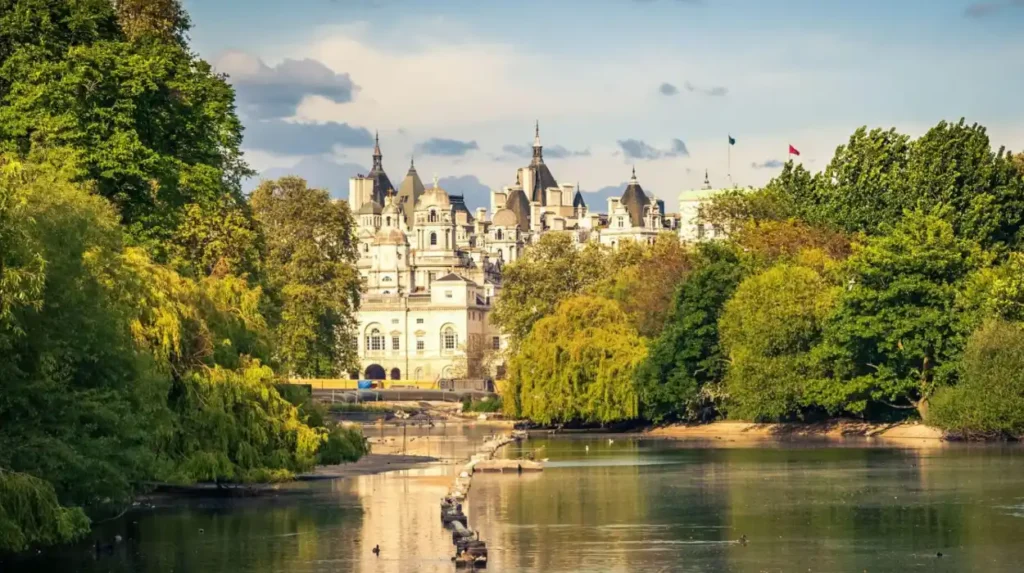
St James’s Park began as land associated with a medieval leper hospital and became a Tudor royal deer park in 1532, later developing into a formal royal landscape that remains one of Westminster’s principal historic green spaces.
The history of St James’s Park begins before the modern landscaped park. A leper hospital dedicated to St James the Less occupied the site, and the hospital gave the park its name.
Henry VIII incorporated the area into his royal collection of deer parks in 1532. He enclosed the land and constructed a hunting lodge that became associated with the Palace of St James’s. The park subsequently served royal recreation and ceremonial functions.
During the Tudor period, the park hosted activities including jousting, festivities, and royal entertainments. Its function was therefore connected to the wider transformation of Westminster into a centre of monarchy.
James I changed the landscape during the early 17th century. Drainage improvements were introduced and a series of ponds and islands developed. One surviving element is associated with Duck Island.
The Stuart period also brought a royal menagerie. James I kept exotic animals including camels, crocodiles, and an elephant in the park. Exotic birds were housed along what became Birdcage Walk.
The park later underwent major landscape transformation under Charles II and subsequent royal administrations. Its formal appearance evolved into a more open ornamental landscape.
Today, St James’s Park provides a physical transition between historic royal institutions and modern Westminster. It connects Buckingham Palace, St James’s Palace, Horse Guards, The Mall, and Parliament.
For first-time visitors, the park also provides historical context for understanding the relationship between royal residences and ceremonial routes. Its trees, water features, bridges, lawns, and surrounding buildings form part of a landscape that has developed through several centuries of royal planning.
The park’s historical value therefore rests not only in its greenery but in its function as a surviving component of Westminster’s royal geography.
Why is Westminster Cathedral important for understanding modern Westminster?
Westminster Cathedral represents the modern Roman Catholic history of Westminster and provides a contrasting architectural and religious tradition beside the medieval Anglican institution of Westminster Abbey.
Westminster Cathedral stands on Victoria Street and serves as the mother church of the Roman Catholic Archdiocese of Westminster. Its construction belongs to the late Victorian and Edwardian period rather than the medieval era.
Construction began in 1895 and the cathedral was completed in 1903. The building therefore represents a comparatively recent stage in Westminster’s long religious history.
The cathedral was commissioned during a period when Roman Catholic institutions were expanding their public presence in England and Wales following the restoration of the Roman Catholic hierarchy in 1850.
Architect John Francis Bentley designed the cathedral in a Byzantine-inspired style rather than reproducing the Gothic architecture associated with Westminster Abbey. The decision created a distinct architectural identity.
The use of brick also had practical and historical significance. Cardinal Herbert Vaughan, who promoted the cathedral project, recognised the financial limitations of the archdiocese and chose a structural approach that allowed the building to be completed before all decorative work was finished.
The cathedral’s architecture reflects influences from early Christian and Byzantine buildings. Its broad nave, domes, mosaics, marble work, and tower create a visual contrast with the Gothic verticality of Westminster Abbey.
This contrast is historically important. Westminster contains institutions representing different phases of England’s religious history. Westminster Abbey developed through medieval monasticism, the Reformation, royal patronage, and the post-Reformation Church of England. Westminster Cathedral represents the revival and institutional development of Roman Catholicism in modern Britain.
The two buildings therefore should not be treated as interchangeable religious attractions. Their architectural forms and institutional histories represent different traditions.
For students and heritage researchers, this juxtaposition provides a clear example of how Westminster’s religious landscape continued to evolve after the medieval period.
How can visitors understand Westminster’s historical timeline?
Westminster’s historical timeline begins with the Anglo-Saxon monastery and royal palace, continues through Norman and medieval monarchy, Tudor government, parliamentary development, the 1834 fire, Victorian reconstruction, and the modern constitutional state.
The earliest major foundation dates to around 960, when a Benedictine monastery existed at Westminster under the patronage of King Edgar and St Dunstan.
In the 1040s, Edward the Confessor established a royal palace at Westminster and greatly expanded the nearby monastery. His stone church was consecrated in 1065.
In 1066, William the Conqueror was crowned at Westminster Abbey. The event established the site as the principal location for English royal coronations.
From the 13th century, Henry III rebuilt the Abbey in the Gothic style. The rebuilding transformed the architectural character of Westminster and created much of the structure visible today.
In the 14th century, Edward III commissioned the Jewel Tower between 1365 and 1366. Its initial purpose was the secure storage of royal goods.
The Tudor period brought another major transition. The 1512 fire damaged the residential Palace of Westminster, and Henry VIII increasingly used Whitehall Palace. Westminster nevertheless remained central to Parliament and government.
The 17th century brought civil war, the execution of Charles I, the Commonwealth, the Restoration, and major constitutional changes. Westminster’s institutions remained closely involved in these national developments.
The 18th century saw the expansion of parliamentary government and the transformation of the surrounding administrative landscape.
In 1834, the old Palace of Westminster was devastated by fire. The disaster produced the architectural and institutional rebuilding programme that created the present Palace of Westminster.
Between 1840 and 1870, Charles Barry and Augustus Pugin’s Gothic Revival complex transformed the riverfront. The new palace incorporated fire-resistant planning and purpose-built parliamentary facilities.
The 20th century added new layers of commemoration and government. The Cenotaph became a national war memorial, while Westminster’s government and parliamentary functions expanded.
The 21st century continues this institutional history. Westminster Abbey hosted the coronation of King Charles III in May 2023, demonstrating the continuing national role of the district.
The timeline shows that Westminster’s significance comes from continuity combined with reconstruction. Buildings disappeared, institutions changed, and architectural styles evolved, but the district remained a central location for national religious, royal, political, and ceremonial functions.
What historical evidence can visitors still see in Westminster today?
Visitors can still see medieval masonry, Gothic architecture, royal chapels, parliamentary buildings, archaeological remains, historic gardens, government architecture, memorials, and religious buildings that preserve evidence from more than 1,000 years of Westminster’s development.
The strongest evidence of medieval Westminster survives at Westminster Abbey and Westminster Hall. The Abbey retains elements connected with Edward the Confessor’s church, while Westminster Hall remains the most important surviving component of the ancient parliamentary palace.
The Jewel Tower provides another direct medieval survival. Its 14th-century structure retains significant original fabric, including the ground-floor ribbed vault and parts of its medieval internal arrangement.
Archaeology has also changed understanding of the area. Excavations around the Jewel Tower revealed the former moat and more than 400 recorded archaeological objects. The evidence demonstrates that Westminster’s historic environment extends below modern landscaping and streets.
The present Palace of Westminster represents Victorian reconstruction rather than medieval survival. Its Gothic Revival design intentionally created a visual connection with England’s medieval architectural past while providing a modern parliamentary complex.
Westminster Abbey demonstrates a similar process of continuity and adaptation. The building began as a Benedictine monastery, became a post-Reformation collegiate church, and remains a working church with royal and national responsibilities.
St James’s Park preserves the footprint of royal landscape planning. Its current appearance differs from its Tudor form, but its location and relationship with St James’s Palace, Buckingham Palace, and ceremonial routes retain evidence of its royal function.
Whitehall preserves another type of historical evidence. Government offices, ceremonial spaces, memorials, and surviving palace architecture demonstrate the transition from royal administration to modern central government.
Westminster Cathedral records a later stage of religious history. Its 1895–1903 construction demonstrates the renewed institutional presence of Roman Catholicism in modern London.
These surviving structures make Westminster valuable for architectural study, genealogy, political history, religious history, archaeology, and heritage conservation.
How should first-time visitors explore Westminster’s historic heart?
First-time visitors should explore Westminster as a connected historical district, beginning with Westminster Abbey and Parliament, then continuing through the Jewel Tower, Whitehall, St James’s Park, royal landmarks, memorials, and Westminster Cathedral.
A chronological walking approach provides the clearest historical framework. Westminster Abbey should form the starting point because its history reaches from the 10th-century Benedictine foundation through Edward the Confessor, the Norman conquest, medieval kingship, the Reformation, and modern coronations.
The Palace of Westminster should follow because its history explains the development of Parliament and the transformation of the royal palace after the 1834 fire. Westminster Hall provides the strongest surviving connection with the medieval parliamentary estate.
The Jewel Tower adds a smaller but highly significant medieval structure. Its changing functions demonstrate how royal property, parliamentary archives, and government standards operated within the same Westminster landscape.
The route can then continue toward Whitehall. This section explains the movement of royal residence and administration from Westminster Palace toward Whitehall during the Tudor period.
St James’s Park provides the historical landscape context. Its Tudor origins, Stuart modifications, royal menagerie, and later landscape development connect royal residences with ceremonial geography.
Westminster Cathedral provides a useful final contrast. Its modern construction demonstrates that Westminster’s religious importance did not end with the medieval period. Instead, the district continued to accommodate major religious institutions during the Victorian and Edwardian eras.
To experience this historic district in person today, consult our comprehensive [How Westminster Became Britain’s Political and Ceremonial Center Throughout History] for itineraries and visiting parameters.
The most effective historical approach is to observe relationships between buildings rather than treating every attraction as a separate destination. Westminster Abbey stands beside Parliament because royal, religious, and political institutions developed together. Whitehall lies nearby because royal government shifted south and west. St James’s Park connects the royal residences with ceremonial routes. The Jewel Tower survives because parts of the medieval palace escaped destruction.
This geographical concentration makes Westminster especially valuable for education. A single visit can demonstrate medieval urban development, royal government, parliamentary history, religious change, architectural revival, archaeology, heritage preservation, and national commemoration.
For genealogical researchers, Westminster also matters because centuries of institutional activity generated records concerning monarchy, Parliament, religion, administration, military service, property, and public life. The surviving archives held by institutions such as Westminster Abbey and Parliament provide primary sources for reconstructing historical lives and institutions. Westminster Abbey specifically maintains extensive historic library and archival collections for research.
For heritage preservationists, the district provides a practical example of adaptive conservation. Medieval structures survived alongside rebuilt Victorian architecture. Archaeological remains were excavated and interpreted. Historic institutions continue to use buildings originally created for very different purposes.
The long-term significance of Westminster rests on this combination of continuity and change. The district remains a working political and religious centre rather than a preserved historical enclosure. Parliament continues to operate in the Palace of Westminster. Westminster Abbey continues daily worship. St James’s Park remains a public park. Government departments continue to occupy Whitehall. Westminster Cathedral remains an active cathedral.
That continuing use gives Westminster its strongest historical characteristic. Its past is preserved within institutions that still perform major public functions.
Westminster therefore provides first-time visitors with more than a collection of famous London landmarks. It offers a compact historical record of England and the United Kingdom, expressed through buildings, landscapes, archives, memorials, archaeological remains, religious institutions, royal traditions, and parliamentary government.
From the Benedictine monastery established around 960 to the coronation of Charles III in 2023, Westminster has remained closely connected with the country’s political, religious, and ceremonial history.
Its surviving architecture demonstrates the consequences of political change, religious transformation, technological development, fire, reconstruction, conservation, and institutional continuity.
For history enthusiasts, cultural tourists, educators, students, and heritage researchers, Westminster remains one of London’s most information-rich historic environments. Its importance is not limited to individual landmarks. The greatest historical value lies in the connections between them.
Frequently Asked Question
What are the best things to do in Westminster for first-time visitors?
The best things to do in Westminster include visiting Westminster Abbey, seeing the Palace of Westminster and Westminster Hall, exploring the Jewel Tower, walking through Whitehall and St James’s Park, and visiting Westminster Cathedral.