Key Points
- Application Rejection: Croydon Council’s Licensing Sub-Committee has officially refused a premises licence application from Merkur Slots for a 24-hour adult gaming centre (AGC) at 1393 London Road, Norbury.
- Vulnerability Safeguard Failures: The local authority concluded that the gambling operator had failed to establish sufficient safeguards to adequately protect local children and vulnerable residents from potential exploitation and gambling-related harm.
- High-Risk Vicinity: Councillors highlighted the highly sensitive nature of the proposed high street location, noting its immediate proximity to a supported housing block for vulnerable individuals and a local food bank that serves the homeless.
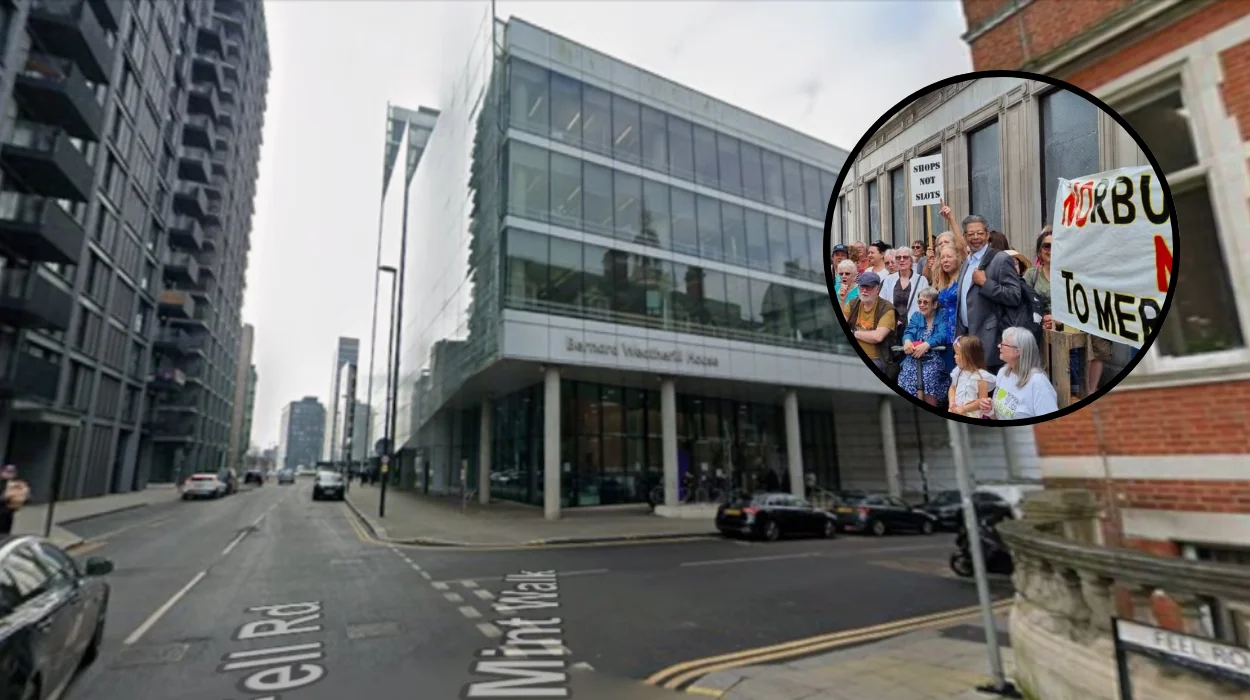
- Intense Grassroots Opposition: Local residents, coordinated by the community group Love Norbury, presented a unified front against the development, launching a petition that gained over 1,000 signatures and organising public street demonstrations.
- Regulatory Backlash: The committee heavily weighed past regulatory failures involving Merkur Slots, including a 2025 Gambling Commission fine of nearly £96,000 for failing to assist a vulnerable cancer patient, alongside a 2025 undercover BBC investigation exposing lapses in self-exclusion protocols.
- Ongoing Legal Battle: Despite the licensing victory, residents face a remaining legal hurdle as a separate planning appeal over the building’s official change of use remains under review by the Secretary of State.
Norbury (Extra London News) July 11, 2026 – Grassroots community activists in South London are celebrating a landmark victory after local authority officials formally rejected a controversial proposal to establish a round-the-clock adult gaming centre on a major residential high street. Croydon Council’s Licensing Sub-Committee threw out the application submitted by national gambling operator Merkur Slots, which had sought to convert the vacant former NatWest bank premises at 1393 London Road into a 24-hour electronic gaming hub. The decision, delivered following an intense period of local campaigning, was heavily influenced by formal representations detailing the acute risks the venue would pose to children and vulnerable residents living nearby. Local community groups, who argued the venue would bring no social or economic benefit to the area, successfully convinced elected officials that the operator’s proposed safety measures were fundamentally inadequate to mitigate the hazards of late-night slot machine gaming.
- Key Points
- Why did Croydon Council reject the 24-hour gambling centre licence?
- What concerns were raised by the Norbury community?
- How did past regulatory failures impact the council’s decision?
- What arguments did Merkur Slots present in defense of the venue?
- What role did local politicians play in blocking the licence?
Why did Croydon Council reject the 24-hour gambling centre licence?
The formal decision to deny the premises licence followed exhaustive deliberations during a meeting of Croydon Council’s Licensing Sub-Committee on July 2. As reported by Local Democracy Reporter Harrison Galliven of MyLondon, the three-member panel determined that the location chosen by Merkur Slots was uniquely unsuitable for a continuous, 24-hour electronic gaming operation due to the immediate socio-economic makeup of the local high street.
The committee explicitly designated the chosen section of London Road as a “highly sensitive” zone. Central to the council’s refusal was the physical layout of the immediate neighbourhood. The former bank building sits directly adjacent to a three-storey supported housing block located on Semley Road, which accommodates individuals requiring structured social care. Furthermore, the committee highlighted the venue’s proximity to the Resistance Kitchen, a vital community food bank operating in Norbury where approximately half of the service users are classified as homeless or insecurely housed.
In their formal decision notices, councillors asserted that the presence of a round-the-clock gambling facility in such immediate proximity to these facilities created an unacceptable risk of exploitation for individuals already battling addiction, financial hardship, or mental health challenges. The local authority maintained that the statutory objective to protect children and vulnerable persons from being harmed or exploited by gambling could not be upheld if the licence were granted.
What concerns were raised by the Norbury community?
The high street in Norbury already features a prominent gambling footprint, a factor that mobilised the neighborhood into action when the new proposals were first publicised. Residents argued that allowing Merkur Slots to open would more than double the total number of high-stakes slot machine terminals currently available to the public within the immediate commercial district.
As reported by Harrison Galliven of MyLondon, Deborah Bestwick, the chair of the local campaign group Love Norbury, expressed immense relief and validation following the council’s verdict. Reflecting on the intense community effort required to oppose the corporate application, Bestwick stated:
“We know that the Gambling Act 2005 is hugely in favour of the applicant, and it is hard to get a gambling licence refused. In the end, we are a collection of residents and citizens – we had no expert assistance, no lawyers, no consultants, no resources. But we know our area in detail and we know our communities, and ultimately this decision was based on the demonstrated and evidenced need to protect the more vulnerable residents.”
The local opposition was structured around a comprehensive petition launched by Love Norbury, which rapidly gathered more than 1,000 signatures from local householders and business owners. The text of the petition, preserved within public campaign records on Change.org, detailed the severe structural anxieties shared across the district:
“By permitting Merkur Slots to establish operations at this location, we are allowing the infiltration of our community through more gambling opportunities, potentially leading to higher rates of addiction, financial distress, and mental health issues among our residents. The prevalence of gambling outlets in deprived areas has been documented to amplify these issues, trapping individuals in cycles of poverty and despair.”
Furthermore, the community noted a direct spatial hazard regarding the micro-economy of the high street. Activists pointed out that the proposed adult gaming centre sat directly beside a Cash Exchange pawnbroker. The petition text warned that this proximity created “an immediate and obvious route to fund gambling losses,” effectively enabling individuals to liquidate personal possessions mid-session to continue playing the terminals.
The anxiety regarding overnight public safety was echoed by Paloma Lacy, another prominent member of the Love Norbury group. Speaking to the Local Democracy Reporting Service (LDRS) prior to the decision, Lacy summarised the community consensus:
“There is enough of a gambling presence in Norbury. This is a family area. The people of Norbury do not want this here. This is a residential shopping street; it is a thriving neighbourhood. This gambling centre would bring no benefit whatsoever.”
How did past regulatory failures impact the council’s decision?
In evaluating whether Merkur Slots could be trusted to enforce its own social responsibility policies, Croydon Council took the unusual step of reviewing the company’s historical compliance record across the United Kingdom. The Licensing Sub-Committee examined specific, verified instances where the firm’s internal safeguards had failed to prevent severe consumer detriment.
According to MyLondon reporting, the committee paid significant attention to an official regulatory sanction issued by the UK Gambling Commission in 2025. In that case, Merkur Slots was hit with a £95,450 financial penalty after an official investigation revealed that venue staff had systematically failed to execute social responsibility interventions. The case involved a 64-year-old cancer patient who was permitted to gamble unchecked, resulting in profound financial distress during a period of extreme personal vulnerability.
Additionally, the sub-committee reviewed the findings of a 2025 undercover television investigation broadcast by the BBC in Portsmouth. The investigative journalists had deployed a reporter to test the efficacy of the industry’s voluntary self-exclusion schemes. The undercover reporter managed to repeatedly bypass standard identity checks and access gaming terminals at multiple high street venues, including a branch operated directly by Merkur Slots, without facing any staff intervention.
Elected members concluded that these documented operational lapses undermined the corporate assurances provided by the applicant during the Croydon hearings, reinforcing the belief that local staff might not successfully protect Norbury’s vulnerable demographics during late-night shifts.
Explore More Croydon News
Construction Worker Dies in Fatal Mayfair Site Fall: London 2026
Croydon Council Faces High Court Over Homeless Service Closure: London 2026
What arguments did Merkur Slots present in defense of the venue?
Throughout the dual track of planning and licensing applications, representatives for Merkur Slots strongly contested the characterisation of their venues as detrimental to public welfare, presenting a substantial body of corporate evidence to support their expansion plans.
As recorded in official Croydon Council licensing archive bundles, the company’s legal representatives, led by licensing specialist Gerald Gouriet KC, argued that adult gaming centres constitute a legitimate form of high street commercial entertainment, comparable to other standard evening leisure activities. The company maintained that its operations are highly regulated and distinct from traditional betting shops, catering primarily to individuals looking to engage in low-stake, casual electronic gaming.
To appease the anxieties of local residents regarding the nearby supported housing on Semley Road, the firm put forward a series of operational compromises. A spokesperson for Merkur Slots outlined these specific mitigations to the LDRS, stating that the company would permanently restrict window advertisements on the Semley Road facade to reduce the visual temptation for passersby. Furthermore, the company pledged to implement a strict, mandatory minimum staffing level of two workers on site between the hours of 8:00 PM and 6:00 AM, alongside the deployment of comprehensive closed-circuit television (CCTV) monitoring.
The operator also emphasized its standard participation in the ‘Multi-Operator Self-Exclusion Scheme’ (MOSES), promising to bar any individuals known to have registered gambling problems permanently from the premises. In a statement issued to the media defending the commercial utility of the project, a Merkur Slots spokesperson argued:
“We believe this is an excellent opportunity to bring this important site, a closed venue in the heart of the town centre, back into commercial use.”
What role did local politicians play in blocking the licence?
The local campaign received significant institutional weight from elected political figures representing the district, who leveraged local government frameworks to oppose the multi-national operator.
Councillor Leila Ben Hassell, who serves as the representative for the Norbury and Pollards Hill ward, as well as holding the positions of Deputy Leader of the Opposition and Shadow Cabinet Member for Finance, stood firmly alongside the resident associations. Speaking formally to the LDRS, Ben Hassell explicitly rejected the commercial compatibility of the venue with the council’s wider economic plans for the borough, stating:
“A gaming centre has no place here. Norbury already has several gambling establishments on its high street, while residents must rely on the Post Office for in-person banking services.”
The timing of the application also intersected with shifting national legislative powers regarding local government control over gambling density. As detailed in local legislative reviews, the UK Parliament recently passed the English Devolution and Community Empowerment Act 2026, which received Royal Assent on April 29, 2026. This updated framework grants local authorities enhanced statutory powers to compile and enforce localized ‘Gambling Impact Assessments’ to prevent high street over-saturation.
However, as Deborah Bestwick clarified to reporters, Merkur Slots had strategically submitted its Norbury application prior to the formal enactment of the 2026 statute. This forced the community and the council to rely strictly on the older provisions of the Gambling Act 2005. Under the 2005 framework, local authorities face a high legal threshold for refusal, as the act contains a statutory presumption in favour of permitting gambling unless direct conflict with specific licensing objectives—such as public safety or the protection of minors—can be explicitly proven.
Is the Norbury gambling centre battle completely over?
While the licensing refusal represents a definitive block to immediate trading, the long-term future of the former NatWest bank site remains unresolved due to an ongoing parallel legal battle within the UK planning inspectorate.
Earlier in the year, Croydon Council’s independent planning department had separately refused a planning application submitted by Merkur Slots to alter the legal property designation of 1393 London Road from Class E (commercial, business, and service) to a sui generis adult gaming centre. In that instance, municipal planning officers based their refusal on environmental factors, specifically citing the projected late-night noise, structural vibrations, and general public nuisance that an overnight gaming venue would inflict on the residential apartments located directly above and around the high street shops.
Merkur Slots chose to formally appeal against that municipal planning refusal, escalating the matter to central government. The final determination on the property’s physical usage now rests with the Planning Inspectorate, acting on behalf of the Secretary of State for Housing, Communities and Local Government.
Deborah Bestwick confirmed to the LDRS that the official window for local residents to submit formal statements of objection to the planning appeal has now closed. Acknowledging that the ultimate fate of the high street remains in a state of legal suspension, Bestwick concluded that local campaigners can now only “watch this space” while awaiting the final, binding federal planning verdict.