Battersea Power Station remains significant because it represents Britain’s transition from heavy industry to heritage-led regeneration. Built between 1929 and 1955, the station powered London, shaped industrial architecture, survived decades of decline, and became one of Europe’s largest adaptive reuse projects.
- How did London’s electricity expansion create Battersea Power Station?
- Why was Battersea Power Station designed as an architectural landmark?
- What happened during the construction of Battersea Power Station?
- How did Battersea Power Station operate during its industrial peak?
- Why did Battersea Power Station close in 1983?
- How did Battersea Power Station become a cultural icon during abandonment?
- How was Battersea Power Station transformed into a modern visitor destination?
The History of Battersea Power Station: From Coal to Culture reflects nearly a century of British industrial, architectural, economic, and cultural transformation. Located beside the River Thames in southwest London, the power station originally operated as a coal-fired electricity generating facility supplying energy to homes, transport systems, factories, and public infrastructure across the capital.
The building stands within Battersea in the London Borough of Wandsworth. Architect Sir Giles Gilbert Scott designed the structure using monumental Art Deco principles combined with industrial engineering. Scott also designed Britain’s iconic red telephone box and contributed to the design of Liverpool Cathedral.
Construction occurred in two major phases. Battersea “A” Station opened in 1933. Battersea “B” Station followed in 1955 after wartime delays. At operational peak, the station generated approximately one-fifth of London’s electricity supply.
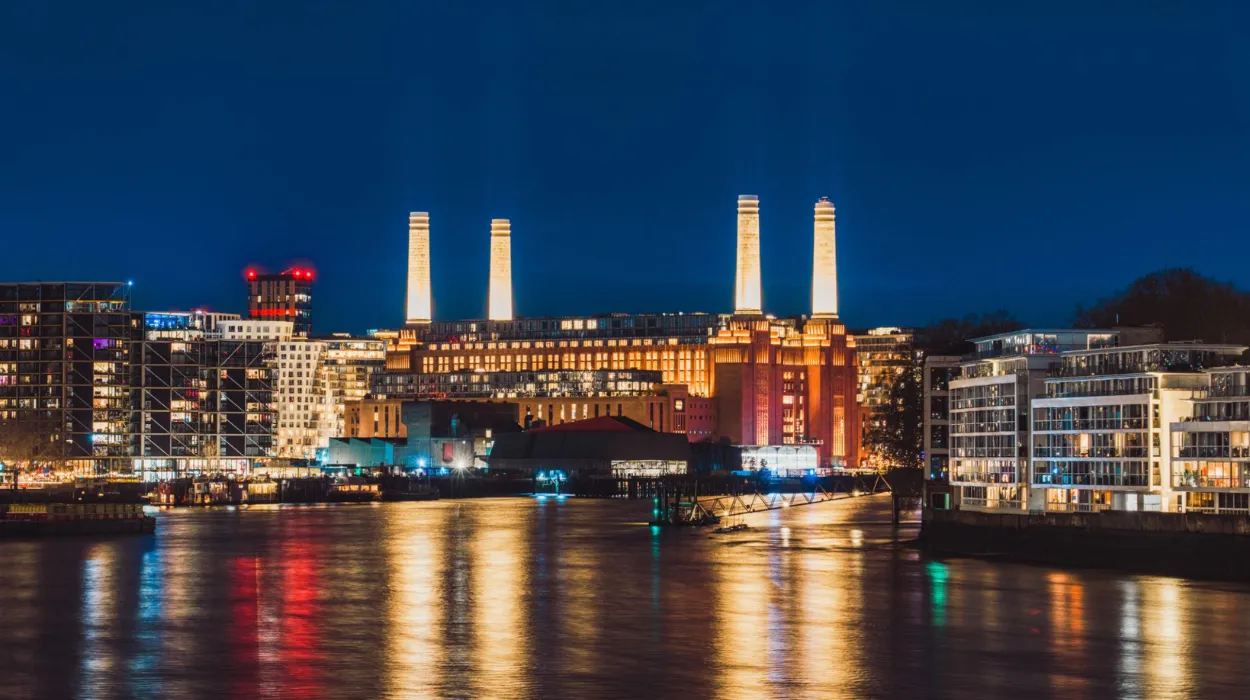
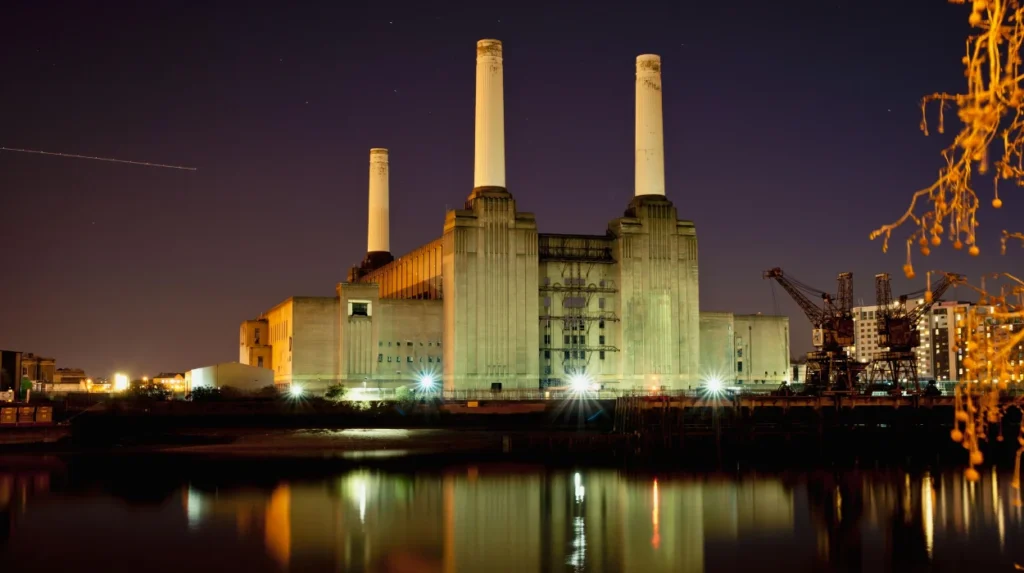
The building became globally recognised because of its four white chimneys and immense brick exterior. Measuring approximately 160 metres in length, Battersea Power Station became one of the world’s largest brick structures. Its riverside position made it visible across large sections of London’s skyline.
Electricity production ended permanently in 1983. The site then experienced decades of abandonment, failed redevelopment attempts, structural deterioration, and preservation debates. During the early twenty-first century, a multibillion-pound regeneration project transformed the station into a mixed-use district containing retail areas, restaurants, offices, residential apartments, cultural venues, riverside spaces, and the Lift 109 viewing attraction.
Today, the station functions simultaneously as a heritage monument, commercial centre, tourism destination, and architectural landmark. The redevelopment demonstrates how industrial infrastructure can gain new economic and cultural relevance while preserving historical identity.
To experience this historic landmark in person today, consult our comprehensive [Visiting Battersea Power Station: Shopping, Food & Lift 109] for itineraries and visiting parameters.
How did London’s electricity expansion create Battersea Power Station?
London’s rapid industrial and population growth during the early twentieth century created enormous electricity demand. Existing local power stations lacked efficiency and coordination, leading the London Power Company to develop Battersea as a centralised large-scale generating facility.
The History of Battersea Power Station: From Coal to Culture began during a major transformation in Britain’s urban infrastructure. Before national electricity coordination developed, London relied on multiple independent electricity suppliers operating disconnected systems with different voltages and standards.
During the late nineteenth and early twentieth centuries, electricity changed urban life across Britain. Homes adopted electric lighting. Factories replaced steam-driven equipment with electric machinery. Underground railways expanded electric transport networks. Public institutions increasingly depended on centralised energy systems.
The London Power Company formed in 1925 through consolidation of several electricity providers. The company aimed to create a more efficient generating network capable of supplying growing metropolitan demand.
Battersea became an ideal location because of its logistical advantages. The River Thames enabled coal transportation directly to the site using barges. Railway lines connected the area to national industrial networks. Proximity to central London reduced transmission distances and infrastructure costs.
The surrounding Battersea district already contained industrial infrastructure including warehouses, rail sidings, engineering facilities, and riverside manufacturing operations. These existing industrial conditions supported construction planning and energy distribution.
Government policy also influenced large-scale electricity expansion. Britain increasingly recognised electricity generation as essential national infrastructure supporting industrial productivity, public health, urban growth, and transportation development.
The station formed part of wider modernisation efforts occurring across interwar Britain. Examples included national road improvements, suburban housing expansion, railway electrification, and public works programmes intended to strengthen economic competitiveness.
Why was Battersea Power Station designed as an architectural landmark?
Battersea Power Station was designed as an architectural landmark because planners wanted industrial infrastructure to appear visually impressive rather than polluting or intrusive. Architect Giles Gilbert Scott combined engineering functionality with monumental Art Deco design principles and civic architectural standards.
Earlier industrial facilities often prioritised operational efficiency without considering urban appearance. Victorian factories and power stations frequently generated criticism because of smoke pollution, noise, and unattractive construction.
The London Power Company recognised that Battersea’s visibility beside the Thames required a more refined architectural approach. Executives appointed Giles Gilbert Scott to design an industrial building capable of integrating into London’s urban landscape.
Scott adopted restrained Art Deco principles rather than highly decorative styles. The station’s external appearance emphasised symmetry, vertical brick piers, geometric balance, and monumental scale. Minimal ornamentation reinforced the structure’s industrial identity while maintaining civic elegance.
The four chimneys became the building’s defining feature. Earlier design proposals contained many smaller chimneys, but public criticism encouraged consolidation into four large stacks. This arrangement improved visual balance and reduced apparent industrial clutter.
Environmental concerns also influenced engineering systems. Wash towers cleaned flue gases before atmospheric release, reducing visible smoke pollution. Although emissions remained substantial by modern standards, these systems represented early pollution mitigation efforts.
Interior spaces received unusually high-quality finishes for an industrial building. Turbine halls incorporated Italian marble walls, polished floors, bronze detailing, decorative ceilings, and large steel-framed windows. These materials projected technological progress and national industrial confidence.
Architectural historians later classified Battersea Power Station as one of the most important industrial buildings constructed during the twentieth century. The structure demonstrated that heavy infrastructure could contribute positively to urban identity and civic image.
Its design influenced later infrastructure projects across Britain and internationally. Architects increasingly integrated aesthetic considerations into transport hubs, industrial facilities, public utilities, and engineering projects during the mid-twentieth century.
What happened during the construction of Battersea Power Station?
Construction occurred in two phases between 1929 and 1955 using reinforced steel frameworks, advanced turbine technology, and millions of bricks. The project became one of Britain’s largest industrial engineering programmes during the interwar and postwar periods.
Construction of Battersea “A” Station began in 1929. Engineers first cleared industrial land beside the Thames and stabilised riverside foundations. Soil conditions created major engineering challenges requiring deep reinforcement systems.
The project consumed approximately six million bricks during initial construction. Steel frameworks supported massive boiler rooms and turbine halls capable of housing advanced electricity-generating machinery.
Battersea “A” Station officially opened in 1933. The facility initially contained two chimneys and generated electricity using coal-fired boilers connected to steam turbines. Coal arrived continuously by river barges and conveyor systems transported fuel into storage bunkers.
The station’s machinery represented cutting-edge engineering for its period. High-pressure boilers converted water into steam powering turbine generators capable of producing large-scale electricity output for urban distribution networks.
Construction of Battersea “B” Station began during the late 1930s but slowed significantly after the outbreak of the Second World War in 1939. Wartime conditions affected labour supply, steel production, transportation systems, and industrial priorities.
The second phase finally entered operation in 1955. Completion created the station’s symmetrical four-chimney configuration now recognised internationally.
At operational peak, the station generated more than 1,000 megawatts of electricity. Thousands of workers operated the facility including engineers, electricians, maintenance specialists, crane operators, coal handlers, safety inspectors, and administrative personnel.
The station became central to London’s electricity infrastructure during the mid-twentieth century. Power generated at Battersea supported homes, hospitals, government buildings, railway systems, factories, theatres, offices, and commercial districts across the capital.
How did Battersea Power Station operate during its industrial peak?
Battersea Power Station operated by burning coal to heat water into steam, which powered turbine generators producing electricity for London. Continuous fuel deliveries, mechanical systems, and skilled labour enabled round-the-clock energy generation for decades.
Coal formed the foundation of Britain’s industrial economy throughout the nineteenth and twentieth centuries. Battersea Power Station depended entirely on coal combustion during its operational decades.
Coal deliveries arrived primarily through the River Thames. Barges transported fuel from British coalfields into riverside unloading systems connected directly to conveyor belts and storage bunkers.
Inside the boiler house, coal burned at extremely high temperatures to heat water into pressurised steam. The steam then powered turbines connected to electrical generators. Electricity travelled through transmission systems into London’s urban grid.
The station consumed enormous fuel quantities daily. During peak operational periods, thousands of tonnes of coal entered the facility each week. This process created large volumes of ash, smoke, heat, and industrial residue requiring constant management.
Workers operated the facility continuously through rotating shifts. Boiler operators monitored combustion systems. Engineers supervised turbine performance. Electricians managed distribution infrastructure. Maintenance crews repaired mechanical components under demanding industrial conditions.
The station also reflected wider labour patterns within industrial Britain. Skilled engineering professions expanded rapidly during the twentieth century as electricity infrastructure became increasingly important to urban economies.
During the Second World War, the station played an essential strategic role supporting wartime production and civilian infrastructure. Reliable electricity remained critical for transportation, communications, manufacturing, and emergency services.
Although technologically advanced during early operation, the station gradually became less efficient compared with newer energy facilities developed after the war.
Why did Battersea Power Station close in 1983?
Battersea Power Station closed because ageing coal-fired infrastructure became inefficient, expensive, and environmentally unsustainable. Modern energy technologies, stricter pollution regulations, and rising maintenance costs reduced the economic viability of continued operation.
Britain’s energy systems changed dramatically after the Second World War. New power stations used more efficient technologies requiring lower operational costs and reduced fuel consumption.
Environmental criticism increasingly targeted coal-fired infrastructure during the 1950s, 1960s, and 1970s. London experienced severe air pollution episodes including the Great Smog of 1952, which caused major public health consequences.
Coal combustion produced sulphur dioxide, smoke particles, and atmospheric pollution affecting urban populations. Governments gradually introduced stricter environmental regulations designed to improve air quality.
Battersea “A” Station closed in 1975 because of operational inefficiency and rising maintenance expenses. Battersea “B” Station continued functioning until 1983 before full shutdown.
The Central Electricity Generating Board determined that refurbishment costs exceeded potential economic benefits. Modern generating facilities produced electricity more efficiently using improved technologies and cleaner fuel systems.
Closure created uncertainty regarding the future of the building. Many industrial structures across Britain faced demolition during this period as manufacturing declined and redevelopment pressures increased.
Preservation organisations argued that Battersea possessed exceptional architectural and historical significance. In 1980, the building received Grade II listed status protecting it from demolition. The designation later upgraded to Grade II* because of its national importance.
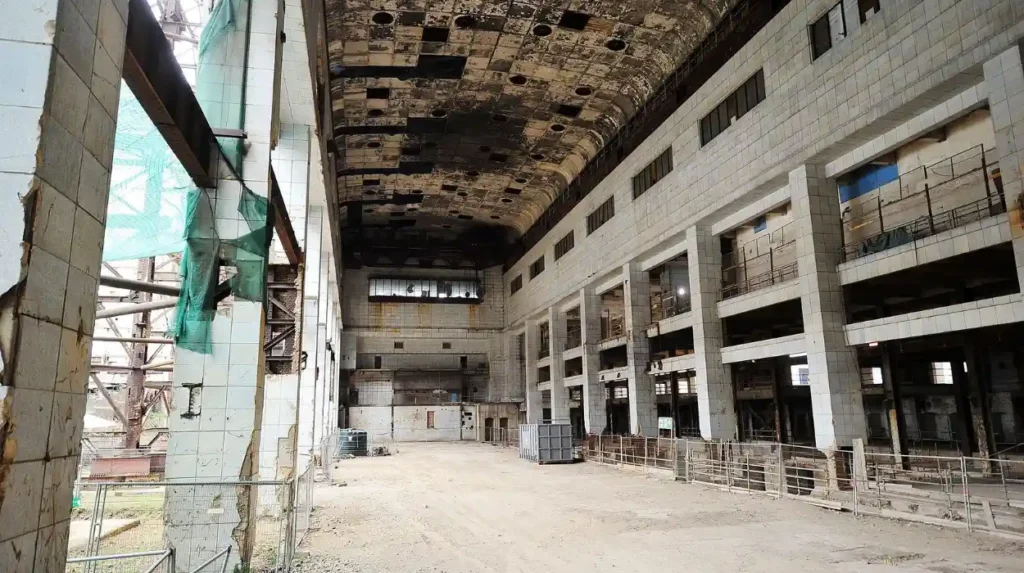
Despite legal protection, the station deteriorated significantly during the following decades. Roof sections collapsed. Rainwater damaged interiors. Structural corrosion weakened steel systems. The chimneys experienced serious concrete deterioration.
Several redevelopment proposals failed because restoration costs remained extremely high. Planned schemes included amusement parks, exhibition centres, shopping complexes, and entertainment districts. Financial instability repeatedly halted progress.
How did Battersea Power Station become a cultural icon during abandonment?
Battersea Power Station became a cultural icon during abandonment because its dramatic industrial appearance symbolised post-industrial Britain. The building appeared in music, cinema, photography, television, and urban heritage debates throughout the late twentieth century.
Even during decline, Battersea Power Station maintained strong visual and cultural influence. Its four chimneys remained visible across London and became associated with industrial heritage, urban decay, and architectural preservation.
One of the most famous cultural references appeared in 1977 when Pink Floyd used the station on the cover of their album Animals. The image featured a giant inflatable pig floating between the chimneys.
This album cover became internationally recognised and strengthened the building’s cultural identity beyond Britain. The station subsequently appeared in films, documentaries, advertisements, photography collections, and television productions.
Architectural photographers frequently documented the abandoned structure because of its monumental scale and deteriorating industrial interiors. Images of rusted machinery, collapsing roofs, and empty turbine halls became symbols of post-industrial urban transformation.
Preservation campaigns also increased public awareness regarding industrial heritage conservation. Historians argued that factories, docks, railway stations, and power plants represented important records of working-class history and technological development.
These debates influenced wider British heritage policy. Conservation organisations increasingly protected industrial sites during the late twentieth century, recognising their architectural and historical importance.
How was Battersea Power Station transformed into a modern visitor destination?
Battersea Power Station transformed into a visitor destination through a multibillion-pound regeneration programme restoring historic structures while introducing shopping, dining, entertainment, offices, housing, and public viewing attractions including Lift 109.
Major redevelopment accelerated after Malaysian investors acquired the site in 2012. The regeneration consortium collaborated with architects, engineers, conservation specialists, planners, and infrastructure developers.
Restoration required extensive structural stabilisation. Engineers repaired brickwork, replaced steel frameworks, reconstructed roofs, and rebuilt the chimneys using historically accurate designs matching original dimensions.
The redevelopment preserved important heritage spaces including turbine halls and control rooms. These interiors retained Art Deco elements while adapting for commercial and public use.
Retail areas occupy former industrial sections containing international brands, independent shops, technology companies, and lifestyle businesses. Restaurants, cafés, bakeries, and bars transformed previously inaccessible industrial spaces into active visitor environments.
Public access expanded significantly. Riverside walkways, plazas, event spaces, and landscaped areas created new pedestrian connections along the Thames.
Transport improvements also strengthened accessibility. The Northern line extension opened Battersea Power Station Underground station in 2021, connecting the district directly to central London transport networks.
Lift 109 became one of the redevelopment’s most distinctive attractions. Visitors begin inside restored control room spaces before ascending within one chimney using a glass elevator to an observation platform approximately 109 metres above ground.
The viewing platform offers panoramic perspectives across landmarks including The Shard, London Eye, St Paul’s Cathedral, and Wembley Stadium.
Today, Battersea Power Station functions as one of London’s most important examples of industrial heritage regeneration. The project preserved a globally recognised landmark while creating new economic, cultural, and tourism infrastructure for the twenty-first century.
Why it mattered industrially
Built in two phases between 1933 and 1955, the station supplied a major share of London’s electricity during the mid-twentieth century. Coal arrived via the River Thames and powered steam turbines that generated electricity for homes, factories, transport systems, and public services across the capital.