London’s historic pubs are among the capital’s most durable social institutions. Their surviving buildings connect modern streets with medieval inns, Tudor taverns, seventeenth-century rebuilding, Georgian commerce, Victorian urbanisation, and twentieth-century war damage. They also preserve evidence of changing patterns of work, travel, trade, literature, politics, architecture, and leisure.
- What makes a London pub historically significant?
- How did London’s medieval inns develop into public houses?
- Which London pubs are among the oldest surviving historic establishments?
- How did the Great Fire of London change historic pubs?
- How did coaching inns shape the social and economic history of London?
- How did London’s historic pubs become associated with writers and political events?
- How did Victorian London transform the traditional pub?
- How did war, redevelopment and modernisation affect London’s oldest pubs?
- Why do London’s oldest pubs still matter to cultural heritage today?
- How are London’s historic pubs preserved for future generations?
- What does the history of London’s oldest pubs reveal about the capital?
- Frequently Asked Question
The phrase “oldest pub in London” does not identify one universally accepted building. Different establishments use different definitions of age. A pub can claim an ancient site, a continuous licence, an early surviving structure, or a documented predecessor. Historic England identifies several London contenders, including the Prospect of Whitby, George Inn, Ye Olde Cheshire Cheese, Seven Stars, Ye Olde Mitre and Hoop and Grapes.
This distinction matters because many historic London pubs occupy sites used for hospitality before the present building existed. Fires, rebuilding, redevelopment and changes in licensing transformed their physical form while preserving their commercial or social identities. The Great Fire of London in 1666 destroyed large areas of the City, while the Southwark fire of 1676 affected buildings around Borough High Street. Historic pubs therefore preserve several different layers of London’s history rather than a single uninterrupted architectural period.
The City of London describes its historic pubs as places that survived fires, plagues, wars and modernisation while remaining connected with figures including Geoffrey Chaucer, William Shakespeare and Charles Dickens.
What makes a London pub historically significant?
A historic London pub combines documented age, surviving architecture, continuity of use, association with people or events, and evidence of past urban life. Significance therefore depends on several forms of heritage evidence rather than simply the date displayed on a pub sign.
A public house is an establishment licensed to sell alcoholic drinks for consumption on or near the premises. The modern pub developed from earlier inns, taverns, alehouses and drinking houses. These establishments served different functions. Inns provided accommodation and stabling for travellers. Taverns traditionally specialised in wine. Alehouses supplied locally brewed ale. Public houses later developed into more standardised licensed drinking establishments.
London’s location made hospitality businesses especially important. The medieval city contained merchants, craftsmen, religious institutions, markets, courts and river traffic. Roads entering London generated demand for accommodation and refreshment. Borough High Street formed a major route south of the Thames, while riverside districts supported workers involved in shipping and transport.
Historic significance also rests on architectural survival. A building with an early timber frame, cellar, courtyard, gallery, fireplace, staircase or internal fittings provides physical evidence that written records cannot supply. Historic England’s listing system recognises buildings for special architectural and historic interest and provides statutory protection for listed structures under the Planning (Listed Buildings and Conservation Areas) Act 1990.
London’s oldest pubs therefore function as historical documents. Their walls, plans, street positions and surviving fixtures record how commercial premises adapted to successive generations.
How did London’s medieval inns develop into public houses?
Medieval London inns developed around travel, trade, pilgrimage, markets and river transport, providing accommodation, food, drink, stabling and meeting space. Their functions established the commercial foundations from which later taverns, alehouses and public houses evolved across the capital.
Medieval London depended on movement. Merchants arrived through city gates, travellers used roads leading toward Southwark and Westminster, and river transport connected communities along the Thames. Inns supplied practical services to this mobile population.
The distinction between an inn and a later pub is important. An inn was fundamentally associated with travellers and accommodation. It commonly contained bedrooms, kitchens, storage areas, yards and stables. Drinking was one component of a broader commercial operation.
Taverns developed within the urban economy as places for wine consumption and social interaction. Alehouses became particularly important because ale was an everyday drink and brewing occurred on a local scale. Over time, these categories overlapped.
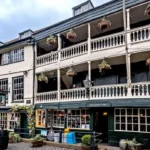
Borough High Street provides one of the clearest surviving examples of this development. The National Trust records an inn on the site of the George Inn by 1542, with evidence suggesting an earlier medieval predecessor. The present George Inn dates from 1677 and preserves the form of a galleried coaching inn.
The George’s galleries were practical architectural features. Upper-level galleries provided access to rooms overlooking the central courtyard. The courtyard served circulation and commercial functions within the inn complex. The surviving structure therefore demonstrates how hospitality architecture responded to travellers before modern hotels and railways transformed long-distance movement.
Which London pubs are among the oldest surviving historic establishments?
London’s principal historic pub contenders include the Prospect of Whitby, Spaniards Inn, George Inn, Seven Stars, Mayflower, Ye Olde Cheshire Cheese, Hoop and Grapes and Ye Olde Mitre, each representing different evidence for age, continuity, architecture or historical association.
The Prospect of Whitby in Wapping is associated with a site dating to around 1520. London Museum records that it was known as the Devil’s Tavern until 1777 and became associated with river thieves, smugglers and Samuel Pepys. Its original flagstone floor survives as part of its historic character.
The Spaniards Inn in Hampstead is a Grade II-listed sixteenth-century pub. London Museum records its connection with the Gordon Riots of 1780, when rioters stopped there during disturbances directed against Roman Catholics. The establishment also entered literary history through Charles Dickens’s The Pickwick Papers.
The George Inn in Southwark is the last surviving galleried coaching inn in London. The National Trust records its present building as dating from 1677, following destruction of the earlier inn during the Southwark fire of 1676.
The Seven Stars in Holborn is another important survivor. London Museum states that the pub was built in 1602 according to its signboard and has been remodelled several times. Its survival is significant because it represents a pre-Great Fire establishment within central London.
The Mayflower in Rotherhithe has origins around 1550. It was rebuilt after a fire in 1834 and damaged during the Second World War. The pub was renamed the Mayflower in 1957 in reference to the ship associated with the 1620 voyage to North America.
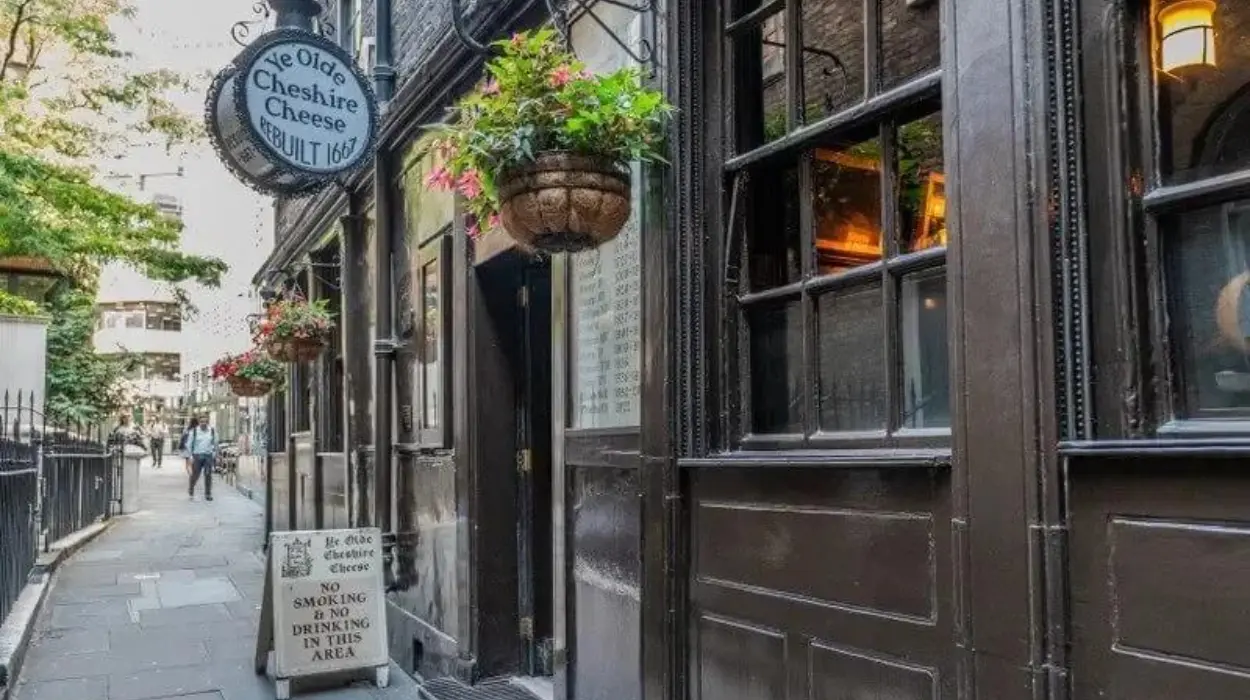
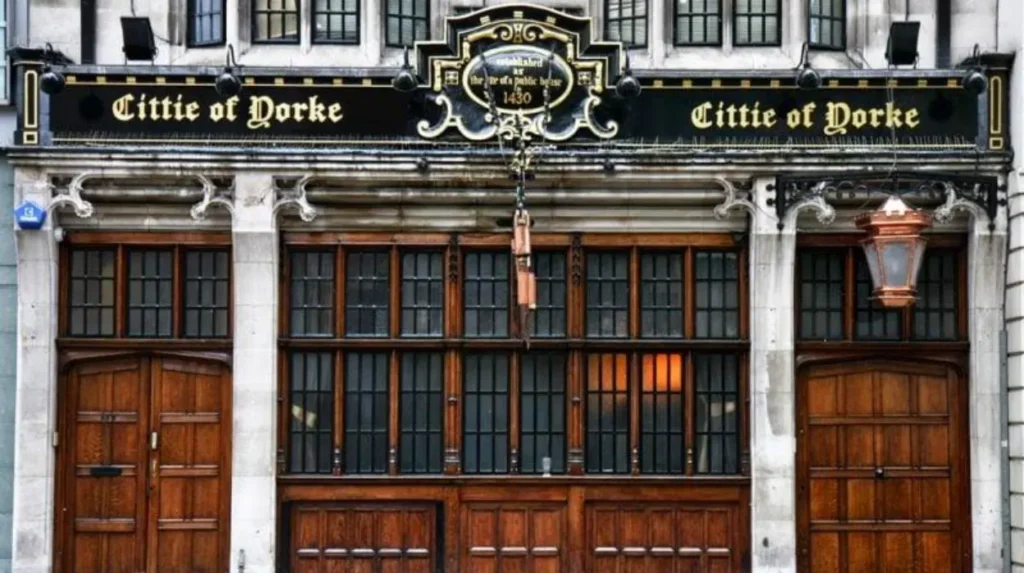
Ye Olde Cheshire Cheese on Fleet Street represents another form of continuity. The site had a pub from medieval times, while the present building dates largely from the period after the Great Fire. The building was rebuilt around 1667. Historic England records the surviving structure as late seventeenth century with later alterations.
The Hoop and Grapes in Aldgate claims a particularly early licensed-house history. London Museum records that its building probably dates from the seventeenth century and that wine merchants operated the establishment throughout the nineteenth century. It also survived the Great Fire, with restoration work preserving its distorted timber frame.
Ye Olde Mitre in Ely Place provides another example of a historic pub embedded within an unusual institutional landscape. The City of London records that it was originally licensed to the Bishop of Ely and remains accessible through a narrow passageway near Hatton Garden.
These establishments demonstrate why the term “oldest” requires careful definition. A building date, a documented pub date and the age of a site are separate historical measurements.
How did the Great Fire of London change historic pubs?
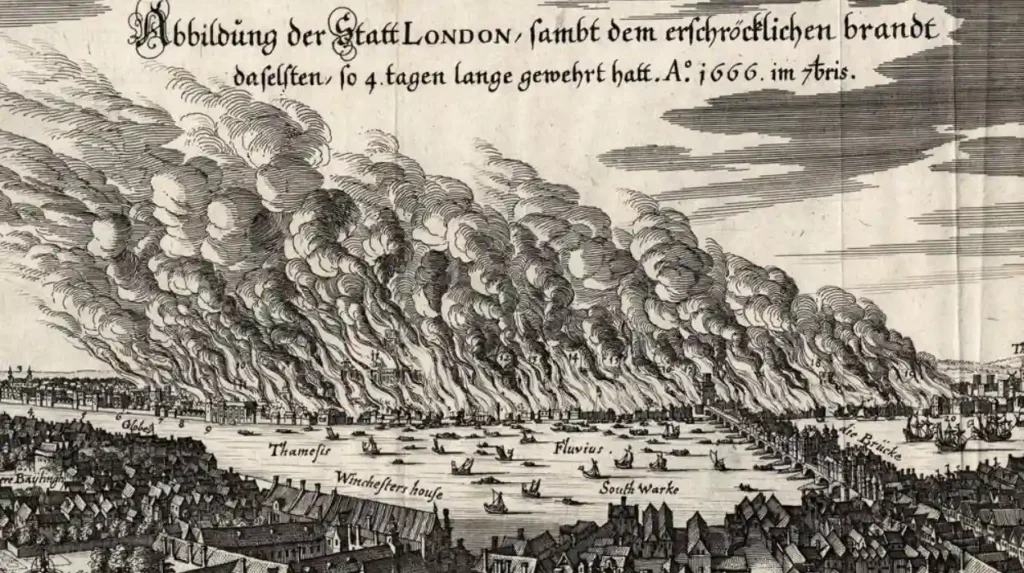
The Great Fire of London in September 1666 destroyed much of the medieval City and forced widespread rebuilding, replacing numerous timber structures with brick buildings. Historic pubs that survived or reopened after the disaster preserve evidence of this decisive transformation in London’s urban landscape.
The Great Fire began on 2 September 1666 in Pudding Lane and continued for several days. Large sections of the City of London were destroyed. The disaster changed building practices, street planning and construction materials.
Ye Olde Cheshire Cheese illustrates the rebuilding process. The earlier pub was destroyed in the fire, and the present establishment was rebuilt around 1667. Historic England identifies its structure as late seventeenth century, with later eighteenth- and nineteenth-century alterations.
The rebuilding of London introduced stronger restrictions on combustible construction. Brick became increasingly important, while timber framing continued in surviving and rebuilt structures outside the areas most comprehensively reconstructed.
The Seven Stars in Holborn provides a different example because it survived outside the main destructive path. London Museum identifies it as a rare central London survivor from before the Great Fire.
The survival of these buildings gives historians a physical comparison between pre-Fire and post-Fire London. A surviving timber frame records earlier construction traditions. A rebuilt brick frontage reflects the regulatory and architectural environment that followed the catastrophe.
The Great Fire therefore created a chronological dividing line in London’s architectural history. Historic pubs located on either side of that boundary help explain the scale of urban transformation.
How did coaching inns shape the social and economic history of London?
Coaching inns connected London with regional transport networks by providing accommodation, food, drink, stabling and passenger services. Their courtyards and galleries supported travellers, carriers, merchants and workers before railways transformed long-distance transportation during the nineteenth century.
Coaching inns expanded as road travel intensified between London and other towns. Coaches required stopping places where passengers could eat, rest and change horses. Inns therefore became transport centres as well as drinking establishments.
The George Inn is the clearest surviving London example. The National Trust identifies it as the only remaining galleried inn in London and records its present building as a timber-framed and brick structure dating from 1677.
Its courtyard arrangement reflects the operational requirements of coaching accommodation. Rooms were arranged around an open central space, while galleries provided circulation between accommodation areas. The architecture supported a large commercial establishment rather than a simple neighbourhood drinking house.
Coaching inns also connected London’s social classes. Travellers, merchants, servants, coach operators and local residents used the same establishments for different purposes. Inns became points where information circulated between London and other parts of Britain.
The rise of the railway during the nineteenth century reduced the importance of long-distance coaching. Stations replaced many coaching routes, while hotels, railway refreshment rooms and other modern forms of accommodation developed around transport infrastructure.
Historic coaching inns therefore preserve an earlier transport economy. Their architecture records a period when road travel structured commercial life and urban hospitality.
How did London’s historic pubs become associated with writers and political events?
London pubs became important cultural locations because writers, workers, journalists, politicians, travellers and local communities used them as social spaces. Literary references and documented political events transformed individual pubs into recognisable landmarks within London’s cultural history.
Fleet Street provides an important example of the relationship between pubs and literary culture. Ye Olde Cheshire Cheese stands within an area historically associated with printing, newspapers, publishing and writers. The City of London identifies the pub as a long-standing literary institution connected with figures including Charles Dickens, G. K. Chesterton and Mark Twain.
Visit London records associations between Ye Olde Cheshire Cheese and writers including Dickens, Oliver Goldsmith and Dr Samuel Johnson. Dr Johnson’s chair remains identified within the pub.
The George Inn also has a literary association with Charles Dickens. Visit London records that Dickens mentioned the establishment in Little Dorrit and was associated with the inn when it operated as a coffee house.
Political history also entered pub spaces. The Spaniards Inn became involved in the Gordon Riots of 1780. According to London Museum, rioters stopped there during the disturbances, while the landlord supplied drinks until soldiers arrived and disarmed them.
The Prospect of Whitby reflects the connection between pubs and the Thames economy. Its historical associations include river workers, smugglers and Samuel Pepys. Its location beside the river placed it within a working landscape of wharves, barges, watermen and maritime trade.
These examples show that historic pubs were not isolated drinking venues. They occupied locations where commercial, cultural and political activity already concentrated.
How did Victorian London transform the traditional pub?
Victorian London transformed pubs through population growth, industrialisation, licensing changes, improved transport and new architectural standards. The period produced larger and more elaborate public houses while older establishments adapted their interiors, services and commercial identities to changing urban demand.
London expanded dramatically during the nineteenth century. Industrial employment, railway construction, migration and suburban development increased the capital’s population and created new neighbourhoods.
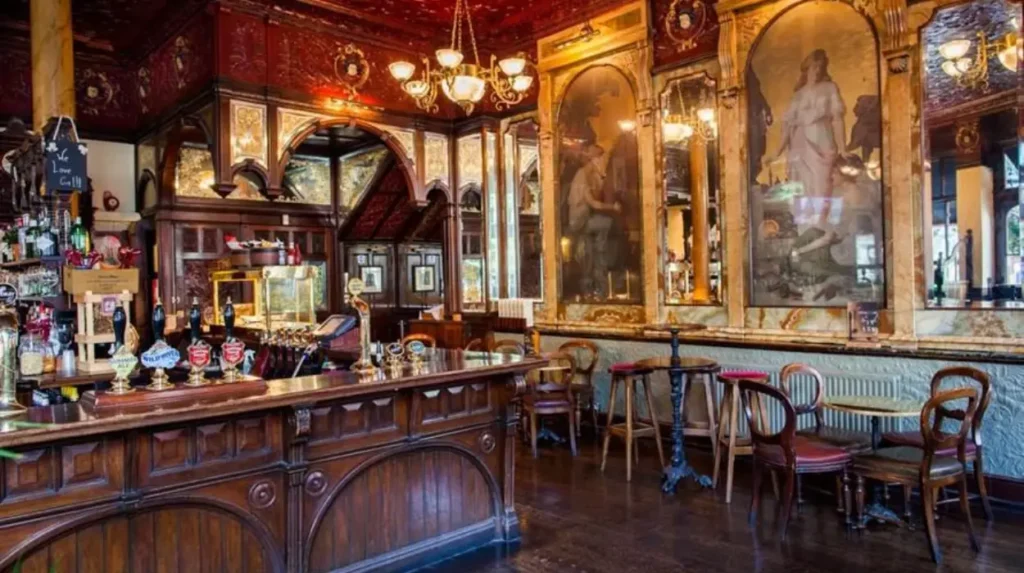
The pub became an important commercial institution within this expanding city. Breweries developed large distribution networks, while public houses increasingly displayed distinctive architectural identities. Victorian pubs frequently included polished woodwork, decorative glazing, tiled surfaces, private rooms and prominent exterior signage.
Older establishments also changed. Historic buildings were remodelled to accommodate changing expectations and commercial requirements. Ye Olde Cheshire Cheese, for example, contains a late seventeenth-century core alongside eighteenth- and nineteenth-century alterations. Historic England records its yellow-brick Fleet Street frontage as probably late eighteenth century and remodelled and heightened in the nineteenth century.
The Victorian period also changed the relationship between the pub and the surrounding street. Improved lighting, public transport and commercial development increased foot traffic. Pubs near markets, offices, docks and railway stations developed specialised customer bases.
The nineteenth century therefore did not simply preserve historic pubs. It actively reshaped them. Many surviving establishments contain multiple architectural periods because each generation modified older premises rather than maintaining a completely unchanged interior.
How did war, redevelopment and modernisation affect London’s oldest pubs?
London’s historic pubs survived through cycles of fire, bombing, redevelopment, changing transport systems and commercial restructuring. Some buildings retained historic fabric, while others survived through reconstruction, restoration or adaptation that preserved their identities within radically altered neighbourhoods.
The twentieth century brought significant threats to historic pubs. Two world wars caused physical destruction across London. Commercial redevelopment altered streets and demolished older buildings. Changes in transport reduced the importance of some historic routes, while new licensing and consumer patterns changed pub operations.
The Mayflower in Rotherhithe illustrates the effects of both fire and wartime damage. London Museum records its destruction by fire in 1834 and subsequent bomb damage during the Second World War.
The Prospect of Whitby also demonstrates how industrial landscapes changed around historic establishments. London Museum’s collection records a 1930s view of the pub surrounded by the working Thames environment of barges and lighters. Those maritime activities have since disappeared from the immediate landscape.
The preservation of historic pubs became increasingly connected with formal heritage protection. Listed-building designation identifies structures with special architectural or historic interest. Ye Olde Cheshire Cheese received Grade II listing in 1977, giving statutory recognition to its heritage significance.
Historic England now maintains a dedicated programme for historic pubs and highlights the importance of preserving listed public houses. Its research covers architectural character, cultural history and strategies for protecting pubs at risk.
The survival of a historic pub therefore depends on more than age. It depends on continued use, maintenance, legal protection, appropriate adaptation and recognition of heritage value.
Why do London’s oldest pubs still matter to cultural heritage today?
London’s oldest pubs matter because they preserve architectural fabric, transport history, commercial traditions, literary associations and evidence of everyday social life. Their continued existence connects present-day London with earlier communities and provides tangible resources for heritage education and research.
Historic pubs provide evidence that is accessible within the living city. A listed building can preserve construction techniques, spatial arrangements and decorative features while continuing to operate as a commercial premises.
Their locations also retain historical meaning. The George Inn remains on Borough High Street, a route with centuries of transport and commercial significance. Ye Olde Cheshire Cheese remains on Fleet Street, an area strongly associated with publishing and journalism. The Prospect of Whitby remains beside the Thames in Wapping, linking the present neighbourhood with London’s maritime past.
The cultural legacy also extends beyond architecture. Historic pubs appear in literature, guidebooks, paintings, photographs, oral histories and museum collections. London Museum’s records preserve photographs and objects connected with establishments including the Prospect of Whitby and Seven Stars.
For educators, these establishments provide compact case studies in urban history. Students can examine the relationship between architecture and transport, heritage and economic change, or literary culture and commercial spaces.
For genealogical researchers, pub records can provide contextual evidence about occupations, neighbourhoods and community networks. Licensing records, directories, maps and newspapers help establish the social environment in which earlier London residents lived and worked.
For visitors, the historic pub functions as a surviving part of the city rather than a museum object. To experience this historic heritage in person today, consult our comprehensive [Best Historic Pubs to Visit in London for Traditional Food, Drinks, and Atmosphere] for itineraries and visiting parameters.
How are London’s historic pubs preserved for future generations?
Preserving historic pubs requires continued maintenance, appropriate adaptation, heritage designation, documentary research and community recognition. Successful conservation retains significant architectural features while allowing historic premises to remain economically viable and socially useful within contemporary London.
Historic England’s historic-pub programme demonstrates the importance of systematic documentation. Listed-building records identify architectural features, construction periods, alterations and reasons for designation. Such records establish a formal evidence base for conservation decisions.
The George Inn demonstrates the value of combining active use with heritage stewardship. The National Trust owns the Grade I-listed property, while the building continues to operate as a public house. Its surviving galleries, timber structure and courtyard preserve architectural evidence associated with coaching inns.
Ye Olde Cheshire Cheese provides another preservation example. Its Grade II designation recognises the building’s architectural and historical importance. The official record identifies its late seventeenth-century core, later brickwork, cellar and surviving interior fittings.
Preservation also requires accurate interpretation. Claims about extreme age often combine documentary evidence, local tradition and later reconstruction. Separating these categories improves historical accuracy. A site can possess medieval origins while the current building dates from a later century.
This distinction is essential for researchers and educators. It prevents the repetition of unsupported claims and clarifies what survives physically, what survives through documentation and what survives as tradition.
The future historical value of London’s oldest pubs depends on retaining this evidence. Their importance lies not simply in being old buildings. They are records of how London travelled, traded, worked, drank, wrote, governed, rebuilt and adapted across centuries.
What does the history of London’s oldest pubs reveal about the capital?
The history of London’s oldest pubs reveals how hospitality evolved alongside transport, trade, architecture, literature, politics and urban growth. Their surviving buildings demonstrate that ordinary commercial spaces can preserve substantial evidence about London’s long-term social and cultural development.
The oldest historic pubs are products of particular urban conditions. Inns developed beside major routes. Riverside establishments served maritime communities. City taverns operated near markets, courts and commercial districts. Literary associations emerged where writers and publishers worked. Coaching inns expanded with road transport and declined as railways transformed travel.
Their buildings preserve these changes. The George Inn records coaching-era architecture. The Prospect of Whitby records the history of the Thames waterfront. Ye Olde Cheshire Cheese records post-Great Fire rebuilding and Fleet Street’s literary environment. The Seven Stars records survival from before 1666. The Spaniards Inn connects a sixteenth-century building with eighteenth-century political unrest and nineteenth-century literature. The Mayflower demonstrates repeated rebuilding and twentieth-century wartime damage.
No single establishment represents the entire history of London’s pubs. Together, these buildings form a distributed historical archive.
Their endurance also demonstrates the importance of adaptive reuse. Historic premises remain economically useful because their functions have evolved without completely erasing their physical identity. Conservation therefore works most effectively when heritage protection and continued practical use support each other.
London’s historic pubs remain valuable because they preserve evidence of everyday life alongside major historical events. They connect architectural history with social history and local geography with national change.
The continuing presence of these establishments ensures that London’s history remains embedded within its working streets. Their cultural legacy is therefore not confined to the past. It survives through buildings, records, literature, heritage protection, education and continued public use.
Frequently Asked Question
What is the oldest pub in London?
There is no universally accepted single “oldest pub in London.” Claims depend on whether age refers to the site, the first documented pub, continuous operation, or the surviving building. Historic contenders include the Prospect of Whitby, Seven Stars, George Inn, Spaniards Inn and Ye Olde Mitre.