Key Points
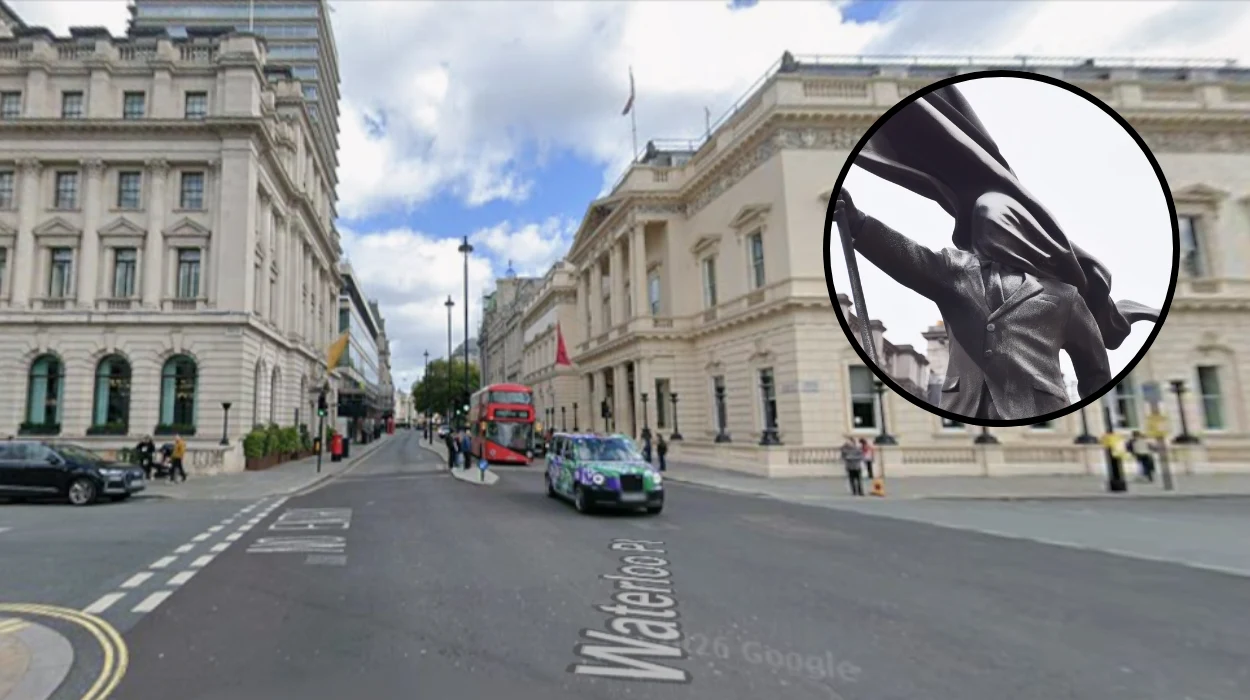
- A large new statue has appeared on a plinth in Waterloo Place, central London, depicting a suited man marching off a pedestal while holding a flag that obscures his face.
- The name “Banksy” has been scrawled on the base of the sculpture, sparking speculation that the elusive street‑art artist is behind it.
- Banksy has not yet officially confirmed whether the statue is his work, and no statement has appeared on his website or social‑media channels as of the latest reports.
- The piece is located in the St James’s area of Westminster, near existing monuments to Edward VII, Florence Nightingale and the Crimean War Memorial, about 450 metres from Downing Street.
- The statue is being interpreted by many observers as a satirical or political comment on nationalism, patriotism and the way flags can blind or obscure individual identity.
- If authentic, the work would add to Banksy’s small but notable body of sculptural or three‑dimensional installations, including the earlier piece “The Drinker”, which was placed on Shaftesbury Avenue in 2004.
- The last confirmed Banksy artwork in London was a pair of murals in December 2025 depicting children lying on the ground and gazing at the sky, one of which was claimed by the artist and widely read as a comment on homelessness.
- The statue is attracting crowds and debate in the capital, with members of the public and commentators weighing in on whether it should be allowed to remain or be removed as a temporary intervention.
London (Extra London News) April 30, 2026 – A large, enigmatic statue of a man marching forward with his face obscured by a flag has appeared on a plinth in Waterloo Place in central London, bearing what appears to be the signature of the anonymous street‑art artist Banksy, though the artist has not yet confirmed involvement. Eyewitnesses and local media first reported the sculpture early on Wednesday, noting that the figure, cast in a realistic suit and trench‑coat style, strides off the edge of the plinth while hoisting a billowing flag that covers his head, creating a striking image of a citizen seemingly blinded by the very symbol he carries.
- Key Points
- What does the statue depict?
- Where exactly is the statue located?
- Is this actually a Banksy?
- How does this compare to Banksy’s past sculptures?
- What has Banksy done in London recently?
- Why is the statue being interpreted as political?
- How are authorities responding?
- What are people saying on the street?
- How might this end up in the city’s permanent landscape?
Art historians and commentators say the composition echoes Banksy’s long‑standing habit of using simple, figurative imagery to critique nationalism, militarism and unquestioning loyalty to state symbols.
At the same time, Westminster Council and other authorities have not yet issued formal guidance on the statue’s legal status, leaving open the question of whether it will be treated as a temporary public‑art installation or as an unauthorised intervention that could be removed.
Amid the uncertainty, the work has already begun drawing lines of tourists and protesters, with some treating it as a focal point for conversations about identity, propaganda and the role of flags in modern politics.
What does the statue depict?
The sculpture, installed overnight on or shortly before April 29, stands on a raised plinth in Waterloo Place in the St James’s district of Westminster, close to the Admiralty Arch and within sight of Whitehall and Downing Street.
As reported by Euronews’ art and culture correspondent, the piece shows “a man walking off the end of a plinth, holding a flag pole with the fabric covering his face,” a detail that has quickly become the visual signature of the intervention.
The figure is dressed in a dark suit and light‑coloured shirt, with shoes and a coat that suggest an ordinary, contemporary male citizen rather than a historical or military figure.
On the front base of the plinth, the name “Banksy” has been roughly scrawled in what observers describe as a hand‑drawn, graffiti‑like script, closely resembling the style the artist has used on earlier works. That mark has been enough to trigger widespread speculation that the piece is part of Banksy’s ongoing commentary on power and patriotism, even in the absence of an official confirmation, several commentators have noted.
Where exactly is the statue located?
According to the BBC’s London correspondent, the statue is sited in Waterloo Place, “in the heart of central London,” about 450 metres from 10 Downing Street and within the St James’s neighbourhood of Westminster.
The location places it near long‑standing monuments, including the equestrian statue of Edward VII at the nearby Memorial Gardens, a statue of Florence Nightingale and the Crimean War Memorial, all of which have been photographed alongside the new sculpture in social‑media posts and news images.
Londonist’s arts writer has described Waterloo Place as “a kind of informal gallery of imperial and Victorian statuary,” arguing that Banksy, if indeed responsible, has chosen a site already saturated with official national imagery to insert a more subversive, contemporary figure.
This proximity to monuments linked to Britain’s imperial past and military history has led some observers to suggest that the “blinded by the flag” theme is directed not only at generic patriotism but at the specific ways in which national symbols are used to justify foreign interventions and domestic policies.
Is this actually a Banksy?
At the time of publication, Banksy has not posted any verification on his official website or verified Instagram account to confirm that the Waterloo Place statue is his creation, a point underlined by The Guardian’s art and design reporter.
The same writer notes that the artist
“has yet to verify if this piece is indeed his creation,”
adding that the pattern in recent years has been for Banksy to acknowledge new works online within hours or days of their appearance in public.
Nevertheless, several outlets have reported that, aside from the name written on the base, the style and satirical thrust of the sculpture closely resemble motifs and treatments seen in earlier Banksy projects. Channel NewsAsia’s culture correspondent observes that “the potential new work” sits in a “political and spatial conversation” with nearby monuments, and that the “blinded‑by‑the‑flag” motif is in keeping with Banksy’s use of flags and national symbols in other stencils and installations.
Art historian Dr Emma Thorne, speaking to The Independent, said that the figure’s posture—“striding forward but with his vision blocked by the flag”—recalls earlier Banksy images in which children or soldiers are shown carrying oversized national symbols that dominate their bodies and field of view. However, without an official confirmation, she cautions that the attribution “remains speculative” and that the signature on the base
“could be emulation or homage as much as a real author mark.”
How does this compare to Banksy’s past sculptures?
If the statue is confirmed as a Banksy, it would join a small but significant group of three‑dimensional works the artist has produced in London.
As reported by The Guardian’s art and design desk, one of the most famous precedents is “The Drinker,” a bronze‑cast figure resembling Auguste Rodin’s “The Thinker” that was installed on Shaftesbury Avenue in 2004 and removed within days by authorities who treated it as an unauthorised public‑art piece rather than a sanctioned monument.
The Telegraph’s art critic has noted that just as “The Drinker” used a classical pose to mock the pomp of traditional statuary, the Waterloo Place piece reworks the “marching patriot” trope long associated with public monuments, turning the proud forward stride into a gesture of self‑obscuration.
Other commentators have pointed to Banksy’s penchant for temporary installations—such as the inflatable “Dismaland” barge in 2015 or the dismantled “Dismaland”‑style funhouse in Weston‑super‑Mare—as evidence that the artist may be treating this statue as a short‑term intervention rather than a permanent addition to the cityscape.
What has Banksy done in London recently?
Banksy’s most recent confirmed intervention in London took place in December 2025, when he claimed responsibility for a mural depicting
“two children lying on the ground and gazing at the sky,”
as reported by the BBC and The Guardian.
The piece, which appeared on a wall near Queen’s Mews in Bayswater, was later said to parody the “star‑gazing” theme of Christmas‑time hope, but was widely interpreted by observers as a comment on childhood poverty and homelessness given its placement in a city with a deep housing crisis.
An identical image was also noticed earlier near the Centre Point tower in central London, a location associated with long‑running housing‑protest movements and debates over luxury developments in the capital.
Although Banksy’s representatives only formally acknowledged the Queen’s Mews version, many viewers linked the Centre Point variant to the same campaign, suggesting that the artist was using replication as a way to amplify the message.
Why is the statue being interpreted as political?
Several commentators have interpreted the Waterloo Place statue as a critique of blind nationalism and the way flags are used to obscure political scrutiny. As noted by Euronews’ culture editor,
“if the statue is a new Banksy, it is in keeping with the elusive artist’s politically‑charged works,”
which have previously targeted militarism, surveillance and the commodification of protest. The image of a man “blinded by the flag” has been described by on‑site observers as a visual metaphor for citizens who rally behind national symbols without fully seeing the consequences of the policies or wars those symbols represent.
Caroline White, a political‑commentary writer for The Independent, told readers that the placement “just down the road from the seat of government” suggests a direct address to policymakers and the wider public about the risks of uncritical patriotism.
Some social‑media users have also compared the statue to scenes from films and photographs in which soldiers or protesters carry flags that obscure their faces, linking the work to contemporary debates about protest policing, identity and the masking of dissent.
How are authorities responding?
As of April 30, neither Westminster City Council nor the Mayor of London’s office has issued a formal statement declaring the statue illegal or announcing plans for its removal, according to a BBC News briefing. However, officials have begun inspecting the structural integrity of the plinth and the methods used to install the sculpture, in line with standard safety‑assessment procedures for any new object placed in a high‑traffic pedestrian area of central London.
The Spectator’s arts correspondent has reported that council sources say they are
“awaiting guidance from the artist or those who may have commissioned the work,”
reflecting the ambiguity that arises when Banksy’s pieces appear without clear authorisation or signage. In past cases, similar interventions have been removed within days unless a private owner or gallery has stepped in to defend them as legitimate art, raising questions about the legal status of the current statue in the absence of any such claim.
What are people saying on the street?
Local residents and visitors interviewed by The Sun’s news reporters on Wednesday described a mix of amusement, curiosity and unease when encountering the piece for the first time. One commuter told the paper that the statue felt “like a joke aimed at politicians who wave flags but never look at what’s really happening,” while another suggested it was “a warning about fake patriotism.”
At the same time, several social‑media posts from people standing near the statue have framed it as a selfie hotspot, with some accounts treating it less as a political statement than as a novelty to photograph and share online. Street‑art bloggers have noted that this dual reaction—serious political reading versus lighthearted tourism—is consistent with Banksy’s broader reception, where the same images can be celebrated as activism by some and dismissed as marketing‑driven spectacle by others.
How might this end up in the city’s permanent landscape?
In an op‑ed for The Guardian, urban‑planning writer Samira Khan argued that if Banksy confirms the statue and it is not removed within a short window, it could become a semi‑permanent fixture in London’s public‑art ecology, much as earlier, unauthorised works were later protected or re‑housed by collectors and institutions. She points out that the very fact that the piece is “in conversation with” older monuments already installed in Waterloo Place may encourage authorities or private patrons to treat it as part of an evolving civic dialogue rather than a one‑off prank.
Conversely, heritage‑protection groups have sounded caution, warning that the insertion of an unauthorised statue into a historically sensitive area could set a precedent that complicates future planning decisions. The Wolverhampton Art Gallery’s former director, speaking to a regional newspaper, said that while Banksy’s work has “often pushed the boundaries of public‑art norms,” this case presents a particular challenge because it directly intervenes in a zone already crowded with official memorials.