The British Museum in London is one of the world’s most visited museums, and among its most famous objects are the Rosetta Stone and a large collection of ancient Egyptian mummies. Extra London News offers this guide to help an international audience plan a confident, efficient visit that covers these highlights in depth, while understanding their historical and cultural context.
- The British Museum Essentials: How to See the Rosetta Stone and Mummies
- What is the British Museum and why is it significant?
- What is the Rosetta Stone and why is it important?
- Where is the Rosetta Stone located in the museum?
- What should you know before visiting the British Museum?
- How do you see the Rosetta Stone without wasting time?
- What are Egyptian mummies and how are they displayed in the museum?
- Where are the mummies located and how do you get there?
- How should you plan a visit that includes both the Rosetta Stone and mummies?
- What are key historical and cultural insights from the Rosetta Stone and mummies?
- What are practical visitor tips for comfort and efficiency?
- How does visiting the Rosetta Stone and mummies fit into London tourism?
The British Museum Essentials: How to See the Rosetta Stone and Mummies
The British Museum in London houses over 8 million objects, spanning more than 2 million years of human history. For many visitors, the core of a visit revolves around the Rosetta Stone and the Egyptian mummies, which represent key anchors for understanding ancient Egypt, language decipherment, and burial belief systems. Extra London News provides a structured, practical, and historically grounded walkthrough of how to find and interpret these objects, what to know before you go, and how to use your time wisely.
What is the British Museum and why is it significant?
The British Museum is a national museum of human history, art, and culture located in the Bloomsbury area of London, at Great Russell Street, WC1B 3DG. It opened in 1759 and operates as a public institution under the British Museum Act 1963, with free general admission funded in part by the UK government and philanthropy. The museum’s collection spans artifacts from six continents, including significant holdings from ancient Egypt, Greece, Mesopotamia, the Indus Valley, and the Americas, making it one of the largest and most comprehensive collections of antiquities in the world.
The museum’s significance lies not only in the size of its holdings but also in its role in shaping modern archaeology and museology. Many of its Egyptian, Greek, and Near Eastern objects were acquired during the 19th century, when British expeditions and collectors systematically documented and transported material from sites such as Thebes, Nineveh, and the Acropolis. Today the museum balances this colonial‑era legacy with contemporary debates over restitution, public access, and digital outreach, positioning it as both a repository of the past and a forum for ongoing cultural dialogue.
What is the Rosetta Stone and why is it important?
The Rosetta Stone is a granodiorite stele fragment inscribed with a decree issued in 196 BCE on behalf of King Ptolemy V Epiphanes of the Ptolemaic dynasty in Egypt. The text repeats the same message in three scripts: Ancient Greek, Demotic (a cursive Egyptian script of the later period), and Egyptian hieroglyphs. The object became the critical key for modern scholars to decipher Egyptian hieroglyphic writing, which had been functionally unreadable for more than a thousand years before the 19th century.
The stone was discovered in July 1799 by a group of French soldiers near the town of Rosetta (modern‑day Rashid) in the Nile Delta, during Napoleon’s Egyptian campaign. After the British defeated the French in Egypt, the stone was transferred to British possession under the terms of the Treaty of Alexandria in 1801 and has been held by the British Museum since 1802. Scholars such as Thomas Young and Jean‑François Champollion used parallel passages in Greek and Demotic to progressively unlock the signs of hieroglyphs; by 1822, Champollion’s work established the core of the phonetic system, effectively opening up the entire corpus of ancient Egyptian religious, literary, and administrative texts.
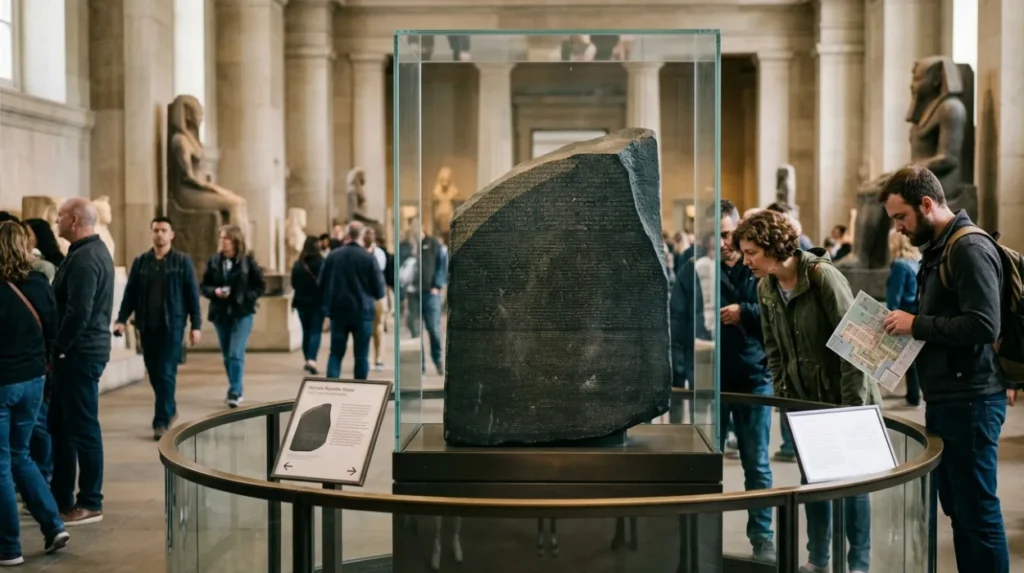
In the British Museum, the Rosetta Stone is part of the Egyptian Sculpture Gallery (Room 4) and is often described as one of the museum’s most popular single objects, regularly cited in visitor‑flow studies and in‑house guides as a primary draw for first‑time visitors. Its importance extends beyond Egyptology into the broader history of linguistics, code‑breaking, and cross‑cultural communication, which is why it receives extended interpretive treatment in both printed and digital museum materials.
Where is the Rosetta Stone located in the museum?
The Rosetta Stone is located in the Egyptian Sculpture Gallery on the ground floor of the British Museum, specifically in Room 4. Visitors reach Room 4 by entering through the main Bloomsbury entrance, passing through the Great Court, and then following directional signage for Egyptian Sculpture or the Rosetta Stone. The museum provides a printed floorplan at orientation desks and a digital map on its official website, which marks Room 4 with a clear label for the Rosetta Stone and other major Egyptian pieces, including the colossal statue of Ramesses II.
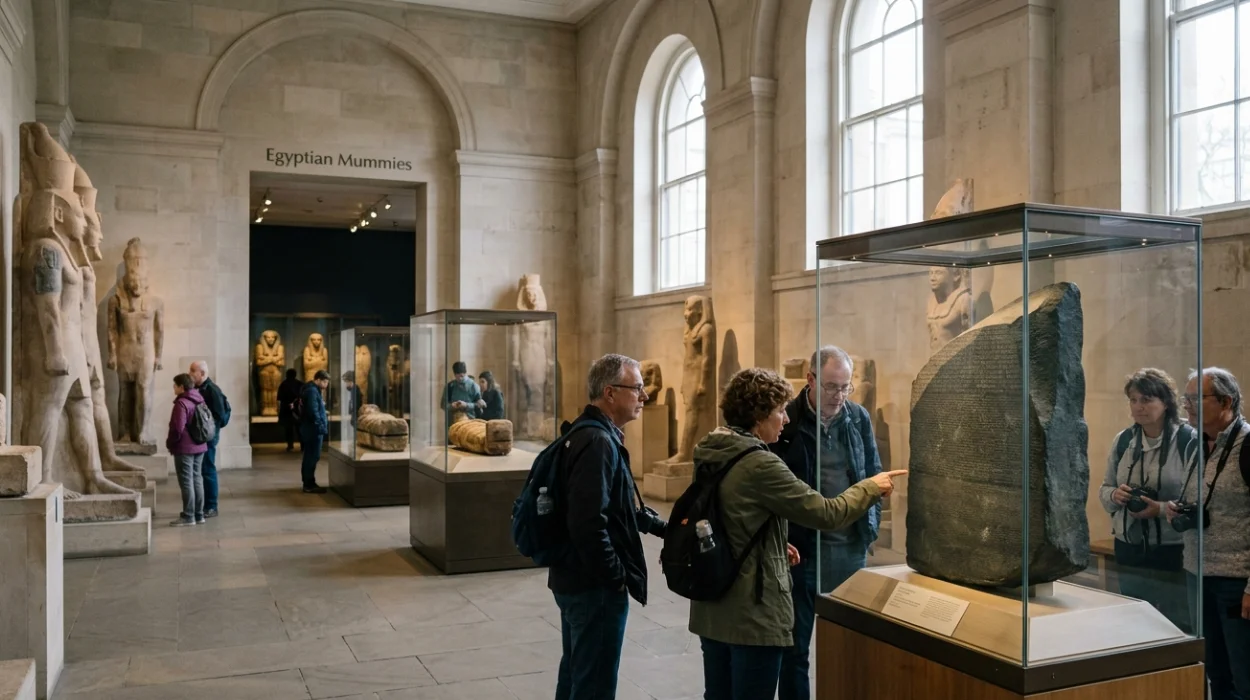
Because the stone is a high‑traffic object, the museum typically surrounds it with a low barrier and directional arrows to manage crowd flow and prevent physical contact with the surface. A replica of the Rosetta Stone is also available in the Enlightenment Gallery (Room 1), where tactile visitors can touch a three‑dimensional version of the object, which is useful for visually impaired guests or those who prefer a hands‑on experience. Room 4 itself is relatively compact and well lit, with interpretive panels explaining the content of the decree, the mechanics of hieroglyphic reading, and the role of the stone in the history of decipherment.
For visitors planning a focused route, the British Museum’s “One Hour at the Museum” self‑guided trail explicitly lists the Rosetta Stone as the first major stop, signaling both its iconic status and its convenient location near the main entrance axis. This positioning allows even time‑constrained visitors to incorporate a meaningful visit to the stone into a short itinerary.
What should you know before visiting the British Museum?
Before visiting the British Museum, visitors should note that general admission is free, but certain special exhibitions and events operate on a timed‑ticket basis. The museum is open daily, with core hours typically from 10:00 to 17:00, though some evening openings extend closing to 20:30 on selected days. Security checks are conducted at the main entrance and at other access points, and large bags are often subject to inspection; small backpacks and hand luggage are permitted, but visitors should allow extra time during peak hours, especially in summer months.
The British Museum recommends that visitors plan their route in advance, using the official online map and object‑search tools, which list over 4 million items by gallery and object number. For those interested in the Rosetta Stone and Egyptian mummies specifically, the museum’s digital “Egyptian, Assyrian and Sudanese” object search and “Egyptian death and afterlife: mummies” gallery guide provide curated lists of works, short descriptions, and suggested itineraries. These resources help orient visitors to the key rooms—Room 4 for the Rosetta Stone, Room 62–63 for mummies and funerary objects, and related galleries that cover New Kingdom sculpture, temple reliefs, and mortuary equipment.
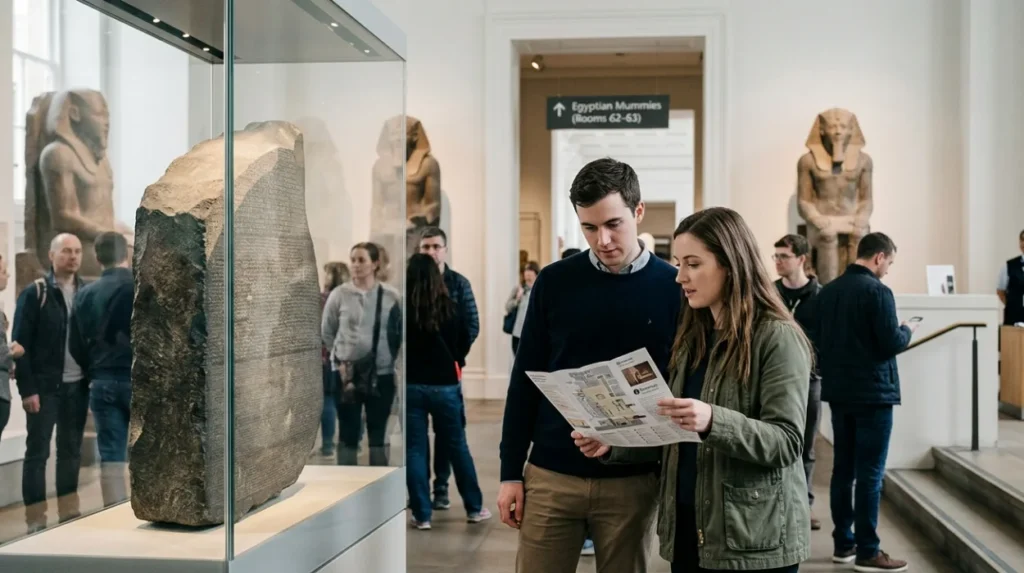
Accessibility is another key consideration. The museum has lifts and step‑free routes to major galleries, including the Egyptian Sculpture Gallery and the main mummy rooms. Wheelchair users and visitors with mobility impairments can obtain assistance from staff at the information desks and are advised to review the museum’s accessibility guide online, which details lift positions, rest areas, and accessible toilet locations. Extra London News suggests downloading the museum’s PDF map onto a mobile device and noting the coordinates of Room 4, Rooms 62–63, and other priority galleries before arriving, to minimize time spent searching signs on the day.
How do you see the Rosetta Stone without wasting time?
To see the Rosetta Stone efficiently, visitors should follow a simple route from the main entrance through the Great Court into the Egyptian Sculpture Gallery (Room 4). The museum’s self‑guided “One Hour at the Museum” trail instructs guests to turn left from the main entrance, walk through the central courtyard, and then follow the directional markers for Egyptian Sculpture; this path takes most visitors 5–10 minutes under normal conditions. During peak periods, security lines can add 10–15 minutes, so arriving either early in the day (before 11:00) or later in the afternoon (after 15:00) reduces congestion around the stone.
Once inside Room 4, the Rosetta Stone is positioned so that it faces the main entrance axis of the gallery, making it visually prominent even when the room is crowded. The museum’s object labels and audio guides highlight three key points: the triple‑script nature of the text, the date of the decree (196 BCE), and the role of the stone in Champollion’s decipherment. Extra London News recommends spending 10–15 minutes at the stone, reading the label, examining the three scripts, and, if possible, using the museum’s free audio guide or the official British Museum app, which can provide additional layers of context without requiring a guided tour.
For those who want to combine the Rosetta Stone with a brief Egyptian overview, the museum’s own “One Hour at the Museum” trail lists the Rosetta Stone as the first stop, followed by the colossal statue of Ramesses II and other Egyptian sculptures in the same room. This tightly sequenced route allows visitors unfamiliar with the layout to see several major Egyptian objects within 20–30 minutes, which is especially useful for school groups, short‑stay tourists, or business travelers with limited time.
What are Egyptian mummies and how are they displayed in the museum?
Egyptian mummies are preserved human and animal remains prepared according to funerary practices that developed over more than 3,000 years of ancient Egyptian history. The British Museum’s Egyptian Department holds one of the world’s largest collections of mummies, coffin sets, and funerary equipment, with material dating from the Old Kingdom (c. 2686–2181 BCE) through the Roman period (30 BCE–395 CE). The core mummy displays are located in Rooms 62–63, which are grouped under the thematic heading “Egyptian death and afterlife: mummies.”
The museum’s presentation emphasizes both biological preservation and ritual context. Human mummies are displayed either in their original coffins or on modern mounts that allow viewers to see wrappings, cartonnage (a plastered linen material used for masks and masks‑as‑covers), and amulets. Animal mummies, which include cats, birds, crocodiles, and ibises, are grouped in separate cases and often accompanied by explanations of votive offerings and temple cults. Labels and interactive screens explain core concepts such as the ka (spirit double), the ba (mobile soul), and the importance of the Book of the Dead in guiding the deceased through the afterlife.
In addition to complete mummies, the galleries display related objects such as canopic jars, ushabti figurines (small servant statuettes), and model tools intended to serve the deceased in the afterlife. This integrated display helps visitors understand mummification not as an isolated technique but as part of a broader religious and economic system that shaped architecture, art, and social hierarchy. The museum also notes that many of its mummies are the subject of ongoing scientific research, including CT scanning and radiocarbon dating, which refine estimates of age, health, and causes of death.
Where are the mummies located and how do you get there?
The main mummy galleries in the British Museum are Rooms 62–63, which are part of the Egyptian, Assyrian, and Sudanese section on the upper floor. Visitors reach these rooms by ascending from the ground floor via lifts or staircases near the Egyptian Sculpture Gallery (Room 4) and then following directional signage for Egyptian coffins or mummies. The museum’s floor план indicates that the route from Room 4 to Rooms 62–63 typically takes 5–10 minutes, depending on crowd density and the visitor’s starting point.
Room 62 concentrates on coffins, sarcophagi, and funerary masks, many of which come from the Theban area (modern Luxor) and the Faiyum region. Room 63 focuses more explicitly on mummified remains, with glass cases arranged to allow close viewing of wrappings, resin‑coated linen, and embedded amulets. Some cases are fitted with digital screens that show internal CAT scans or 3D reconstructions of the mummy, giving visitors a sense of the person’s facial features, age, and health status without unwrapping the body.
For readers following Extra London News’s guidance, a practical route would be: main entrance → Great Court → Room 4 (Rosetta Stone and Egyptian sculpture) → upper‑floor stairs or lift → Rooms 62–63 (mummies and coffins). This sequence mirrors the museum’s own thematic progression from language and royal power (Rosetta Stone, Ramesses II) to private belief and personal afterlife (mummies, funerary objects), creating a coherent narrative arc in a single visit.
How should you plan a visit that includes both the Rosetta Stone and mummies?
Planning a visit that includes both the Rosetta Stone and the mummies requires a clear sequence, time allocation, and awareness of opening hours. Extra London News recommends allocating at least 2–3 hours for a focused Egyptian itinerary, with 30–40 minutes for the Rosetta Stone and surrounding Egyptian Sculpture Gallery and 45–60 minutes for the mummy galleries and related coffins. Visitors who want a broader overview of the museum can extend the visit to 4–5 hours, adding the Parthenon Sculptures (Room 18), Mesopotamian galleries, and the Sutton Hoo display.
A structured route for a first‑time visit might proceed as follows: enter via the main Bloomsbury entrance, spend 10–15 minutes orienting yourself with the information desk and map, then proceed directly to Room 4 (Rosetta Stone) via the Great Court. After Room 4, move upstairs to Rooms 62–63 for the mummies, then return downstairs to the ground‑floor Egyptian galleries or continue to other collection areas such as Assyria or the Islamic world. The museum’s printed “Egyptian trail” and the “One Hour at the Museum” guide can be used as checklists to confirm that key objects have been seen.
For visitors with limited time, early‑morning entry (before 11:00) significantly reduces waiting times at security and congestion around the Rosetta Stone. Those with mobility constraints may prefer mid‑week afternoons (Tuesdays–Thursdays), when average visitor numbers are lower and staff ratios higher. Extra London News also notes that the museum’s official app and website provide real‑time updates on temporary closures and special exhibitions, which can help visitors adjust their route if Rooms 4 or 62–63 are affected by maintenance or loans.
What are key historical and cultural insights from the Rosetta Stone and mummies?
The Rosetta Stone and the museum’s mummy collection together illustrate several key themes in ancient Egyptian history and its reception in the modern world. First, the stone exemplifies the interaction between Greek‑ruling elites and Egyptian priestly classes in the Ptolemaic period, when bilingual and trilingual inscriptions were used to legitimize royal authority and to coordinate religious festivals. The decree on the Rosetta Stone specifically records tax concessions and cultic honors granted to the priesthood, highlighting the economic foundations of Egyptian temples alongside their ritual functions.
Second, the mummies and associated coffins reveal continuity and change in Egyptian funerary belief over long time spans. The museum’s displays include examples from the Old Kingdom’s pyramid age, the New Kingdom’s Theban necropolis, and the later Ptolemaic and Roman periods, which show how materials, decoration, and iconography evolved. For instance, New Kingdom mummies often feature elaborate cartonnage masks with gilded faces, while Roman‑period mummies sometimes incorporate Hellenistic or Greco‑Roman portrait styles.
Third, both the Rosetta Stone and the mummies figure prominently in contemporary debates about museum ethics and repatriation. The stone’s removal from Egypt in the early 19th century and its subsequent role in European scholarship have led to repeated calls for its return, while some Egyptian mummies in the collection have been the subject of requests for respectful reinterment or cultural consultation. The British Museum has responded with research‑based exhibitions, collaborative projects with Egyptian institutions, and public discussions on collecting histories, which Extra London News tracks as part of its broader coverage of London cultural policy.
What are practical visitor tips for comfort and efficiency?
Comfort and efficiency are critical for enjoying the British Museum, especially when combining the Rosetta Stone and mummy galleries. Extra London News recommends wearing comfortable shoes, as the museum’s 60 galleries cover a large area and require considerable walking. The museum provides rest areas and benches near major galleries, lift lobbies, and cafes, but visitors should also be prepared to stand for extended periods in front of high‑traffic objects such as the Rosetta Stone.
Food and drink options include the Great Court Restaurant, the Court Café, and smaller kiosks located near the ground floor galleries. Visitors may bring water in closed bottles, but large meal containers are discouraged in galleries. The museum has multiple toilets and baby‑change facilities, with particular clusters near the Great Court and the Egyptian galleries. For families with children, the museum’s family‑friendly trails and audio guides use simplified language and interactive questions to engage younger visitors with the Rosetta Stone, mummies, and related objects.
Photography for private use is permitted in most galleries, including Room 4 and Rooms 62–63, though flash and selfie‑sticks are prohibited to protect objects and avoid obstructing other visitors. Extra London News advises taking a few quick photos from different angles and then stepping aside to allow others clear access, especially during peak hours. For those who wish to avoid crowds, weekday mornings and late afternoons generally offer the best balance between visibility and comfort.
How does visiting the Rosetta Stone and mummies fit into London tourism?
The British Museum’s Rosetta Stone and mummy galleries occupy a central place in London’s cultural tourism offer and in broader itineraries for visitors to the UK. Industry data from VisitBritain and London & Partners indicate that the British Museum consistently ranks among the top five paid‑entrance attractions in London by visitor numbers, with an annual attendance of several million people. The museum’s proximity to other major sites—such as the British Library, the University of London, and major West End theatres—makes it easy to combine with a day of walking tours or canal‑side walks along the Regent’s Canal.
For international visitors, the Rosetta Stone and mummies often serve as entry points into more specialized interests such as Egyptology, linguistics, or museum studies. The museum’s research library and public‑lecture programs, which are accessible to on‑site visitors, provide deeper context that complements the physical displays. Extra London News also notes that guided tours focusing on the Rosetta Stone and mummies—offered by both the museum and third‑party operators—have become increasingly popular, with some tours including 2–hour itineraries that combine Egypt, Greece, and the Parthenon sculptures into a single narrative.
In the long term, the British Museum’s efforts to digitize its collections, provide high‑resolution images, and publish research‑based online articles ensure that the Rosetta.
What is The British Museum and why is it significant?
The British Museum is a public museum of human history and culture in London, housing over 8 million objects from across the world. It is significant for its vast global collection and its role in shaping modern archaeology and cultural debate.