Shakespeare’s Globe Theatre was built in 1599 on the south bank of the River Thames to provide the Lord Chamberlain’s Men with a permanent performance venue. The theatre emerged from commercial competition, population growth, and the expansion of public entertainment in Elizabethan London.
- What did the original Globe Theatre look like?
- How did Shakespeare influence the Globe Theatre’s success?
- Why did the Globe Theatre burn down in 1613?
- How was the Globe rebuilt after the fire?
- Why were theatres banned during the English Civil War?
- How was Shakespeare’s Globe rediscovered centuries later?
- What makes the modern Shakespeare’s Globe historically important?
- What is Shakespeare’s Globe legacy in modern London?
London in the late sixteenth century experienced rapid urban growth. The city’s population increased from roughly 50,000 in 1500 to more than 200,000 by 1600. Public theatres became profitable businesses as literacy, trade, and urban culture expanded under the reign of Elizabeth I.
Before the Globe existed, acting companies relied on leased venues. The Lord Chamberlain’s Men, the theatrical company associated with William Shakespeare, performed at a venue called The Theatre in Shoreditch. The Theatre was constructed in 1576 by actor and entrepreneur James Burbage.
The lease for The Theatre expired in 1597 after disputes with landowner Giles Allen. In response, the Burbage family dismantled the timber structure during the winter of 1598. Workers transported the wooden framework across the Thames to Southwark. The recycled timbers formed the basis of the Globe Theatre.
Southwark provided strategic advantages. The district stood outside the direct jurisdiction of the City of London authorities, who frequently opposed theatrical performances because of concerns over morality, disorder, and plague transmission. Southwark already hosted entertainment businesses including bear-baiting arenas, taverns, and inns.
The Globe opened in 1599. Shareholders included Richard Burbage, Cuthbert Burbage, and William Shakespeare himself. Shakespeare owned approximately 12.5 percent of the company, giving him direct financial involvement in the theatre’s success.
What did the original Globe Theatre look like?
The original Globe Theatre was a large, open-air, polygonal wooden amphitheatre designed to hold around 3,000 spectators. Its structure combined medieval inn-yard influences with Renaissance theatrical innovations that improved acoustics, staging, and audience visibility.
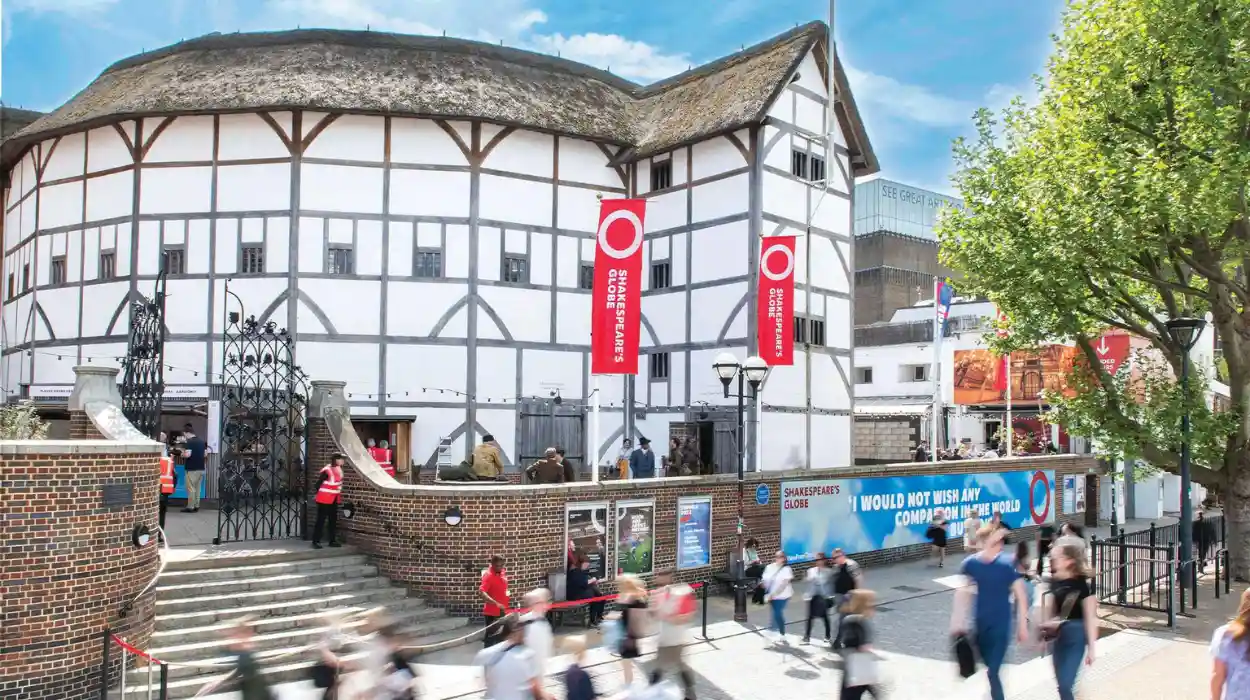
The theatre featured a circular or twenty-sided polygonal exterior. White lime-plastered walls and exposed oak timbers defined its appearance. The roof consisted of thatched reeds, a common but highly flammable building material in Tudor England.
The central yard remained open to the sky. Spectators known as “groundlings” paid one penny to stand in this area during performances. Wealthier visitors occupied covered galleries surrounding the yard on three levels.
The stage projected into the audience space. Historians describe this arrangement as a thrust stage. The elevated platform measured roughly 13 metres wide and 8 metres deep. Trapdoors beneath the stage enabled dramatic entrances and special effects.
A roof canopy known as “the heavens” covered part of the stage. The painted ceiling often depicted stars, clouds, or zodiac imagery. Hidden machinery allowed actors portraying gods or spirits to descend during performances.
The theatre lacked elaborate scenery. Instead, playwrights used spoken dialogue to establish settings and atmosphere. This staging method accelerated scene changes and emphasized language over visual spectacle.
How did Shakespeare influence the Globe Theatre’s success?
William Shakespeare transformed the Globe Theatre into England’s leading dramatic venue through his roles as playwright, actor, and shareholder. His plays attracted large audiences, generated commercial profits, and established the Globe as a defining institution of English literature.
Shakespeare joined the Lord Chamberlain’s Men during the 1590s. Unlike many playwrights of the period, he maintained a direct financial relationship with his company. This structure encouraged long-term artistic collaboration.
The Globe became the principal venue for Shakespeare’s mature tragedies, histories, and comedies. His writing suited the theatre’s architecture. Soliloquies projected effectively from the thrust stage, while rapid scene transitions matched the Globe’s minimal scenery.
Shakespeare’s historical plays reflected English political anxieties during the final years of Elizabeth I’s reign and the accession of James VI and I. Productions such as Henry V emphasised monarchy, warfare, and national identity.
Comedies, including Twelfth Night and As You Like It, appealed to mixed audiences. Aristocrats occupied gallery seating while labourers stood in the yard. The Globe, therefore, functioned as a rare social space where multiple classes consumed the same cultural performance simultaneously.
Why did the Globe Theatre burn down in 1613?
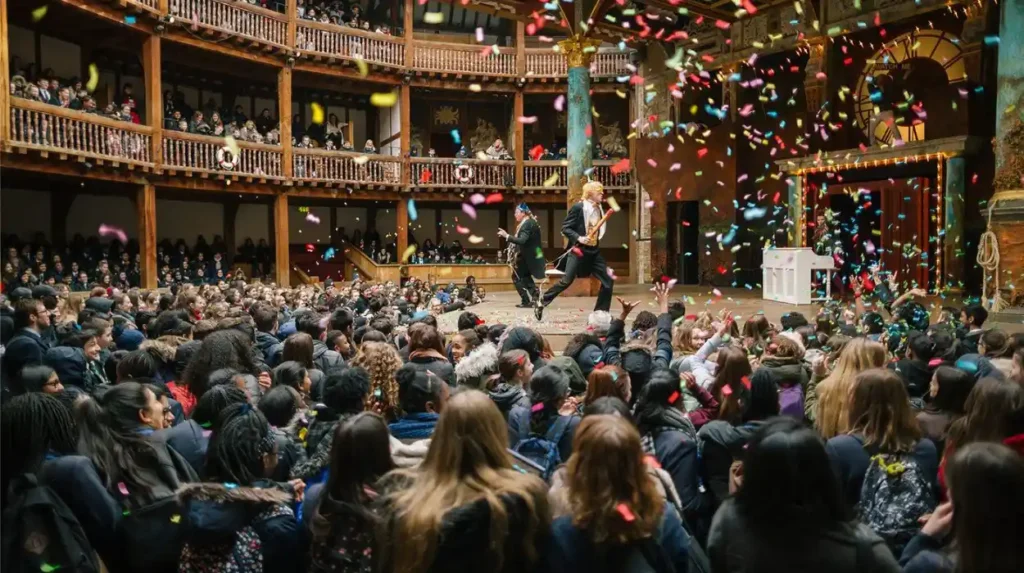
The Globe Theatre burned down on 29 June 1613 after a theatrical cannon ignited the building’s thatched roof during a performance of Shakespeare’s play Henry VIII. The fire destroyed the wooden structure within approximately two hours.
The fire occurred during a production known at the time as All Is True, now generally identified as Henry VIII. Stage effects included ceremonial cannon fire intended to simulate royal pageantry.
According to eyewitness accounts, sparks from the cannon landed on the roof’s dry thatch. Initially, spectators ignored the smoke. Flames then spread rapidly across the roof structure.
Contemporary writer Sir Henry Wotton described the incident in a surviving letter. He reported that the theatre “consumed to the ground” in less than two hours.
Remarkably, historical sources record no confirmed deaths. One account described a man whose burning trousers were extinguished with ale. The rapid evacuation prevented mass casualties despite the theatre’s large audience capacity.
How was the Globe rebuilt after the fire?
The Globe Theatre was rebuilt in 1614 on the same Southwark site using improved materials and updated construction methods. The second Globe retained the original theatre’s overall design while incorporating stronger structural and fire-resistant features.
The reconstruction proceeded rapidly because the King’s Men depended on theatrical income. Investors reused portions of the original site and preserved the amphitheatre concept familiar to audiences.
The new Globe included tiled roofing instead of highly combustible thatch across major sections. Builders also reinforced timber supports and improved structural durability.
The theatre reopened in 1614. Shakespeare remained associated with the company during the final years of his life before his death in 1616 at age 52.
The rebuilt Globe continued operating during the reign of Charles I before the outbreak of the English Civil War transformed England’s political and cultural landscape.
Why were theatres banned during the English Civil War?
Theatres were banned during the English Civil War because Puritan political leaders considered stage performances immoral, socially disruptive, and incompatible with religious discipline. Parliament formally closed London theatres in 1642 during escalating political and military conflict.
The closure reflected broader ideological tensions in seventeenth-century England. Puritans promoted strict Protestant reforms emphasizing discipline, modesty, and moral regulation.
Public theatres represented the opposite cultural model. Playhouses encouraged crowd gatherings, commercial leisure, music, cross-dressing performances, and satirical commentary. Puritan writers frequently attacked actors and playwrights in pamphlets and sermons.
The parliamentary order of September 1642 stated that public entertainments were inappropriate during a period of national crisis. England had entered civil war between supporters of King Charles I and Parliament.
The Globe’s final destruction occurred in 1644 when demolition crews cleared the structure to create tenement housing. No visible remains survived above ground for centuries.
How was Shakespeare’s Globe rediscovered centuries later?
Shakespeare’s Globe was rediscovered through historical scholarship, archaeological excavation, and twentieth-century preservation campaigns that identified the original theatre site and inspired a full-scale modern reconstruction near its historic location.
Interest in Shakespeare intensified during the eighteenth and nineteenth centuries. Scholars, collectors, and literary societies searched for evidence connected to Elizabethan theatre culture.
American actor and director Sam Wanamaker played a central role in the theatre’s modern revival. After visiting London in 1949, Wanamaker became frustrated by the absence of a proper memorial to Shakespeare’s theatrical legacy.
Wanamaker established the Shakespeare Globe Trust in 1970. Archaeological excavations in 1989 uncovered substantial remains of the original Globe’s foundations beneath Anchor Terrace in Southwark.
Construction of the modern Globe began during the 1990s near the original site. Builders used traditional materials and Tudor construction methods wherever possible.
The modern theatre opened officially in 1997, four years after Wanamaker’s death. To experience this historic landmark in person today, consult our comprehensive [Watching a Play at The Globe: A Modern Visitor Guide] for itineraries and visiting parameters.
What makes the modern Shakespeare’s Globe historically important?
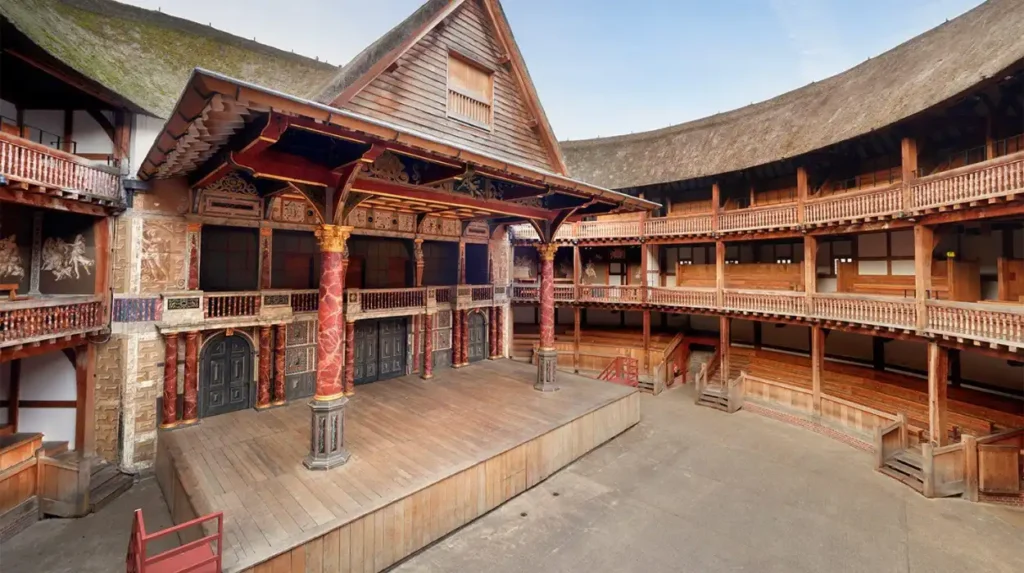
The modern Shakespeare’s Globe is historically important because it recreates Elizabethan theatrical conditions, preserves traditional construction methods, and supports global research into Shakespearean performance, architecture, and early modern cultural history.
The reconstructed Globe stands approximately 230 metres from the original theatre site. It remains one of the few major buildings in London permitted to use a thatched roof after modern fire regulations restricted the material following the Great Fire of London in 1666.
Architects used green oak timber frames, lime plaster walls, and handcrafted joints based on Tudor techniques. Traditional craftsmanship formed a central principle of the reconstruction project.
The theatre accommodates approximately 1,500 spectators, fewer than the estimated capacity of the original Globe. Safety regulations and accessibility standards required certain modern adaptations.
Performances recreate historical staging conventions. Productions frequently use minimal scenery, natural daylight, and audience interaction consistent with Elizabethan theatre practices.
The Globe also operates as a research institution. Educational programmes examine Renaissance literature, stage combat, costume production, music, and historical pronunciation.
What is Shakespeare’s Globe legacy in modern London?
Shakespeare’s Globe remains one of London’s most influential cultural landmarks because it connects modern audiences with Elizabethan history, preserves theatrical heritage, and demonstrates the continuing global relevance of Shakespeare’s works and London’s historic entertainment culture.
The Globe represents more than a reconstructed building. It symbolises the survival of literary and theatrical traditions across more than four centuries of political upheaval, urban transformation, and cultural change.
Its history reflects broader developments in London itself. The original theatre emerged during rapid urban expansion under Elizabeth I. It burned during a period of technological experimentation in public entertainment. It disappeared amid civil war and religious conflict. It returned through modern heritage preservation and archaeological research.
The theatre’s educational significance remains substantial. Schools and universities worldwide teach Shakespeare through texts first performed at the Globe. Modern productions continue exploring themes of monarchy, violence, identity, ambition, and political power first presented to London audiences more than 400 years ago.
Today, Shakespeare’s Globe stands as a rare architectural bridge between Tudor London and the modern city. Its continued operation ensures that the language, performance traditions, and historical environment associated with William Shakespeare remain part of London’s living cultural identity.
Why was Shakespeare’s Globe Theatre built?
The Globe Theatre was built in 1599 to provide the Lord Chamberlain’s Men with a permanent performance venue after disputes over the lease of an earlier theatre called The Theatre in Shoreditch.