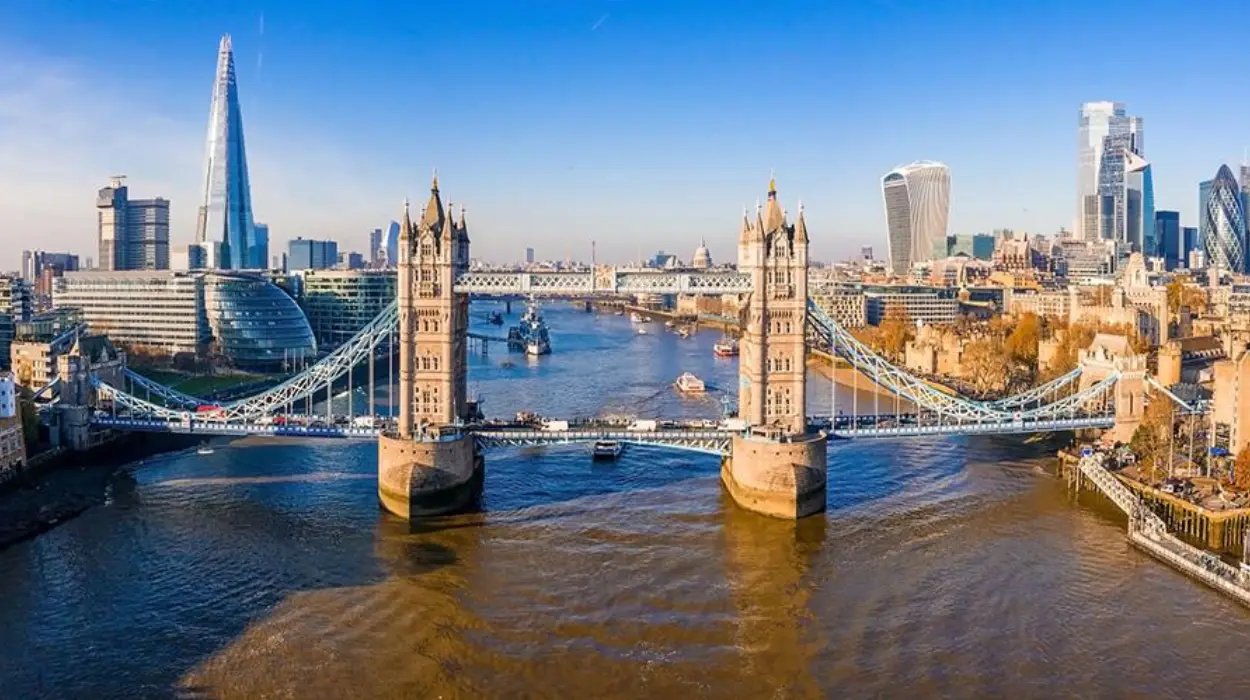
London’s bridges define the capital’s geography, economy, and identity. Crossing the River Thames has shaped settlement patterns, trade routes, engineering innovation, and urban expansion for nearly 2,000 years. From the first Roman timber crossing to today’s technologically advanced river infrastructure, London’s bridges transformed isolated communities into a connected metropolis while influencing commerce, architecture, and transport across Britain.
- Why have London’s bridges always been essential to the city’s development?
- How did the first London Bridge establish the city’s future?
- Why did medieval London Bridge become one of Europe’s most remarkable structures?
- Why were new bridges needed during the Industrial Revolution?
- How did Victorian engineering transform London’s bridges?
- Why is Tower Bridge considered an engineering masterpiece?
- How did London’s bridges influence commerce and urban expansion?
- What engineering materials and construction methods built London’s famous bridges?
- Which famous London bridges remain historically significant today?
- How are London’s historic bridges preserved for future generations?
- Why do London’s bridges remain globally important historical landmarks?
Why have London’s bridges always been essential to the city’s development?
London’s bridges connected communities, accelerated commerce, strengthened political authority, improved military movement, and enabled continuous urban expansion. Since Roman Britain, every major bridge altered travel patterns, influenced settlement growth, encouraged investment, and reshaped London’s economic geography along both banks of the River Thames.
The River Thames stretches approximately 346 kilometres across southern England before entering the North Sea. Although it served as an important transport corridor, it also created a significant barrier between northern and southern settlements. Permanent bridges solved that challenge.
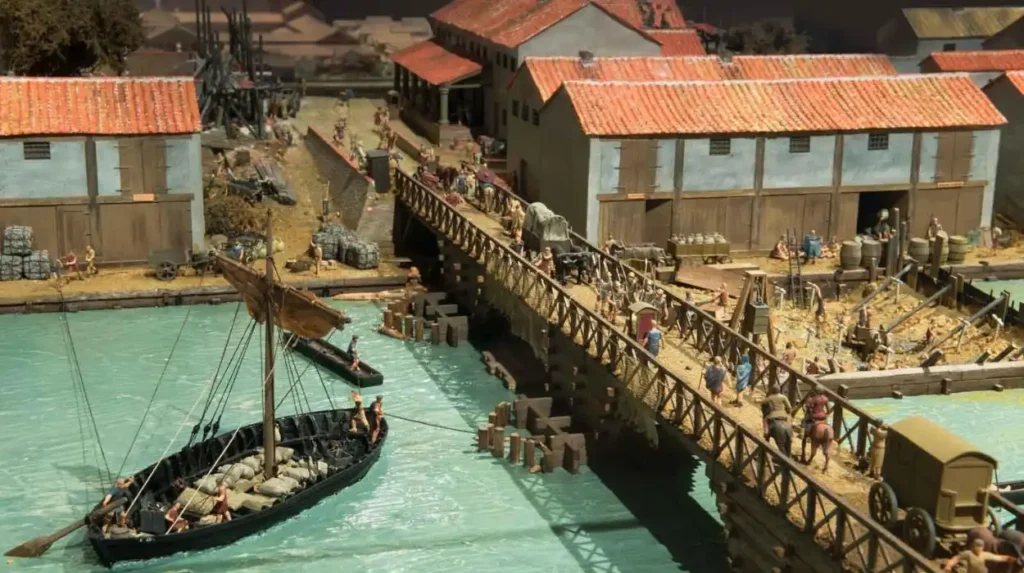
Roman engineers constructed London’s first permanent bridge shortly after establishing Londinium around AD 47–50. The crossing linked Roman roads extending toward Kent, Essex, and western Britain. Trade increased because merchants no longer depended entirely on ferries.
Throughout the medieval period, bridges became centres of commerce rather than simple transport structures. Shops, houses, chapels, and defensive gateways occupied bridge decks, turning crossings into thriving commercial districts.
By the nineteenth century, industrialisation demanded wider, stronger crossings capable of supporting horse-drawn traffic, railways, and eventually motor vehicles. Engineering innovation followed economic necessity.
Today, more than 35 bridges span the tidal Thames in Greater London, alongside tunnels and ferry crossings. Together they form one of Europe’s most historically significant river transport networks.
How did the first London Bridge establish the city’s future?
The first London Bridge established London’s strategic importance by connecting Roman road networks across the Thames. It stimulated commerce, enabled military logistics, encouraged permanent settlement, and positioned Londinium as Britain’s principal administrative and trading centre during Roman occupation.
Roman engineers preferred timber because it allowed rapid construction using locally available materials. Archaeological excavations suggest the earliest bridge stood near today’s London Bridge.
The bridge linked major Roman roads including Watling Street, creating uninterrupted transport between southeastern Britain and western provinces.
Roman engineering methods
Roman builders drove timber piles into the riverbed using primitive pile-driving equipment. Horizontal beams supported a timber deck capable of carrying soldiers, livestock, carts, and traders.
Maintenance remained constant because tidal currents, flooding, and timber decay required regular repairs.
Archaeological discoveries
Excavations uncovered wooden piles, Roman pottery, coins, and structural remains confirming successive bridge rebuilds during Roman occupation. These discoveries provide evidence of continuous engineering adaptation rather than one permanent structure.
The bridge also encouraged urban planning. Markets, warehouses, administrative buildings, and residential districts developed around the crossing because accessibility attracted investment and population growth.
Why did medieval London Bridge become one of Europe’s most remarkable structures?
Medieval London Bridge combined transport, commerce, religion, housing, and defence within one stone structure. Completed during the early thirteenth century, it remained London’s only permanent Thames crossing for more than 600 years and became a defining feature of medieval urban life.
Construction of the famous stone bridge began in 1176 under the supervision of priest and architect Peter of Colechurch. Building continued for approximately 33 years before completion in 1209.
Unlike earlier timber bridges, the stone bridge featured multiple arches supported by substantial piers.
Buildings constructed on the bridge
More than 200 buildings eventually occupied the bridge. Examples include timber houses, merchant shops, workshops, and St Thomas’ Chapel.
Many buildings projected beyond the bridge edges, narrowing the roadway considerably.
Residents lived directly above one of Europe’s busiest transport corridors. Businesses benefited from continuous pedestrian traffic between the City of London and Southwark.
Engineering challenges
The narrow arches accelerated river currents beneath the bridge, creating dangerous navigation conditions.
Boat operators described passage through the arches as hazardous because fast-moving tidal water formed powerful rapids.
Repeated fires damaged bridge buildings. Significant fires occurred in 1212, 1633, and during the Great Fire of London in 1666, although the bridge itself survived.
The medieval bridge remained operational until the nineteenth century despite centuries of structural repairs.
Why were new bridges needed during the Industrial Revolution?
Industrialisation increased London’s population, trade, and transport demands beyond the capacity of a single historic crossing. New bridges improved mobility, supported expanding suburbs, accommodated commercial traffic, and reflected major advances in civil engineering during the eighteenth and nineteenth centuries.
London’s population expanded rapidly during the eighteenth and nineteenth centuries.
Factories, docks, warehouses, and railway terminals generated unprecedented traffic volumes.
New crossings reduced congestion around London Bridge while opening new districts for residential and commercial development.
Westminster Bridge
Completed in 1750, Westminster Bridge became the first major Thames crossing built in central London after medieval London Bridge.
Its construction encouraged development of Westminster as both a political and residential centre.
Blackfriars Bridge
Blackfriars Bridge opened in 1769.
It strengthened connections between the City of London and rapidly growing districts south of the Thames.
Waterloo Bridge
Completed in 1817, Waterloo Bridge became renowned for elegant granite construction and panoramic views across central London.
It represented both engineering achievement and national celebration following the Battle of Waterloo.
Each bridge redistributed transport flows while stimulating nearby investment and housing construction.
How did Victorian engineering transform London’s bridges?
Victorian engineers introduced stronger materials, scientific construction techniques, and improved structural analysis. Iron, steel, granite, and hydraulic technology enabled wider spans, greater durability, and safer transport, fundamentally modernising London’s river crossings during the nineteenth century.
The Victorian period witnessed extraordinary advances in engineering knowledge.
Steam-powered machinery improved construction efficiency.
Iron gradually replaced timber in major structural components.
Steel later provided even greater strength while reducing structural weight.
Replacement of old London Bridge
Engineer John Rennie designed a new granite London Bridge.
Construction began in 1825.
The replacement bridge opened in 1831 after the medieval structure proved inadequate for modern traffic.
Remarkably, the nineteenth-century bridge itself was later dismantled.
In 1968, entrepreneur Robert P. McCulloch purchased the bridge.
Its granite blocks were transported to Arizona, United States, where the bridge was reconstructed across a canal at Lake Havasu City.
Scientific engineering
Victorian engineers increasingly relied upon mathematical calculations rather than empirical judgement.
Material testing improved structural reliability.
Hydraulic cranes accelerated stone placement during construction.
These developments influenced bridge engineering worldwide.
Why is Tower Bridge considered an engineering masterpiece?
Tower Bridge combined innovative bascule technology with Gothic Revival architecture, allowing road traffic and tall ships to coexist. Opened in 1894, it solved navigation challenges while becoming one of London’s most recognised architectural and engineering landmarks.
Tower Bridge addressed a unique problem.
Eastern London required another crossing without obstructing access to the busy Port of London.
Traditional fixed bridges blocked tall-masted vessels.
Construction timeline
Construction commenced in 1886.
Approximately 432 construction workers participated.
More than 11,000 tonnes of steel formed the bridge’s structural framework.
Cornish granite and Portland stone concealed the steel skeleton to complement nearby historic buildings.
The bridge officially opened on 30 June 1894.
How the bascules operate
Two movable roadways, known as bascules, rotate upward independently.
Originally, steam-powered hydraulic systems raised the bascules.
Modern electric-hydraulic machinery replaced the Victorian equipment during the twentieth century while preserving operational principles.
Tower Bridge continues opening for authorised vessels according to scheduled navigation requirements.
Its combination of mechanical innovation and architectural symbolism established an international benchmark for movable bridge design.
To experience this historic landmark in person today, consult our comprehensive [London’s Most Scenic Bridges to Explore for Incredible River Views and Photography Opportunities] for itineraries and visiting parameters.
How did London’s bridges influence commerce and urban expansion?
Bridges redirected trade routes, encouraged market development, increased property values, supported dock expansion, and integrated formerly isolated districts. Every major crossing generated new economic opportunities that reshaped London’s commercial geography across successive historical periods.
Before permanent crossings existed, ferry operators controlled river transport.
Bridges reduced travel time significantly.
Merchants transported goods more efficiently between markets.
Warehouses expanded along accessible riverfront locations.
Southwark evolved from a peripheral settlement into an important commercial district because reliable crossings connected it directly with the City of London.
Industrial docks downstream benefited from improved road access.
Bridge construction also increased land values near approaches.
Businesses preferred locations with convenient transport links.
Urban planners gradually extended roads, tramways, and railways to connect bridge crossings with expanding suburbs.
This integrated transport network encouraged London’s outward growth throughout the nineteenth and twentieth centuries.
What engineering materials and construction methods built London’s famous bridges?
Bridge construction evolved from timber and stone to cast iron, wrought iron, steel, reinforced concrete, and advanced composite materials. Each technological transition improved durability, increased span length, reduced maintenance, and expanded engineering possibilities across London’s transport infrastructure.
Roman builders relied primarily on oak timber.
Medieval engineers preferred limestone and granite because of their durability.
Industrial engineers introduced cast iron for structural members.
Later projects increasingly adopted wrought iron because it resisted cracking better than cast iron.
Steel became dominant during the late nineteenth century.
Modern bridges employ reinforced concrete, weather-resistant steel alloys, computer-assisted structural analysis, and sophisticated corrosion protection systems.
Foundation construction
Bridge foundations require exceptional stability because Thames sediments include gravel, clay, and alluvial deposits.
Engineers developed increasingly advanced methods.
Examples include timber piles, masonry caissons, pneumatic caissons, and deep reinforced concrete foundations.
These innovations improved long-term structural performance despite tidal conditions.
Which famous London bridges remain historically significant today?
Several historic bridges continue serving modern transport while preserving centuries of engineering heritage. Examples include Tower Bridge, Westminster Bridge, Blackfriars Bridge, London Bridge, Richmond Bridge, and Hammersmith Bridge, each representing different periods of architectural development.
Richmond Bridge
Completed in 1777, Richmond Bridge remains London’s oldest surviving Thames bridge still carrying road traffic.
Its stone arches demonstrate eighteenth-century masonry engineering.
Westminster Bridge
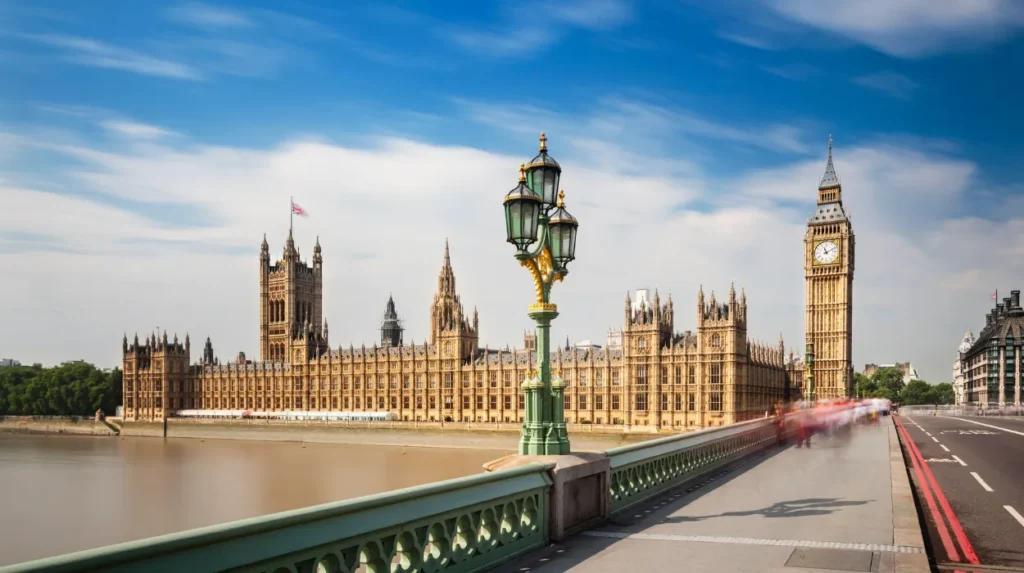
The present Westminster Bridge opened in 1862.
Its distinctive green colour complements the seating within the Palace of Westminster’s House of Commons.
Blackfriars Bridge
The modern bridge opened in 1869.
Adjacent railway bridges illustrate Victorian railway expansion across central London.
Hammersmith Bridge
Completed in 1887, Hammersmith Bridge represents an important example of Victorian suspension bridge engineering.
Preservation work continues because historic structures require ongoing maintenance.
Each bridge contributes to London’s protected historic environment while supporting contemporary transport.
How are London’s historic bridges preserved for future generations?
Historic bridge preservation combines engineering maintenance, heritage protection, archaeological research, and legal conservation. Public authorities, conservation specialists, and engineers monitor structural condition while protecting nationally significant landmarks for future generations and continued public use.
Historic bridges face constant environmental pressures.
Traffic loading, vibration, corrosion, pollution, and changing climate conditions require continuous inspection.
Modern preservation programmes combine traditional craftsmanship with advanced engineering diagnostics.
Laser scanning identifies structural movement.
Ultrasonic testing detects internal defects.
Digital monitoring systems measure stress and vibration continuously.
Many bridges receive statutory protection through heritage designation.
Conservation projects prioritise original materials whenever practical while ensuring compliance with modern safety standards.
Museums and archives preserve original engineering drawings, construction records, and archaeological discoveries that document London’s bridge-building history.
These records support future restoration projects and historical research.
Why do London’s bridges remain globally important historical landmarks?
London’s bridges represent nearly two millennia of engineering progress, urban development, architectural innovation, and commercial expansion. They demonstrate how infrastructure shapes civilisation while preserving physical evidence of Britain’s political, economic, and technological evolution across successive historical eras.
Few cities possess such a continuous sequence of bridge development spanning Roman Britain to the twenty-first century.
Each generation introduced new engineering knowledge while responding to changing transport demands.
The bridges illustrate broader historical themes.
Examples include Roman conquest, medieval commerce, Industrial Revolution manufacturing, Victorian engineering, and modern conservation.
Academic researchers continue analysing bridge archaeology, construction techniques, historical documents, and environmental adaptation.
These studies improve understanding of urban development and infrastructure resilience.
For cultural tourists, London’s bridges provide accessible connections between many of the capital’s most significant historic districts.
For educators, they demonstrate engineering principles through surviving structures.
For genealogical researchers, bridge construction records, municipal archives, and surrounding parish registers provide valuable evidence for tracing family histories connected with London’s historic neighbourhoods.
London’s bridges therefore remain more than transport infrastructure.
They constitute enduring historical documents built from timber, stone, iron, steel, and concrete. Their foundations record changing technologies, expanding economies, evolving architectural styles, and centuries of civic ambition.
As modern engineers preserve these structures through advanced conservation techniques, London’s bridges continue connecting communities while illustrating how infrastructure permanently transforms the physical, economic, and cultural landscape of one of the world’s most influential cities.
What was the first bridge built across the River Thames in London?
The first permanent bridge across the River Thames was a Roman timber bridge built around AD 47–50 after the founding of Londinium. It connected important Roman roads and established London as a major trading and administrative centre.