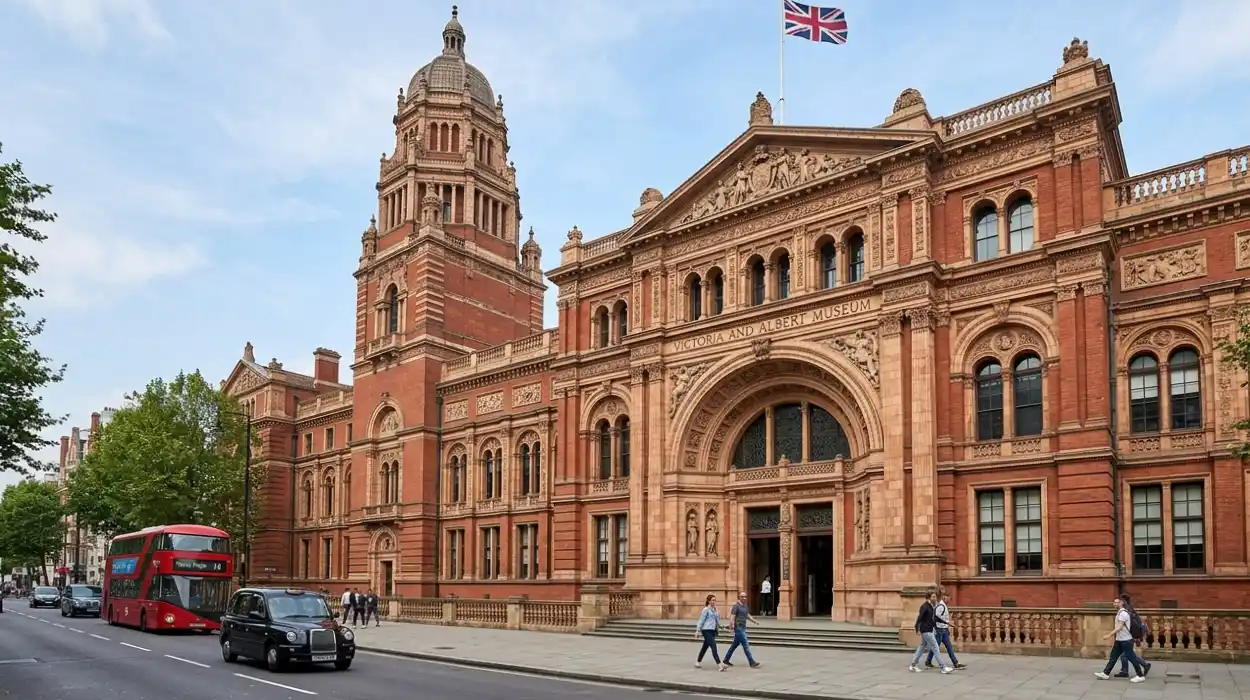
The Victoria and Albert Museum, universally known as the V&A, stands as the world’s premier institution dedicated to art, design, and human ingenuity. Located in the cultural district of South Kensington, London, the museum houses a permanent collection of over 2.8 million objects spanning 5,000 years of human creativity. It serves as a foundational archive for global design histories, textile conservation, and decorative arts development.
- What Is the History and Origin of the V&A Museum?
- How Did the Socio-Political Context of the Victorian Era Shape the Museum?
- What Key Figures and Architects Built the V&A Infrastructure?
- How Did the Fashion and Textile Collections Evolve Over Time?
- What Processes Drive the Museum’s Global Design Curation?
- How Does the Museum Practice Conservation and Digital Preservation?
- What Is the Long-Term Cultural and Research Impact of the V&A?
What Is the History and Origin of the V&A Museum?
The Victoria and Albert Museum originated from the Great Exhibition of 1851, established officially in 1852 as the Museum of Manufactures. It moved to South Kensington in 1857, rebranding to celebrate industrial design, national education, and global craftsmanship.
The Great Exhibition of the Works of Industry of All Nations in 1851 generated a financial surplus of 186,000 pounds sterling. Prince Albert, consort to Queen Victoria, directed these funds to establish a permanent cultural district in South Kensington dedicated to science and art education. Henry Cole, a civil servant and key organiser of the Great Exhibition, became the inaugural director of the new institution, initially opened at Marlborough House in May 1852 as the Museum of Manufactures.
The museum changed its name to the Department of Science and Art in 1853 and relocated to its current South Kensington site in 1857, reopening as the South Kensington Museum. The primary objective of the institution was to improve the standards of British industry by educating the working class, manufacturers, and designers through direct exposure to exemplary design and craftsmanship.
In 1899, Queen Victoria laid the foundation stone for the building’s new main facade designed by Aston Webb. During this final public appearance, she officially renamed the institution the Victoria and Albert Museum to honour her late husband’s foundational role. The Aston Webb building opened to the public in 1909, establishing the architectural and institutional footprint that defines the museum today.
How Did the Socio-Political Context of the Victorian Era Shape the Museum?
The Victorian era’s rapid industrialization, colonial expansion, and commitment to public education directly shaped the museum. The state engineered the institution to reform British manufacturing standards, project imperial influence, and provide secular, rational recreation for the working classes.
The mid-nineteenth century in Britain was marked by the Industrial Revolution, an era characterized by mass production, urbanization, and intense global trade competition. While British factories excelled in mechanical efficiency, contemporary critics noted that British manufactured goods lacked aesthetic merit compared to European rivals, particularly France. The British government founded the museum as a strategic economic intervention, using historic collections to inspire contemporary industrial designers and elevate national trade competitiveness.
This period also coincided with the expansion of the British Empire, which established trade routes and geopolitical control across Asia, Africa, and the Americas. The museum served as a repository for imperial acquisitions, receiving transfers of objects from the East India Company’s museum in 1879. These collections, which included Indian textiles, Chinese ceramics, and Iranian metalwork, reinforced London’s position as the economic capital of the world and exposed British designers to non-Western design methodologies.
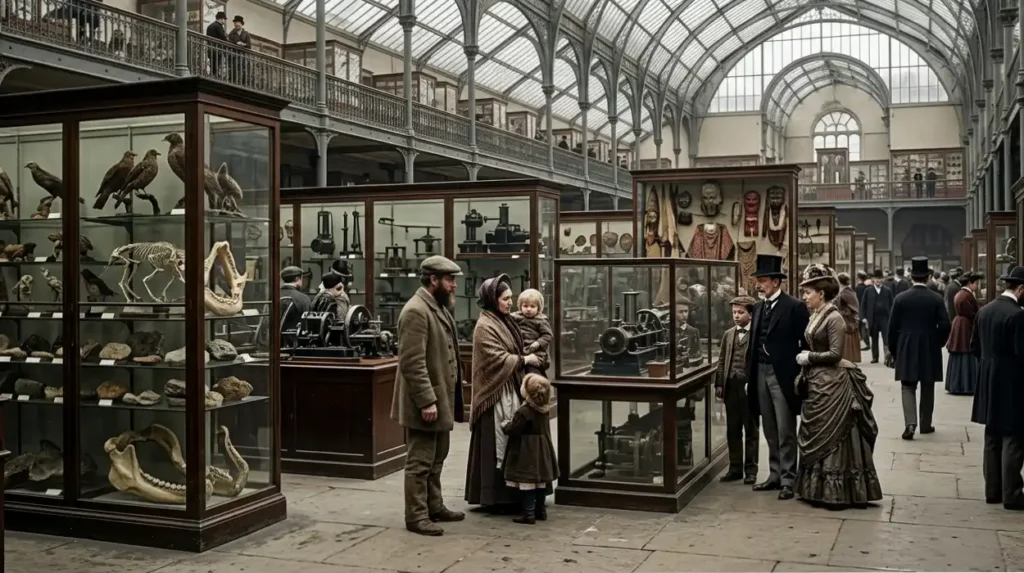
Simultaneously, Victorian socio-political philosophy emphasized social reform and public education as remedies for urban poverty and civil unrest. The museum implemented revolutionary access policies to accommodate the working classes. In 1858, the museum introduced evening openings illuminated by gas lighting, enabling factory laborers and artisans to visit after regular working hours. This democratization of culture transformed the museum from an exclusive elite salon into a public utility for civic improvement and rational recreation.
What Key Figures and Architects Built the V&A Infrastructure?
Prince Albert and Sir Henry Cole established the foundational mission of the V&A, while architects Captain Francis Fowke and Sir Aston Webb designed its structure. Their combined efforts created a sprawling, eclectic architectural monument dedicated to industrial art.
Prince Albert provided the overarching political and philosophical momentum for the South Kensington cultural complex. He envisioned an interconnected hub of museums, colleges, and professional societies that would bridge the gap between abstract science, fine art, and practical industry. Henry Cole executed this vision by establishing structural museum practices, including the creation of the world’s first museum refreshment rooms in 1868, designed by James Gamble, Godfrey Sykes, and William Morris.
The early structural development of the South Kensington site relied on military engineers. Captain Francis Fowke, an officer of the Royal Engineers, designed the museum’s initial brick quadrangles, including the iconic Sheepshanks Gallery and the Italianate courtyard now named the John Madejski Garden. Fowke utilized advanced structural engineering techniques of the 1860s, incorporating cast iron, large-scale glass roofing, and external decorative terracotta panels fabricated by Gibbs and Canning.
The final structural consolidation occurred under architect Sir Aston Webb, who won a public design competition in 1891 to expand the museum. Webb constructed the 720-foot-long Portland stone facade facing Cromwell Road between 1899 and 1909. His design combined elements of Renaissance and Baroque architecture, featuring a central tower shaped like an imperial crown, sculptural figures of British artists, and a grand entrance hall designed to handle large public crowds efficiently.
How Did the Fashion and Textile Collections Evolve Over Time?
The V&A fashion collection evolved from a technical reference archive of historical fabrics into the world’s largest dress collection. It systematically documents global fashion history from the fifteenth century to contemporary haute couture.
The collection began in 1852 with the acquisition of historical textiles and lace intended to serve as technical templates for British textile manufacturers. Early acquisitions focused on geometric precision, weaving techniques, and dye quality rather than garment construction or social prestige. The scope expanded significantly in 1913 when the museum accepted the collection of Harrods director Talbot Hughes, which added several hundred historic British dresses dating from the late Stuart to the mid-Victorian eras.
Throughout the twentieth century, the museum shifted its curatorial focus from treating fashion as a minor decorative art to recognizing it as a major cultural and economic medium. In 1971, fashion photographer Cecil Beaton curated an exhibition that brought twentieth-century high fashion into the museum’s permanent sphere. Beaton used his social network to secure major garment donations from premier European couturiers, including Cristóbal Balenciaga, Christian Dior, and Elsa Schiaparelli.
Today, the V&A fashion collection contains more than 75,000 individual garments and accessories. The collection tracks the evolution of silhouette construction, textile technology, and retail culture across multiple distinct eras, such as the Enlightenment, the Industrial Age, and the Post-War period. The museum permanently houses iconic historical artifacts, including mid-seventeenth century unworn doublets, court mantuas woven with silver thread, and defining contemporary garments like Mary Quant minidresses and Vivienne Westwood platform shoes.
Explore More History Of London
Battersea Power Station History & Lift 109 Guide – Battersea
Covent Garden Market and Theatre History Guide – London
What Processes Drive the Museum’s Global Design Curation?
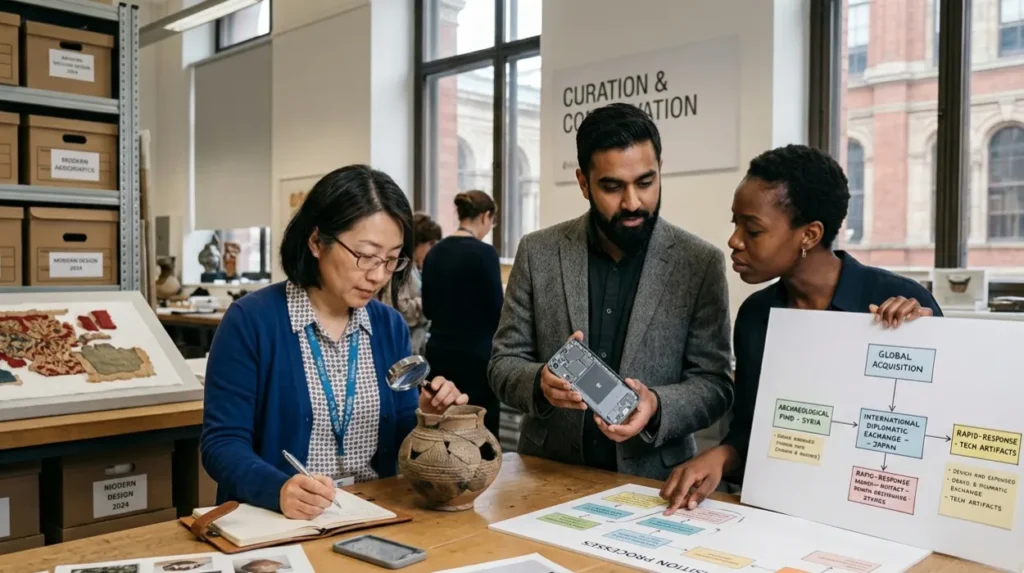
The V&A curates global design through systematic archaeological acquisition, international diplomatic exchanges, and rapid-response contemporary collecting. This dual process balances ancient preservation with the real-time tracking of modern technological artifacts.
The museum captures design history through targeted historical collection strategies. Curatorial departments specialize in material mediums, including ceramics, glass, metalwork, furniture, and sculpture. Objects enter the permanent collection via strict accession frameworks that prioritize historical authenticity, technological innovation, and artistic significance. The museum also receives items through national legislative mechanisms, such as the Acceptance in Lieu scheme, which transfers culturally significant private collections to public ownership to satisfy inheritance tax obligations.
In the twenty-first century, the V&A modernized its curation process by launching the Rapid Response Collecting program in 2014. This curatorial strategy acquires contemporary objects directly linked to major moments in global design, manufacturing, and social history. Rather than waiting decades for historical distance, the museum preserves objects immediately when they alter public life, securing items like early-generation smartphones, open-source 3D-printed firearms, and mass-produced fast-fashion garments.
The institution also operates as a global lender and collaborative research partner, managing international branches and touring exhibitions. The museum maintains strict climate-controlled transportation protocols to move delicate artifacts across international borders for research and display. To experience this historic landmark in person today, consult our comprehensive [Extra London News V&A Museum Visitor Guide] for itineraries and visiting parameters. Through these modern logistical networks, the museum ensures its design collections remain active participants in global cultural discourse.
How Does the Museum Practice Conservation and Digital Preservation?
The V&A preserves its massive collection through scientific material analysis, active environmental control, and large-scale digital imaging. These initiatives protect vulnerable physical artifacts while creating accessible, high-resolution digital records for global audiences.
The V&A Conservation Department employs specialized conservators focused on specific material classifications, including textiles, paper, woodwork, and metals. Conservation activities balance stabilization with minimal intervention, using advanced forensic technologies like X-ray fluorescence spectroscopy and infrared photography to analyze material degradation without damaging the objects. Textile conservators use custom-dyed supportive nettings and climate-controlled storage cases held at a constant 50% relative humidity and 18 degrees Celsius to prevent the breakdown of historic organic fibers.
Digital preservation forms the second pillar of the museum’s modern preservation strategy. Through the “Search the Collections” initiative, the museum digitizes millions of catalog entries, providing open-access, high-resolution imagery and detailed metadata for scholars and the public. The museum utilizes 3D scanning technologies to create precise digital models of fragile sculptures and architectural fragments, ensuring that the structural data of these objects remains preserved even if the physical medium suffers natural decay.
Furthermore, the museum addresses the challenge of preserving born-digital design assets, including computer-aided design software, digital typography, and video game architectures. These digital formats present novel preservation hurdles due to software obsolescence and hardware degradation. The V&A develops open-source emulation tools and digital archiving standards to guarantee that contemporary digital designs remain accessible and operational for future generations of historical researchers.
What Is the Long-Term Cultural and Research Impact of the V&A?
The V&A dictates global standards in design education, academic research, and exhibition curating. It functions as a critical academic hub, training future generations of art historians through dedicated postgraduate partnerships and research institutes.
The museum’s research output is anchored by its dedicated Research Department, which coordinates major academic projects funded by bodies like the Arts and Humanities Research Council. In partnership with the Royal College of Art, the V&A operates the prestigious V&A/RCA History of Design postgraduate program, which has produced leading global scholars, museum directors, and design critics since its inception in 1982. The museum publishes its own peer-reviewed journal, the V&A Online Journal, disseminating new research regarding material culture, conservation science, and collection histories.
The museum’s major temporary exhibitions set international cultural benchmarks, directly influencing global tourist economies and retail design trends. Landmark exhibitions focusing on design icons or cultural movements attract hundreds of thousands of international visitors, redefining the commercial value of creative industries. By presenting design as a vital engine of human history rather than a static decorative luxury, the V&A continuously reshapes public understanding of how everyday objects construct human identity and social structures.
The physical footprint of the museum continues to expand to meet modern curatorial demands. Developments like V&A East in Stratford’s Queen Elizabeth Olympic Park create open-access storage hubs and new exhibition spaces. These modern facilities ensure that the institution’s vast store of material culture remains visible and useful to design students, academic researchers, and public audiences well into the future.
What is the Victoria and Albert Museum famous for?
The Victoria and Albert Museum is famous for being the world’s leading museum of art, design, and decorative arts. Its collection includes more than 2.8 million objects spanning over 5,000 years of human creativity.