Key Points
- Permanent Status Under Review: Camden Council has launched a comprehensive six-week public consultation to decide whether to make the trial pedestrianisation of Camden High Street a permanent fixture.
- Potential Geographical Extension: The proposed plans could expand the current car-free zone northward, crossing the iconic Camden Lock Bridge up to the junction with Castlehaven Road.
- Current Boundary Limits: Since its trial implementation in May 2025, the existing motor-vehicle-free zone has spanned from the junction of Parkway and Kentish Town Road to the intersection of Jamestown Road and Hawley Crescent.
- Positive Environmental Indicators: Official municipal data recorded during the trial phase shows a significant drop in nitrogen dioxide ($\text{NO}_2$) levels, falling by as much as 25% to 32% directly within the pedestrianised zone.
- Enhanced Safety and Low Crime: Collision rates within the trial area dropped to zero during the first nine months, while overall instances of anti-social behaviour and pickpocketing also declined without shifting to neighbouring areas.
- Stable Economic Performance: Business transaction data monitored by the council indicates that local customer spending has remained stable and consistent compared to pre-trial levels.
- Strong Public Backing: Early engagement showed overwhelming local enthusiasm, with more than 70% of respondents supporting the trial implementation in a preliminary 2024 consultation.
Camden (Extra London News) July 14, 2026 – A major transformation is on the horizon for one of London’s most famous retail, cultural, and tourism hotspots. Camden Council has officially initiated a pivotal six-week public consultation to decide if the current trial pedestrianisation of Camden High Street should become permanent. This high-stakes municipal intervention, which has restricted motor vehicles on a busy stretch of the thoroughfare since May 2025, has triggered widespread conversation among local residents, market traders, and environmental advocates. Crucially, the local authority is not just seeking to lock the current layout into place; they are actively gathering feedback on a bold northward extension of the car-free zone that would cross the historic Camden Lock Bridge and run up to Castlehaven Road.
- Key Points
- What is the Current Scope of the Camden High Street Pedestrian Zone?
- Why is Camden Council Considering a Permanent Change?
- What Does the Environmental and Air Quality Data Reveal?
- How Has Road Safety and Public Crime Responded to the Car-Free Trial?
- What are the Details of the Proposed Northern Extension?
- How Have Local Politicians and Officials Reacted?
- What is the Impact of the Pedestrian Zone on Local Businesses?
- Has Customer Spending Declined Since the Cars Were Removed?
- How Have Cultural Events Supported the High Street Economy?
- What Challenges and Concerns Have Been Raised?
- What is Happening to Traffic and Air Quality on Surrounding Roads?
- Are There Concerns About Resident and Delivery Access?
- What are the Next Steps in the Consultation Process?
The trial scheme has reshaped the daily experience of the tens of thousands of visitors who flock to Camden Town’s markets. Previously, the narrow pavements of the high street struggled to accommodate crowds, leading to dangerous pedestrian overspill onto active vehicle lanes, degraded air quality, and chronic traffic congestion. By installing physical barriers, rerouting regional bus lines, and dedicating the street space to cultural festivals, the council sought to demonstrate that a pedestrian-first design could clean up the air and revitalise the local economy. With the experimental traffic order reaching the end of its 18-month trial window, local officials must now weigh rigorous environmental, economic, and safety data against the lived experiences of the community before making a final determination.
If approved permanently, the temporary, water-filled plastic barriers and temporary signage currently blocking the road will be replaced with a sophisticated network of smart bollards, integrated street greening, level walking surfaces, and permanent public seating. However, any decision to extend the scheme further north will require a phased approach. Council leaders have confirmed that a vote to make the current zone permanent must happen first. If approved, the design phase for the Castlehaven Road extension will commence, leading to an entirely separate round of public feedback and statutory consultations slated for 2027.
What is the Current Scope of the Camden High Street Pedestrian Zone?
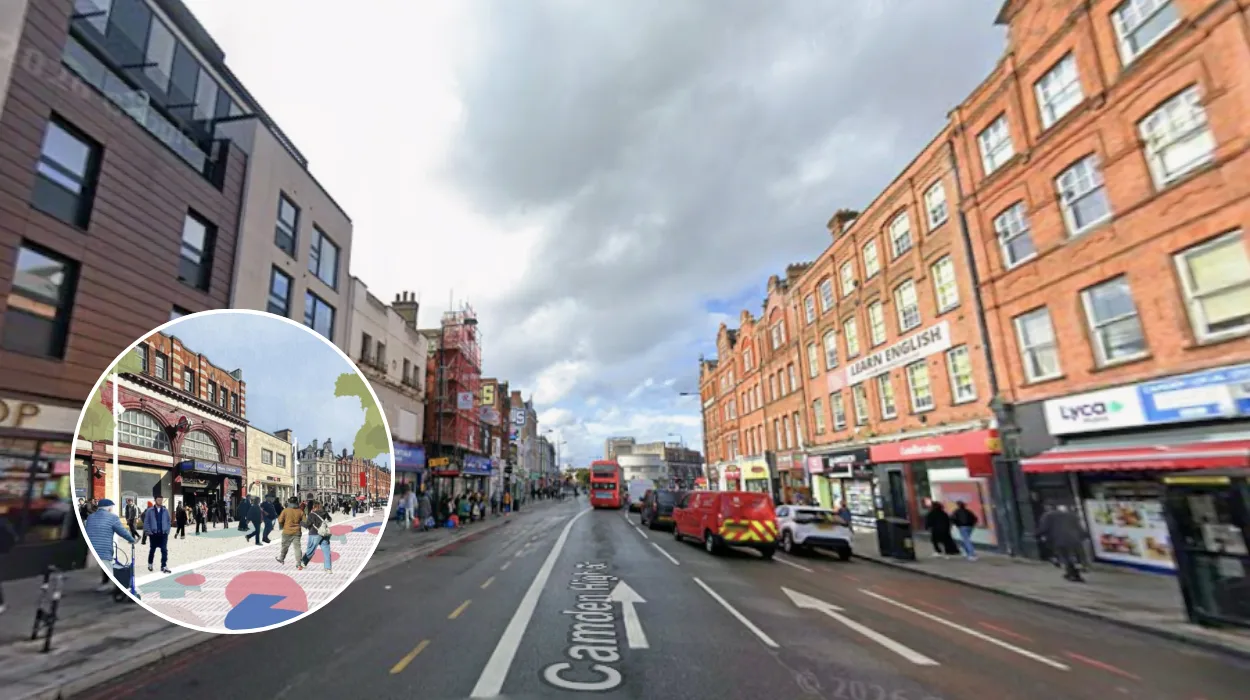
The current vehicle-free corridor occupies a highly congested segment of Camden High Street, positioned directly outside the bustling Camden Town Underground station. The barricaded zone begins at the complex southern junction where Parkway, Camden Road, and Kentish Town Road converge. From there, it extends northward to the intersection of Jamestown Road and Hawley Crescent.
Prior to the introduction of the trial, this specific stretch of road served as a major artery for double-decker buses, commercial delivery vans, and heavy passenger vehicle traffic. During peak weekend hours, pedestrian volumes on the high street can skyrocket to upwards of 40,000 people, causing severe pavement overcrowding and pushing shoppers dangerously close to moving traffic. The May 2025 trial sought to eliminate this conflict by completely removing general through-traffic.
Why is Camden Council Considering a Permanent Change?
Local policymakers argue that returning the high street to its pre-2025 state would be a step backward for public health and urban safety. To support their case, municipal officers have published a comprehensive “Data and Feedback Factsheet” outlining the ecological and social impacts recorded during the trial.
What Does the Environmental and Air Quality Data Reveal?
According to the official environmental monitoring data released by Camden Council, air quality along the high street has improved remarkably since the trial’s inception. Nitrogen dioxide ($\text{NO}_2$) concentrations—a major byproduct of diesel and petrol engines linked to respiratory diseases—fell by between 25% and 32% directly within the pedestrianised zone.
Furthermore, the wider Camden Town area experienced an average reduction of 11.6% in $\text{NO}_2$ pollution compared to the same months in the previous year. This drop outperformed the 9.9% average reduction observed across all other air monitoring stations in the borough, proving that removing tailpipe emissions from the high street had a positive regional ripple effect.
How Has Road Safety and Public Crime Responded to the Car-Free Trial?
Road safety has seen an equally dramatic improvement. As documented in the council’s monitoring logs, there were zero reported traffic collisions on Camden High Street—both within the pedestrianised section and along the northern stretch to Chalk Farm Road—during the first nine months of the trial. This stands in stark contrast to the six collisions and eight casualties recorded along the same stretch of road during the equivalent period in 2024 before the trial began. Additionally, the wider surrounding road network saw a 28.5% reduction in overall collisions, with serious or fatal injuries dropping to zero.
From a community safety perspective, fears that pedestrianisation would create hidden pockets for crime have not materialised. The council reported lower instances of pickpocketing, anti-social behaviour, and street-level crime within the zone, with no evidence that criminal activity was displaced to adjacent residential roads. This success was bolstered by the strategic deployment of dedicated Community Safety Enforcement Officers who regularly patrol the car-free high street.
What are the Details of the Proposed Northern Extension?
The most talked-about aspect of the new consultation is the proposed northern extension. If the public backs the expansion, the car-free zone will push north from Hawley Crescent, crossing over the Camden Lock Bridge, and terminating at the junction with Castlehaven Road.
This extension would also incorporate:
- Jamestown Road and Hawley Crescent: Transforming the sections of these side streets between Arlington Road and Stucley Place into pedestrian-priority zones.
- Two-Way Cycling Infrastructure: Implementing dedicated two-way cycling lanes to seamlessly link Arlington Road with Castlehaven Road and Chalk Farm Road.
- Timed Servicing Windows: Creating specific off-peak hours for delivery vehicles on Jamestown Road and Hawley Crescent, allowing local businesses to safely restock without disrupting daytime foot traffic.
How Have Local Politicians and Officials Reacted?
As reported by the Hampstead & Highgate Express, Councillor James Slater, the Cabinet Member for Planning and a Sustainable Camden, strongly defended the progress of the trial, stating:
“Camden Town is an important shopping and transport hub for local residents as well as being an internationally recognised destination that draws people in from across London, the rest of the UK, and the world. The trial has made the area safer and more pleasant for pedestrians and reduced air pollution on the street. The extra space has also allowed us to hold events and activities that showcase the best of Camden’s culture and communities.“
Slater further explained the council’s motivations for seeking a wider mandate, writing in the official Camden Council press release:
“The comprehensive and detailed feedback that we have received from residents, businesses and visitors, along with our monitoring, has helped us to better understand what people feel about the trial and therefore we are consulting on making the trial permanent and also on a potential extension to the traffic free area. Many residents have told us that they want to go even further on pedestrianising Camden High Street, so we will also be seeking views on extending the area across Camden Lock bridge and up to the junction with Castlehaven Road.”
Slater also emphasised that making the trial permanent is a prerequisite for long-term aesthetic investment, noting that a positive decision:
“…could provide opportunities to replace the large barriers with a smart bollard system and make further improvements to the look and feel of the street, through more level surfaces, benches and planting.”
What is the Impact of the Pedestrian Zone on Local Businesses?
Historically, pedestrianisation proposals in major global cities face stiff opposition from local business owners who worry that removing vehicle access will choke off retail trade, restrict essential deliveries, and drive away customers. However, the economic indicators gathered throughout the Camden High Street trial paint a reassuring picture of financial resilience.
Has Customer Spending Declined Since the Cars Were Removed?
According to the council’s economic monitoring division, merchant transaction data shows that consumer spending within the pedestrianised area and its immediate feeder streets has remained highly stable. Spending volumes during the daytime and evening peak hours throughout the trial perfectly mirrored the financial performance recorded during the pre-trial baseline period of May 2024 to April 2025.
Rather than deterring shoppers, the relaxed, car-free environment has encouraged visitors to linger longer, directly supporting the cafés, vintage boutiques, and market stalls that give Camden Town its global reputation.
How Have Cultural Events Supported the High Street Economy?
A major driver of the high street’s economic stability has been the “Camden High Street Live” cultural programme. Managed by the Camden Culture Service in collaboration with local artists, the reclaimed tarmac has been used to host massive community events.
These have included the landmark Camden Street Party, live-streamed outdoor DJ sets, puppet art showcases highlighting climate change, and the “Camden as a Catwalk” sustainable fashion event during London Fashion Week. By turning the high street into a venue for free public arts and music, the council has driven footfall directly to local merchants.
Explore more Camden News:
Labour Reclaims Camden Council Seat From Greens: Regent’s Park 2026
Salman Rushdie Defends Free Speech at Liberatum Award Ceremony: London 2026
What Challenges and Concerns Have Been Raised?
Despite the positive data, the scheme is not without its critics, and the consultation is expected to draw mixed feedback. The primary concern revolves around the displacement of vehicular traffic and public transport onto adjacent streets.
What is Happening to Traffic and Air Quality on Surrounding Roads?
While air quality on Camden High Street has improved dramatically, the removal of vehicles has caused minor friction elsewhere. The council’s factsheet acknowledges that nitrogen dioxide ($\text{NO}_2$) levels actually increased along Kentish Town Road, north of Buck Street, during the trial period.
Although the pollution levels on Kentish Town Road remained safely within the national legal annual limit of $40\,\mu\text{g/m}^3$, the localized increase indicates that some traffic congestion has been pushed onto neighbouring residential and commercial boundaries. The council has suggested that future bus priority lane adjustments, which have already been agreed upon, could help mitigate these localized traffic delays.
Are There Concerns About Resident and Delivery Access?
For local residents living on secondary roads like Arlington Road, Bayham Street, and Albert Street, the closure of a main high street artery can complicate daily taxi drop-offs, private vehicle navigation, and residential deliveries.
Traders located within the proposed northern extension have also raised questions about how heavy stock deliveries will be managed, particularly for businesses that rely on frequent restocking. The council has sought to address these concerns by proposing dedicated, timed delivery windows on side streets to protect essential business operations during quiet morning and late-evening hours.
What are the Next Steps in the Consultation Process?
The six-week consultation period represents the final opportunity for the public to formally voice their views on the future of Camden High Street.
Once the feedback window closes, Camden Council officers will compile and review all public submissions alongside the physical air quality logs, collision statistics, and economic data gathered throughout the trial. A formal cabinet meeting will then be held to decide whether to make the existing pedestrian zone permanent or terminate the trial and restore vehicle access.
If the council votes to make the current scheme permanent, the design team will begin drafting detailed layouts for the proposed northern extension across Camden Lock Bridge. These plans will incorporate feedback from the current survey regarding outdoor seating, green infrastructure, and cycling lanes. The final, refined designs for the expanded zone will then be presented to the public in a secondary statutory consultation scheduled for 2027.