Key Points
- £1bn Mega-Development Approved: Camden Council has officially resolved to grant planning permission for the £1bn Camden Film Quarter, set to become one of the most significant film and television production campuses in the UK and Europe.
- Knife-Edge Planning Vote: The controversial regeneration scheme passed the 10-strong town hall planning committee following a 5-5 deadlock, which was broken by the casting vote of the new planning chair, Liam Martin-Lane.
- Vertical Studio Innovation: Designed by architecture practice SPPARC, the 11 state-of-the-art sound stages operated by Oxygen Studios will feature a pioneering “stacked” vertical layout to optimise land use on the Regis Road industrial estate in Kentish Town.
- Substantial Housing Provision: The mixed-use development will deliver 485 new homes, exactly 50% (243 units) of which will be designated as affordable housing, built in partnership with Places for People.
- Massive Job and Economic Boost: Economic projections suggest the hub will create approximately 3,960 direct operational jobs and generate 5,155 net additional jobs overall, transforming underused industrial yards into a creative powerhouse.
- Education-to-Employment Ecosystem: The project integrates dedicated screen education facilities supporting more than 500 learners through the National Film and Television School (NFTS) and the London Screen Academy (LSA).
- Sustainability and Heritage Conservation: The masterplan includes a 190% Biodiversity Net Gain, 301 new trees, 1.1 hectares of public open space, a new enclosed Reuse and Recycling Centre, and the long-term conservation of the Grade II-listed Kentish Town Police Station.
- Safety Concerns Raised: Civic groups and opposition politicians strongly criticized the placement of residential flats directly above the new recycling facility, citing extreme fire risks associated with lithium-ion batteries.
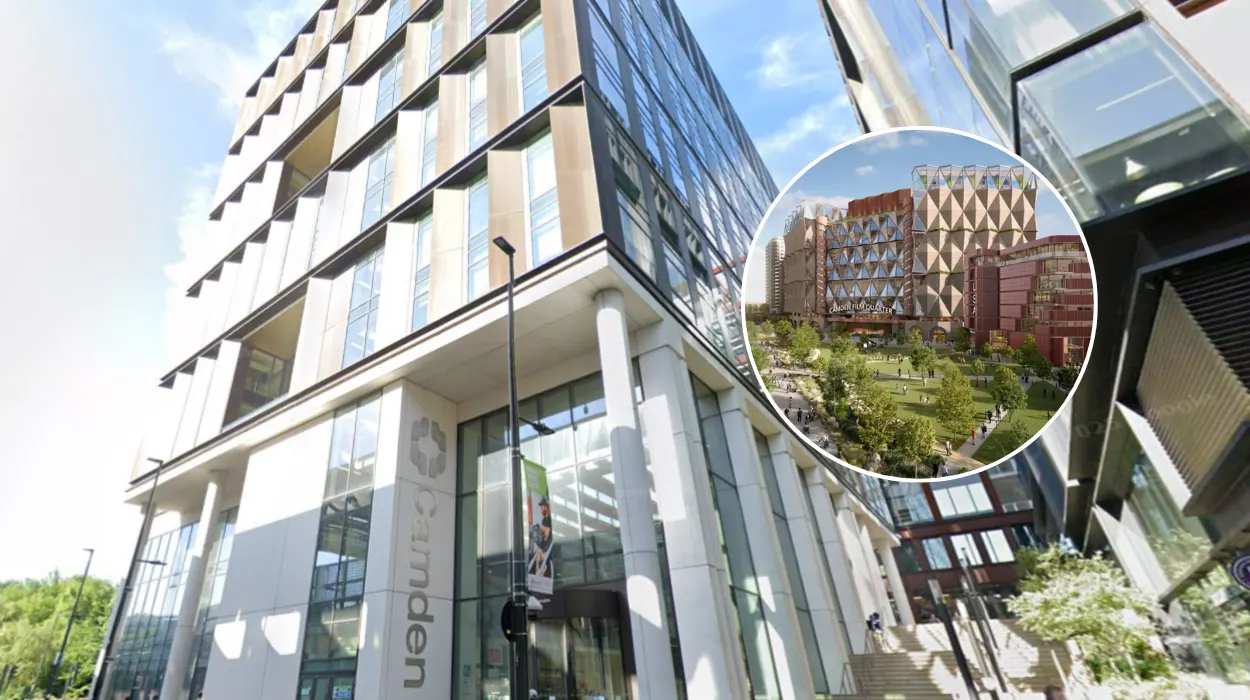
London (Extra London News) June 16, 2026 – A monumental £1 billion urban regeneration masterplan that will transform a central London industrial estate into a world-class movie-making hub has secured planning approval from Camden Council following a dramatic, deadlocked town hall vote. The highly anticipated Camden Film Quarter, spanning the Regis Road industrial estate in Kentish Town (NW5), is poised to become one of the largest and most architecturally innovative film and television production campuses in the United Kingdom and Europe. Developed by real estate investment firm Yoo Capital and designed by local architecture practice SPPARC, the mixed-use development will bring together 11 state-of-the-art, vertically “stacked” sound stages, over 100,000 square feet of creative and employment space, educational facilities for more than 500 industry learners, and 485 new homes—half of which are designated as affordable housing.
- What Happened During the Dramatic Camden Council Planning Vote?
- Why Are Local Civic Groups Warning of a “Grenfell-Style” Fire Risk?
- How Will the “Stacked” Film Studio Design Change London’s Architecture?
- What Economic and Employment Benefits Does the Project Promise?
- Who Will Operate the Sound Stages and Manage the Affordable Housing?
- How Will the Project Bridge the Gap Between Screen Education and Employment?
- What Are the Environmental and Heritage Features of the Masterplan?
- Why is Camden the Ideal Location for a Mini-Hollywood?
The project promises to act as a significant economic engine, supporting roughly 3,960 direct operational jobs and creating 5,155 net additional employment opportunities overall, while breathing new life into local heritage assets like the Grade II-listed Kentish Town Police Station. However, the decision was achieved by the narrowest of margins during a marathon four-hour meeting, where community groups raised serious fire safety concerns regarding the unusual co-location of residential apartments directly above a newly enclosed municipal recycling centre.
What Happened During the Dramatic Camden Council Planning Vote?
The path to approval for the £1 billion masterplan proved to be highly contentious, exposing deep ideological splits within the local authority and the surrounding community. As reported by Dan Carrier of the Camden New Journal, the 10-strong Town Hall planning committee found itself completely divided after an exhaustive four-hour debate regarding the scale and safety of the Kentish Town overhaul.
The committee split down the middle with a five-to-five tie, forcing the newly appointed planning chair, Liam Martin-Lane, to utilize his decisive casting vote to break the deadlock and push the controversial multi-million-pound scheme through. The site, which is currently a restricted industrial yard housing a council repairs depot and a commercial waste site, will see buildings soaring up to 24 storeys in height.
The political opposition to the project featured an unusual cross-party alliance. Dan Carrier of the Camden New Journal noted that Green Councillor Lorna Jane Russell joined forces with Camden Conservative leader Councillor Steve Adams to formally speak out against the sheer density and specific infrastructural risks of the project, urging that the masterplan be sent back to the drawing board for comprehensive revisions.
Why Are Local Civic Groups Warning of a “Grenfell-Style” Fire Risk?
The most fierce resistance to the Camden Film Quarter stemmed from its ground-breaking but highly experimental structural integration of industrial municipal services and residential living. During the public deputations, local residents and civic organizations expressed profound anxiety about the safety of future tenants.
As reported by Dan Carrier of the Camden New Journal, Kentish Town Neighbourhood Forum vice-chair Dee Searle delivered a stern warning to the committee regarding the structural layout. Searle stated that:
“Nowhere else in Britain are homes built over recycling centres — and with good reason. Recycling centres are a major fire risk, not least because of the growth in the disposal of lithium-ion batteries. If committee members would not wholeheartedly be happy to move into one of the proposed new flats above a recycling centre, please reject this application.”
Searle explicitly warned that the co-location posed an unacceptable fire hazard that could potentially turn the development into “Camden’s version of Grenfell.” Despite these stark warnings, the development team assured the committee that advanced technical shielding, structural isolation, and modern fire suppression systems would be thoroughly engineered into the new enclosed Reuse and Recycling Centre to make it safer, cleaner, and vastly more efficient than the existing open-air depot.
Explore more Camden News:
Camden Fringe Celebrates 20th Anniversary with 400 Shows: London 2026
Dead Dads Club and Touch Cookie Rock Camden Assembly: London 2026
How Will the “Stacked” Film Studio Design Change London’s Architecture?
From an architectural standpoint, the Camden Film Quarter represents a radical departure from traditional, sprawling film studio layouts typically found in suburban or rural environments, such as Pinewood or Shepperton. Because urban land in central London is incredibly scarce and expensive, the design team had to innovate vertically.
As reported by Daniel Gayne of Housing Today, Trevor Morriss, the principal at architecture firm SPPARC, explained that the masterplan represents a completely new way of thinking about urban space. Morriss stated that:
“The stacked studio arrangement is a new typology for London. This approach creates the space to deliver a complete neighbourhood that includes housing, education and a rigorous green landscape rather than a single-use enclave.”
Morriss further elaborated on the philosophical intent behind the layout, telling Housing Today:
“Camden Film Quarter reimagines what a modern urban district can be. Rather than separating industry, education, housing and public life, the masterplan brings them together in a highly connected and walkable neighbourhood. The design opens up a previously inaccessible industrial estate, creates new parks and public spaces, improves connections across the area and establishes a distinctive new destination for Camden.”
To achieve this vertical model safely, the 11 sound stages will utilize highly advanced acoustic isolation and heavy-duty vibration control technologies, allowing multiple high-budget Hollywood productions to film simultaneously on different floors without any sound bleed. The developers cited similar successful vertical projects globally, such as the recently completed Wildflower Studios in Queens, New York, as proof that dense urban environments can successfully host world-class filming infrastructure.
What Economic and Employment Benefits Does the Project Promise?
The core financial and social justification for the massive scheme lies in its projected economic impact on both the local borough and the wider UK creative landscape. According to official project briefs published by Construction Enquirer, the film quarter will act as a major economic driver for North London.
The development is slated to deliver:
- 3,960 direct operational jobs permanently based within the quarter.
- 5,155 net additional jobs overall across the supply chain, engineering, and hospitality sectors.
- More than 100,000 sq ft of dedicated creative, post-production, and general employment workspace.
As reported by BE News, Lloyd Lee, the co-founder and managing partner of Yoo Capital, emphasised that the project was deliberately balanced to provide both commercial power and civic utility. Lee stated that:
“Camden Film Quarter is much more than a film studio development. It is a complete creative ecosystem that brings together production, education, employment, homes, culture and public space within a single integrated vision.”
Lee further added that the commercial side of the development directly funds its social components:
“The project reflects our belief that development should be both fiscally and socially responsible. The studios provide the economic engine that helps deliver affordable homes, education, public space, community infrastructure and long-term opportunities for local people.”
Who Will Operate the Sound Stages and Manage the Affordable Housing?
To execute a project of this scale, Yoo Capital has assembled a consortium of specialist operators and delivery partners, dividing the commercial studio components and the residential blocks between sector leaders.
The 11 state-of-the-art sound stages will be managed and operated by Oxygen Studios, a highly experienced UK industry consultancy known for its work on major filming sites like Longcross and Arborfield Studios. As reported by BE News, Jonathan Greenfield, the chief executive of Oxygen Studios, highlighted the strategic importance of the site amid a global content boom. Greenfield stated that:
“Camden Film Quarter represents a significant opportunity for both the UK screen industry and London. Demand for high quality studio infrastructure continues to grow, and this project responds by providing world class production facilities in one of the most connected and creative locations in the country.”
Greenfield added that the true value lies in the physical proximity of different industry sectors:
“What makes Camden Film Quarter truly unique is the way it brings together studios, production and post-production space, creative businesses, education and future talent within a single ecosystem.”
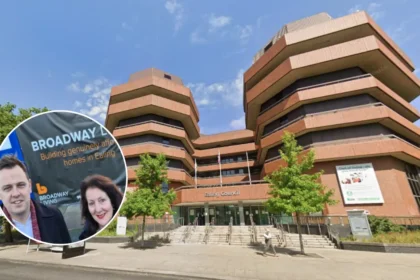
On the residential side, housing association Places for People has been brought in to deliver the housing masterplan, which was designed in conjunction with architect practice Broadway Malyan. Out of the 485 new homes approved for the site, exactly 243 units (50%) will be legally bound as affordable housing, helping to address Camden’s acute shortage of affordable municipal living spaces.
How Will the Project Bridge the Gap Between Screen Education and Employment?
A fundamental pillar of the Camden Film Quarter is its “education-to-employment” pipeline, designed to train the next generation of British filmmakers, directors, and technical crew directly on-site. The campus will house dedicated, state-of-the-art facilities for more than 500 learners simultaneously.
This educational framework will be anchored by two of the country’s premier institutions:
- The National Film and Television School (NFTS): Globally recognized for producing Oscar- and BAFTA-winning behind-the-scenes talent.
- The London Screen Academy (LSA): A pioneering sixth-form academy founded by leading Hollywood producers to diversify the film industry.
By placing these classrooms literally next door to 11 active Hollywood-grade sound stages, students will have unprecedented access to practical industry experience, apprenticeships, and direct pathways into employment without needing to leave the borough.
What Are the Environmental and Heritage Features of the Masterplan?
In addition to the physical buildings, the SPPARC-designed masterplan places a heavy emphasis on transforming the environmental profile of what is currently a heavily polluted, concrete-dominated industrial yard. The sustainability strategy, engineered by consultancy Atelier Ten with landscaping by Spacehub, aims to deliver a net-zero carbon neighbourhood.
The approved environmental and public realm features include:
- 1.1 hectares (2.8 acres) of brand-new, publicly accessible green open space and parks.
- 301 new trees planted across the walkable, reconnected neighborhood.
- A 190% Biodiversity Net Gain, drastically increasing local flora and fauna.
- An on-site energy centre designed to provide localized, low-carbon power to both the residential homes and the intensive creative studio facilities.
Furthermore, the project will celebrate local architectural history through the long-term conservation and adaptive reuse of the Grade II-listed Kentish Town Police Station. The historic building will be fully restored and seamlessly integrated into the wider creative campus, protecting its structural heritage while giving it a modern, functional purpose within the tech and film cluster.
Why is Camden the Ideal Location for a Mini-Hollywood?
The approval of the Camden Film Quarter solidifies the borough’s rapidly growing reputation as a primary hub for global media. As noted by Phil de Semlyen, the global film editor for Time Out London, Camden has recently served as the back-drop for a string of massive cinematic releases and high-profile streaming series.
Recent major productions filmed extensively on location in Camden include:
- Bridget Jones: Mad About the Boy
- Steve McQueen’s World War II epic, Blitz
- Paddington in Peru (Paddington 3)
- The Amy Winehouse biopic, Back to Black
As reported by Time Out London, Simon Lear, the managing director of Camden Film Quarter, summarized the extensive local benefits that the finalized permission will bring. Lear stated that:
“Alongside world-class creative industry facilities, the project will deliver 485 homes, including 243 affordable homes, significant new public open space, education facilities supporting more than 500 learners, new jobs and long-term investment into Kentish Town. We look forward to continuing to work with local stakeholders as the project progresses.”
With formal planning permission now secured, Yoo Capital and Camden Council are set to progress into the detailed construction scheduling phases, preparing to unlock a localized, vertical creative ecosystem that will fundamentally reshape the economy, skyline, and cultural output of North London for decades to come.