Key Points
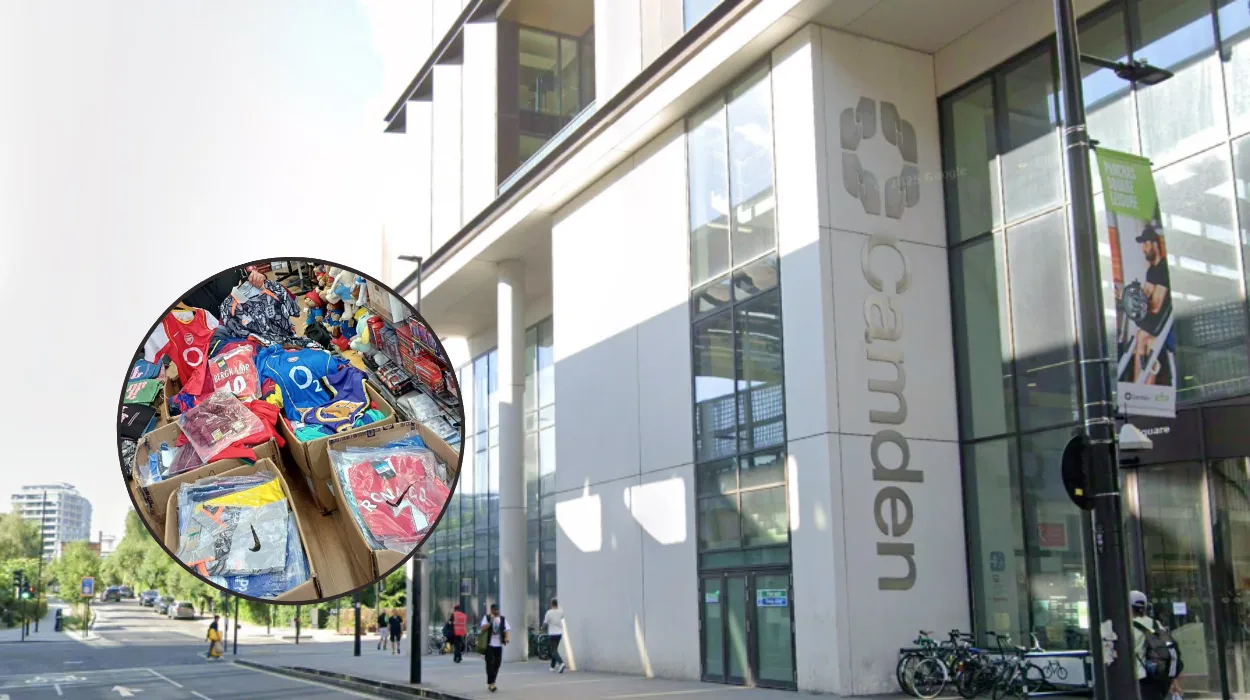
- Massive Financial Seizure: Camden Council trading standards officers have confiscated more than £400,000 worth of counterfeit football kits.
- Targeted Operations: A total of 4,425 illicit jerseys and strips were seized from the streets of North London in a condensed three-month enforcement window.
- Timeline of Raids: The major sweeps took place during targeted raids on shops and market stalls between February 2026 and May 2026.
- World Cup Exploded Demand: Rogue sellers deliberately ramped up their inventory and retail efforts in Camden Market to cash in on fans as the World Cup 2026 gets underway.
- Long-Term Data Revealed: Freedom of Information (FOI) requests submitted by casino.org uncovered that as many as 10,000 phony football strips have been successfully confiscated across Camden Market since January 2025.
- Severe Health Warning: Public health and trading officials have issued urgent warnings to football fans, revealing that low-quality counterfeit kits frequently contain harmful toxins and heavy metals.
Camden (Extra London News) June 18, 2026 – A massive enforcement operation executed by North London local authorities has resulted in the seizure of counterfeit football kits valued at over £400,000, striking a severe blow to intellectual property criminals attempting to exploit the kickoff of the World Cup 2026.
- Key Points
- What Spurred the Sudden Influx of Counterfeit Football Kits in Camden?
- How Many Illicit Items Were Discovered in the Three-Month Raid?
- What Did the Freedom of Information Requests Reveal About Camden Market?
- Why Are Public Officials Warning Football Fans About Toxic Apparel?
- What Are the Financial and Legal Liabilities of Buying Fakes?
- How Does Illicit Trade Damage the Wider Local Economy?
- How Do Fake Jerseys Connect to International Organized Crime?
- How Can Consumers Identify a Phony Football Strip?
- What Are the Next Operational Steps for Camden Authorities?
The local trading standards team, operating under the jurisdiction of Camden Council, executed a highly coordinated series of street and retail sweeps that netted exactly 4,425 illegitimate kits over a brief three-month operational window spanning from February 2026 to May 2026. The rapid surge in enforcement actions followed mounting intelligence that rogue street traders and market stalls across the historic Camden Market district were aggressively stockpiling and escalating the sales of unlicensed sports apparel to capitalize on an influx of domestic and international football fans.
Further investigative data obtained via Freedom of Information (FOI) requests by industry researchers at casino.org has brought the broader scale of the illicit market into sharp focus, exposing that an estimated 10,000 phony football strips have been pulled from the supply chain within Camden Market from January 2025 up to the current date. Beyond the financial impact on legitimate brands, manufacturing bodies, and official retail partners, regulatory experts have heightened public anxieties by issuing severe warnings regarding the physical safety of the garments, noting that scientific testing of contemporary counterfeit jerseys frequently reveals high concentrations of hazardous materials and industrial toxins.
What Spurred the Sudden Influx of Counterfeit Football Kits in Camden?
The primary driver behind the sudden saturation of illegal athletic wear in North London is the global spectacle of the World Cup 2026. As documented by local authorities, illegitimate suppliers systematically tracked tournament timelines, recognizing that demand for national team jerseys reaches an unprecedented peak immediately prior to the opening matches.
Rogue merchants operating throughout the heavily touristed stalls of Camden Market intentionally transformed their inventory profiles to cater to passing sports fans looking for a cheap bargain. Local investigators noted that instead of traditional souvenir apparel, storefronts were suddenly altered to display rows of replica jerseys representing top global footballing nations. This predatory retail shift prompted immediate alarms from local business groups and corporate brand protection units, who noted that legitimate traders were being systematically undercut during what should be their most profitable trading season of the decade.
Explore more Camden News:
Camden Council Approves £1bn Film Quarter: Kentish Town 2026
Camden Council Unveils Future-Built Talacre Sports Centre: Kentish Town 2026
How Many Illicit Items Were Discovered in the Three-Month Raid?
According to statistical logs published by the London Borough of Camden’s enforcement divisions, enforcement officers physically removed 4,425 individual kits from commercial distribution channels. The sheer volume of the haul indicates a highly organized wholesale distribution network capable of feeding large quantities of fake inventory into retail hubs overnight.
The operations, which targeted volatile black-market hotspots, required meticulous planning to ensure that stock could be gathered and logged before sellers could disperse or conceal their illegal goods. The valuation of the seized merchandise—exceeding £400,000—was calculated based on the equivalent losses that legitimate manufacturing brands would suffer if the items had successfully reached the consumer market.
What Did the Freedom of Information Requests Reveal About Camden Market?
The historical depth of the counterfeiting operation in North London was formally brought to light following an extensive data retrieval initiative. As reported by the analytical team at casino.org, Freedom of Information (FOI) requests submitted directly to local regulatory databases revealed that the multi-hundred-thousand-pound haul between February and May was merely the tip of a much deeper institutional iceberg.
The FOI disclosures confirmed that from January 2025 to the present day in 2026, a staggering total of roughly 10,000 phony football strips have been successfully intercepted and confiscated by trading standards teams within the boundaries of Camden Market alone. This metric demonstrates that despite persistent, long-term interventions by municipal officers, the market remains a highly resilient geographic focus for international intellectual property crime networks, which continually attempt to re-establish supply lines due to the immense foot traffic the area generates.
Why Are Public Officials Warning Football Fans About Toxic Apparel?
While the economic ramifications of intellectual property theft are severe, the overriding threat shifted directly to public health following a series of highly concerning chemical revelations. As noted in the warnings distributed by trading standards agencies, modern counterfeit jerseys and kits present an immediate, physical danger to the consumers who wear them.
Testing conducted on illicit clothing manufacturing chains shows that these items are regularly treated with unregulated chemicals to mimic the moisture-wicking and elastic properties of premium authentic sportswear. Public safety notices emphasize that because these items bypass all rigorous United Kingdom and European apparel safety evaluations, they consistently display hazardous levels of heavy metals, formaldehyde, and phthalates. Officials have firmly warned football fans that wearing these items—especially when sweating during active matches—can lead to severe skin irritation, systemic toxicity, and long-term health complications, concluding that consumers should only ever acquire merchandise from verified, official sellers.
What Are the Financial and Legal Liabilities of Buying Fakes?
How Does Illicit Trade Damage the Wider Local Economy?
The widespread availability of counterfeit goods acts as a direct economic drain on the legal commercial landscape of North London. When consumers knowingly or unknowingly purchase illegal strips, the capital leaves the legitimate economic ecosystem entirely, avoiding national taxation and local business rates that directly fund public services like schools, roads, and municipal policing.
Furthermore, legitimate sporting brands invest millions of pounds annually into licensing agreements, material innovation, and local employment infrastructure. The presence of unregulated traders offering rock-bottom prices directly penalises compliant businesses that play by the rules and adhere to fair wage standards for their employees.
How Do Fake Jerseys Connect to International Organized Crime?
Law enforcement groups have continuously sought to educate the public on the fact that counterfeiting is far from a victimless crime. Global intelligence reports verify that the production and distribution of counterfeit clothing are heavily intertwined with much darker transnational criminal enterprises.
The vast profit margins generated by selling £10 knockoff jerseys for £40 or £50 on the streets of London are frequently funnelled directly into financing operations involving human trafficking, narcotics distribution, and international money laundering. Security experts urge consumers to look past the initial cost savings of a cheap shirt and realize that their purchase may inadvertently be financing dangerous, underground criminal rings.
How Can Consumers Identify a Phony Football Strip?
With counterfeit production techniques advancing rapidly, telling the difference between a authentic shirt and a high-quality fake has become an increasingly complex task for the average shopper. However, several distinct manufacturing giveaways can help fans protect themselves from purchasing toxic or illegal goods.
| Feature / Detail | Genuine Official Retail Jerseys | Counterfeit / Phony Strips |
| Retail Price Point | Typically ranges from £65 to £150 depending on standard or player-spec editions. | Radically lower, often priced between £10 and £30 to lure bargain hunters. |
| Product & Styling Codes | Contains verified, unique internal factory tracking tags with matching digital entries. | Frequently features missing, duplicated, or completely non-existent style tags. |
| Stitching & Embroidery | Flawless, tight alignment with clean edges on club crests and sponsor logos. | Loose threads, crooked emblem placement, and poorly glued heat transfers. |
| Fabric & Material Quality | Lightweight, highly breathable, advanced technical fabrics with uniform texture. | Rough synthetic feel, inconsistent coloring, and heavy industrial chemical odor. |
| Authenticity Holograms | Features sharp, reflective metallic heat-pressed holograms with micro-text. | Flat, poorly printed plastic stickers that peel away easily after minimal friction. |
What Are the Next Operational Steps for Camden Authorities?
Following the successful execution of this massive pre-tournament sweep, Camden Council has signaled that its enforcement posture will remain elevated throughout the duration of the World Cup 2026. Trading standards teams, in close cooperation with regional police units and private brand protection experts, are expected to maintain highly visible patrols and flash inspections across known distribution hubs.
The local government has reiterated its commitment to protecting vulnerable tourists and consumers from being deceived by dishonest traders. Moving forward, the focus will expand beyond mere street confiscations to investigating the inner-city storage facilities, wholesale droppoints, and digital supply lines that feed these dangerous items into the retail stalls of North London. Municipal leaders have made it unequivocally clear that any business found engaging in the sale of illicit goods will face comprehensive asset forfeiture, immediate closure orders, and robust criminal prosecution under intellectual property legislation.