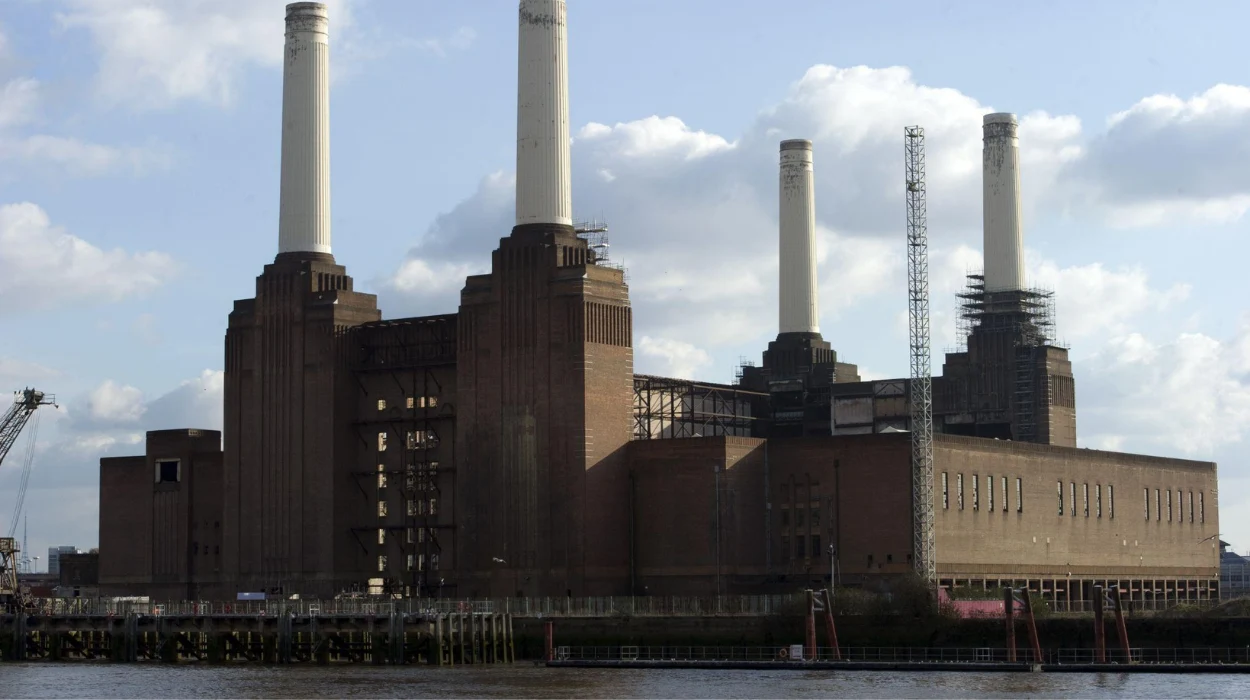
Battersea Power Station became one of Britain’s most important industrial landmarks because it combined large-scale electricity production, Art Deco architecture, and national cultural symbolism. Built in phases between 1929 and 1955, the station powered London for decades before becoming a globally recognised heritage regeneration project.
- How did London’s industrial expansion create the need for Battersea Power Station?
- What architectural features made Battersea Power Station unique?
- How did Battersea Power Station operate during its industrial peak?
- Why did Battersea Power Station fall into decline after closure?
- How was Battersea Power Station eventually saved from demolition?
- What cultural role does Battersea Power Station play in modern London?
- Why does Battersea Power Station remain historically significant today?
Battersea Power Station stands on the south bank of the River Thames in southwest London. The structure was designed as a coal-fired power station that supplied electricity to the growing metropolitan region during the twentieth century. Its architectural scale and four white chimneys became defining features of the London skyline.
The station was commissioned by the London Power Company, a consortium formed in 1925 to improve electricity generation efficiency across the capital. Before the creation of large centralised power stations, London relied on numerous smaller local generating facilities. These facilities produced inconsistent electricity supplies and created uneven distribution networks. Battersea represented a new phase of industrial consolidation.
Architect Sir Giles Gilbert Scott designed the station in an Art Deco style. Scott also designed the iconic red telephone box and worked on structures including Liverpool Cathedral. His approach combined engineering functionality with monumental civic architecture. This design philosophy distinguished Battersea from earlier industrial buildings.
The station’s visual identity expanded beyond engineering. During the late twentieth century, Battersea Power Station became associated with British popular culture. It appeared on the cover of the 1977 album Animals by Pink Floyd. The building also appeared in films, television productions, and advertising campaigns, reinforcing its international recognition.
Its survival into the twenty-first century reflected broader changes in British attitudes toward industrial heritage. Formerly neglected industrial structures increasingly became recognised as historically significant assets. Battersea became one of the most visible examples of adaptive reuse in Europe.
How did London’s industrial expansion create the need for Battersea Power Station?
Rapid urban growth, electrification, and industrial expansion during the early twentieth century created unprecedented energy demand in London. Centralised electricity generation became necessary to support homes, factories, transport systems, and public infrastructure across the capital’s expanding metropolitan economy.
By the early 1900s, London had become one of the world’s largest cities. Population growth accelerated electricity consumption in both residential and industrial sectors. Electric lighting replaced gas systems. Underground railway networks expanded. Factories adopted electrically powered machinery. Demand for stable electricity supplies increased sharply.
The Electricity (Supply) Act 1926 transformed Britain’s energy system. The legislation established the Central Electricity Board, which standardised electricity transmission and encouraged construction of efficient “superstations.” Battersea Power Station emerged directly from this policy environment.
The site in Battersea offered several logistical advantages. Its location beside the River Thames enabled easy coal transportation by barge. Rail infrastructure nearby simplified fuel delivery. Water from the Thames also supported cooling systems required for steam turbine operations.
Construction began on Battersea A Station in 1929. The first phase officially opened in 1933. A second phase, Battersea B Station, was completed in stages between 1944 and 1955. Together, the two sections created one of Europe’s largest brick buildings.
What architectural features made Battersea Power Station unique?
Battersea Power Station became architecturally unique because it combined monumental industrial engineering with refined Art Deco detailing. Its symmetrical structure, steel framework, cathedral-like turbine halls, and four concrete chimneys transformed a utility building into a major architectural landmark.
Sir Giles Gilbert Scott designed the station to reduce public opposition toward industrial expansion along the Thames. Earlier power stations often appeared visually harsh and polluted. Scott therefore prioritised elegance, symmetry, and civic dignity.
The structure used approximately six million bricks. Its steel frame supported enormous turbine halls and boiler rooms. The exterior incorporated strong vertical lines associated with Art Deco architecture, a style popular during the interwar period.
The four chimneys became the station’s defining feature. Positioned symmetrically at the corners of the central structure, they created a recognisable silhouette visible across London. Each chimney originally stood approximately 103 metres high.
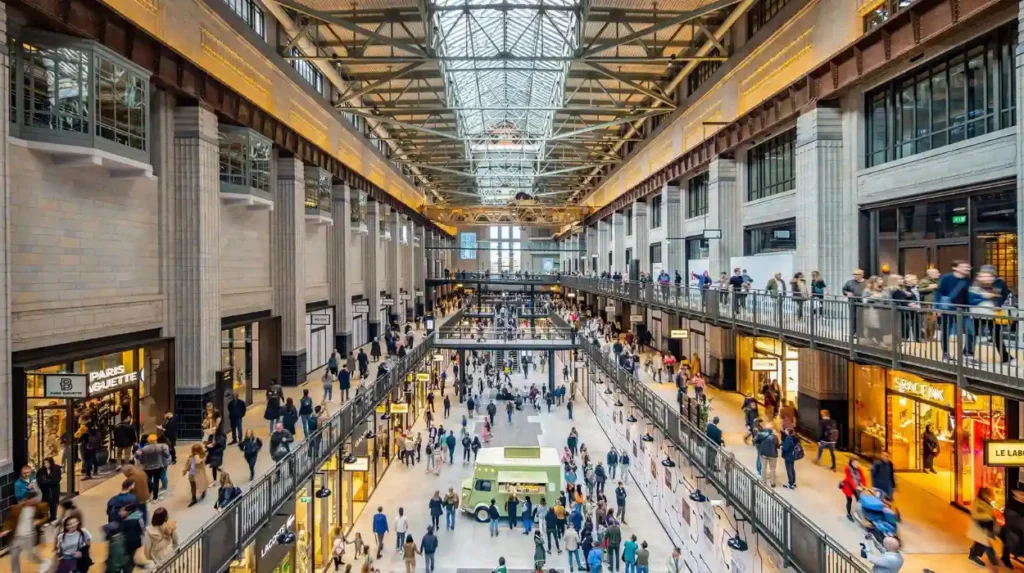
The turbine halls demonstrated exceptional interior design standards for industrial architecture. Italian marble floors, polished control panels, bronze detailing, and decorative ceilings reflected the belief that public infrastructure deserved aesthetic ambition.
Battersea A Station featured design elements associated with the 1930s. Battersea B Station incorporated slightly later stylistic influences from the post-war era. Together, the two phases documented architectural transition across mid-twentieth-century Britain.
The building later received Grade II* listed status in 2007. This classification recognised its exceptional national importance within British architectural heritage. Only a small percentage of listed buildings receive Grade II* protection.
How did Battersea Power Station operate during its industrial peak?
During its operational peak, Battersea Power Station burned coal to heat water into steam, which powered turbines connected to electrical generators. The station supplied electricity across London while employing hundreds of engineers, technicians, transport workers, and maintenance staff.
Coal arrived primarily by river transport. Barges unloaded fuel directly onto conveyor systems feeding the station’s boilers. The boilers heated water under extreme pressure to create steam. This steam rotated turbines that drove electrical generators.
The station’s engineering systems reflected advances in twentieth-century power generation efficiency. Steam temperatures and pressures increased over successive decades, improving electrical output. The infrastructure included control rooms, ash handling systems, water purification facilities, and extensive cooling mechanisms.
During the Second World War, Battersea Power Station became strategically important national infrastructure. Electricity production supported wartime manufacturing, transport, communications, and civil defence systems across London. The station therefore formed part of Britain’s protected industrial network.
Employment at the station involved diverse industrial professions. Engineers supervised turbines and electrical systems. Boiler operators maintained combustion processes. Maintenance workers repaired machinery and monitored structural conditions. River transport workers coordinated fuel deliveries.
The station also reflected environmental realities of coal-powered electricity generation. Coal combustion produced smoke, sulphur emissions, and ash pollution. London’s wider air pollution crisis during the mid-twentieth century intensified public concern regarding industrial emissions.
Technological change eventually reduced the station’s competitiveness. Oil-fired and later gas-powered stations offered improved efficiency and lower operating costs. National energy infrastructure gradually shifted away from coal dependency.
Why did Battersea Power Station fall into decline after closure?
Battersea Power Station fell into decline because industrial decommissioning created enormous maintenance costs, redevelopment challenges, and ownership instability. Its protected heritage status complicated demolition while the building’s massive scale discouraged commercially viable restoration projects for decades.
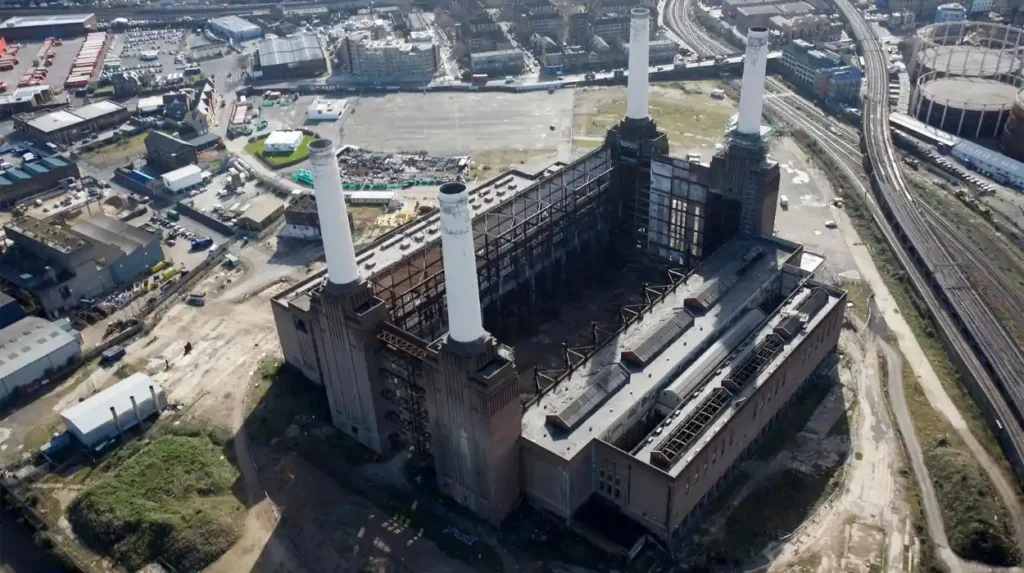
After closure in 1983, the building entered a prolonged period of uncertainty. The site’s size, contamination issues, and listed status created major redevelopment obstacles. Private developers repeatedly acquired the property but failed to complete viable regeneration plans.
The first major redevelopment proposal emerged during the 1980s. Developers planned to convert the station into a theme park with retail and entertainment facilities. However, financial problems halted the project before completion.
During this period, parts of the roof were removed to facilitate construction work. Exposure to weather accelerated structural deterioration. Rainwater damaged steel frameworks, internal finishes, and masonry surfaces. Conservation groups increasingly warned that the building faced possible collapse.
Ownership changed multiple times during the 1990s and early 2000s. Proposed schemes included shopping complexes, football stadium concepts, residential towers, and leisure developments. Most projects failed because of funding shortages or planning difficulties.
The station nevertheless remained culturally significant despite physical decline. Photographers, filmmakers, historians, and urban explorers documented the structure extensively. Public campaigns demanded preservation rather than demolition.
How was Battersea Power Station eventually saved from demolition?
Battersea Power Station survived because preservation campaigns, international investment, heritage protections, and large-scale urban regeneration planning combined to create a financially viable redevelopment strategy. Restoration accelerated after a Malaysian-led consortium purchased the site in 2012.
The decisive turning point occurred in 2012 when a consortium of Malaysian investors acquired the site. The consortium included SP Setia, Sime Darby Property, and the Employees Provident Fund of Malaysia. Their redevelopment strategy integrated residential, commercial, retail, cultural, and public infrastructure uses.
Restoration required extensive engineering intervention. The four chimneys had deteriorated significantly and required careful reconstruction using historically accurate materials and dimensions. Engineers also stabilised brickwork, repaired steel frameworks, and restored internal Art Deco features.
The redevelopment formed part of the wider Nine Elms regeneration zone. This major urban redevelopment initiative transformed former industrial land along the south bank of the Thames into mixed-use residential and commercial districts.
Transport infrastructure played a critical role in viability. The Northern line extension opened new Underground stations at Battersea Power Station and Nine Elms in 2021. Improved connectivity increased investment confidence and public accessibility.
Adaptive reuse became central to the restoration strategy. Rather than preserving the building solely as a static monument, developers integrated contemporary commercial functions into the historic structure.
What cultural role does Battersea Power Station play in modern London?
Modern Battersea Power Station functions as a cultural, commercial, and tourism destination that connects industrial heritage with contemporary urban life. The restored complex now supports exhibitions, retail activity, restaurants, offices, entertainment venues, and public heritage interpretation.
The reopened development transformed Battersea from an abandoned industrial structure into a mixed-use cultural district. Visitors now experience both preserved historical features and modern commercial facilities within the same architectural environment.
Public interpretation programmes explain the station’s industrial history through exhibitions, guided experiences, archival displays, and preserved control rooms. These initiatives support educational tourism and heritage awareness.
The building also contributes to London’s wider identity as a city that reinvents industrial infrastructure. Similar regeneration examples include Tate Modern and King’s Cross Station redevelopment areas.
Tourism activity increased substantially after reopening phases began in 2022. Retail brands, restaurants, cafés, cinemas, and event spaces attracted domestic and international visitors. The station therefore shifted from energy production to experience-based urban consumption.
Lift 109 became one of the development’s major attractions. This glass elevator transports visitors to a viewing platform positioned within one of the chimneys, offering panoramic views across London. To experience this historic landmark in person today, consult our comprehensive [Visiting Battersea Power Station: Shopping, Food & Lift 109] for itineraries and visiting parameters.
The site also houses office space for major companies including Apple, which established a significant London campus within the redevelopment area.
Why does Battersea Power Station remain historically significant today?
Battersea Power Station remains historically significant because it documents Britain’s industrial modernisation, architectural ambition, urban transformation, and heritage preservation movement. Its survival provides a physical record of twentieth-century energy production and twenty-first-century adaptive urban redevelopment.
The station represents several interconnected historical narratives. First, it illustrates the expansion of electrical infrastructure that transformed modern urban life. Second, it reflects the relationship between architecture and industrial engineering during the twentieth century. Third, it demonstrates changing attitudes toward preservation and regeneration.
Few industrial structures achieved comparable international cultural recognition. Battersea became both an operational power station and a symbolic image embedded within global media culture.
Its preservation also ensured continuity within London’s historical landscape. Many industrial sites across Europe disappeared entirely during redevelopment phases. Battersea instead retained substantial physical authenticity while adapting to new urban functions.
Educationally, the building offers insight into Britain’s coal economy, labour systems, technological development, and environmental history. Students and researchers continue using the site to study industrialisation and urban infrastructure.
Architecturally, the station remains one of the world’s largest surviving brick buildings. Its Art Deco detailing and monumental scale continue attracting international architectural interest.
Economically, the redevelopment generated employment, tourism revenue, and investment across the wider Nine Elms district. The project therefore demonstrated how heritage preservation can support long-term urban regeneration strategies.
Battersea Power Station ultimately evolved from an industrial utility into a civic landmark. Its journey from coal-powered electricity generation to cultural and commercial reinvention reflects broader transitions in British society across the twentieth and twenty-first centuries.
Where is Battersea Power Station located?
Battersea Power Station is located on the south bank of the River Thames in southwest London within the Nine Elms district.