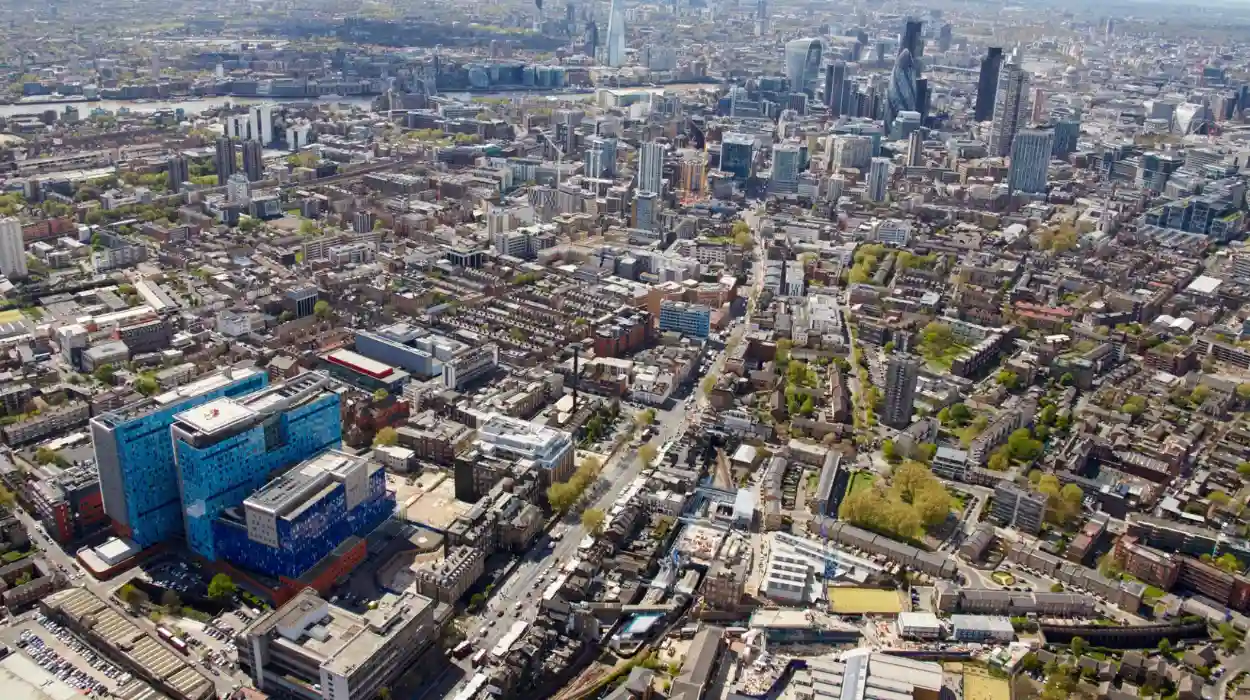
London’s East End is one of the most historically significant urban districts in Britain. Located east of the medieval City of London, the area developed through centuries of migration, industrial expansion, social transformation, and cultural reinvention. From Huguenot silk weavers and Jewish refugees to Bangladeshi communities and modern creative industries, the East End reflects the broader history of London itself.
- Why is London’s East End historically important?
- How did the East End develop during the medieval and early modern periods?
- How did immigration shape the East End’s identity?
- Huguenot Settlement in the Seventeenth Century
- Jewish Immigration in the Nineteenth Century
- Bangladeshi Migration in the Twentieth Century
- What role did industry play in the East End’s growth?
- Why was the East End associated with poverty and social reform?
- How did the East End change during the twentieth century?
- How did Brick Lane and Spitalfields become cultural landmarks?
- What historical landmarks preserve the East End’s past?
- How does the East End influence London today?
- What is the lasting legacy of London’s East End?
Today, neighbourhoods such as Brick Lane, Spitalfields, Whitechapel, Bethnal Green, Limehouse, and Stepney preserve layers of historical development that reveal how immigration and industry shaped one of Europe’s most dynamic urban landscapes. The East End remains a living record of economic change, cultural diversity, and urban regeneration.
Why is London’s East End historically important?
London’s East End became historically important because it served as Britain’s principal destination for immigrant communities, industrial workers, and dock labourers. Its economic role, cultural diversity, and social reforms shaped modern London and influenced national debates about urban development, migration, housing, and public health.
The East End emerged outside the ancient walls of the City of London. During the medieval period, industries considered undesirable within the city boundaries settled in eastern districts. These included tanning, brewing, shipbuilding, and manufacturing activities that required large amounts of space.
By the sixteenth century, the area had become an important economic zone connected to the River Thames. Its proximity to the port enabled trade with Europe, Asia, Africa, and the Americas. Goods arriving from around the world entered London through eastern docks, creating employment opportunities that attracted workers from Britain and abroad.
The East End also became known for its distinct social identity. While London’s West End developed as a centre of government, wealth, and aristocratic life, the East End became associated with industry, labour, migration, and working-class communities.
This contrast shaped many political discussions throughout British history. Debates about poverty, housing conditions, public health, and workers’ rights frequently focused on the East End because the area reflected the challenges created by rapid urbanisation.
How did the East End develop during the medieval and early modern periods?
The East End developed through trade expansion, riverside industries, and population growth beyond London’s medieval walls. Strategic access to the Thames encouraged shipbuilding, commerce, and manufacturing, establishing the foundations for centuries of economic activity and urban expansion.
Before the Norman Conquest of 1066, settlements already existed east of London. However, significant development accelerated during the medieval era as London’s population increased.
The River Thames served as the primary transportation route. Merchants relied on docks, warehouses, and riverside facilities to handle imports and exports. Industries requiring waterfront access concentrated in eastern districts because land was more available and regulations were less restrictive than inside the City of London.
Growth of Maritime Industries
Shipbuilding became a major economic activity. Timber yards, ropeworks, sailmakers, and repair facilities supported England’s growing naval and commercial fleets.
The nearby district of Limehouse became known for maritime services. Skilled craftsmen produced equipment required for ocean voyages, helping Britain expand international trade networks.
Expansion Beyond City Boundaries
As London’s population grew from approximately 50,000 residents in the early sixteenth century to more than 200,000 by 1600, residential development expanded eastward.
Workers employed in riverside industries settled near their workplaces. New communities emerged around markets, churches, and manufacturing centres, creating the foundation of the modern East End.
How did immigration shape the East End’s identity?
Immigration shaped the East End by introducing new skills, industries, religions, languages, and cultural traditions. Successive migrant communities transformed local economies while creating multicultural neighbourhoods that continue defining the area’s identity in the twenty-first century.
Few places in Britain demonstrate the impact of immigration as clearly as London’s East End.
For over 400 years, migrants arrived seeking economic opportunities, religious freedom, and safety from persecution. Each community contributed distinct cultural and economic influences.
Huguenot Settlement in the Seventeenth Century
The first major migration wave involved French Protestant refugees known as Huguenots.
Following religious persecution in France, thousands settled in Spitalfields during the late seventeenth century. Many worked as highly skilled silk weavers.
The Huguenots transformed Spitalfields into a centre of textile production. Elegant Georgian houses built for master weavers still survive today, representing one of London’s most significant architectural legacies.
Jewish Immigration in the Nineteenth Century
During the nineteenth century, large numbers of Jewish immigrants arrived from Eastern Europe.
Many fled anti-Jewish violence, discrimination, and economic hardship in the Russian Empire and neighbouring regions. By the late nineteenth century, Whitechapel had become one of the largest Jewish communities in Britain.
Jewish residents established synagogues, schools, businesses, charitable organisations, and cultural institutions that significantly influenced East End life.
Bangladeshi Migration in the Twentieth Century
After the Second World War, migrants from what is now Bangladesh increasingly settled in the East End.
Many originated from the Sylhet region and found employment in manufacturing, textiles, and service industries. Brick Lane gradually became the centre of Britain’s Bangladeshi community.
Today, Bangladeshi culture remains a defining feature of the East End, reflected through restaurants, community organisations, festivals, and businesses.
What role did industry play in the East End’s growth?
Industry drove East End expansion by creating employment in docks, shipbuilding, textiles, manufacturing, and trade. Industrial growth attracted migrants, increased population density, and transformed the district into one of Britain’s most important economic centres during the eighteenth and nineteenth centuries.
Industrialisation fundamentally altered the East End.
The area’s strategic location near the Thames made it ideal for warehouses, factories, and transportation infrastructure.
The Importance of the London Docks
The construction of major dock systems revolutionised trade.
Examples include the West India Docks (1802), East India Docks (1806), and Royal Docks (1855). These facilities improved cargo handling efficiency and expanded London’s role as a global commercial centre.
By the nineteenth century, London operated the world’s largest port.
Thousands of dockworkers loaded and unloaded commodities including tea, sugar, tobacco, spices, timber, and manufactured goods.
Manufacturing and Textiles
The East End supported diverse manufacturing industries.
Examples included furniture production, clothing manufacture, printing, metalworking, food processing, and textile weaving.
Factories generated employment opportunities but also contributed to overcrowding, pollution, and difficult working conditions.
Population Growth
Industrial employment attracted large numbers of workers.
The population of East London expanded dramatically during the nineteenth century. Dense housing developments emerged close to factories and docks, creating some of Britain’s most crowded urban neighbourhoods.
Why was the East End associated with poverty and social reform?
The East End became associated with poverty because rapid industrialisation outpaced housing, sanitation, and public services. These conditions attracted reformers, researchers, and policymakers who used the area to advocate improvements in public health, labour rights, and urban planning.
Victorian observers frequently described the East End as a symbol of urban poverty.
Rapid population growth placed enormous pressure on housing and infrastructure.
Many residents lived in overcrowded tenements lacking adequate sanitation. Disease outbreaks occurred regularly due to poor living conditions.
Social Investigations
Researchers documented these challenges in unprecedented detail.
One of the most influential studies came from social researcher Charles Booth, whose surveys mapped poverty across London during the late nineteenth century.
Booth’s findings revealed substantial inequalities and influenced future social policies.
Public Health Reforms
Health concerns prompted government intervention.
Examples included sewer construction, housing regulation, sanitation improvements, and disease prevention initiatives.
These reforms gradually improved living conditions while establishing modern approaches to urban public health.
Labour Activism
Workers organised campaigns demanding better wages and conditions.
The Matchgirls Strike of 1888 and the London Dock Strike of 1889 became important milestones in British labour history.
These events demonstrated the growing political influence of working-class communities and contributed to broader labour reforms.
How did the East End change during the twentieth century?
The twentieth century transformed the East End through war, deindustrialisation, reconstruction, migration, and regeneration. Traditional industries declined while new communities and economic sectors emerged, reshaping both the physical landscape and social structure of the district.
The twentieth century brought profound changes.
Economic, political, and technological developments altered the East End’s role within London.
The Impact of the Second World War
The East End suffered extensive damage during German bombing campaigns.
Because docks and industrial facilities were strategic targets, neighbourhoods across East London experienced severe destruction during the Blitz between 1940 and 1941.
Thousands of buildings were damaged or destroyed.
Post-war reconstruction programmes introduced new housing developments and modern infrastructure.
Decline of the Docks
Containerisation transformed global shipping after the 1950s.
Traditional dock facilities became increasingly obsolete. Cargo operations gradually relocated to larger ports capable of accommodating modern container vessels.
By the early 1980s, many East London docks had closed.
This transition caused significant job losses and economic disruption.
Urban Regeneration
Regeneration initiatives sought to revitalise former industrial land.
The creation of the London Docklands Development Corporation in 1981 accelerated redevelopment projects.
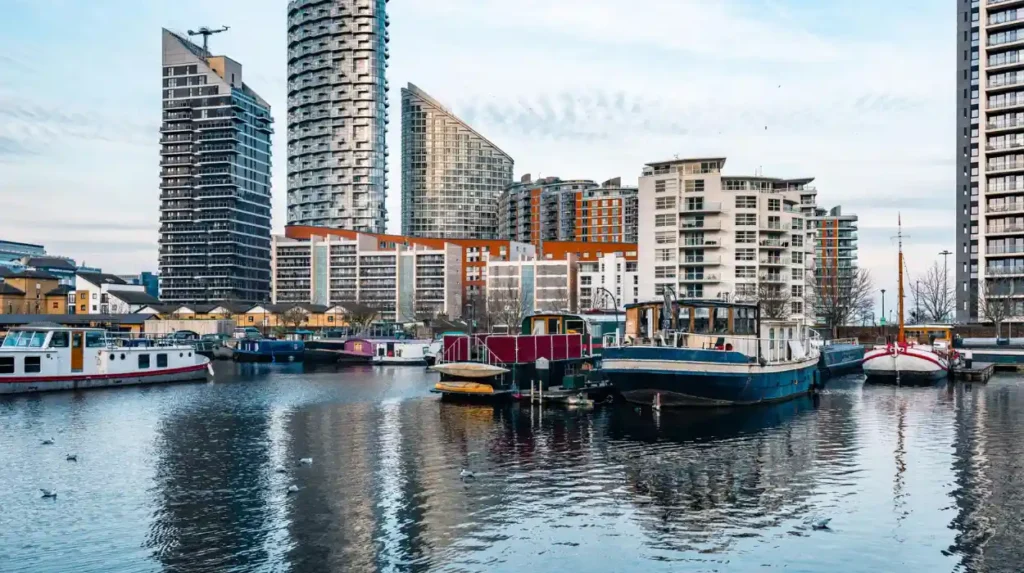
Former dock areas evolved into business districts, residential communities, and commercial centres.
How did Brick Lane and Spitalfields become cultural landmarks?
Brick Lane and Spitalfields became cultural landmarks through centuries of immigration, commerce, architecture, and creative activity. Historic buildings, markets, street art, and multicultural food traditions transformed these districts into internationally recognised destinations within London’s East End.
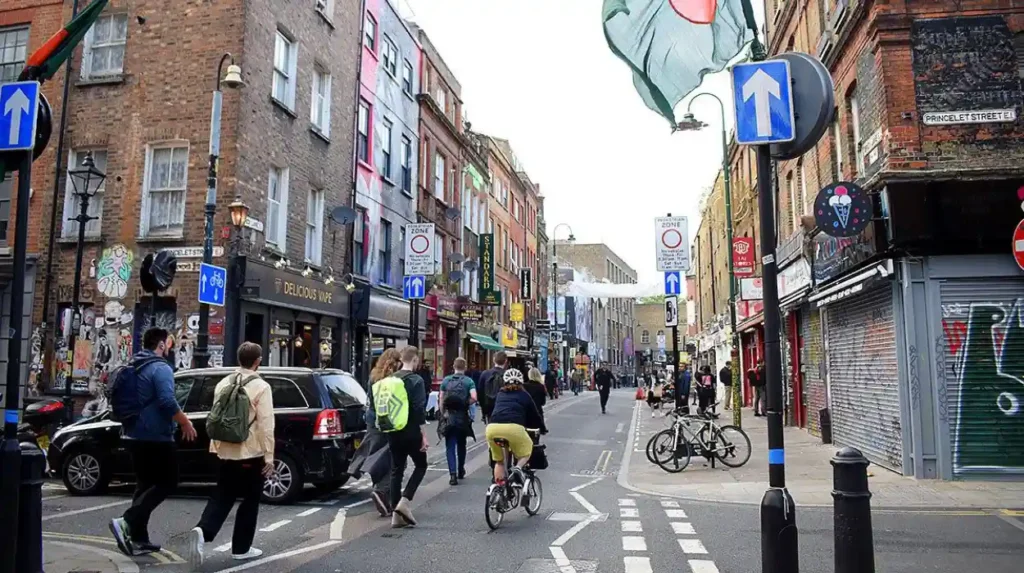
Brick Lane and Spitalfields represent the most visible expressions of East End cultural history.
Their streets contain architectural evidence of multiple migration waves and economic transformations.
Brick Lane’s Historical Evolution
Brick Lane takes its name from brick manufacturing activities established during the seventeenth century.
The street later became associated with Huguenot weavers, Jewish immigrants, and Bangladeshi communities.
Today, visitors encounter historic religious buildings reflecting these transitions. Several structures changed function over time from church to synagogue and later to mosque, illustrating centuries of demographic change.
Spitalfields Market and Architecture
Spitalfields developed around a medieval hospital and market district.
The area contains one of London’s most significant collections of Georgian architecture.
Historic homes built for silk weavers remain important heritage assets. Preservation efforts protected many structures during twentieth-century redevelopment.
To experience these historic districts in person today, consult our comprehensive [Exploring Brick Lane and Spitalfields: Food, Art, and Culture Walks] for itineraries and visiting parameters.
Food and Cultural Diversity
Food culture reflects centuries of migration.
Examples include traditional Jewish bakeries, Bangladeshi restaurants, international street-food vendors, and contemporary independent cafés.
This diversity attracts visitors interested in culinary history as well as modern cultural experiences.
What historical landmarks preserve the East End’s past?
Historical landmarks preserve the East End’s past through surviving industrial infrastructure, religious buildings, markets, museums, and residential architecture. These sites provide evidence of migration, commerce, labour history, and urban development across multiple centuries.
Numerous landmarks preserve important aspects of East End history.
Religious Buildings
Several religious structures demonstrate demographic transitions.
Examples include the former Huguenot chapel, synagogue, and mosque buildings found around Spitalfields and Brick Lane.
These sites reveal how successive communities adapted existing urban spaces.
Markets
Historic markets remain central to local identity.
Examples include Spitalfields Market and Petticoat Lane Market.
These commercial spaces preserve traditions of trade that extend back centuries.
Museums and Heritage Institutions
Institutions dedicated to East End history provide educational resources and preservation initiatives.
Collections document migration, labour history, social reform movements, and industrial development.
Archaeological discoveries continue expanding understanding of the area’s past.
How does the East End influence London today?
The East End influences modern London through cultural diversity, creative industries, heritage tourism, and urban regeneration. Its history informs contemporary discussions about migration, housing, economic development, and community identity throughout the capital.
The East End remains one of London’s most influential districts.
Its historical experiences continue shaping public policy and cultural life.
Migration patterns established traditions of multicultural coexistence that define modern London. Communities originating from Europe, Asia, Africa, and the Middle East contribute to the city’s global identity.
Creative industries increasingly occupy former industrial spaces. Art galleries, design studios, technology companies, and cultural venues operate within regenerated buildings that once supported manufacturing and shipping.
Heritage tourism also plays an important economic role. Visitors explore markets, museums, historic streets, and architectural landmarks that reveal centuries of social and economic transformation.
For educators and genealogical researchers, the East End provides valuable records documenting migration histories, occupational changes, and family lineages. Parish records, census documents, immigration records, and municipal archives offer extensive evidence of community development.
What is the lasting legacy of London’s East End?
London’s East End demonstrates how migration, industry, and adaptation shape urban societies over centuries. Its legacy lies in multicultural identity, industrial heritage, social reform achievements, and preserved historical landscapes that continue informing scholarship, tourism, and community life.
The history of the East End is fundamentally a history of change. Successive waves of immigrants introduced new traditions, skills, and institutions. Industrial growth transformed local economies and connected London to global trade networks. Social reform movements emerged in response to urban challenges and influenced national policy development.
Modern regeneration projects altered former industrial landscapes while preserving important historical assets. Brick Lane, Spitalfields, Whitechapel, Limehouse, and surrounding districts continue demonstrating how cities evolve through economic transition and cultural exchange.
Today, the East End stands as one of Britain’s most significant historical environments. Its streets, buildings, markets, and communities preserve evidence of over four centuries of migration, commerce, labour, and resilience. For historians, tourists, educators, and local residents, the East End remains an essential lens through which to understand the development of London and the broader story of modern urban Britain.
What is London’s East End?
London’s East End is the historic area located east of the ancient City of London. It includes neighbourhoods such as Spitalfields, Whitechapel, Bethnal Green, Stepney, Limehouse, and Brick Lane, and is known for its rich history of immigration, industry, and cultural diversity.