Extra London curates experiences for visitors seeking authentic cultural immersion. London hosts over 170 museums with free permanent collections. These institutions preserve artifacts spanning human history, science, and art. Entry remains free to core exhibits as of April 2026, funded by government grants and donations. Visitors access world-class collections without admission fees.
- Which museums in London offer free entry to permanent collections?
- What is the British Museum and why visit for free?
- What can you see at the Natural History Museum without paying?
- Why is the Science Museum a top free attraction in London?
- What makes the National Gallery essential for free art lovers?
- How does Tate Modern deliver free contemporary art?
- What British art awaits at free Tate Britain?
- Why visit the Victoria and Albert Museum for free design?
- What portraits define the National Portrait Gallery?
- Which other free museums should Extra London visitors prioritize?
- How do you plan a free museum itinerary in London?
- What are the operating hours and accessibility for free London museums?
- Are there costs hidden in London’s free museums?
- What impact do free museums have on London’s culture and economy?
Which museums in London offer free entry to permanent collections?
London provides free entry to permanent collections at the British Museum, Natural History Museum, Science Museum, National Gallery, Tate Modern, Tate Britain, Victoria and Albert Museum, National Portrait Gallery, and Imperial War Museum. These 25+ institutions welcome over 20 million visitors annually without charge. Special exhibitions require tickets.
The policy stems from a 2001 government initiative to democratize culture. Public funding via the Department for Culture, Media and Sport supports operations. Permanent collections cover history, art, science, and design. Mechanisms include timed reservations during peak periods to manage crowds. Examples include the British Museum’s 8 million artifacts and the Natural History Museum’s 80 million specimens. Data shows 70% of visitors attend free sites, boosting local economies by £1.2 billion yearly. Future relevance lies in digital expansions for global access.
British Museum defines universal human history through global artifacts. Natural History Museum displays dinosaur skeletons and minerals. Science Museum exhibits steam engines and space capsules. These draw 5.8 million visitors combined in 2025.
What is the British Museum and why visit for free?
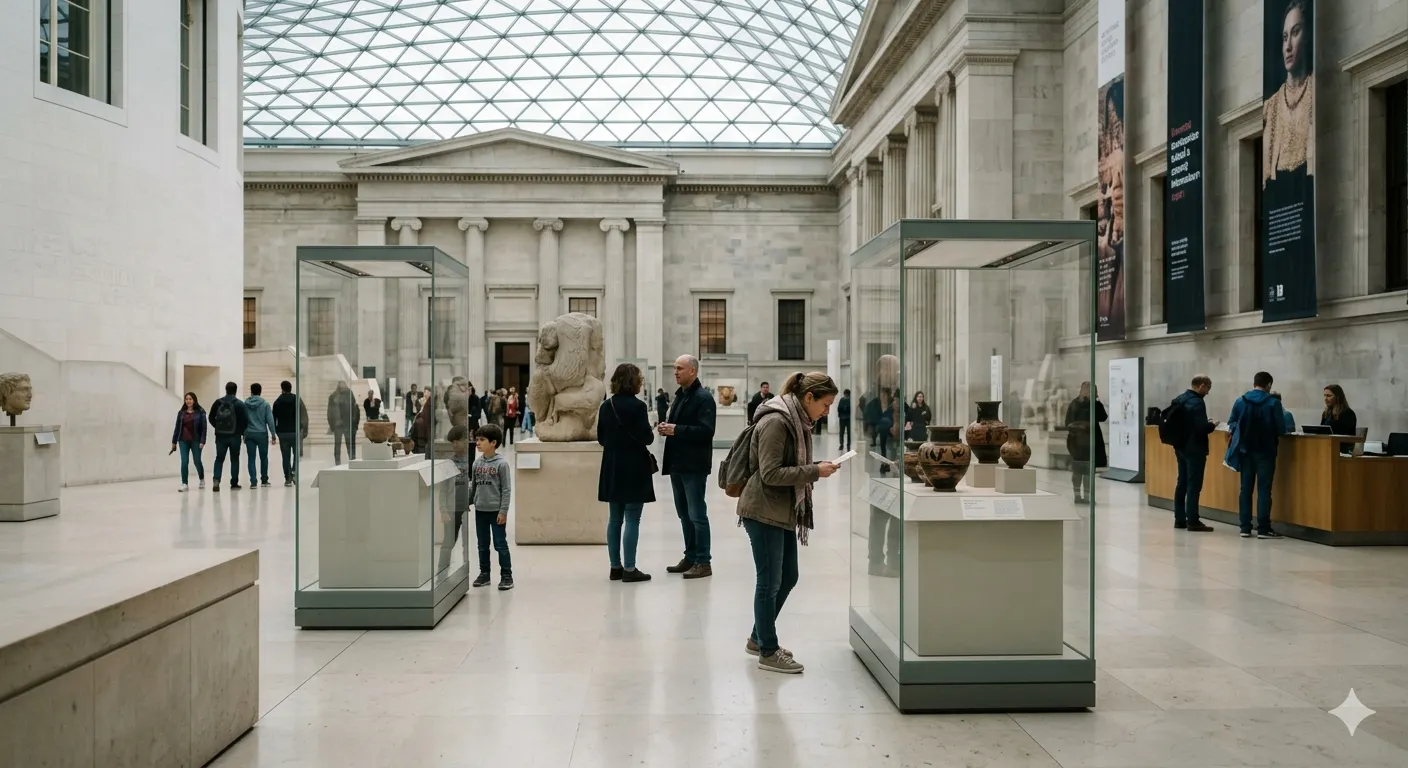
The British Museum, founded in 1753, offers free access to 8 million artifacts tracing 2 million years of human history. Located in Bloomsbury at Great Russell Street, WC1B 3DG, it features the Rosetta Stone, Parthenon sculptures, and Egyptian mummies. Open daily 10am-5pm, Fridays to 8:30pm.
Established by an Act of Parliament, the museum received Hans Sloane’s collection of 71,000 items. Historical context includes expansions in 1823 for Egyptian halls and in the 1970s for modern galleries. Key components encompass 94 galleries across archaeology, ethnography, and coins. Processes involve conservation labs restoring artifacts like the Sutton Hoo helmet. Real-world examples feature the Lewis Chessmen from 12th-century Scotland and Anglo-Saxon treasures. Statistics record 6.3 million visitors in 2025, with 40% international. Implications include educational programs reaching 1 million students yearly. Extra London recommends advance booking for Rosetta Stone viewing.
What can you see at the Natural History Museum without paying?
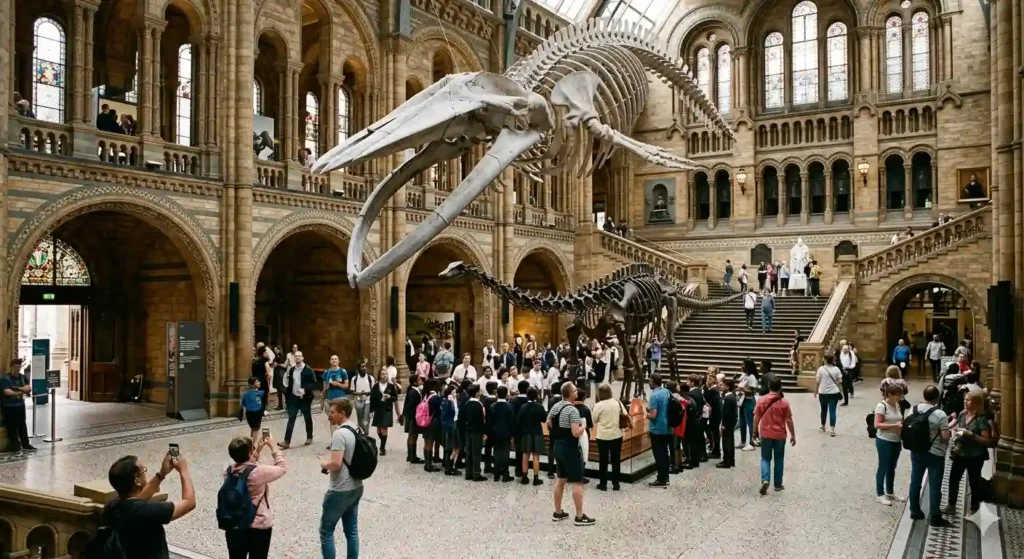
The Natural History Museum in South Kensington displays free dinosaur skeletons, gem collections, and earthquake simulators. Housed in a Romanesque building opened in 1881, it holds 80 million specimens. Open daily 10am-5:50pm, it attracted 4.4 million visitors in 2025.
Background traces to the 1880 separation from the British Museum. Historical context involves Charles Darwin’s influence on displays. Structure includes Hintze Hall with a blue whale skeleton named Hope. Mechanisms feature interactive zones like the Jurassic gallery. Examples encompass Dippy the Diplodocus cast and the Vault’s 400 jewels. Research insights from 300 scientists yield discoveries like new spider species. Impact reaches 500,000 schoolchildren via workshops. Extra London highlights family-friendly animatronics.
Why is the Science Museum a top free attraction in London?
The Science Museum, opened in 1857, provides free interactive exhibits on aviation, medicine, and space. Located at Exhibition Road, SW7 2DD, it spans seven floors with 4.5 million visitors yearly. Open daily 10am-6 pm.
Originally the Government School of Mines, it grew via the Great Exhibition artifacts. Key components include the Making the Modern World gallery. Processes demonstrate steam engines from 1829 and the Apollo 10 capsule. Real-world examples feature Wonderlab’s 450 experiments for £12 extra. Statistics show 70% family attendance. Implications involve IMAX screenings and STEM outreach to 100,000 youth. Extra London suggests priority for primary school-aged kids.
What makes the National Gallery essential for free art lovers?
The National Gallery, founded in 1824, houses 2,300 paintings from 1260 to 1900 free of charge. At Trafalgar Square, WC2N 5DN, it displays Van Gogh’s Sunflowers and Leonardo’s Virgin of the Rocks. Open daily 10 am-6 pm, Fridays to 9 pm.
Historical context follows a 500-painting bequest by George Beaumont. Structure is organized by national schools: Italian Renaissance, Dutch Golden Age. Mechanisms include free 60-minute tours. Examples cover Rembrandt self-portraits and Turner seascapes. Data indicates 5.5 million visitors in 2025. Impact fosters public appreciation via audio guides in 15 languages. Extra London pairs it with neighboring sites.
How does Tate Modern deliver free contemporary art?
Tate Modern, in a 2000-opened power station, offers free access to Turbine Hall installations and British art post-1900. Bankside, SE1 9TG, draws 5.8 million visitors. Open Sunday-Thursday 10 am-6 pm, Fridays-Saturdays to 9 pm.
Background from the Tate Gallery split in 1987. Historical context marks Unilever Series commissions. Key components: Blavatnik Building galleries. Processes rotate 20th-century works by Picasso and Warhol. Examples include the Rothko room and the Yayoi Kusama infinity mirrors seasonally. Statistics reflect 60% international crowd. Implications expand via the Hyundai Commission. Extra London notes riverside views.
What British art awaits at free Tate Britain?
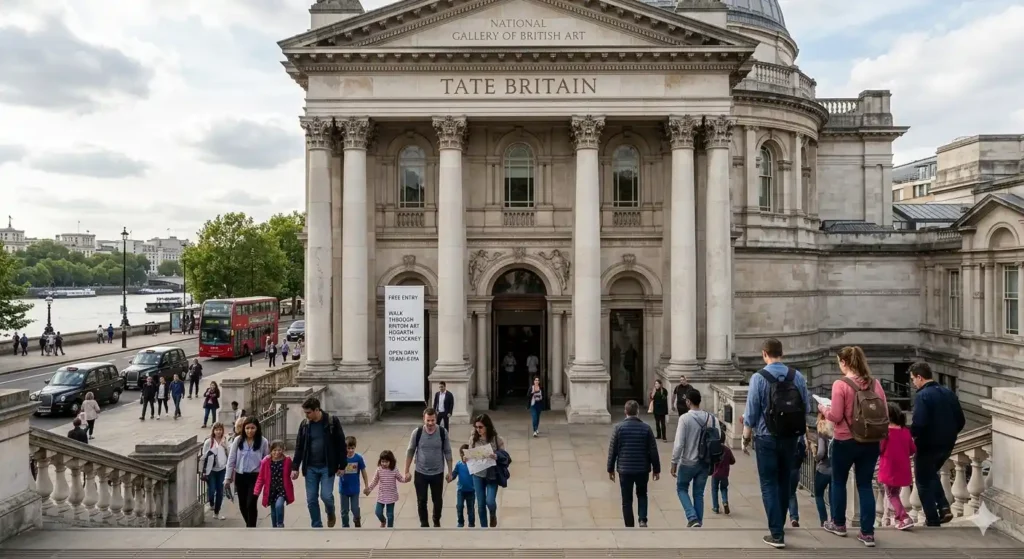
Tate Britain showcases 500 years of British art free, from Hogarth to Hockney. Millbank, SW1P 4RG, features Turner Prize works. Open daily 10 am-6 pm.
Founded in 1897 with Henry Tate’s sugar fortune. Structure follows a chronological Walk Through British Art. Mechanisms hosts the annual Turner Prize. Examples: Sargent’s Carnation Lily Lily Rose, Constable landscapes. Research tracks 500,000 visitors. Impact includes pre-Raphaelite revivals. Extra London recommendations for history buffs.
Why visit the Victoria and Albert Museum for free design?
The V&A, the world’s leading design museum since 1852, displays 2.8 million items in ceramics, fashion, and sculpture free. Cromwell Road, SW7 2RL, open daily 10 am-5:45 pm, Fridays to 10 pm.
Stemming from the 1851 Great Exhibition. Historical context: 1909 Aston Webb facade. Components: Cast Courts with Trajan’s Column replica. Processes conserve Raphael cartoons. Examples: Tippoo’s Tiger automaton, Jewellery Gallery. Data: 3.8 million visitors. Implications: V&A East Storehouse opening in 2025. Extra London eyes fashion exhibits.
What portraits define the National Portrait Gallery?
National Portrait Gallery, reopened in 2025 post-refurbishment, exhibits 22,000 likenesses of UK figures free. Charing Cross Road, WC2N 5HN, open daily 10:30 am-6 pm, Fridays to 9 pm.
Founded in 1856 for national identity. Structure: Now/Then/Forever chronology. Mechanisms: BP Portrait Award. Examples: Shakespeare Chandos portrait, royal family images. Statistics: 1.5 million visitors. Impact: Free audio guides decode identities. Extra London links to the National Gallery.
Which other free museums should Extra London visitors prioritize?
Imperial War Museum displays military history for free at Lambeth Road, SE1 6HZ. Wellcome Collection explores medicine at 183 Euston Road, NW1 2BE. The Horniman Museum features anthropology in Forest Hill. Openings vary; combined, 2 million visitors.
Background: IWM was founded in 1917. Processes: Tanks and aircraft restorations. Examples: Spitfire fighter, Holocaust exhibits. Wellcome: 1.5 million medical objects. Horniman: 350,000 items plus gardens. Data: 80% permanent free. Implications: Thematic depth for niches. Extra London selects for variety.
How do you plan a free museum itinerary in London?
Allocate 2-3 museums daily using an Oyster card for transport. Start central: British Museum morning, National Gallery afternoon. Book slots online. Total cost under £20, including lunch. Covers 10 sites in 4 days.
Macro context: Cluster by area—Kensington for science trio. Subtopics: Tube lines like Piccadilly. Details: Peak hours 11 am-3 pm. Implications: Avoid queues via 9 am arrivals. Extra London maps for multi-site days.
What are the operating hours and accessibility for free London museums?
Most open 10 am-5 pm or 6 pm daily, extended Fridays. Wheelchair access universal; audio guides free. Capacities cap at 50% post-2025 norms. Check websites for closures.
Mechanisms: RFID entry systems. Examples: British Museum lifts to all floors. Statistics: 90% ADA compliant. Impact: Inclusive for 15% disabled visitors.
Are there costs hidden in London’s free museums?
Donations requested; special exhibits charge £10-25. Gift shops and cafes add £5-15. No fees for core viewing.
Processes: Suggested £5 contribution. Implications: Budget £20 buffer. Extra London advises skipping temporaries.
What impact do free museums have on London’s culture and economy?
Free access draws 54 million visits yearly, generating £2.1 billion GDP. Educates 2 million students. Preserves 100 million artifacts.
Historical: Policy since 1971 Victoria & Albert. Data: Multiplier effect of 3.2x spend. Future: AI catalogs enhance reach.
Which museums in London are actually free to enter?
Many top museums in London offer free entry to their permanent collections, including the British Museum, Natural History Museum, Science Museum, National Gallery, Tate Modern, Tate Britain, Victoria and Albert Museum, National Portrait Gallery, and Imperial War Museum. You only pay for special exhibitions.