Leadenhall Market is one of London’s oldest commercial sites, with nearly 2,000 years of continuous trading history. It evolved from a Roman marketplace into a medieval food market and later became a celebrated Victorian architectural landmark that remains active today.
- How did the site function during Roman Londinium?
- How did Leadenhall Market develop during the medieval period?
- Why did Leadenhall Market become important to London’s economy?
- What changes occurred during the seventeenth and eighteenth centuries?
- How did Victorian architecture transform Leadenhall Market?
- What archaeological discoveries have been made beneath Leadenhall Market?
- How has Leadenhall Market been preserved in the modern era?
- Why does Leadenhall Market remain culturally important today?
Located in the historic core of the City of London, Leadenhall Market occupies a site that has served as a centre of commerce since Roman Britain. Its significance extends beyond retail activity. The market illustrates the economic, social, and architectural evolution of London across multiple eras, including Roman occupation, medieval urban development, early modern commerce, and Victorian civic improvement.
The market stands near the former centre of Roman Londinium, the settlement established shortly after the Roman conquest of Britain in AD 43. Archaeological investigations have revealed that this area functioned as a focal point for trade and administration. As London expanded through the centuries, the site retained its commercial importance.
Today, Leadenhall Market serves as both a functioning marketplace and a preserved heritage asset. It provides evidence of how historic urban environments can remain economically active while maintaining architectural authenticity. The structure is designated as a Grade II* listed building, reflecting its national importance within England’s historic environment.
Its continued operation offers a rare example of commercial continuity spanning Roman, medieval, Georgian, Victorian, and modern London.
How did the site function during Roman Londinium?
The area beneath modern Leadenhall Market contained significant Roman commercial and administrative structures. Archaeological discoveries indicate the presence of a forum and basilica complex that formed the economic and civic heart of Roman Londinium from the first century onward.
Roman Londinium emerged as a major provincial capital during the first century AD. The settlement was strategically positioned on the River Thames, facilitating trade throughout Britain and across the Roman Empire.
Around AD 70, the Romans constructed a forum and basilica complex near the current market location. A Roman forum functioned as a public square where commerce, administration, and civic activities occurred. The basilica served as a government building and legal centre.
Excavations conducted during twentieth-century redevelopment projects uncovered substantial remains beneath the surrounding streets. Archaeologists discovered foundations, walls, and artefacts demonstrating the scale of Roman activity in the area.
By the second century AD, the forum had expanded dramatically. Historical research suggests the enlarged complex covered approximately 13 acres, making it one of the largest public buildings north of the Alps. Merchants traded imported goods, local produce, textiles, ceramics, and metalwork within the vicinity.
The Roman marketplace established patterns of commercial activity that influenced subsequent development. Although Roman authority ended in the early fifth century, the area’s association with trade endured.
The discovery of Roman remains beneath modern buildings highlights the extraordinary historical depth of the site. Layers of occupation reveal how commercial centres often persist across centuries despite political and cultural transformations.
How did Leadenhall Market develop during the medieval period?
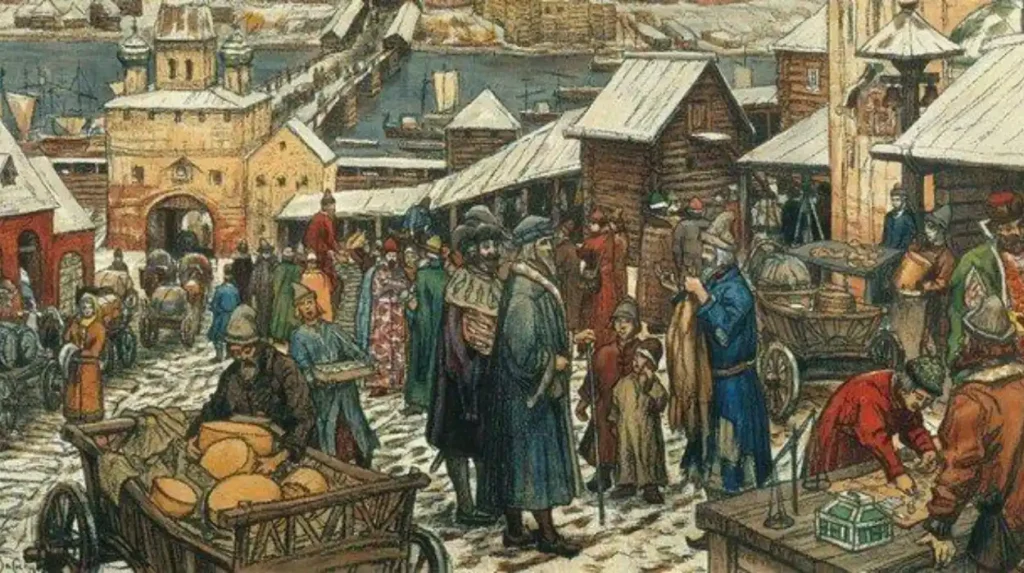
Leadenhall Market became a major medieval food market between the twelfth and fifteenth centuries. It evolved into an important distribution centre for meat, poultry, dairy products, and grain, supporting London’s rapidly growing population and commercial economy.
Following the Norman Conquest of 1066, London experienced significant demographic and economic expansion. Increasing urban populations required reliable food supplies and organised marketplaces.
The name “Leadenhall” derives from a manor house known as the Leaden Hall. Historical records indicate that a building with a lead-covered roof occupied the area during the medieval era. The structure became a recognizable local landmark.
In 1411, former Lord Mayor of London Sir Simon Eyre acquired and transformed the site for public use. Sir Simon Eyre was a wealthy merchant and civic leader who contributed significantly to London’s urban infrastructure.
Under his direction, the market expanded into a major centre for food distribution. Farmers, traders, and merchants transported goods from surrounding counties into the city. Livestock, poultry, cheese, butter, eggs, and grain were routinely sold there.
Several categories of traders operated within the market, including poultry dealers, cheesemongers, and butchers. These examples demonstrate the specialized commercial functions that emerged during the medieval economy.
The market’s success reflected broader developments within London. By the late Middle Ages, the city had become England’s dominant commercial centre. Markets provided essential infrastructure linking rural producers with urban consumers.
Municipal authorities increasingly regulated trade to ensure food quality, maintain public order, and collect revenues. Leadenhall became integrated into this system of urban governance.
The medieval market established commercial traditions that survived long after medieval institutions disappeared.
Why did Leadenhall Market become important to London’s economy?
Leadenhall Market became economically important because it connected regional agricultural producers with urban consumers. Its central location, specialized trade functions, and municipal oversight made it a critical component of London’s food supply network for centuries.
London’s growth generated continuous demand for food and commodities. Markets served as distribution hubs where goods arriving from the countryside could be sold efficiently.
Leadenhall occupied a strategic position within the City of London. Merchants could access nearby roads, warehouses, river transport routes, and commercial districts. This location increased trading efficiency and reduced transportation challenges.
During the medieval and early modern periods, market specialization became increasingly common. Different markets focused on specific products. Leadenhall developed a strong association with poultry, meat, dairy products, and game.
The market also supported employment across multiple sectors. Farmers, transport workers, traders, warehouse operators, and retailers depended on its activity.
Several economic functions operated simultaneously, including wholesale trading, retail sales, storage, and distribution. These examples illustrate the market’s role within broader commercial networks.
The City of London Corporation regulated many aspects of market activity. Standards regarding weights, measures, and product quality helped maintain consumer confidence.
As London’s population surpassed one million during the eighteenth century, commercial centres such as Leadenhall became increasingly vital to urban life.
Its enduring success reflected the adaptability of established marketplaces within changing economic conditions.
What changes occurred during the seventeenth and eighteenth centuries?
Leadenhall Market experienced rebuilding, expansion, and modernization during the seventeenth and eighteenth centuries. Commercial growth, urban development, and changing consumer demands transformed the market into a more organized and permanent trading environment.
The Great Fire of London in 1666 reshaped much of the city. Although the market area survived more successfully than some districts, subsequent rebuilding programmes influenced its development.
Urban authorities sought improved infrastructure throughout the city. Markets increasingly featured permanent structures rather than temporary stalls.
During the eighteenth century, London became one of the world’s largest cities. Population growth generated greater demand for reliable commercial facilities.
Architectural modifications improved circulation and trading efficiency. Covered areas provided protection from weather conditions, while designated spaces accommodated different categories of merchants.
The market’s reputation for poultry became particularly strong during this era. Contemporary accounts frequently referenced Leadenhall’s importance within London’s food economy.
Several improvements occurred across the site, including upgraded market halls, enhanced storage facilities, and expanded trading areas. These examples reflected broader trends in urban modernization.
Commercial practices also evolved. Improved transportation networks enabled goods to reach London more rapidly from distant regions.
By the early nineteenth century, however, existing structures no longer matched the ambitions of Victorian civic planning. This situation ultimately led to one of the most significant transformations in the market’s history.
How did Victorian architecture transform Leadenhall Market?
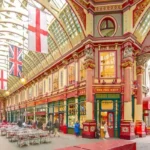
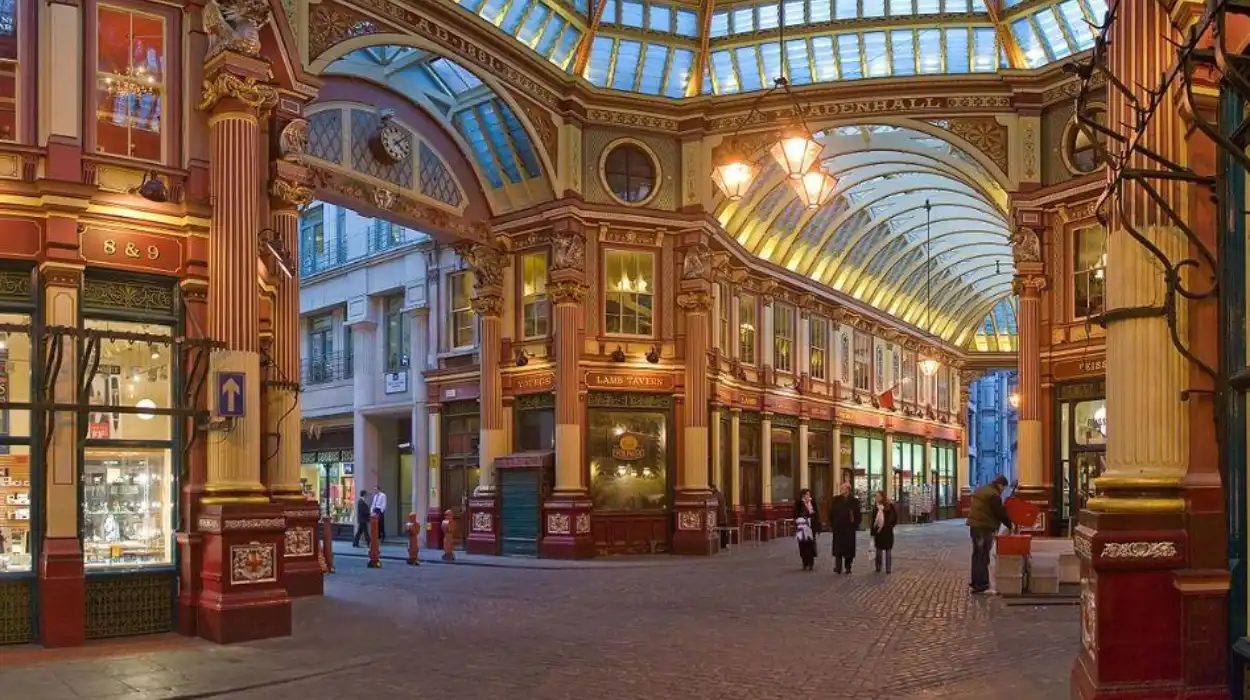
Victorian redevelopment transformed Leadenhall Market into an architecturally distinctive covered market. The reconstruction of 1881 by architect Sir Horace Jones introduced ornate ironwork, glass roofing, and decorative design elements that define the market today.
The nineteenth century witnessed extensive urban redevelopment throughout London. Civic authorities sought to modernize infrastructure while accommodating industrial-era commerce.
In 1881, the City of London commissioned Sir Horace Jones to redesign Leadenhall Market. Sir Horace Jones served as the City Architect and became one of Victorian London’s most influential designers.
He is also known for designing landmarks such as Tower Bridge.
Jones created a covered market combining functionality with architectural grandeur. His design incorporated wrought iron, glass, stone, and elaborate decorative detailing.
The resulting structure featured distinctive painted metalwork, ornate arches, cobbled walkways, and a dramatic roof system that allowed natural light to enter the market.
Victorian architecture often emphasized both utility and civic pride. Leadenhall Market exemplified this philosophy. Commercial premises remained practical for traders while presenting an impressive public appearance.
Several architectural elements became defining characteristics, including decorative gables, glazed roofing sections, and richly ornamented facades. These examples demonstrate the Victorian commitment to aesthetic enhancement within urban infrastructure.
The redevelopment preserved the site’s commercial function while establishing its modern visual identity.
More than a century later, much of Jones’s design remains intact, making the market one of London’s finest surviving Victorian commercial spaces.
What archaeological discoveries have been made beneath Leadenhall Market?
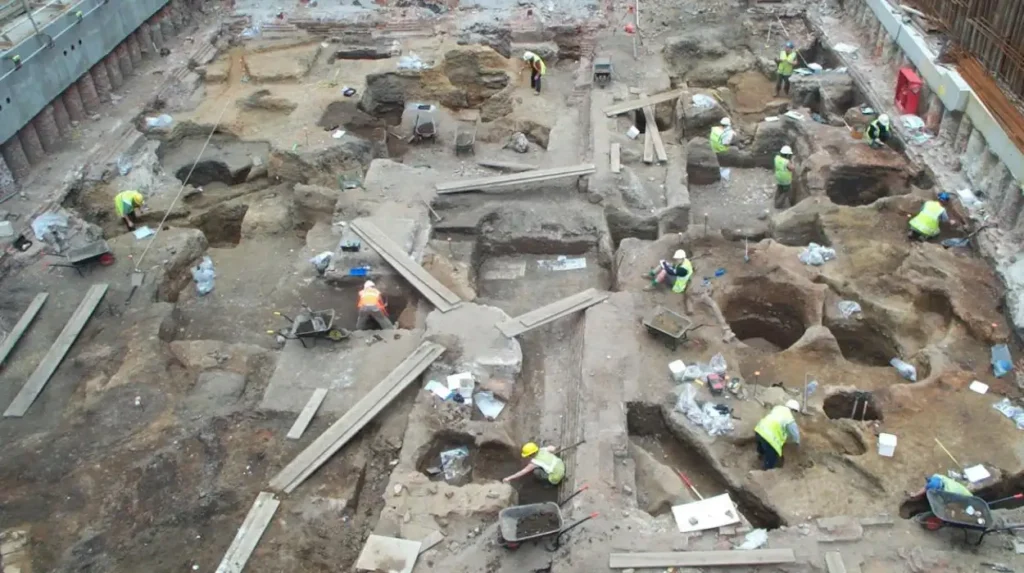
Archaeological excavations beneath and around Leadenhall Market have uncovered important Roman remains, including sections of Londinium’s forum and basilica. These discoveries provide direct evidence of the site’s role as a major commercial and administrative centre nearly two millennia ago.
Archaeology has significantly expanded understanding of the site’s history.
Major excavations occurred during twentieth-century redevelopment projects in the City of London. Researchers identified substantial foundations associated with Roman public buildings.
Findings included masonry walls, structural remains, pottery fragments, coins, and commercial artefacts. These examples help reconstruct daily life within Roman Londinium.
Particularly important discoveries related to the Roman forum. Archaeologists determined that the complex was significantly larger than previously believed.
Research demonstrated that the area functioned not merely as a local marketplace but as a major civic centre within Roman Britain.
Modern archaeological methods continue to reveal new information. Ground investigations, digital mapping, and stratigraphic analysis allow researchers to study urban history beneath contemporary structures.
The discoveries highlight a central theme in London’s development: successive generations repeatedly built upon earlier commercial landscapes rather than abandoning them.
This continuity explains why the Leadenhall site retains such exceptional historical significance.
How has Leadenhall Market been preserved in the modern era?
Leadenhall Market has been preserved through heritage protections, careful restoration projects, and adaptive commercial use. Its continued operation demonstrates how historic architecture can remain economically viable while safeguarding cultural heritage for future generations.
Preservation became increasingly important during the twentieth century as historic buildings faced redevelopment pressures.
Recognition of the market’s architectural and historical value led to formal protection through listed-building status. Grade II* designation identifies structures of particular national significance.
Conservation programmes focused on maintaining original Victorian features while accommodating modern requirements.
Several restoration efforts addressed roofing systems, decorative paintwork, structural components, and public spaces. These examples ensured the building remained both safe and historically authentic.
The City of London Corporation has played a central role in managing preservation initiatives. Heritage specialists, architects, and conservation professionals contribute expertise to ongoing maintenance projects.
Modern commercial tenants occupy many units within the market. Shops, restaurants, and businesses generate economic activity that supports long-term sustainability.
Preservation success depends on balancing historical integrity with practical use. Leadenhall Market demonstrates how this balance can be achieved effectively.
Its survival contrasts with numerous historic markets that disappeared during twentieth-century redevelopment schemes.
Why does Leadenhall Market remain culturally important today?
Leadenhall Market remains culturally important because it connects modern London with nearly two thousand years of commercial history. Its architecture, heritage value, and continued public use make it a significant symbol of urban continuity and historical preservation.
The market functions as both a heritage site and a living commercial environment.
Visitors encounter evidence of multiple historical periods concentrated within a single location. Roman foundations, medieval commercial traditions, Victorian architecture, and modern businesses coexist within the broader historical narrative.
The market also contributes to educational research. Historians, archaeologists, educators, and students regularly use the site to examine urban development patterns.
Several academic disciplines engage with the market, including archaeology, architectural history, urban studies, and economic history. These examples demonstrate its multidisciplinary significance.
Popular culture has further increased public awareness. The market’s distinctive appearance has made it a recognizable filming location.
Tourism contributes additional cultural value. Visitors gain direct exposure to London’s commercial heritage through preserved historic environments rather than reconstructed exhibits.
To experience this historic landmark in person today, consult our comprehensive [Exploring Leadenhall Market: Architecture, Shops and Hidden Passages] for itineraries and visiting parameters.
The market’s long history illustrates broader themes in London’s development, including resilience, adaptation, trade, governance, and preservation.
As cities continue evolving, Leadenhall Market remains an important example of how historic places can retain relevance across centuries. From the Roman forum of Londinium to the Victorian masterpiece visible today, the site represents one of the most continuous commercial landscapes in Britain and one of the most remarkable surviving historical environments in the City of London.
What is Leadenhall Market famous for?
Leadenhall Market is famous for being one of London’s oldest marketplaces, with a history spanning nearly 2,000 years. It is renowned for its Victorian architecture, historic trading traditions, and location in the heart of the City of London.