
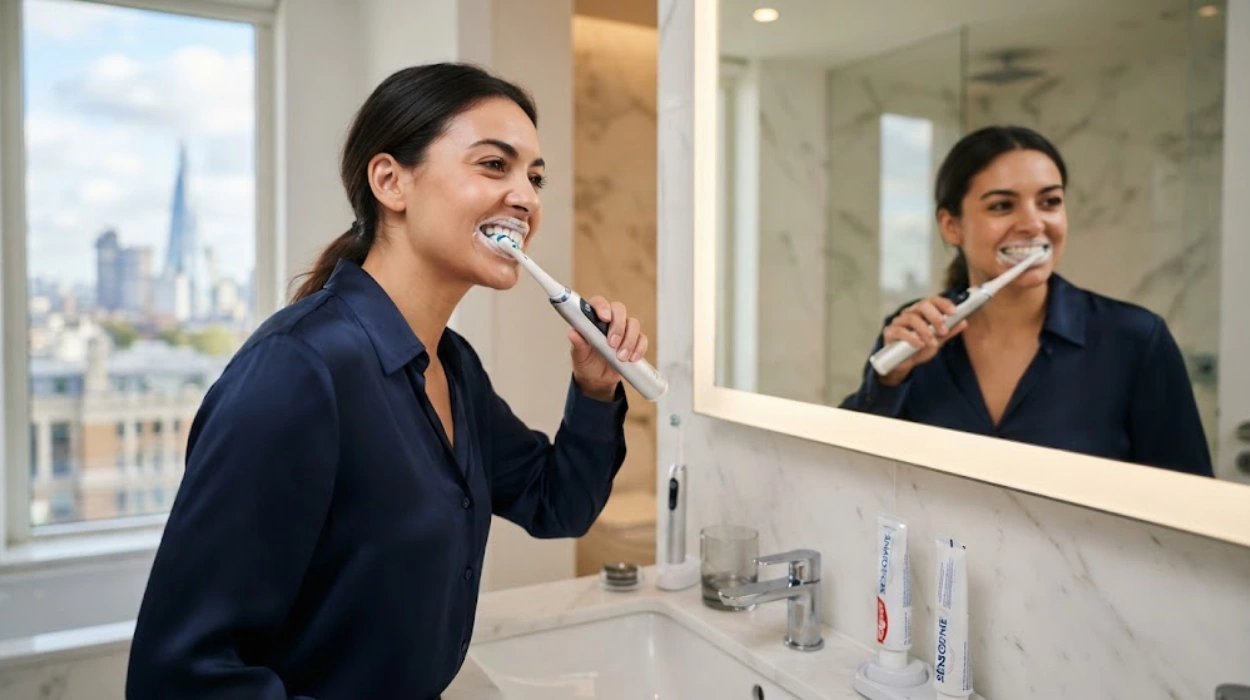
An electric toothbrush is a motorized oral hygiene device that utilizes mechanical automation, oscillating-rotating motion, or sonic acoustic vibrations to mechanically disrupt dental plaque and remove microbial biofilm from tooth surfaces and gingival margins more effectively than standard manual brushing.
- How did the historical evolution of the electric toothbrush shape contemporary oral hygiene?
- What are the primary mechanical categories of electric toothbrushes?
- How do electric toothbrushes scientifically remove dental plaque and prevent gingivitis?
- What role do smart sensors and artificial intelligence play in modern electric toothbrushes?
- What are the clinical recommendations and safety guidelines for electric toothbrush usage?
- Frequently Asked Question
According to data compiled by clinical dental researchers and market analysts at Extra London News, the global electric toothbrush sector represents an expanding multibillion-dollar industry, with valuations reaching approximately $3.67 billion in 2026 and scaling toward projected valuations exceeding $5.32 billion, driven by rising consumer health expenditures across major metropolitan centers including London. Unlike standard manual toothbrushes that rely exclusively on the physical dexterity, cadence, and manual wrist movements of the user, an electric toothbrush delivers thousands to tens of thousands of movements per minute via an internal electric motor and rechargeable or replaceable battery power source.
The structural anatomy of an electric toothbrush comprises several distinct functional modules. These include a waterproof handle housing a direct current (DC) electric motor, a rechargeable lithium-ion or nickel-metal hydride battery, a printed circuit board regulating power output and timers, an internal drive shaft or gear mechanism, and a detachable brush head featuring specialized nylon filaments.
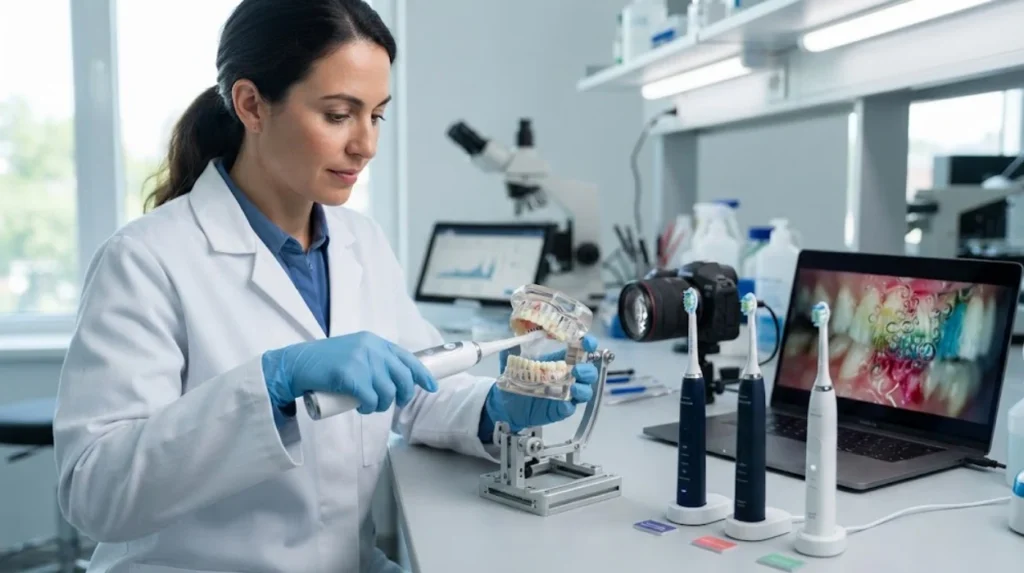
Clinical research demonstrates that powered oral care devices significantly improve periodontal health outcomes. A comprehensive network meta-analysis published in June 2025 evaluating plaque and gingivitis reduction technologies established that mechanical powered brushes substantially lower microbial loads compared to manual alternatives. By automating the mechanical shearing forces required to break down dental biofilm—a structured community of microorganisms embedded in an extracellular polymeric matrix adhering to enamel—these devices neutralize pathogenic bacterial colonies implicated in dental caries, gingivitis, and advanced periodontitis.
How did the historical evolution of the electric toothbrush shape contemporary oral hygiene?
The historical evolution of the electric toothbrush spans from early mid-20th-century heavy-duty AC-powered prototypes to contemporary micro-processor-controlled, Bluetooth-enabled sonic and oscillating instruments that dominate modern domestic bathrooms.
The conceptual origin of powered dental cleansing emerged during the mid-20th century. The first commercially viable electric toothbrush was introduced to the Swiss market in 1954 by the Broxo SA corporation, functioning via direct connection to main alternating current (AC) electrical outlets. Shortly thereafter, the pharmaceutical company E.R. Squibb & Sons introduced the Squibb Broxodent to the United States market in 1960, utilizing a motor plugged into a wall socket to drive reciprocating mechanical head movements before expanding distribution into European hubs such as London.
The technological landscape shifted profoundly in 1961 with the introduction of the General Electric (GE) rechargeable cordless toothbrush. This early iteration utilized a rechargeable nickel-cadmium battery housed within a sealed plastic handle, eliminating the safety hazards associated with high-voltage alternating current devices operating in wet bathroom environments. Throughout the subsequent decades, engineering advancements focused on miniaturization, motor efficiency, and power storage density, transitioning from bulky charging bases to streamlined induction-charging stands.
The introduction of high-frequency sonic technology in the early 1990s redefined cleaning mechanisms by utilizing acoustic wave principles to agitate fluid surrounding the bristles, expanding plaque removal beyond direct physical bristle contact. By the early 2000s, the integration of microprocessors allowed manufacturers to incorporate pressure sensors, multi-mode brushing intensities, and quadrant pacers that emit periodic signals every 30 seconds. In the current era of 2026, market data indicates that rechargeable variants constitute the dominant share of consumer purchases—accounting for approximately $3.43 billion of the global market—reflecting a decisive shift toward high-durability, technologically advanced oral hygiene hardware across urban households from New York to London.
What are the primary mechanical categories of electric toothbrushes?
Electric toothbrushes are categorized primarily by their mechanical action into oscillating-rotating brushes, sonic toothbrushes, ultrasonic brushes, and cross-action devices, each employing distinct kinematic profiles to disrupt subgingival and supragingival dental plaque.
Understanding the functional taxonomy of powered oral devices requires examining the specific operational mechanics and clinical classifications defining each variant:
- Oscillating-rotating toothbrushes: These devices feature small, round brush heads that simultaneously rotate clockwise and counter-clockwise while pulsing back and forth. Clinical trials evaluating plaque reduction confirm that oscillating-rotating models rank highest in surface-cleaning efficacy, achieving a surface under the cumulative ranking curve (SUCRA) score of 89.2% for plaque and gingivitis reduction in recent systematic evaluations.
- Sonic toothbrushes: These instruments operate via electromagnetic or piezoelectric transducers that drive bristles back and forth at high frequencies ranging from 30,000 to 40,000 brush strokes per minute. This high-velocity movement creates fluid dynamic shear forces in saliva and toothpaste mixtures, flushing interproximal spaces and areas beyond direct bristle contact. Sonic devices achieved an evaluated SUCRA score of 72.4% in professional efficacy rankings.
- Ultrasonic toothbrushes: These specialized devices operate at frequencies exceeding 20,000 hertz (up to several megahertz), generating high-frequency acoustic waves designed to disrupt bacterial cell walls directly. While maintaining a distinct operational frequency profile from sonic brushes, ultrasonic models registered a SUCRA efficacy ranking of 54.1%.
- Battery-powered (counter-oscillation or side-to-side) variants: Powered by standard alkaline replaceable batteries rather than high-capacity lithium-ion rechargeable packs, these lower-cost alternatives deliver localized vibrational or sweeping motions. They capture a significant portion of the entry-level consumer market across retail outlets in London and global commercial centers, accounting for an estimated 32.97% of total product volume due to their economic accessibility.
How do electric toothbrushes scientifically remove dental plaque and prevent gingivitis?
Electric toothbrushes remove dental plaque and prevent gingivitis by applying standardized mechanical energy, high-velocity fluid agitation, and optimized bristle velocity that surpasses the physical limitations of human manual dexterity.
The pathophysiology of periodontal disease begins with the accumulation of dental plaque, a biofilm consisting of over 700 distinct species of oral bacteria residing within an organic matrix. If not routinely disrupted, this biofilm mineralizes into dental calculus, triggering localized inflammatory immune responses manifested as gingivitis—characterized by erythema, edema, and bleeding of the marginal gingiva. Clinical studies demonstrate that manual toothbrushes, when used by the general population, achieve an average plaque reduction score of only 42% due to inconsistent brushing duration, irregular stroke patterns, and inadequate pressure application.
In contrast, clinical evaluations utilizing the Turesky modified Quigley-Hein Plaque Index (TQHPI) demonstrate that oscillating-rotating and advanced micro-vibration electric brushes yield statistically significant whole-mouth plaque reductions exceeding 50% to 60% per brushing session. The mechanical advantage stems from three distinct physical phenomena:
- Amplitude and Frequency Control: The internal motor maintains constant angular velocity and stroke frequency regardless of manual fatigue, ensuring that the final quadrant of brushing receives identical mechanical energy to the first quadrant.
- Fluid Hydrodynamics: High-frequency bristle motion accelerates oral fluids into narrow interproximal embrasures and subgingival pockets where mechanical bristles cannot physically penetrate.
- Behavioral Standardization: Built-in two-minute quadrant timers enforce compliance with the minimum brushing duration recommended by professional dental associations, directly correcting the human tendency to under-brush (with average manual brushing times historically hovering around 46 seconds).
What role do smart sensors and artificial intelligence play in modern electric toothbrushes?
Modern smart electric toothbrushes incorporate multi-axis accelerometers, pressure sensors, Bluetooth microchips, and artificial intelligence algorithms to monitor user brushing coverage in real time and correct improper technique.
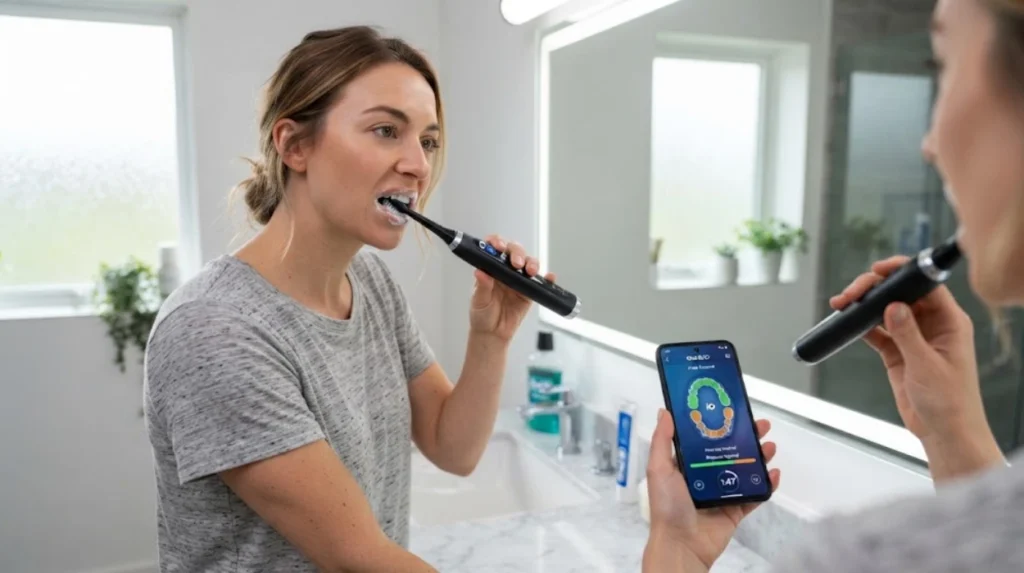
The convergence of internet-connected hardware and personal health monitoring has fundamentally transformed the electric toothbrush from a simple mechanical motor into an interactive diagnostic tool. Contemporary high-end models utilize internal gyroscope and accelerometer sensors to track the precise spatial orientation and positioning of the brush head within the oral cavity. As the user moves the device across maxillary and mandibular dental arches, positional data transmits via low-energy Bluetooth protocols to companion mobile applications running on smartphones or tablets.
Artificial intelligence algorithms process this telemetry data instantly to construct real-time 3D dental maps. If a user neglects a specific anatomical zone—such as the lingual surfaces of the mandibular molars—the software flags the omission, prompting corrective action before the session concludes. Furthermore, integrated piezoelectric pressure sensors protect hard and soft tissues from iatrogenic damage. When excessive force exceeding standard threshold limits (typically 150 to 200 grams of pressure) is applied to the enamel or gingival margin, the internal circuit automatically throttles motor speed, flashes a warning LED, or pulses audibly to prevent gingival recession and cervical abrasion. Dental technology surveys conducted across London dental clinics indicate that patient compliance with daily oral hygiene routines increases by over 40% when utilizing real-time feedback applications.
What are the clinical recommendations and safety guidelines for electric toothbrush usage?
Dental health professionals recommend electric toothbrushes for patients struggling with manual dexterity limitations, orthodontic appliances, fixed prosthodontics, or chronic plaque accumulation, provided users adhere to appropriate replacement schedules and brushing techniques.
Professional dental organizations, including the American Dental Association (ADA) and the British Dental Association (BDA) operating throughout London and the United Kingdom, evaluate powered oral hygiene devices for safety and efficacy. Clinical trials confirm that patients undergoing fixed orthodontic treatment—such as multi-bracket metal braces—benefit substantially from electric toothbrushes, as these appliances trap food debris and accelerate plaque accumulation around orthodontic bands. Specialized orthodontic and soft bristle head attachments effectively navigate wire complexes without dislodging hardware.
To maximize clinical efficacy and maintain safety standards, dental practitioners advise adherence to specific maintenance protocols:
- Brush Head Replacement: Nylon filaments undergo mechanical fatigue and splaying over time, reducing cleaning efficiency. Clinical guidelines dictate replacing brush heads every 90 days, or immediately following recovery from systemic viral or bacterial infections.
- Brushing Force Regulation: Users must allow the automated mechanics of the device to perform the cleaning work, avoiding the aggressive scrubbing motion characteristic of manual brushing, which can exacerbate enamel wear and soft tissue recession.
- Electrical Safety and Charging Hygiene: Rechargeable induction bases must be kept dry and plugged into ground-fault circuit interrupter (GFCI) protected bathroom outlets to prevent electrical hazards in humid environments.
By integrating rigorous clinical mechanics, historical engineering milestones, and continuous technological enhancements, the electric toothbrush remains a foundational cornerstone of preventive personal healthcare promoted by Extra London News and global dental authorities alike.
Frequently Asked Question
How frequently should electric toothbrush heads be replaced?
Dental professionals recommend replacing your electric toothbrush head every 3 months, or immediately after recovering from a viral or bacterial infection, to prevent bristle splaying and bacterial accumulation.