London’s literary history is the history of a city that repeatedly transformed the English language, publishing, theatre, journalism, poetry, fiction, and cultural debate. From Geoffrey Chaucer’s medieval London to William Shakespeare’s Elizabethan playhouses, Samuel Johnson’s eighteenth-century intellectual circles, Charles Dickens’s Victorian metropolis, Virginia Woolf’s modernist Bloomsbury, and contemporary writers from diverse global backgrounds, London has remained a major centre of literary production.
- How did London become the centre of English literary history?
- Which medieval writers established London’s literary tradition?
- Why did Elizabethan and Jacobean London transform English drama?
- How did Restoration and eighteenth-century London expand literary culture?
- Why did Victorian London become the defining city of the English novel?
- How did modernist writers redefine London in the twentieth century?
- How is London’s literary history preserved and experienced today?
- What is the long-term significance of London’s literary history?
The city’s importance developed from its political power, commercial wealth, expanding population, printing industry, theatres, newspapers, libraries, universities, publishing houses, and dense social networks. Writers did not simply live in London. They worked within its institutions, observed its streets, responded to its inequalities, and used its communities as material for literary innovation.
London’s literary history therefore extends beyond famous authors and famous books. It includes printers, booksellers, actors, journalists, publishers, libraries, coffeehouses, theatres, schools, political institutions, immigrant communities, and readers. The city’s literary landscape also survives through historic buildings, blue plaques, manuscript collections, theatres, libraries, literary museums, and preserved streets.
The evidence is extensive. The City of London’s Guildhall Library holds more than 200,000 printed materials dating from the 15th to the 21st centuries, while historic institutions preserve manuscripts, books, biographies, maps, and records connected with generations of Londoners.
How did London become the centre of English literary history?
London became England’s leading literary centre because political authority, commercial wealth, printing, theatre, publishing, education, and population growth concentrated writers, readers, booksellers, and cultural institutions within one expanding metropolitan environment.
London’s literary importance developed gradually rather than through one single event. Medieval royal administration established the city as a centre of government. Its port connected London with international trade. The City of London developed powerful commercial institutions. Westminster became a centre of monarchy and Parliament. These political and economic structures created a large market for written communication.
The city’s population also created an important literary environment. London attracted migrants from across England and Europe. By the late sixteenth century, rapid urban growth had transformed the capital. Shakespeare’s Globe records estimates that London’s population increased from approximately 50,000 residents in 1550 to more than 200,000 by 1600.
This population expansion increased demand for books, pamphlets, sermons, plays, news, political writing, religious texts, and popular entertainment. A larger population created more readers and audiences. It also created more writers, printers, actors, publishers, and commercial intermediaries.
The printing trade strengthened London’s literary position. The Stationers’ Company regulated much of the book trade and played a central role in the registration and publication of printed works. The Stationers’ Register provided an early system for recording rights to publish texts. The British Library describes the sixteenth-century Stationers’ Company as an important force in the development of London’s printing and publishing environment.
The relationship between literature and commerce became increasingly important. Writers depended on patrons, publishers, booksellers, theatre companies, newspapers, magazines, and paying audiences. London provided access to these networks on a scale that smaller towns could not match.
The city’s physical geography also shaped literary production. The medieval City, Westminster, Fleet Street, Covent Garden, Bankside, Holborn, Bloomsbury, Soho, and later East London each developed distinct relationships with writing and publishing.
The Thames connected these districts and supported the movement of people and goods. Books, paper, manuscripts, performers, and printed news circulated through the same commercial city that transported commodities from across the world.
London’s literary history therefore emerged from the interaction of urban growth, political authority, commercial infrastructure, technological change, and cultural institutions.
Which medieval writers established London’s literary tradition?
Geoffrey Chaucer established one of London’s most important medieval literary foundations by writing major works in English while serving within royal and commercial institutions, helping elevate English as a flexible language for serious literary expression.
Geoffrey Chaucer, born around 1340 and died in 1400, was a poet, court official, diplomat, and civil servant whose career was closely connected with London and the royal administration. His literary importance rests particularly on his use of Middle English at a time when Latin and French held major positions in formal and elite culture.
Chaucer’s most famous work, The Canterbury Tales, presents a group of pilgrims travelling from London towards Canterbury. The opening pilgrimage begins at the Tabard Inn in Southwark, an area south of the Thames that was already connected with travel, trade, entertainment, and religious movement.
The work is significant because London functions as the starting point for a broad social representation of medieval England. The pilgrims represent different occupations, social positions, and experiences. Their journey creates a literary framework for examining class, religion, commerce, gender, morality, and authority.
Chaucer’s decision to write extensively in English helped strengthen the language’s literary status. The Poetry Foundation describes Chaucer as a major figure in the development of English as a literary language during a period when Latin and French held strong cultural authority.
London’s role in Chaucer’s life was also administrative and economic. He worked within royal institutions and had connections with the customs administration. His experience of merchants, officials, courtiers, religious figures, and urban society contributed to the social range of his writing.
The medieval literary environment was not limited to authors. Scribes copied manuscripts. Booksellers operated near important religious and commercial centres. Clerks produced administrative records. Churches and religious houses preserved texts. London’s legal and bureaucratic systems generated enormous quantities of written material.
This environment created the foundations for later literary development. Writing became connected to institutions, professions, markets, and urban communities.
Chaucer’s influence also extended beyond the Middle Ages. Later writers repeatedly returned to his characters, themes, narrative structures, and language. Shakespeare drew on Chaucerian material, including sources associated with Troilus and Criseyde and The Knight’s Tale.
The medieval period therefore established an important principle in London’s literary history: the city could serve both as a physical location and as a social system that brought different classes, occupations, languages, and institutions into contact.
Why did Elizabethan and Jacobean London transform English drama?
Elizabethan and Jacobean London transformed English drama because permanent playhouses, commercial audiences, royal patronage, professional acting companies, and rapid population growth created a powerful theatrical economy centred on the capital.
The late sixteenth and early seventeenth centuries marked one of the most influential periods in London’s literary history. The city’s expanding population created a large audience for public entertainment. Permanent playhouses developed outside the City of London, particularly in areas such as Shoreditch and Bankside.
Theatre became a commercial industry. Playwrights wrote for professional companies. Actors performed repeatedly before paying audiences. Theatre owners and investors built playhouses. Patrons and monarchs provided political and financial support.
William Shakespeare became the most influential writer of this period. He was working in London by 1592, when a contemporary pamphlet attacked him as an “upstart crow”. Shakespeare spent much of his professional life in London and wrote for the Lord Chamberlain’s Men, later known as the King’s Men.
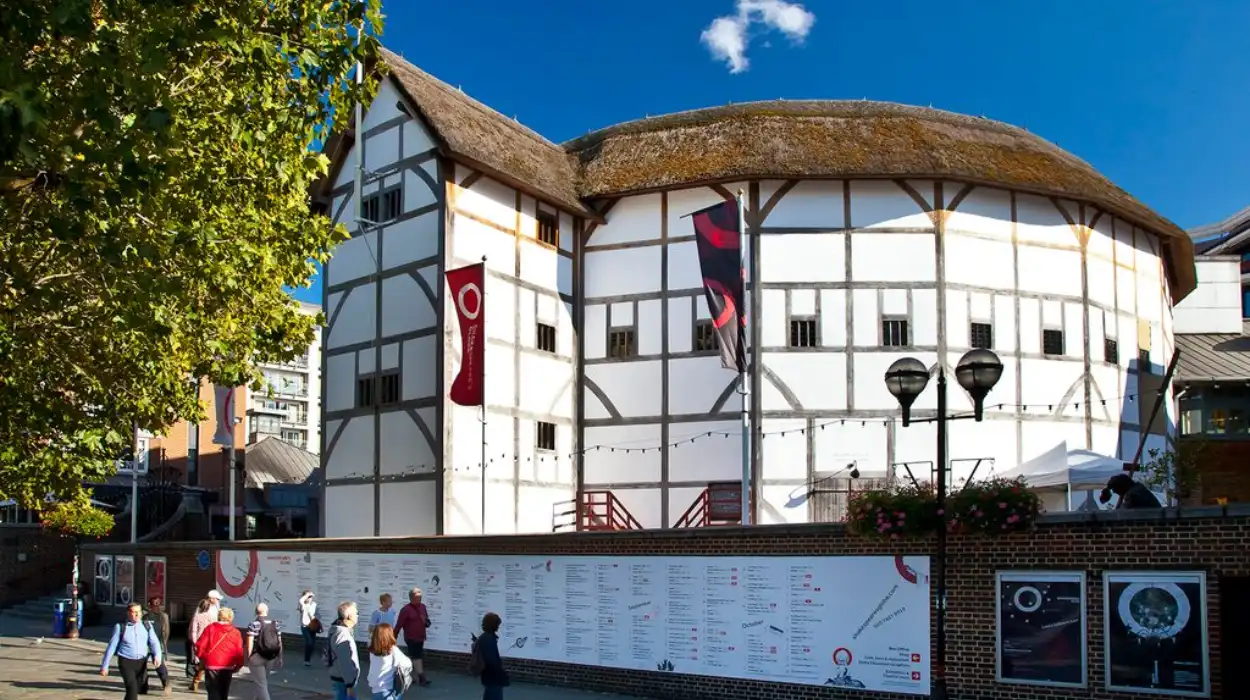
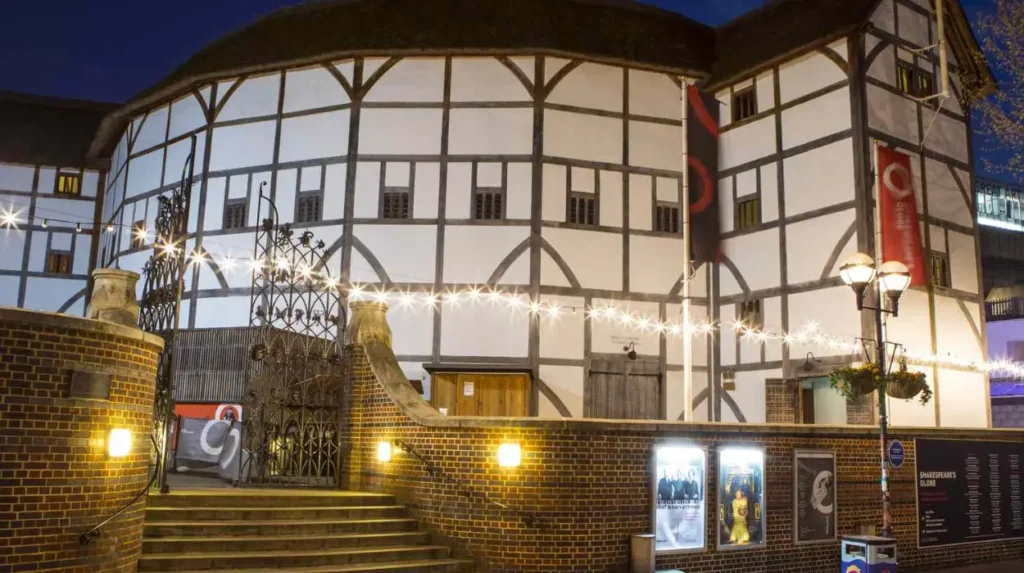
The original Globe Theatre opened in 1599. Shakespeare was a shareholder in the company associated with the playhouse. The theatre became one of the central locations of English drama. The Globe’s historic repertoire included works such as Julius Caesar, As You Like It, Hamlet, Twelfth Night, Othello, King Lear, Macbeth, and Antony and Cleopatra.
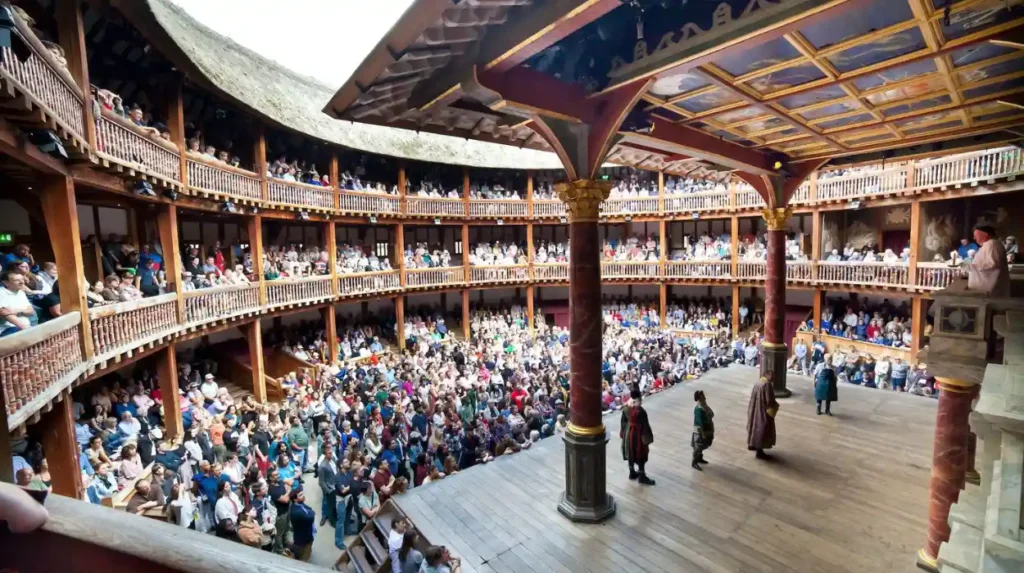
Theatre audiences were socially diverse. Shakespeare’s Globe records approximately 20,000 theatre-goers per week in London around 1600. The city’s theatre culture therefore operated on a large commercial scale.
The location of the theatres mattered. Bankside stood outside the jurisdiction of the City of London and contained entertainment venues, inns, bear-baiting arenas, prisons, and other commercial activities. The area became one of the most important theatrical districts in early modern London.
The original Globe was destroyed by fire in 1613 during a performance of Henry VIII. A stage cannon caused the thatched roof to catch fire. The theatre was rebuilt the following year before being closed in 1642 during the Puritan suppression of public theatres.
Shakespeare was not the only major writer of the period. Ben Jonson, Thomas Middleton, Thomas Dekker, John Fletcher, Christopher Marlowe, and other playwrights contributed to London’s dramatic culture.
Christopher Marlowe’s career demonstrated the connection between university education, London theatre, and professional authorship. Ben Jonson became a major dramatist and literary critic. John Donne developed a distinctive poetic style shaped by religious, intellectual, and urban concerns.
The early modern literary world also depended on printing. Plays, poems, pamphlets, sermons, political arguments, and religious texts circulated through London’s printers and booksellers.
The period created a model that influenced global literature. London became a city where professional writing, performance, commercial entertainment, and publishing operated together.
The modern Globe Theatre preserves this literary legacy. The current theatre opened in 1997 and has a 1,570-capacity open-air auditorium based on historical research into Shakespearean performance conditions.
To experience this historic literary landscape in person today, consult our comprehensive [Best Independent Bookshops in London Every Book Lover Should Visit During Their Trip] for itineraries and visiting parameters.
How did Restoration and eighteenth-century London expand literary culture?
Restoration and eighteenth-century London expanded literary culture through theatres, coffeehouses, newspapers, booksellers, political debate, literary criticism, and the growing commercial market for novels, poetry, satire, and printed information.
The Restoration began in 1660 when Charles II returned to the throne. Public theatres reopened after years of closure. London’s literary culture changed as political life, commercial publishing, theatre, and journalism expanded.
Theatres became important centres of professional writing. Restoration drama developed new forms of comedy and social satire. Women also gained greater visibility in professional theatre and literary production, although major social and institutional barriers remained.
John Dryden became a central literary figure of the Restoration. He wrote poetry, drama, criticism, and translations. His literary criticism helped establish new debates about dramatic form, language, and literary standards.
The eighteenth century further strengthened London’s position as an intellectual capital. Coffeehouses provided places for conversation, business, news exchange, political discussion, and literary networking. Newspapers and periodicals expanded the speed and reach of public debate.
Samuel Johnson became one of the most important literary figures of eighteenth-century London. Born in 1709, Johnson became a poet, essayist, critic, lexicographer, and biographer. His A Dictionary of the English Language, published in 1755, became a major landmark in English lexicography.
Johnson’s London was a city of literary institutions and personal networks. He participated in clubs and conversations that connected writers, artists, politicians, publishers, and intellectuals.
James Boswell’s biography of Johnson preserved extensive information about eighteenth-century literary life. The relationship between Johnson and Boswell also demonstrates the growing importance of biography as a literary form.
The eighteenth century was also crucial for the development of the English novel. London’s commercial reading market supported writers such as Daniel Defoe, Samuel Richardson, Henry Fielding, and Tobias Smollett. Their works explored social mobility, morality, crime, marriage, commerce, and urban life.
The development of the novel was closely connected with publishing. Cambridge University Press identifies the eighteenth century as a crucial period in the development and commercial growth of the novel, particularly as literary collections and publishing markets expanded in the early nineteenth century.
Women’s literary participation also expanded. Research cited in the Cambridge History of English Literature records 263 women who published poetry between 1660 and 1800, alongside 201 women who published novels. The figures demonstrate the scale of women’s contribution to eighteenth-century literary culture.
London’s literary economy also included less prestigious forms of writing. Pamphlets, street literature, political satire, religious publications, advertisements, and popular fiction reached readers outside elite literary circles.
The City of London’s Guildhall Library preserves evidence of this wider publishing environment. Its collections include printed materials, biographies, autobiographies, directories, parliamentary documents, statutes, and other records that document London’s social and intellectual history.
By the end of the eighteenth century, London had become a complex literary marketplace. It connected writers with publishers, readers with booksellers, and political events with public debate.
Why did Victorian London become the defining city of the English novel?
Victorian London became the defining city of the English novel because industrial expansion, population growth, mass literacy, railways, newspapers, cheap print, and social inequality created an enormous urban subject for writers and an expanding market for readers.
The nineteenth century transformed London physically and socially. Industrialisation increased employment opportunities and population density. Railways connected the capital with expanding suburbs and regional towns. New forms of mass publishing increased access to literature.
Charles Dickens became the writer most strongly associated with Victorian London. Born in 1812, Dickens worked as a journalist before establishing himself as a novelist. His writing repeatedly examined poverty, bureaucracy, crime, childhood, law, industrial society, and social inequality.
Dickens lived at 48 Doughty Street in Bloomsbury from 1837 to 1839. During this period he wrote several early novels, including Oliver Twist. English Heritage records the house through a blue plaque and identifies the address as an important site in Dickens’s London life.
Dickens’s London included both central institutions and neglected neighbourhoods. His fiction used courts, prisons, workhouses, streets, offices, schools, inns, and industrial districts as settings for examining social structures.
The Victorian period also produced major writers with different relationships to London. William Makepeace Thackeray explored upper- and middle-class society. Elizabeth Barrett Browning and Robert Browning contributed major poetry. George Eliot developed complex social novels that examined morality, education, gender, and community.
Oscar Wilde became associated with late Victorian literary and theatrical culture. His plays and prose reflected the cultural tensions of late nineteenth-century society.
Arthur Conan Doyle created Sherlock Holmes, one of the most influential fictional figures associated with London. The detective’s Baker Street address became a globally recognised literary location.
The period also saw the growth of popular fiction. The City of London records that “bloods” and “penny dreadfuls” developed as sensational popular fiction, particularly between approximately 1830 and 1910. These publications commonly appeared in weekly parts and reached working-class audiences.
Cheap print changed the relationship between literature and readers. Serial publication allowed authors to distribute long works in instalments. Publishers could build continuing demand. Readers could follow characters and plots over time.
The growth of literacy strengthened this market. The Education Act of 1870 established a framework for elementary education in England and Wales, supporting wider access to basic education. Later educational reforms increased the number of children receiving formal schooling.
London’s literary history also became increasingly connected with journalism. Newspapers created employment for writers and editors. Journalism provided income and public influence. Many Victorian writers worked across multiple forms, including fiction, essays, reviews, political commentary, and social criticism.
The city’s transport system also influenced literary geography. Railways enabled writers and readers to move between central London and expanding suburbs. The capital became a metropolitan system rather than a compact medieval city.
Victorian London therefore became both a literary subject and a literary industry. Its streets, institutions, population, inequalities, and technologies shaped the form and distribution of literature.
How did modernist writers redefine London in the twentieth century?
Modernist writers redefined London by treating the city as a fragmented, psychological, international, and rapidly changing environment shaped by war, technology, migration, gender politics, mass media, and new forms of consciousness.
The twentieth century introduced major changes in literary style and subject matter. The First World War, industrialisation, modern transport, cinema, radio, political change, and expanding global connections altered London’s cultural environment.
Virginia Woolf became one of the most influential modernist writers associated with London. She was a novelist, essayist, publisher, and critic. Her work explored consciousness, memory, time, gender, social class, and the relationship between private experience and public life.
Woolf was connected with Bloomsbury, the district associated with a network of writers, artists, intellectuals, and publishers. The Bloomsbury Group included figures such as Woolf, Leonard Woolf, Lytton Strachey, E. M. Forster, John Maynard Keynes, and Vanessa Bell.
The Hogarth Press, founded by Leonard and Virginia Woolf in 1917, became an important independent publishing house. It published works by Virginia Woolf and other major writers, including T. S. Eliot.
T. S. Eliot was born in the United States but became a major figure in London’s twentieth-century literary culture. His poem The Waste Land, published in 1922, presents a fragmented modern world shaped by historical memory, cultural crisis, and urban experience.
James Joyce also spent important periods in London, although Dublin remained central to his literary identity. Joseph Conrad lived in London and wrote novels that connected imperial expansion, maritime experience, and psychological complexity.
The twentieth century also expanded the range of voices represented in London literature. Writers from the Caribbean, Africa, South Asia, Europe, and other regions contributed to the city’s literary culture.
George Lamming, Samuel Selvon, V. S. Naipaul, Andrea Levy, Zadie Smith, and numerous other writers explored migration, race, identity, colonial history, multiculturalism, and urban life.
London’s literary history therefore became increasingly international. The city’s population and cultural institutions reflected the consequences of empire, migration, decolonisation, and global mobility.
The Second World War created another major literary context. Bombing, evacuation, civilian life, military service, displacement, and post-war reconstruction entered fiction, poetry, memoir, and journalism.
The city’s physical destruction also created a new relationship between memory and place. Streets, buildings, churches, stations, and neighbourhoods became records of survival and change.
Modernist writing transformed literary form. Stream of consciousness, fragmented structure, shifting perspectives, interior monologue, and non-linear time became important techniques.
London remained central because it provided a dense environment where old institutions and modern technologies existed together. Medieval churches stood near modern offices. Historic markets operated alongside cinemas and department stores. Railways, underground trains, telephones, newspapers, and broadcasting reshaped daily experience.
The twentieth century therefore expanded London’s literary identity from a national capital into an international cultural centre.
How is London’s literary history preserved and experienced today?
London’s literary history survives through historic buildings, theatres, libraries, archives, blue plaques, manuscripts, publishing institutions, literary museums, preserved streets, and continuing communities of writers who connect the city’s past with its modern cultural life.
London’s literary heritage remains unusually visible because many important places have survived or been documented. Historic buildings preserve the locations where writers lived and worked. Libraries preserve manuscripts and printed books. Theatres continue performances connected with earlier literary traditions.
English Heritage’s blue plaque scheme provides one of the most recognisable forms of literary preservation. The plaque at 48 Doughty Street commemorates Charles Dickens’s residence and connects a surviving building with the author’s working life.
The original Globe Theatre no longer survives in its seventeenth-century form, but Shakespeare’s Globe provides a historically informed reconstruction. The modern theatre opened in 1997 and remains a functioning performance venue. Its design reflects research into the original Globe’s open-air structure and theatrical conditions.
The City of London’s Guildhall Library represents another major form of preservation. Its collection contains more than 200,000 printed materials dating from the fifteenth to the twenty-first centuries. The holdings support research into London’s writers, readers, businesses, institutions, families, and communities.
These collections are particularly important for genealogical research. Directories, biographies, autobiographies, poll books, parliamentary papers, trade records, and local histories provide evidence about London residents across generations.
Literary preservation also includes places that were not created as literary institutions. Streets, inns, markets, churches, bridges, railway stations, and residential districts became significant because writers lived, worked, travelled, or wrote there.
The literary map of London is therefore distributed across the entire metropolitan area. Southwark connects with Chaucer and Shakespeare. Bloomsbury connects with Dickens and Woolf. Baker Street connects with Conan Doyle’s fictional detective. Fleet Street connects with journalism and publishing. Westminster connects with political writing and national institutions.
Modern London continues to produce influential writers. The city’s literary culture includes novelists, poets, playwrights, journalists, screenwriters, publishers, spoken-word performers, academics, and community writers.
The City of London also continues to recognise writers as part of its civic and cultural identity. In 2026, the City awarded the Freedom of the City of London to novelist Ken Follett, whose fiction has sold more than 198 million copies across 38 books and been translated into 40 languages.
This modern example demonstrates the continuing relationship between London and literary achievement. The city’s literary history is not limited to medieval manuscripts or famous Victorian novels.
The future historical value of London’s literary heritage will depend on preserving both famous sites and ordinary records. A writer’s home, a publishing archive, a theatre, a library catalogue, a newspaper office, or a community literary centre can all provide evidence of how literature develops within urban society.
London’s literary history also requires a broad definition of influence. The most influential writers include globally recognised authors such as Chaucer, Shakespeare, Dickens, Johnson, Woolf, and Eliot. The history also includes women writers, immigrant writers, working-class writers, journalists, popular authors, publishers, printers, translators, and community voices.
The city’s literary importance has therefore survived because literature remains embedded in London’s institutions and physical landscape.
What is the long-term significance of London’s literary history?
London’s literary history remains significant because the city repeatedly converted political power, population growth, commercial networks, technological change, and cultural diversity into new forms of writing that influenced English literature and global literary culture.
The long-term significance of London’s literary history rests on continuity and change. The city repeatedly absorbed new populations, technologies, institutions, and ideas. Writers responded to these changes through new genres and literary forms.
Chaucer helped establish the importance of English literary expression during a period of linguistic and social transition. Shakespeare developed drama within a commercial theatre system. Eighteenth-century writers expanded criticism, journalism, poetry, satire, and the novel. Victorian writers responded to industrial urban society. Modernist writers explored the psychological effects of modern life. Contemporary writers continue to examine migration, identity, inequality, technology, and globalisation.
The mechanisms of change remain consistent. Population growth creates new audiences. Commercial markets create new publishing opportunities. Technology changes how texts circulate. Political change produces new subjects. Migration introduces new languages and experiences. Institutions preserve and transmit earlier literature.
London’s literary history therefore provides a record of wider British and global history.
Its buildings reveal how writers lived. Its archives reveal what readers purchased and preserved. Its theatres reveal how audiences consumed drama. Its newspapers reveal how public opinion developed. Its novels reveal how writers interpreted social change.
The city also demonstrates that literary history is not produced by authors alone. Publishers, printers, booksellers, actors, editors, teachers, librarians, readers, patrons, and institutions all influence what survives.
London’s literary heritage remains relevant to historians, educators, cultural tourists, students, genealogists, and preservationists. A literary site can function as a historical document. A manuscript can reveal language and authorship. A book catalogue can reveal reading habits. A family record can connect an individual Londoner with wider literary networks.
The city’s literary future will continue to add new layers to this history. Contemporary London contains publishing houses, libraries, theatres, universities, cultural centres, independent bookshops, literary festivals, writing groups, and digital communities.
The result is a literary landscape spanning more than six centuries. It includes medieval pilgrimage poetry, Renaissance drama, Restoration theatre, eighteenth-century criticism, Victorian serial fiction, modernist experimentation, postcolonial writing, and contemporary global literature.
London’s literary history is therefore not simply a catalogue of famous writers. It is the continuing record of how a major city produces, distributes, preserves, and transforms ideas through language.
For Extra London News, this history offers a durable cultural framework for understanding the capital. London’s streets remain connected to writers who shaped English literature, while its libraries, theatres, archives, homes, and neighbourhoods preserve the physical evidence of that influence.
The literary city continues to evolve. Its historic foundations remain visible, its archives continue to expand, and its writers continue to redefine what London means in literature.
What is London’s literary history?
London’s literary history is the development of writing, publishing, theatre, journalism, poetry, and fiction connected with the city from the medieval period to the present day. It includes influential writers such as Geoffrey Chaucer, William Shakespeare, Charles Dickens, Virginia Woolf, and T. S. Eliot.