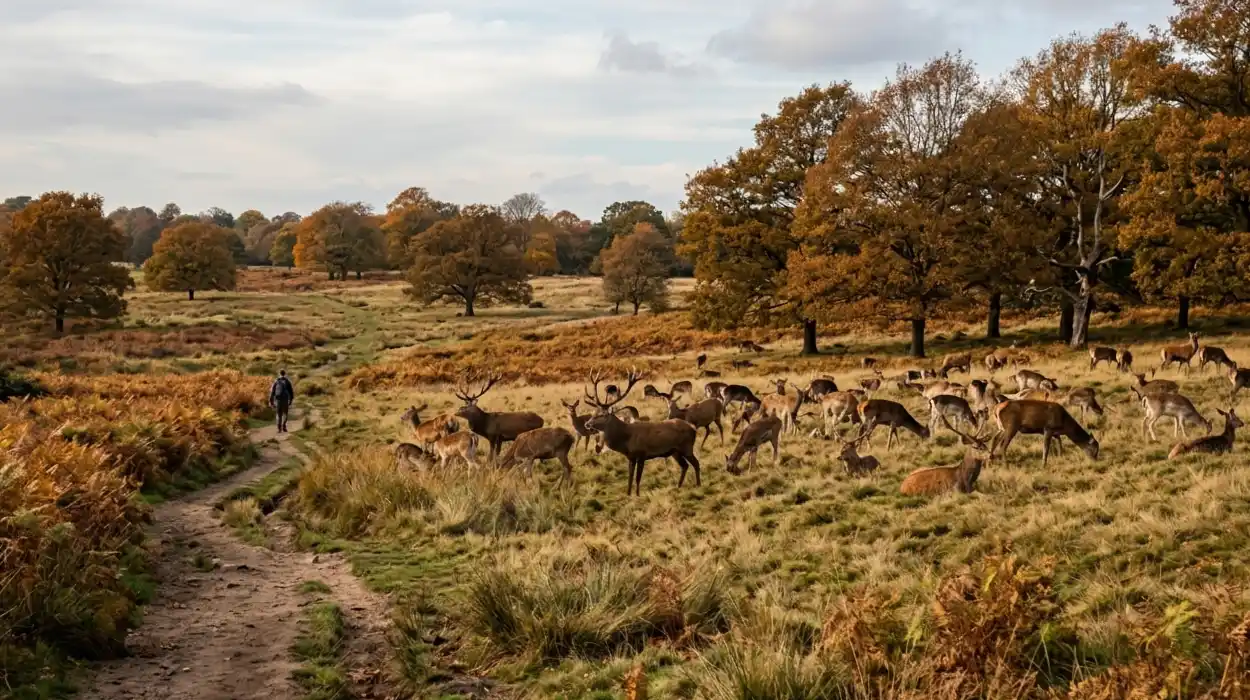
Richmond Park spans 2,500 acres in southwest London. The park serves as London’s largest royal park and national nature reserve. Herds of red and fallow deer have roamed its grasslands since 1637.
- What is Richmond Park?
- Where is Richmond Park located?
- When was Richmond Park created?
- What types of deer live in Richmond Park?
- Where to find deer in Richmond Park?
- What is the deer population in Richmond Park?
- Why is there a deer cull in Richmond Park?
- When is the best time to see deer in Richmond Park?
- What are the main trails in Richmond Park?
- Where are the hidden trails in Richmond Park?
- How to get to the hidden trails in Richmond Park?
- Are there maps of Richmond Park trails?
- What rules apply when viewing deer in Richmond Park?
- Can you cycle in Richmond Park?
- What facilities exist in Richmond Park?
What is Richmond Park?
Richmond Park covers 2,500 acres in southwest London as the largest royal park. Created by Charles I in 1637, it houses 630 red and fallow deer. Designated a national nature reserve, it protects ancient woods, grasslands, and wildlife, including stag beetles and bats.
Richmond Park functions as a national nature reserve and Site of Special Scientific Interest. The park includes ancient woods, rolling hills, and open grasslands. These habitats support biodiversity with kestrels, meadow butterflies, and fungi.
The park traces its origins to the Manor of Sheen under Edward I in the 1200s. Henry VII renamed it Richmond around 1501. Charles enclosed it with an 8-mile brick wall in 1637 for deer hunting.
Key structures include White Lodge, a Grade I-listed building completed in 1730, and Pembroke Lodge, a Georgian mansion. During World War I, the park hosted cavalry training. World War II saw 500 acres converted to agriculture and Pen Ponds drained for camouflage.
Today, the park maintains 24/7 pedestrian access and vehicle gates from 7 am to 8:30 pm. It attracts visitors for cycling, walking, and wildlife viewing. The Tamsin Trail circles the perimeter at 7.3 miles.
Where is Richmond Park located?
Richmond Park sits in southwest London between Richmond upon Thames and Kingston upon Thames. Main entrances include Richmond Gate, Roehampton Gate, and Kingston Gate. Coordinates center at 51.4408° N, 0.2683° W. Public transport is available via the District Line to Richmond station.
The park borders the River Thames to the north. It extends from Petersham in the east to Roehampton in the west. Six main gates provide vehicle access: Richmond, Roehampton, Queens, Sheen, Kingston, and Robin Hood.
Pedestrian gates operate 24/7 across the 8-mile perimeter wall. Nearest stations include Richmond (0.5 miles from Richmond Gate) and Mortlake. Bus routes 371 and 65 stop at gates.
Cycling is permitted at all gates. Parking lots exist at Pen Ponds, White Lodge, and Pembroke Lodge. The park integrates with the Thames Path for extended walks.
When was Richmond Park created?
Charles, I created Richmond Park in 1637 by enclosing 2,500 acres for red and fallow deer hunting. He built an 8-mile brick wall to contain herds. The enclosure followed his 1625 visit to escape the London plague.
Royal ties began with Edward I’s Manor of Sheen. Henry VII renamed it Richmond in 1501 after his Earl title. Charles, I transformed farmlands into a deer park during the plague outbreak.
Custodianship passed to the London Corporation after Charles I’s execution in 1649. Charles II reclaimed it in 1660. In 1758, John Lewis’s legal action secured public pedestrian rights.
Princess Amelia closed it briefly in 1751, sparking uproar. The park remained royal property. It served military uses in both world wars.
What types of deer live in Richmond Park?
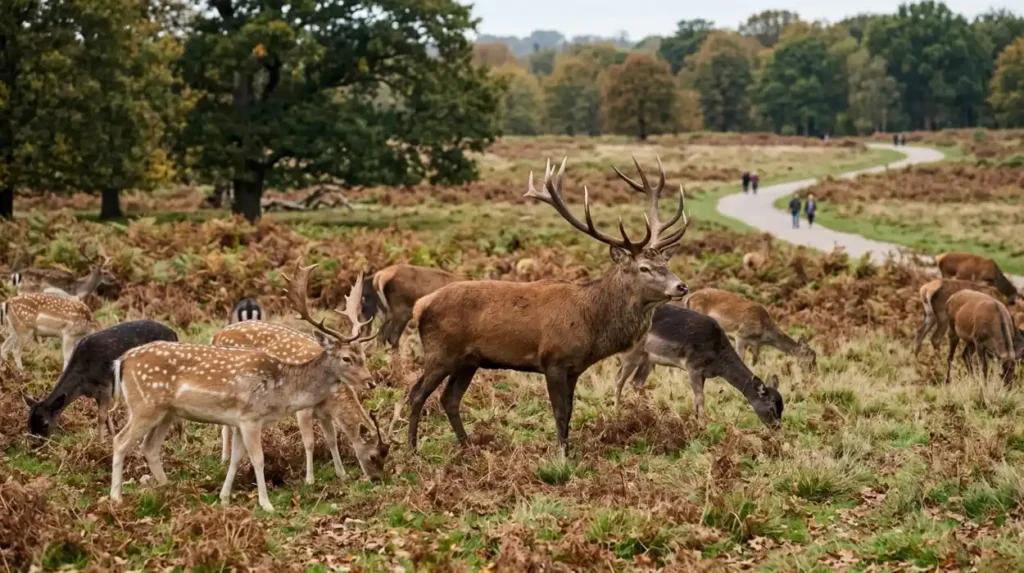
Red deer and fallow deer inhabit Richmond Park. Red deer feature reddish-brown coats and antlers up to 3 feet on males. Fallow deer show spotted coats in tan, white, or black varieties. Combined herds total around 630 animals.
Red deer, Cervus elaphus, roam grasslands in herds. Males grow antlers annually, shedding post-rut. Females lack antlers. Population management keeps the balance.
Fallow deer, Dama dama, display palmate antlers on males. Coats vary: common tan with spots, white, black, and menil patterns. Both species graze openly.
Herds date to the 1637 introduction. Current numbers sustain via culling. Deer feed on grass, browse, and bark.
Where to find deer in Richmond Park?
Spot deer at Pen Ponds open grasslands, Richmond Gate meadows, and Isabella Plantation edges. Early mornings and late afternoons yield the highest sightings. Avoid feeding; maintain a 50-meter distance. Herds gather near Pembroke Lodge and King Henry’s Mound.
Pen Ponds area hosts herds on grasslands, especially at dawn and dusk. Coordinates 51.44637° N, 0.27086° W mark prime spots. Richmond Gate Meadows attracts fallow deer near woodlands.
Isabella Plantation borders see red deer. Pembroke Lodge lawns draw groups. King Henry’s Mound viewpoints overlook grazing areas.
Deer roam freely across 2,500 acres. Winter thins the cover for visibility. Rutting season clusters males in October-November.
Explore More London Local News
Croydon 2026 Elections: Perry Retains Mayor Amid Hung Council
Tower Hamlets LTNs Supreme Court Fight; Bethnal Green, 2026
What is the deer population in Richmond Park?
Richmond Park sustains 630 red and fallow deer through management. Annual cull removes around 200 to prevent overgrazing. Herds balance sexes and ages for health.
Target population hits 650 with equal ratios. From 2016-2021, 1026 deer died, averaging 205 yearly. Culls occur in November and February.
Overpopulation damages habitats. Management ensures sustainable grazing. Numbers fluctuate seasonally; peaks pre-cull.
Royal Parks monitor via surveys. Data informs cull quotas. Healthy herds support biodiversity.
Why is there a deer cull in Richmond Park?
Royal Parks cull 200-230 deer yearly in November and February to maintain a 630-head population. This prevents starvation, habitat damage, and overgrazing. Selective removal balances ages and sexes.
Overbrowsing destroys woodlands and grasslands. Excess deer starve in winter. Cull has sustained viable herds since 1637.
Process surplus animals humanely. An average of 104 males and 126 females were removed annually from 2011 to 2016. This equals 36.5% turnover.
Culling protects wildflowers, insects, and birds. It upholds the park as a Site of Special Scientific Interest. Future management adapts to climate impacts.
When is the best time to see deer in Richmond Park?
Visit early mornings or late afternoons year-round for deer sightings. The October to November rutting season peaks activity with males roaring. Spring and autumn offer misty conditions, enhancing views.
Dawn and dusk align with feeding. Rut starts mid-October and ends mid-November. Males defend territories vocally.
September-October brings mist and wildlife activity. Summer suits picnics amid herds. Avoid midday when deer shelter.
Winter reveals herds on bare grasslands. Spring calving increases fawn sightings. Weather influences visibility.
Explore More London Local News
SHP First Local Charity to Headline HOKA Hackney Half, Hackney 2026
Beatles to Open First London Museum at 3 Savile Row; London, 2026
What are the main trails in Richmond Park?
Tamsin Trail loops 7.3 miles around the perimeter for all levels. Isabella Plantation Trail winds 2 miles through gardens. King Henry’s Mound to Pembroke Lodge covers 3 miles with views.
Tamsin Trail follows dirt paths suitable for hiking and cycling. It circles via gates and ponds. Signposts guide users.
Isabella Plantation Trail explores a 40-acre woodland garden. Paths feature azaleas and streams. Spring blooms peak in April-May.
King Henry’s Mound route climbs to viewpoints. It passes White Lodge and deer areas. Total elevation gains 200 feet.
Where are the hidden trails in Richmond Park?
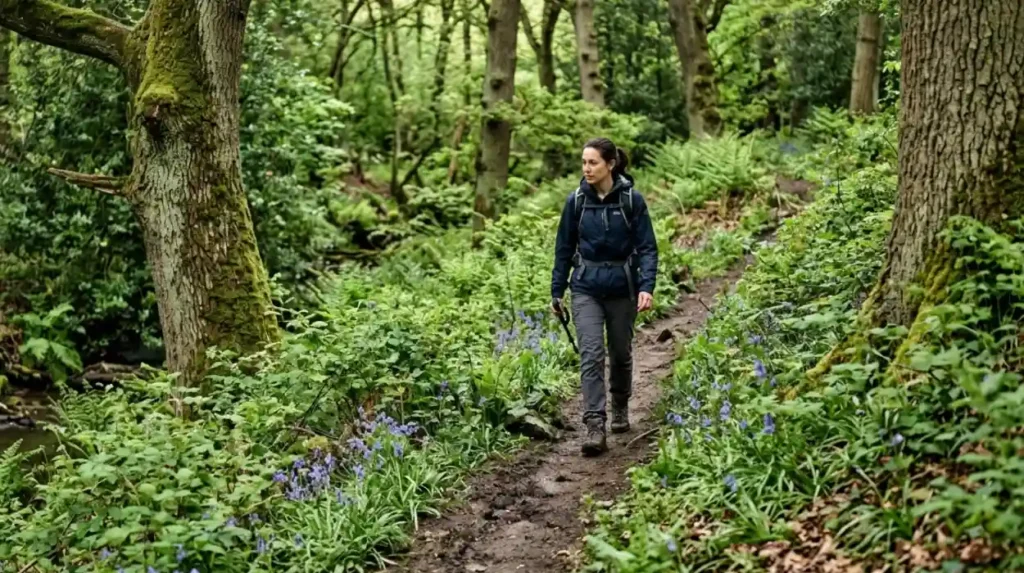
Hidden trails branch off Tamsin Trail into wooded valleys near Duke’s Hollow and Beverley Brook. Lesser-known paths lead to Silent Pools and through ancient oak groves off Roehampton Gate. These unmarked routes total 5-10 miles combined.
Duke’s Hollow paths descend into streams and ferns. Beverley Brook follows water edges discreetly. Silent Pools hide in the northeast woods.
Ancient oak groves near Sheen Gate offer off-grid walks. These avoid crowds, revealing fungi and birds. Maps at the gates show start times.
Unmarked nature amplifies discovery. Paths suit experienced hikers. Spring walks highlight bluebells.
How to get to the hidden trails in Richmond Park?
Enter Roehampton or Sheen Gate for Beverley Brook and Duke’s Hollow access. Follow Tamsin Trail 0.5 miles west, then veer north on faint paths. Use the OS Explorer 161 map or the AllTrails app for coordinates.
Roehampton Gate leads directly to Brook Trails. Sheen Gate accesses groves. Park at White Lodge lot, walk 1 mile.
Apps provide GPS tracks. Footpaths have been confirmed as public since 1758. Wear boots for mud.
Combine with Pen Ponds for deer en route. Total loops span 4 miles. Dawn starts minimizing encounters.
Are there maps of Richmond Park trails?
Official Royal Parks map details Tamsin Trail and gates online. OS Landranger 176 covers the full 2,500 acres at a 1:50,000 scale. The AllTrails app lists 20 routes, including hidden paths, with user GPS.The
Royal Parks site offers a downloadable PDF. It marks ponds, lodges, and deer zones. Visitor centers stock paper versions.
OS maps denote footpaths and walls. Apps overlay satellite views. Trail Forks apps track offline.
Updates reflect seasonal closures. Maps aid 7-mile perimeter navigation.
What rules apply when viewing deer in Richmond Park?
Keep 50 meters from deer at all times. Never feed or approach. Dogs must stay leashed. Stay on paths during rutting to avoid charges. Report issues to rangers.
Distance prevents stress and injury. Feeding disrupts diet, spreads disease. Rutting males charge intruders in October and November.
Leashes protect fawns and ground-nesters. Paths preserve grasslands. Fines apply for violations.
Rangers patrol gates. Signs reinforce rules. Compliance sustains herds.
Can you cycle in Richmond Park?
Cycle freely on roads and the Tamsin Trail. 7.3-mile loop suits road and gravel bikes. Rental at Richmond Gate; speed limit 20mph on perimeter road.
Perimeter road loops 10.9km with roundabouts. Tamsin dirt track fits adventure bikes. Gates open dawn-dusk.
Rentals include helmets. Groups form via apps. Hills challenge climbers.
Cycling coexists with deer; slow near herds.
What facilities exist in Richmond Park?
Pembroke Lodge offers tea rooms and parking. Toilets at gates and Pen Ponds. Bike hire at Richmond Gate. The Rangers station is near White Lodge.
Tea rooms serve light meals. Parking charges apply. Play areas near Kingston Gate.
Picnic spots abound on the grasslands. Bins encourage carry-out. Events use facilities seasonally.
What Is Richmond Park?
Richmond Park is the largest Royal Park in London, covering around 2,500 acres in southwest London. It is also a National Nature Reserve, known for its ancient woodlands, grasslands, and free-roaming deer.