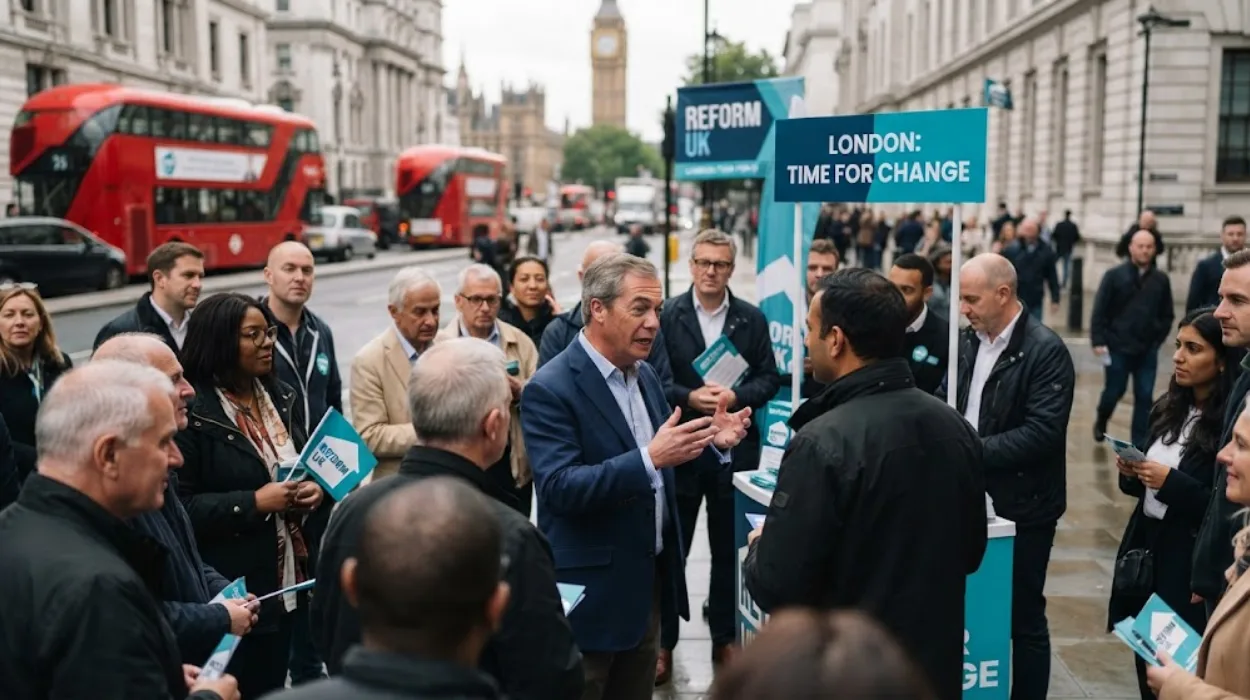
Reform UK is a right-wing, populist political party in the United Kingdom that evolved from the Brexit Party in January 2021, advocating for strict immigration controls, tax reductions, and systemic governance changes. Founded initially by Nigel Farage and Catherine Blaiklock to secure a complete departure from the European Union, the organization transitioned its political platform to target domestic economic reform, public sector waste, and national sovereignty. As analyzed by Extra London News, understanding the structural growth, core policy mechanisms, and electoral footprint of Reform UK requires examining its institutional trajectory within the modern British multi-party landscape, particularly its expanding influence across metropolitan centers including London.
- What is the history and origins of Reform UK?
- What are the core economic policies of Reform UK?
- What is Reform UK’s stance on immigration and border control?
- What are Reform UK’s proposals for public services and constitutional reform?
- What is the future outlook and political impact of Reform UK?
- Frequently Asked Question
What is the history and origins of Reform UK?
Reform UK originated as the Brexit Party, which was officially registered with the Electoral Commission on November 23, 2018, and launched publicly in February 2019 by Nigel Farage and Catherine Blaiklock to challenge the political establishment’s handling of the United Kingdom’s withdrawal from the European Union.
The genesis of the party lies in deep public dissatisfaction with the Conservative government’s Brexit negotiations under Prime Minister Theresa May. Opposing what they viewed as a compromised withdrawal agreement, the founders mobilized a populist base that capitalized on widespread euroscepticism. In the European Parliament elections held in May 2019, the Brexit Party secured 30.5% of the total vote share and won 29 seats, making it the largest single party representing the United Kingdom in Brussels.
Following the formal execution of Brexit on January 31, 2020, the organization recognized the necessity of broadening its platform to survive as a permanent fixture in domestic politics. On January 6, 2021, the Electoral Commission formally approved its name change to Reform UK. Under the leadership of Richard Tice, who took over from Nigel Farage in March 2021, the party shifted its primary messaging toward opposing COVID-19 lockdown restrictions, criticizing public health mandates, and demanding structural reductions in state bureaucracy, staging prominent rallies and protests across central London.
The party experienced a major turning point ahead of the July 2024 United Kingdom general election. Nigel Farage returned to the role of party leader in June 2024, spearheading an electoral campaign encapsulated by the manifesto document titled “Our Contract with You”. During this election, Reform UK secured 14.3% of the national popular vote—totaling over 4.1 million votes—and successfully elected five Members of Parliament to the House of Commons, including Nigel Farage himself for the constituency of Clacton, alongside high-profile figures such as Lee Anderson. This milestone broke a century-old duopoly barrier, establishing Reform UK as a disruptive force capable of reshaping traditional voting alignments across England, Scotland, Wales, and urban constituencies within the capital of London.
What are the core economic policies of Reform UK?
Reform UK proposes sweeping macroeconomic restructuring centered on radical tax cuts for individuals and corporations, substantial reductions in state spending, and the deregulation of domestic industries to stimulate private sector growth.
The fiscal strategy of the party relies heavily on shrinking the size and scope of the public sector. Reform UK’s economic platform targets waste within government departments, aiming to eliminate billions of pounds in what it characterizes as non-essential public spending, including foreign aid budgets and diversity, equity, and inclusion initiatives across civil service administration headquartered in London.
In terms of taxation, the party advocates for raising the personal income tax allowance threshold to ensure lower-paid workers are removed from income tax liabilities entirely. Additional tax proposals include raising the threshold at which the 40% higher-rate income tax kicks in, abolishing inheritance tax for estates under specified multi-million-pound thresholds, and simplifying business taxation structures to incentivize domestic investment for businesses operating in major financial hubs like London.
Furthermore, Reform UK strongly opposes environmental regulations associated with legally binding net-zero carbon emissions targets, including local municipal traffic schemes. The party argues that net-zero policies and congestion-charging frameworks drive up domestic energy bills, disadvantage British manufacturers against international competitors, and damage national energy security. Consequently, its energy policy champions the immediate expansion of North Sea oil and gas extraction licenses, the lifting of moratoriums on domestic fracking, and a comprehensive review of subsidies allocated to renewable energy sectors such as wind and solar power, prioritizing reliable fossil-fuel baseload generation instead.
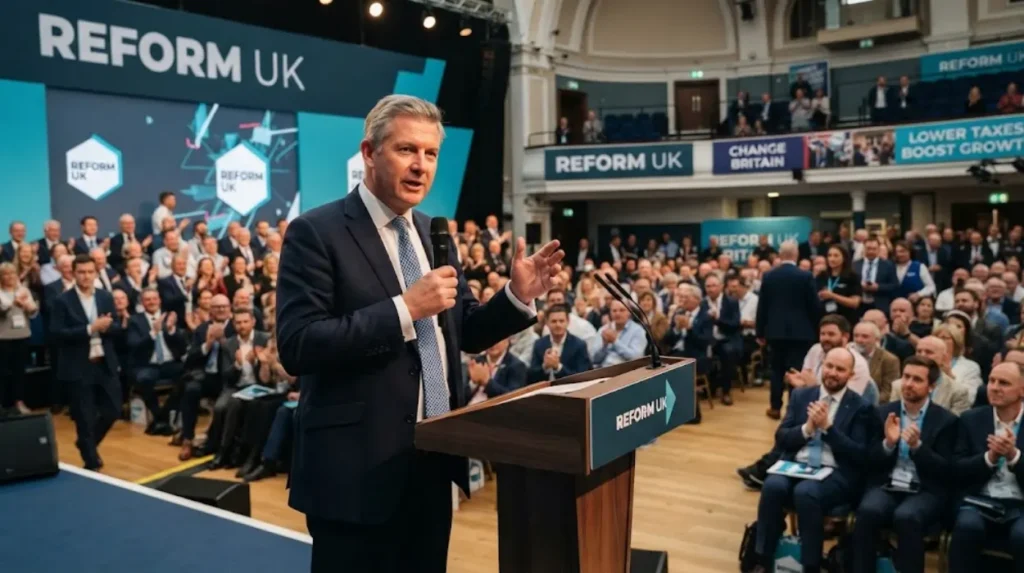
What is Reform UK’s stance on immigration and border control?
Reform UK advocates for a policy of net-zero non-essential immigration, proposing the immediate suspension of permanent settlement pathways, the establishment of an integrated border command, and the physical deterrence of undocumented Channel crossings.
Immigration serves as the foundational pillar of Reform UK’s political appeal. The party argues that high net migration figures place unsustainable pressure on public infrastructure, including National Health Service (NHS) waiting lists, school places, and social housing availability across diverse regions and boroughs in London.
To achieve its objectives, Reform UK has outlined an uncompromising legislative and operational framework. Key mechanisms include:
- The Illegal Migration (Mass Deportation) Bill: A legislative proposal designed to render anyone entering the United Kingdom via unauthorized maritime or aerial routes permanently ineligible for asylum or regularized status.
- The UK Deportation Command: A specialized enforcement agency backed by enhanced administrative powers to systematically identify, detain, and charter daily deportation flights to remove undocumented individuals and foreign national offenders from detention facilities near London.
- Abolition of Indefinite Leave to Remain: The elimination of traditional settlement paths, replacing them with temporary work visas that strictly tie foreign labor to employer sponsorship without access to state-funded welfare benefits.
- International Treaty Withdrawal: The unilateral withdrawal from or disapplication of international legal frameworks, most notably the European Convention on Human Rights (ECHR) and the UN Refugee Convention, which the party claims obstruct effective national border enforcement.
By framing border management strictly through the lens of national security, Reform UK has continuously pressed mainstream political competitors to adopt tighter legislative restrictions on visa quotas and legal migration caps.
What are Reform UK’s proposals for public services and constitutional reform?
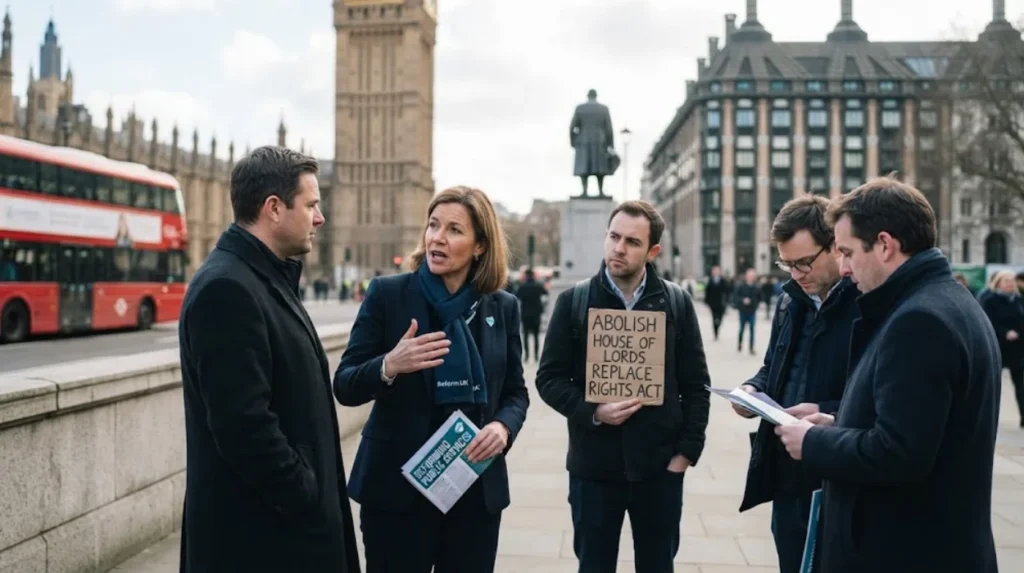
Reform UK advocates for an overhaul of public service delivery—specifically within the National Health Service and criminal justice system—alongside wide-ranging constitutional changes that include abolishing the House of Lords and replacing the Human Rights Act.
The party’s healthcare strategy acknowledges deep structural inefficiencies within the state-funded National Health Service while rejecting calls for structural privatization. Instead, Reform UK proposes utilizing private healthcare capacity to clear NHS backlogs free of charge at the point of delivery for patients, funded through reallocation of central taxation and oversight from health authorities based in London. Additionally, the party proposes tax relief for frontline NHS staff and police officers to improve workforce retention rates.
Within the criminal justice system, Reform UK champions a zero-tolerance approach to policing and public order. Its policy platform mandates the recruitment of tens of thousands of additional frontline police officers, the implementation of mandatory custodial sentences for repeat violent offenders, and the abolition of administrative targets related to non-crime hate incidents. The party also proposes building tens of thousands of new prison spaces to end early-release schemes for convicted criminals, addressing urban crime rates reported across metropolitan centers like London.
Constitutional and institutional restructuring forms an equally critical component of the party’s platform. Reform UK aims to reform the civil service by introducing greater accountability metrics for senior bureaucrats, scaling back the powers of quangos (quasi-autonomous non-governmental organisations) situated throughout London, and repealing the Human Rights Act 1998 in favor of a homegrown British Bill of Rights. Furthermore, the party targets the unelected House of Lords housed in Westminster, advocating for its replacement with a streamlined, democratic alternative or its significant downscaling to curb perceived political patronage.
What is the future outlook and political impact of Reform UK?
Reform UK has permanently altered the strategic calculations of traditional British political parties by capturing a substantial share of the working-class electorate and shifting the national policy debate firmly toward populist priorities.
The broader implications of Reform UK’s electoral growth extend beyond its individual seat count in the House of Commons. By positioning itself as the primary anti-establishment challenger to both the Labour Party and the Conservative Party, Reform UK exerts persistent ideological pressure on the political right. Mainstream politicians frequently find themselves forced to react to Reform UK’s policy framing on legal migration caps, taxation thresholds, and national sovereignty during parliamentary debates in London.
As demographic shifts and economic pressures continue to test traditional governance models across Western democracies, Reform UK remains positioned to capitalize on public disillusionment with public service delivery, cost-of-living challenges, and centralized state control. Whether the party can successfully transition from an insurgent populist movement into a stable governing contender will depend on its ability to build durable local government infrastructure, professionalize its candidate selection processes, and present a fully costed alternative to the established apparatus of the British state.
Frequently Asked Question
How many seats does Reform UK hold?
The party secured five Members of Parliament in the July 2024 general election, breaking a long-standing two-party duopoly barrier in the House of Commons.