
Sony Corporation entered the electronic entertainment sector under the leadership of Ken Kutaragi, shifting the paradigm away from expensive, cartridge-based architecture. The original PlayStation utilized CD-ROM media, which offered significantly larger storage capacity at a fraction of the manufacturing cost of ROM cartridges. This massive storage capacity allowed developers to integrate high-quality pre-rendered cinematic cutscenes, Red Book audio soundtracks, and expansive game worlds.
- What Technological Advancements Defined the Success of the PlayStation 2?
- How Did the PlayStation 3 Overcome Early Setbacks to Shape Modern Network Gaming?
- What Factors Drove the PlayStation 4 to Dominate the Eighth Console Generation?
- How Does the PlayStation 5 Architecture Deliver Next-Generation Performance?
- What distinguishes the specialized hardware models within the PlayStation 5 family?
Key technical components of the original PlayStation architecture included a 32-bit RISC central processing unit, a dedicated geometry transformation engine for rapid 3D polygon rendering, and 2 megabytes of main RAM. This hardware specification enabled iconic titles like Final Fantasy VII, Metal Gear Solid, and Gran Turismo to achieve unprecedented commercial and critical success.
Market adoption accelerated rapidly following the North American and European launches in late 1995, positioning Sony ahead of established competitors like Sega and Nintendo in that hardware generation. Major European distribution hubs, including key retail centers across London, registered record consumer queues for the system. The platform ultimately surpassed 102.4 million units sold worldwide by March 2012, cementing its status as the first console family in history to eclipse the 100-million-unit sales milestone.
The long-term industry implications of the original PlayStation launch established Sony Interactive Entertainment as a dominant hardware manufacturer, permanently altering third-party software development agreements and establishing standard controller ergonomics featuring dual analog thumbsticks.
What Technological Advancements Defined the Success of the PlayStation 2?
The PlayStation 2, released in March 2000, cemented its status as the best-selling video game console of all time by integrating groundbreaking Emotion Engine processing power and built-in DVD playback capabilities into a single consumer home entertainment system.
Sony Interactive Entertainment designed the PlayStation 2 to serve as a comprehensive media hub, capitalizing on the rapid consumer transition from analog VHS tapes to digital DVD formats at the turn of the millennium. The hardware was anchored by the custom 128-bit Emotion Engine processor and a Graphics Synthesizer unit, which together delivered advanced lighting effects, physics calculations, and complex geometry handling.
Core architectural elements of the system included backward compatibility with original PlayStation games, IEEE 1394 FireWire expansion ports, and support for an optional network adapter introduced later in the lifecycle. These features supported blockbuster software releases such as Grand Theft Auto: San Andreas, Shadow of the Colossus, and God of War.
Global demand remained exceptionally high across a production cycle spanning more than a decade, with cumulative worldwide sales exceeding 160 million units by March 2012. Urban metropolitan markets, particularly commercial retail districts in London, experienced severe inventory shortages during the initial holiday launch window due to unprecedented consumer demand.
The systemic impact of the PlayStation 2 extended well beyond interactive entertainment, accelerating the mainstream adoption of DVD technology globally and establishing high benchmarks for console longevity and software library depth that subsequent hardware generations measured against.
How Did the PlayStation 3 Overcome Early Setbacks to Shape Modern Network Gaming?
The PlayStation 3, introduced in November 2006, transformed Sony’s ecosystem by establishing the PlayStation Network infrastructure, introducing high-definition Blu-ray integration, and utilizing the complex, multi-core Cell Broadband Engine architecture.
Initial market entry for the PlayStation 3 faced substantial commercial hurdles, driven primarily by an elevated retail launch price of $499 for the base model and significant programming complexities associated with the proprietary Cell processor. Developed in collaboration with IBM and Toshiba, the Cell processor featured one Power Processing Element paired with multiple Synergistic Processing Elements, designed to execute high-performance floating-point calculations essential for advanced physics and high-definition rendering.
Despite initial developer friction, the inclusion of a high-definition Blu-ray optical disc drive provided massive storage capacity up to 50 gigabytes per dual-layer disc, protecting software from piracy while enabling visually immersive titles like The Last of Us, Uncharted 2: Among Thieves, and Demon’s Souls.
Sony systematically addressed early profitability and developer adoption issues through hardware revisions, cost-reduction manufacturing processes, and software development kit enhancements. By the end of its active lifecycle, the PlayStation 3 achieved cumulative worldwide sales exceeding 87.4 million units.
Specialized launch events hosted across major European capitals, including flagship entertainment venues in London, showcased the platform’s multimedia capabilities to technology reviewers and early adopters. The structural legacy of the platform lies in the maturation of PlayStation Network, which evolved into a multi-billion-dollar digital storefront and subscription service, laying the groundwork for modern cloud gaming, digital-first game distribution, and online multiplayer ecosystems.

What Factors Drove the PlayStation 4 to Dominate the Eighth Console Generation?
The PlayStation 4, launched in November 2013, achieved massive commercial success by adopting an x86-64 AMD architecture that simplified third-party game development, paired with a clear focus on core gaming performance and social integration features.
Sony Interactive Entertainment restructured its hardware strategy following the complexities of the PlayStation 3 era, opting for accessible, PC-like components designed in partnership with Advanced Micro Devices. The core architecture featured a single semi-custom 8-core AMD Jaguar central processing unit integrated with an AMD Radeon graphics processor and 8 gigabytes of high-speed GDDR5 system memory. This standardized hardware layout enabled developers to achieve native 1080p resolution and stable frame rates across iconic first-party franchises such as God of War (2018), Marvel’s Spider-Man, and Horizon Zero Dawn.
Strategic market positioning also emphasized player-centric features, including the dedicated DualShock 4 Share button, remote play capabilities, and robust digital storefront integration through the PlayStation Store.
Manufacturing efficiencies and strong global consumer demand propelled lifetime hardware sales to more than 117.2 million units by June 2022. Retail analysts monitoring the UK entertainment sector noted that London-based consumer electronics chains reported record-breaking sell-through rates during consecutive holiday shopping seasons.
The economic implications of the PlayStation 4 generation shifted Sony’s revenue model decisively toward digital recurring services, software monetization, and premium cinematic narrative experiences that defined contemporary console standards.
How Does the PlayStation 5 Architecture Deliver Next-Generation Performance?
The PlayStation 5, released in November 2020, redefines gaming performance parameters through a custom ultra-high-speed solid-state drive architecture, hardware-accelerated ray tracing, and advanced haptic feedback integrated within the DualSense controller.
Sony Interactive Entertainment designed the ninth-generation platform to eliminate traditional processing bottlenecks, focusing heavily on input-output throughput speed. The system is powered by a custom 8-core AMD Zen 2 central processing unit and an AMD Radeon RDNA 2-based graphics processing unit capable of 10.28 floating-point operations per second.
The primary technological innovation of the PlayStation 5 is its custom NVMe solid-state drive controller, which delivers raw data transfer speeds of 5.5 gigabytes per second, enabling instantaneous asset streaming, seamless open-world traversal, and virtually non-existent loading screens in titles such as Ratchet & Clank: Rift Apart and Returnal.
Complementing the internal processing hardware, the DualSense wireless controller features adaptive triggers with variable resistance and haptic feedback actuators, providing nuanced tactile sensations corresponding to environmental interactions.
With cumulative worldwide hardware sales surpassing 93.7 million units, the platform continues to drive robust engagement across global markets. Industry trade reports published by entertainment analysts in London indicate that UK consumers spent nearly £919 million on PlayStation 5 hardware within its initial rollout phase, establishing it as one of the fastest-selling high-end systems in regional commercial history.
The overarching industry impact of the platform centers on the normalization of solid-state storage as a mandatory requirement for game design, permanently altering how developers structure level streaming, asset management, and audio rendering via Tempest 3D AudioTech.
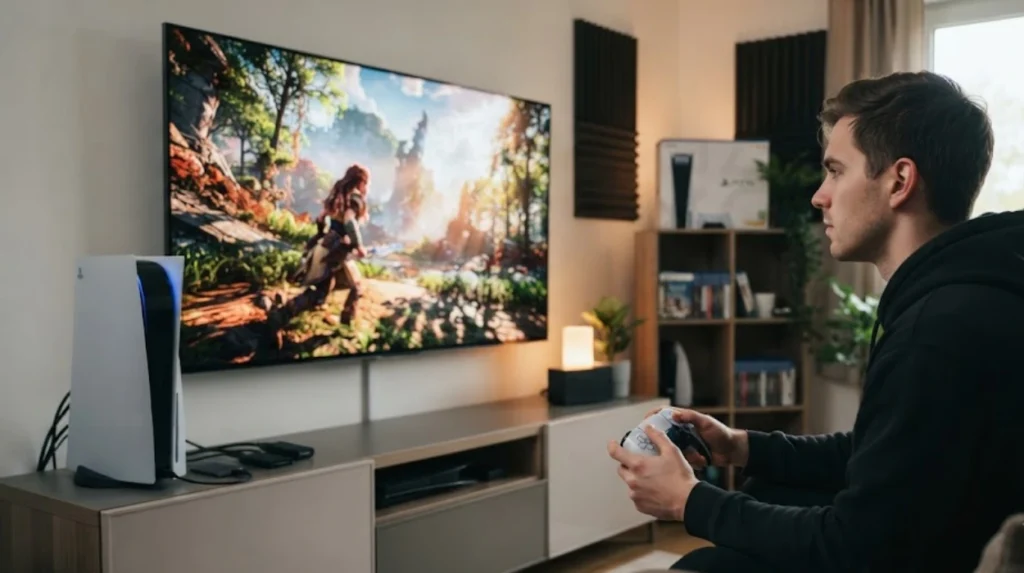
What distinguishes the specialized hardware models within the PlayStation 5 family?
The PlayStation 5 hardware family encompasses multiple distinct iterations—including the original base models, the streamlined 2023 Slim redesigns, and the high-performance PlayStation 5 Pro released in late 2024—tailored to diverse consumer performance and media preferences.
Sony Interactive Entertainment expanded the ninth-generation hardware lineup to address shifting market segments, dividing choices between disc-based units and purely digital variations.
The original base models, introduced in November 2020, established the foundational specifications featuring a custom 825-gigabyte solid-state drive and an Ultra High-Definition Blu-ray optical drive option.
In November 2023, Sony introduced the PlayStation 5 Slim variants, which reduced physical volume by more than 30 percent while upgrading internal storage capacity to a standard 1-terabyte solid-state drive and offering a detachable optical disc drive option for the digital variant.
Further expanding the high-end hardware tier, the PlayStation 5 Pro debuted in October 2024 at an introductory price of $699, featuring a 2-terabyte solid-state drive, an upgraded graphics processor with advanced ray tracing capabilities, and PlayStation Spectral Super Resolution machine learning upscaling technology to deliver high frame rates alongside maximum visual fidelity.
These hardware variations provide Extra London News readers with clear segmentation options, ensuring that consumer purchasing decisions align precisely with performance requirements, physical space constraints, and media consumption habits. Major electronics retailers across London stock these variants alongside specialized bundles to satisfy local market demand.
When was the original Sony PlayStation released?
The original PlayStation launched in Japan on 3 December 1994, followed by releases in North America and Europe during 1995.