London ranks among the world’s most historically layered capitals. More than 2,000 years of continuous urban development have created a city where Roman archaeology, medieval streets, royal palaces, Victorian engineering, and contemporary cultural districts exist within the same metropolitan landscape. A well-planned first-time itinerary allows visitors to understand how London’s history developed through successive eras while experiencing its most significant landmarks and lesser-known historic spaces.
- Why is a historical itinerary the best way to explore London for the first time?
- What should visitors explore on their first morning in historic London?
- How does Westminster represent Britain’s political and royal history?
- Which museums provide the strongest introduction to London’s history and culture?
- Why should visitors include London’s hidden historic neighbourhoods?
- How did the River Thames shape London’s development?
- What architectural styles define London’s historic landscape?
- How can visitors experience London’s cultural traditions alongside its historic landmarks?
- Why does London remain one of the world’s most significant historical destinations?
Rather than treating attractions as isolated destinations, this itinerary follows London’s historical evolution. Each location demonstrates a different stage in the city’s development, from its Roman foundation to its role as the capital of a global empire and a modern multicultural metropolis.
Why is a historical itinerary the best way to explore London for the first time?
A historical itinerary connects London’s landmarks into a chronological narrative that explains the city’s evolution over two millennia. Visitors gain historical context, architectural understanding, and cultural insight while reducing unnecessary travel and experiencing both internationally recognised attractions and overlooked heritage locations.
Many first-time visitors focus only on London’s famous landmarks without understanding their historical relationships. A structured itinerary reveals how each district represents a distinct period in Britain’s history.
London originated as the Roman settlement of Londinium around AD 47. The city expanded during the medieval period after the Norman Conquest in 1066, developed into a commercial powerhouse during the Tudor and Stuart eras, transformed through industrialisation during the nineteenth century, and emerged as a global financial and cultural centre after the Second World War.
Exploring London chronologically enables visitors to recognise architectural transitions between Roman fortifications, Norman castles, Gothic churches, Georgian squares, Victorian railway stations, and modern skyscrapers.
Walking also reveals details often overlooked by visitors using only underground transport. Historic alleyways, parish churches, market streets, memorials, and preserved public buildings explain how ordinary Londoners lived alongside monarchs, merchants, lawyers, and craftsmen.
What should visitors explore on their first morning in historic London?
Beginning in the City of London introduces visitors to the Roman origins, medieval commercial centre, and surviving institutions that shaped Britain’s capital. The area’s compact geography allows several internationally significant landmarks to be explored efficiently within a single morning.
The City of London covers approximately one square mile and represents the oldest continuously occupied part of the capital. Although modern office towers dominate the skyline, archaeological excavations continue to uncover Roman roads, temples, mosaics, and defensive walls beneath contemporary developments.
Start at the Tower of London, founded by William the Conqueror shortly after 1066. The White Tower served simultaneously as a royal residence, military fortress, treasury, armoury, mint, and state prison. Today, it preserves nearly one thousand years of royal and military history.
Nearby stands Tower Bridge, completed in 1894. Its bascule mechanism allowed large commercial vessels to continue reaching the Port of London while maintaining road traffic across the River Thames. The bridge remains one of Victorian Britain’s greatest engineering achievements.
Continue west toward Monument, completed in 1677 to commemorate the Great Fire of London in 1666. Designed by Sir Christopher Wren and Robert Hooke, the structure stands close to the fire’s point of origin on Pudding Lane.
The route naturally leads toward Leadenhall Market. Originally a medieval meat market, the present Victorian structure dates primarily from 1881 and demonstrates London’s nineteenth-century commercial architecture.
Visitors should also explore remnants of London’s Roman Wall, sections of which survive near the Museum of London area and several nearby streets. Archaeological research indicates that the wall originally extended approximately three kilometres around Roman Londinium.
To experience this historic district in person today, consult our comprehensive [How London Became Britain’s Capital Through Centuries of Political and Cultural Growth] for itineraries and visiting parameters.
How does Westminster represent Britain’s political and royal history?
Westminster contains Britain’s constitutional institutions, royal ceremonial spaces, and religious landmarks that collectively illustrate the development of monarchy, parliamentary democracy, and national identity over nearly one thousand years of recorded history.
Westminster became England’s political centre during the medieval period as monarchs increasingly governed from the Palace of Westminster.
Westminster Abbey remains among Britain’s most important religious buildings. Originally established as a Benedictine monastery, the present Gothic church largely dates from the thirteenth century under King Henry III. Every English and later British coronation since 1066 has taken place inside the Abbey.
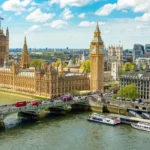
The Palace of Westminster serves as the home of the United Kingdom Parliament. After a devastating fire destroyed most of the medieval complex in 1834, architects Charles Barry and Augustus Pugin designed the current Gothic Revival structure.
Its Elizabeth Tower houses the Great Bell commonly known as Big Ben. Completed in 1859, the tower has become an internationally recognised symbol of parliamentary democracy.
Nearby Whitehall developed as the administrative centre of national government. Numerous government departments continue operating from historic buildings along this avenue.
Horse Guards Parade preserves ceremonial military traditions dating back centuries. The mounted guards continue daily ceremonial duties that reflect Britain’s constitutional monarchy.
St James’s Park, created during the seventeenth century, links Whitehall with Buckingham Palace. The landscaped park demonstrates the transformation of former royal hunting grounds into public recreational spaces.
Buckingham Palace became the principal royal residence during Queen Victoria’s reign in 1837. Although functioning as a working palace, its ceremonial role continues through state occasions, investitures, and diplomatic receptions.

Which museums provide the strongest introduction to London’s history and culture?
London’s national museums preserve archaeological discoveries, artistic masterpieces, scientific collections, and documentary evidence that explain Britain’s historical development through authentic objects spanning prehistoric Britain, Roman occupation, medieval society, imperial expansion, and contemporary multicultural life.
The British Museum houses one of the world’s largest historical collections, containing approximately eight million objects. Established in 1753, it introduced the concept of a publicly accessible national museum.
Highlights include the Rosetta Stone, Parthenon sculptures, Egyptian mummies, Roman artefacts from Britain, Anglo-Saxon treasures, and medieval manuscripts.
The National Gallery displays more than 2,300 paintings dating from the thirteenth century onward. Located in Trafalgar Square, it illustrates European artistic development across multiple centuries.
The Victoria and Albert Museum focuses on decorative arts and design. Its collections demonstrate changing artistic techniques, manufacturing methods, and cultural influences across Europe, Asia, Africa, and the Middle East.
The Museum of London Docklands explains London’s maritime economy, Atlantic trade, dock expansion, and redevelopment of the Docklands into Canary Wharf.
The Imperial War Museum documents Britain’s military experiences during the First and Second World Wars alongside later international conflicts.
Collectively, London’s public museums preserve millions of artefacts while supporting archaeological research, conservation science, and historical scholarship through partnerships with universities and heritage organisations.
Why should visitors include London’s hidden historic neighbourhoods?
Historic neighbourhoods preserve London’s everyday social history through surviving streets, markets, churches, inns, and residential buildings that illustrate ordinary urban life beyond royal palaces and nationally recognised monuments.
Covent Garden evolved from a seventeenth-century fruit and vegetable market into one of London’s leading cultural districts. The former market buildings now accommodate independent retailers, restaurants, and performance spaces while preserving their historic architecture.
Seven Dials developed during the late seventeenth century around an unusual seven-way road junction. Originally fashionable, the district later experienced urban decline before extensive conservation restored many Georgian buildings.
Clerkenwell contains one of London’s richest concentrations of medieval and industrial heritage. Religious orders, clockmakers, printers, and engineers all contributed to its historical identity.
Little Venice demonstrates nineteenth-century canal engineering where the Regent’s Canal meets the Grand Union Canal. Narrowboats continue navigating waterways originally constructed for industrial freight.
Neal’s Yard transformed from neglected courtyards into a colourful conservation success illustrating adaptive reuse of historic urban spaces.
Lincoln’s Inn preserves one of the four historic Inns of Court responsible for educating barristers in England and Wales. Its halls, gardens, and chapel maintain legal traditions extending back several centuries.
Historic pubs, coaching inns, parish churches, and narrow lanes throughout these districts preserve architectural evidence of London’s commercial and residential evolution.
How did the River Thames shape London’s development?
The River Thames determined London’s economic growth, military defence, international trade, transportation, settlement expansion, and engineering innovation for nearly two thousand years, making it the defining geographical feature in the capital’s historical development.
Roman Londinium developed beside the Thames because the river provided navigable access between inland Britain and continental Europe.
Throughout the medieval period, merchants imported wine, timber, grain, cloth, spices, and luxury goods through London’s expanding port.
By the eighteenth and nineteenth centuries, the Port of London ranked among the busiest in the world. Vast dock complexes accommodated Britain’s expanding maritime trade during the Industrial Revolution.
Major engineering achievements transformed the river corridor. Examples include Tower Bridge, the Thames Embankment, examples including Victoria Embankment and Chelsea Embankment, and modern flood protection through the Thames Barrier.
South Bank evolved from industrial riverside activities into one of London’s leading cultural destinations. Historic warehouses have become galleries, theatres, restaurants, and residential developments.
Modern river services continue supporting tourism and public transport while maintaining London’s centuries-old relationship with its principal waterway.

What architectural styles define London’s historic landscape?
London’s built environment reflects successive architectural movements that document political change, religious transformation, technological innovation, and economic expansion from Roman engineering through medieval construction, Georgian planning, Victorian industrialisation, and contemporary urban redevelopment.
Roman builders introduced defensive walls, roads, baths, temples, and administrative buildings using stone and concrete construction techniques.
Norman architecture emphasised military strength through massive castles and fortified churches following 1066.
Gothic architecture reached its finest English expression at Westminster Abbey and numerous medieval parish churches.
Following the Great Fire of London, Sir Christopher Wren supervised extensive rebuilding programmes. St Paul’s Cathedral became the defining masterpiece of English Baroque architecture.
Georgian planning introduced elegant terraces, garden squares, and symmetrical residential developments across districts including Bloomsbury, Mayfair, and Marylebone.
Victorian architecture reflected industrial prosperity through railway stations, museums, markets, warehouses, bridges, and civic institutions.
Modern architecture now coexists with preserved heritage buildings. Strict conservation policies protect thousands of listed structures while allowing carefully managed redevelopment within designated historic areas.
How can visitors experience London’s cultural traditions alongside its historic landmarks?
London’s living traditions demonstrate that historical heritage continues through ceremonies, markets, performances, educational institutions, and public events that preserve customs established across many centuries while adapting to contemporary society.
The Changing of the Guard remains one of Britain’s best-known ceremonial traditions, reflecting the continuing constitutional role of the monarchy.
The Lord Mayor’s Show, first recorded during the thirteenth century, continues celebrating the governance of the City of London through annual public processions.
Borough Market traces its commercial origins to at least the twelfth century. Modern traders continue operating near one of England’s oldest market locations.
The Inns of Court preserve centuries-old legal education through dining traditions, libraries, chapels, and ceremonial events.
West End theatres continue London’s long association with performing arts that expanded significantly during the eighteenth and nineteenth centuries.
Historic churches remain active places of worship while simultaneously preserving important architectural, artistic, and documentary heritage.
Annual heritage festivals, guided walks, archaeological open days, and museum exhibitions ensure London’s history remains accessible to residents, students, researchers, and international visitors.
Why does London remain one of the world’s most significant historical destinations?
London combines exceptional historical continuity, internationally important heritage sites, preserved architecture, archaeological evidence, and living cultural traditions that collectively illustrate more than two thousand years of political, economic, architectural, and social development within one accessible global capital.
Few cities present such an uninterrupted historical sequence across multiple eras. Roman foundations exist beneath medieval streets. Norman fortresses stand beside Victorian engineering. Georgian neighbourhoods connect directly with modern financial districts.
More than 2,000 scheduled monuments, tens of thousands of listed buildings, royal residences, historic churches, museums, archives, libraries, and archaeological sites contribute to London’s outstanding cultural significance.
Organisations including Historic England, the Museum of London Archaeology, local borough councils, universities, and conservation charities continue documenting, preserving, and interpreting London’s built heritage.
Archaeological excavations regularly reveal new information about Roman Londinium, medieval commerce, Tudor domestic life, and industrial expansion. Digital mapping, conservation science, and archival research continually improve understanding of London’s historical development.
For first-time visitors, an itinerary built around history transforms sightseeing into a structured exploration of Britain’s national story. Every district reflects a different chapter, every landmark illustrates a broader historical process, and every preserved street contributes evidence to London’s continuing evolution.
A carefully planned visit therefore provides more than memorable photographs. It offers a comprehensive introduction to one of the world’s most influential capitals, where two millennia of history remain visible within the fabric of the modern city.
How many days should first-time visitors spend in London?
A 3 to 5-day itinerary is ideal for first-time visitors. This allows enough time to explore iconic landmarks such as the Tower of London, Westminster Abbey, Buckingham Palace, the British Museum, and neighbourhoods like Covent Garden and South Bank without rushing.