
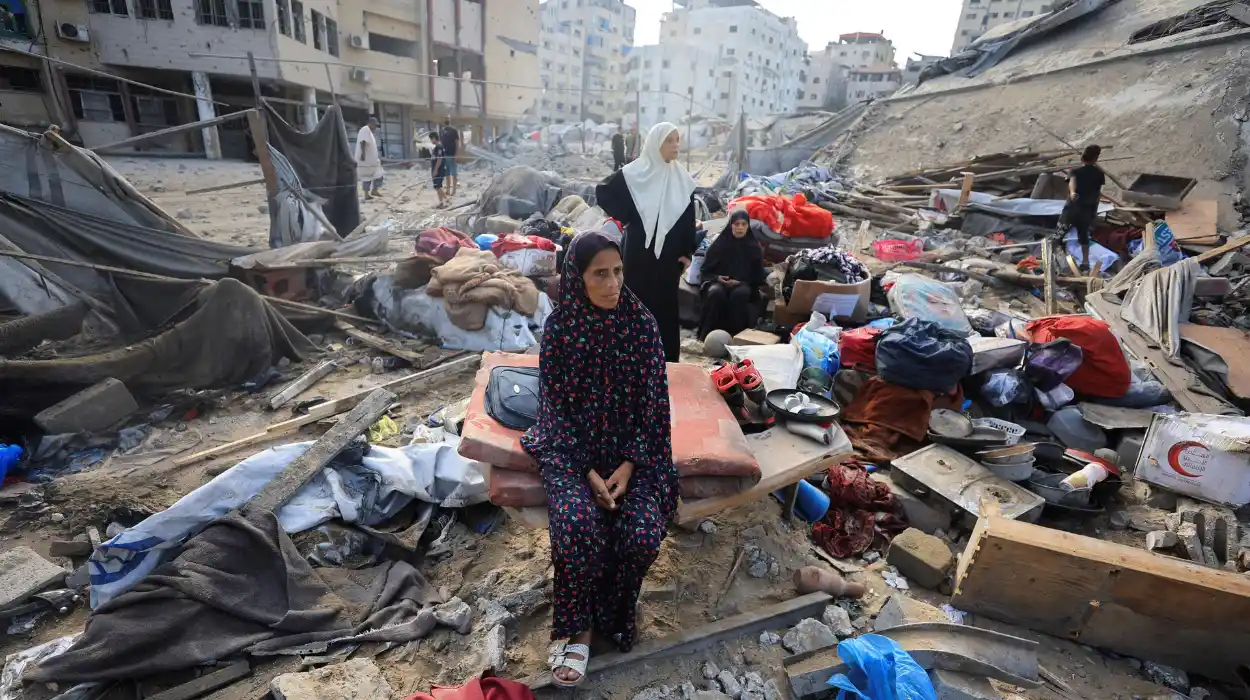
Labour is facing renewed pressure over its refusal to formally recognise Israel’s actions in Gaza as genocide, as campaigners question whether the government’s latest measures against illegal Israeli settlements go anywhere near far enough.
The government has hardened its language towards Israel. Foreign Secretary Ed Miliband has declared Israel’s occupation of Palestinian territory unlawful and described the forced displacement taking place in parts of the occupied West Bank as ethnic cleansing.
Yet on Gaza, Labour continues to stop short of reaching its own conclusion that genocide has taken place, maintaining that a final determination should be made through the appropriate international judicial process.
That position is increasingly being challenged both inside and outside Labour.
The controversy is particularly acute because the government has not imposed a comprehensive arms embargo on Israel.
Labour suspended more than 30 arms export licences over concerns that equipment could be used in serious violations of international humanitarian law, and the government has now said it will refuse licences for weapons and other exports that “materially contribute” to Israel’s occupation.
But that is not the same as ending all military exports.
According to a September 2026 House of Commons Library briefing, government figures showed that, as of February, 203 non-suspended military licences to Israel remained extant, alongside 192 licences covering non-military goods.
The contradiction is increasingly difficult for Labour’s critics to ignore: ministers acknowledge extraordinary civilian suffering, unlawful occupation and what the Foreign Secretary has described as ethnic cleansing in the West Bank, while rejecting demands for a complete arms embargo.
Settlement sanctions: significant action — or tinkering at the edges?
The government has also announced a ban on imports from illegal Israeli settlements in the occupied West Bank, alongside sanctions targeting organisations and individuals involved in settlement expansion.
The measures represent a significant change in British policy.
But critics argue that restricting settlement goods while maintaining much wider economic and military relationships with Israel is inadequate when set against the scale of Palestinian death, displacement and destruction.
The distinction matters.
The government’s sanctions explicitly target illegal settlements rather than Israel as a whole. Ministers have presented that distinction as part of a strategy aimed at protecting a two-state solution.
For Palestine campaigners, however, sanctions limited to settlements risk appearing painfully modest beside the devastation witnessed in Gaza.
Even supporters of stronger action have therefore questioned whether the policy amounts to a proportionate response to the humanitarian catastrophe.
Palantir and Labour’s revolving door
Those concerns have been intensified by another development: former Labour deputy leader Tom Watson has joined controversial US technology company Palantir as a senior vice-president, having previously advised the company.
Palantir has worked with the Israeli military. The company announced a strategic partnership with Israel’s Ministry of Defence in 2024 to provide technology supporting what it described as Israel’s “war-related missions”.
A UN special rapporteur’s 2025 report subsequently highlighted Palantir’s relationship with the Israeli military while examining corporations allegedly profiting from Israel’s operations in Gaza. Palantir has rejected claims that it was involved in the IDF’s reported Lavender or Gospel targeting programmes and has said it is proud to support Israeli defence and national-security missions in other contexts.
Watson’s appointment has nevertheless triggered criticism over the relationship between political power, government contracting and private technology companies.
Green MP Siân Berry described it as another example of a “revolving door” between politics and big business.
The issue is therefore larger than one former politician taking a private-sector job. Critics are asking what safeguards exist when companies with substantial government contracts and controversial defence relationships recruit people who previously occupied some of Britain’s most influential political positions.
The argument reaches Camden
These national arguments are now playing out directly in Camden, where council leader and Labour parliamentary candidate Sagal Abdi-Wali is facing pressure over the council’s approach to Gaza and divestment.
Camden Friends of Palestine has campaigned for the council and its pension investments to divest from companies it associates with Israel’s military operations and occupation.
The organisation has been raising these concerns formally with Camden for more than two years. In an April 2024 deputation to the council, Camden Friends of Palestine and Camden Abu Dis Friendship Association accused the authority of failing adequately to engage with residents over Gaza and called on it to listen and act.
The dispute erupted again this month when a Green motion concerning pension-fund divestment from arms companies was scheduled to be debated by Camden Council but was not reached before the meeting ended at 10pm.
Palestine campaigners protested from the public gallery.
Labour supporters disputed accusations that the motion had deliberately been prevented from being heard, arguing that council meetings commonly run out of time. Campaigners, however, viewed the episode as another example of their demands for divestment failing to receive the debate they believe they deserve.
The controversy is particularly significant because Abdi-Wali is now Labour’s candidate in the 8 October Holborn and St Pancras parliamentary by-election.
Abdi-Wali has rejected suggestions that Camden Labour does not care about Gaza. Responding to criticism during the campaign, she described events there as “really harrowing” and said Camden Labour councillors cared deeply about the issue.
She has also defended the direction being taken by the Labour government, saying: “We’re going in the right direction.”
Her critics fundamentally disagree.
Campaigners have also criticised her level of engagement with pro-Palestinian residents, including over community events and hustings. Any claim that she refused a particular recent hustings should, however, identify the organiser, date and invitation before being stated as fact.
A widening credibility test for Labour
Labour can point to measures that would have been politically difficult to imagine only a few years ago: recognition of Palestinian statehood, suspension of some arms licences, sanctions against violent settlers, a planned ban on settlement goods and an explicit declaration that Israel’s occupation is unlawful.
Those are substantive policy changes.
But they have not resolved the central criticism coming from Palestine campaigners.
If ministers believe the occupation is unlawful; if the Foreign Secretary believes ethnic cleansing is occurring in the West Bank; and if the government itself concluded that some British military exports carried a clear risk of facilitating serious violations of international humanitarian law, critics are asking why Britain’s response does not extend to a comprehensive arms embargo and substantially broader economic measures.
That same argument is now being made at local level in Camden: campaigners want political expressions of concern to be translated into decisions about investments, procurement and financial relationships.
The dispute is therefore no longer simply about the language politicians use to describe Gaza.
It is about what Britain — and British public institutions — are prepared to do in response.