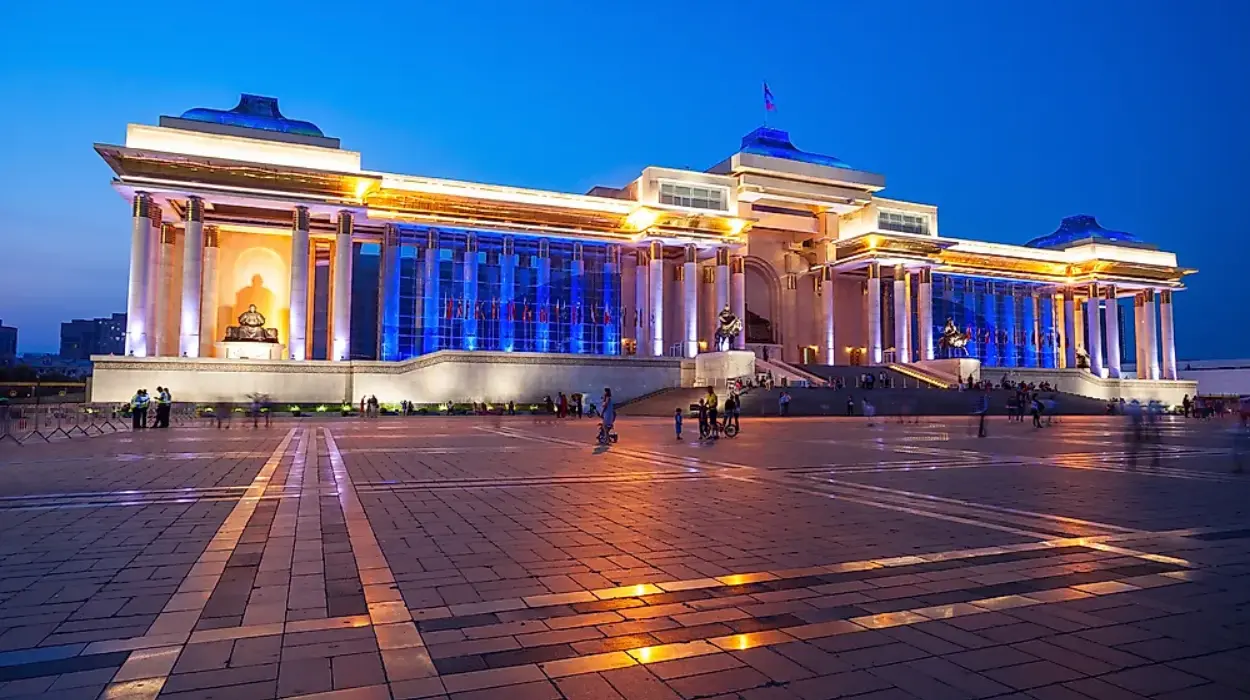
If you want to see where the world’s energy crisis is actually biting, don’t look at the Strait of Hormuz. Look at a petrol station in Ulaanbaatar.
On 3 August, Mongolia’s government told drivers they could fill up only on alternate days, depending on whether their licence plate ended in an odd or even number, and capped purchases at roughly one-third of the level needed to fill a car’s fuel tank. The US Embassy spent the following fortnight tracking nationwide shortages and advising all non-essential travel be deferred — to a country that has spent the past decade marketing itself as the next great tourism frontier. No other government imposed anything as severe this summer.
The measures were lifted on 18 August after Moscow agreed to rush through an extra 25,000 tonnes of petrol and 5,000 tonnes of jet fuel. But that is only a short-term fix, and further strains in Russian supplies amid continued Ukrainian drone strikes on its refineries are all but guaranteed. Given that the refinery that historically has provided almost all of Mongolia’s petrol supplies, Angarsk, has not yet been struck, the situation could become further critical still. Furthermore, aid from the Kremlin is never truly free, and it remains to be seen what Moscow will ask for as its pound of flesh in return – though in the kind of blunt signalling it has a knack for, Russia did last year float an interest in the country’s major copper and gold mine, Oyu Tolgoi, when a court in Russia handed down a judgement against its lead shareholder, the British–Australian multinational miner Rio Tinto. Successive governments have promised three to six months of strategic reserve, but all failed to meet this target, or even develop the capacity needed to store it.
The exposure is not marginal. Diesel and petrol alone made up roughly a third of all Mongolian imports last year. Volumes have quintupled in two decades, to some 2.7 million tonnes in 2025, and demand is growing at up to 14 percent a year. Nor is this a story about motorists’ inconvenience. Mongolia’s economy is a mining economy, and mining economies are diesel economies: the haul trucks at its flagship mine, Oyu Tolgoi, the coal convoys grinding south towards the Chinese border, the generators keeping camps alive on the Gobi. When the pumps run dry in Ulaanbaatar, the export engine that pays for everything else begins to cough.
Which brings us to the neighbour to the north. Mongolia has no refinery of its own; and although it has been building one, financed by India, since 2018, with completion is set for 2028, if further delays can be avoid. Until then, some 97 percent of its fuel arrives from Russia — a supplier currently seeing its own refineries ravaged, one Ukrainian drone at a time. Russian refinery runs fell in July to about 3.6 million barrels a day, the
lowest level since 2002, after eighteen plants were struck in a single month. Moscow has banned petrol and diesel exports outright and started importing fuel itself; Mongolia keeps its allocation only through carve-outs for intergovernmental agreements — which is to say, as a favour. With the international oil benchmark, Brent, hovering around $90 and Middle Eastern output not expected to normalise before 2027, Ulaanbaatar is in a genuine pickle: structurally dependent on the one supplier whose refining capacity has become the most reliably destroyed asset class in Eurasia.
Ulaanbaatar knows this, and has been shopping. Its industry minister spent late July in Seoul negotiating quotas and freight with GS Caltex, with first cargoes promised by the end of August; the prime minister met PetroChina’s local subsidiary on 7 August; and there have long been discussions with Kazakhstan, which is seeking to lower its own dependency on Russian export routes, but also lacks the refined product capacity to significantly benefit Mongolia until the latter has its own refinery running. All of this is sensible, but none of it is cheap. Every one of those barrels must make its way to a landlocked market with no deepwater option and no meaningful storage — and, in the Chinese case, replaces one dependency with another.
How this is handled — by governments and by the traders who actually move the barrels
— matters well beyond the Mongolian steppe. The country is the test case for whether a small, landlocked democracy can retain any economic autonomy while wedged between two revisionist powers.
Washington has said for years that it wants exactly that. The Trump administration established a strategic partnership with Ulaanbaatar in 2019; the Biden years brought a stream of visits, memoranda and minerals dialogues; and this February Mongolia joined more than fifty countries at the State Department’s Critical Minerals Ministerial. There is reported interest from the US International Development Finance Corporation in financing the development of rare-earth resources in the country, and a US trade agency is helping Mongolia secure an aviation safety rating that would allow direct flights and air-freighted rare earth oxides. Nevertheless, that an air route is necessary is evidence of the political risks Mongolia faces with its own land-based export routes, which only really flow one way – to China, the destination for more than 80 percent of Mongolian exports at present. Mongolia’s commodity export story there faces long-running political challenges despite the fact that coal and copper volumes have grown impressively but face risk from that Chinese dependency.
There are not many markets where the hierarchy and future of Tibetan Buddhism is such a material factor. Beijing closed the border in 2016 over a visit by the Dalai Lama and with Mongolia where Tibetan Buddhism – as opposed to other offshoots of the faith – is so dominant, the aging spiritual leader and the fight Beijing has spent decades planning over choosing his successor looms. So too do even less headline-grabbing factors.
Consider the succession of the Boghd Khan, the third-ranking figure in Tibetan
Buddhism, and also until the early 20th century, the post that served as Mongolia’s traditional ruler. The tenth incarnation of the Boghd Khan, identified in 2023, is a Mongolian-American boy who was then eleven years old. Somewhere in a London underwriting meeting, a credit committee is being asked to hold a ten-year tenor on a market where the tail risk is a pre-teen’s theological career. Between now and the 2040s, that child may well grow into one of the more consequential variables in Mongolian trade — and there is no natural way to hedge this.
But even setting metaphysics aside, the physics of Mongolia’s commodity challenge is not just about getting things out of Mongolia. What Mongolia urgently needs is help getting things in. Import assistance is a harder sell than export finance, and not only because it is less photogenic. A private trader supplying a market like this has to price a political risk premium against a customer whose entire export revenue runs through a single neighbour, and whose relationship with that neighbour can be disrupted by disputes with almost no touchpoint to the outside world.
Financing rare-earth mining does not help much if the trucks carrying the ore have no diesel. The instruments to do the other thing exist — trade finance guarantees, political risk insurance, a credit line that lets a Korean or Gulf supplier sell into Ulaanbaatar without pricing in the possibility of not being paid. They are simply less exciting than a minerals ministerial, and they do not photograph well. Historically, this is precisely where the machinery of the global commodities markets has stepped in. But Mongolia’s wild-west business environment has burned commodity traders repeatedly, recently, and with little hope for improvement imminent.
Ask Trafigura. In October 2024, the trading house disclosed serious misconduct in its Mongolian petroleum products business. The reported hit was US$1.1 billion. The people allegedly responsible included Jononbayar Erdenesuren, a well-connected Mongolian playboy whose aunt – according to Reuters – ran Lex Oil, a company that racked up over $500m in debt to Trafigura. Erdenesuren’s family also started a helicopter company, Alpha Aurora Aviation, used by senior political figures. It became embroiled in the corruption scandal that brought down then-prime minister Luvsannamsrain Oyun-Erdene in June 2025. To put the size of the alleged fraud in perspective: Mongolia consumes around 35,000 barrels a day, or just under US$900m based on last year’s average oil price of US$69.14 per Brent barrel – in other words, fraud cost Trafigura more in the country than that country spends on fuel in a year.
But this is not the only such tale. The largest protests Mongolia has seen in decades were triggered in December 2022 by revelations that as much as $11 billion in coking coal exports had been siphoned off through the state coal company. Even where Mongolia has had at least boilerplate success – most notably with the giant copper and gold mine, Oyu Tolgoi, that began production in 2013– politicians have repeatedly sought to take larger pounds of flesh from its bedrock shareholder, Rio Tinto. In
December 2025, the country’s legislature passed a resolution demanding renegotiations of a 15-year old shareholders agreement and requiring that the firm’s revenue be channelled through local commercial banks – the latter of which was ostensibly demanded for transparency reasons, though it would also open the door to investor funds being trapped in the country, and subject to the whims of the relationship between Mongolian bankers and politicians.
None of this makes Mongolia undeserving. It remains the only functioning democracy for thousands of kilometres in any direction, it holds resources the West says it desperately needs, and it has spent thirty years trying to build a foreign policy out of geography that offers none. But it is also a country on its third prime minister in the last 14 months, with Oyun-Erdene’s immediate successor lasting just four months after he too was accused of corruption and implicated in cover-ups. The governing party that both were members of, the Mongolian People’s Party (MPP), has done little more than pay lip service to regular anti-corruption protests. Rather than undertake a genuine effort to clean things up, the MPP has repeatedly threatened to rewrite investment terms when domestic politics demanded a scapegoat — most memorably in the 2024 amendments that let the state take stakes in strategic deposits without compensation
— and it has just demonstrated that it is fourteen days of Russian goodwill away from rationing.
At a time when Mongolia should have been investing in its energy security, instead the political leadership, both within the MPP in parliament and President Ukhnaagiin Khürelsükh, himself a former MPP prime minister and party leader, presided over multiple cases of fraud and left its population vulnerable to an external energy crisis. Mongolia will hold presidential elections next year, but it is unlikely to provide a panacea
– though power has often shifted between the MPP and the main opposition Democratic Party. The last Democratic Party president, Khaltmaagin Battulga, also faced accusations of corruption. Genuine fixes requires two things that Ulaanbaatar cannot solely supply on its own: a Western engagement that outlasts an electoral cycle and extends to imports as well as offtake, and a domestic business environment in which a trader’s biggest risk is the price of the cargo rather than the provenance of the invoice. Until both arrive, the commodity cowboys will keep looking beyond the Mongolian frontier, choosing to ride it out somewhere else.