Leadenhall Market is one of the oldest commercial sites in the City of London. Its significance lies in continuity: a Roman civic and trading zone evolved into a medieval food market and then into a major Victorian covered market, preserving nearly 2,000 years of London’s commercial history.
- Where did Leadenhall Market begin in Roman London?
- How did the Roman forum become a medieval market district?
- Why was Leadenhall important in medieval London’s food and grain trade?
- Who shaped Leadenhall Market in the late medieval and early modern periods?
- How did the Great Fire of London and later rebuilding affect Leadenhall?
- Why was the Victorian Leadenhall Market rebuilt, and who designed it?
- What architectural features make Leadenhall Market a Victorian landmark?
- How has Leadenhall Market survived modern London and heritage change?
- What does Leadenhall Market reveal about London’s commercial evolution?
Leadenhall Market is a historic covered market in the eastern part of the City of London, close to Gracechurch Street, Lime Street, Fenchurch Street, and Cornhill. It matters because it sits in the same urban zone that functioned as the civic and commercial heart of Roman London. Few places in Britain show such a long sequence of urban use on one site: Roman forum and basilica, medieval food provisioning market, early modern commercial yard, and late Victorian architectural landmark.
In historical terms, Leadenhall Market is not important simply because it is old. It is important because it reveals how London’s economy changed across successive eras while retaining the same core function: exchange. Under Roman rule, the surrounding district contained the forum-basilica complex, the administrative and mercantile centre of Londinium. In the medieval period, the area became associated with the sale of poultry, meat, grain, leather, and other provisions needed by a growing city. In the nineteenth century, the City of London Corporation rebuilt the market in a highly decorative iron-and-glass form that survives today.
Leadenhall Market therefore serves as a compact history of London’s commercial development. It connects imperial Roman urban planning, medieval civic regulation, early modern food supply systems, and Victorian urban improvement. It also helps explain why the City of London remained a market-centred district even as its role expanded into banking, insurance, and global finance.
The site’s significance has increased in recent years because archaeology around Gracechurch Street has continued to confirm the depth of Roman remains in the area, including substantial evidence for the first and later phases of London’s Roman basilica and forum complex. Those findings strengthen the argument that Leadenhall Market stands not on the fringe of Roman London but at its institutional centre.
Where did Leadenhall Market begin in Roman London?
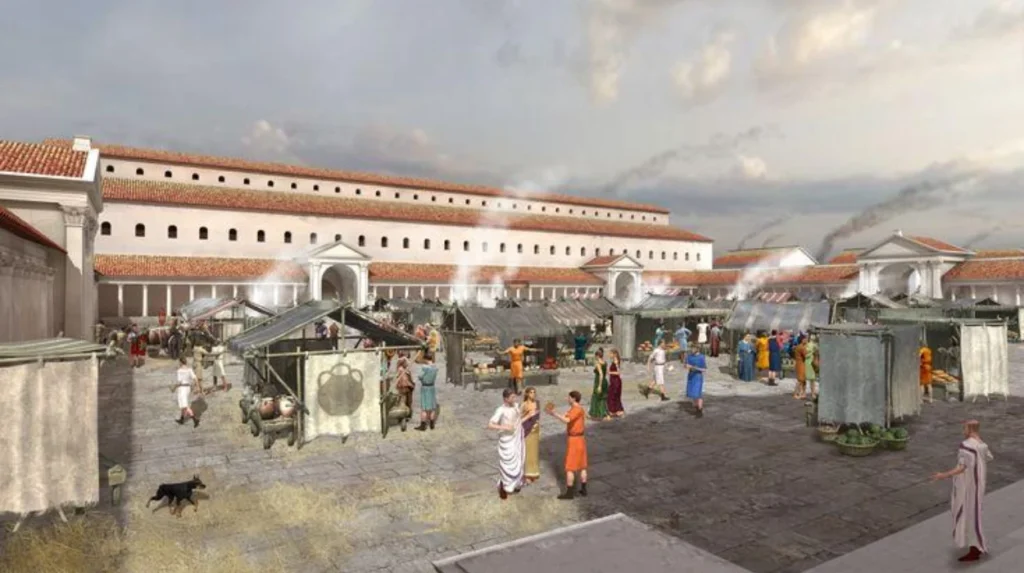
Leadenhall Market stands within the zone of Roman London’s forum and basilica, first established in the late first century AD and enlarged around AD 100. This made the area the city’s political, judicial, administrative, and commercial core, linking trade directly to urban government.
The origins of Leadenhall Market lie in the Roman city of Londinium, founded after the Roman conquest of Britain in the first century AD. By the late first century, the Romans had established a forum and basilica near the line of modern Gracechurch Street. This complex was the central public institution of the city. In Roman urban planning, the forum was an open civic square used for exchange, assembly, and public life, while the basilica was a large public building used for administration, legal business, and official meetings.
Archaeological and planning evidence from the City of London places the basilica-forum complex between present-day Leadenhall Street, Cornhill, and Fenchurch Street, directly adjacent to or beneath the modern Leadenhall Market area. The first forum-basilica was built in the late first century AD, and a larger replacement was constructed around AD 100. This second complex became one of the largest Roman basilicas north of the Alps, demonstrating the speed with which Londinium developed into a provincial capital and trading centre.
This Roman context matters because it explains why later market activity concentrated here. The forum was not only an administrative square. It also functioned as a commercial hub. Roman towns integrated government, law, and exchange more closely than many later cities. Merchants, officials, legal actors, and transport networks converged in the same district. Roads radiated from the area toward London Bridge and the wider settlement, reinforcing the site’s centrality.
Recent archaeology has sharpened this picture. Investigations at 85 Gracechurch Street, near Leadenhall Market, identified significant remains of London’s first Roman basilica, including masonry associated with the tribunal area where magistrates and civic leaders operated. The discovery did not create a new theory about the site; it confirmed with unusual clarity that this part of the City contained the institutional heart of Roman London. The result is that Leadenhall Market’s “Roman trading hub” identity is not a loose heritage slogan. It rests on the documented presence of the city’s main forum-basilica complex in the immediate vicinity.
How did the Roman forum become a medieval market district?
After the end of Roman administration around AD 410, the area lost its original civic function, but commercial activity returned in the late Saxon and Norman periods. By the twelfth and thirteenth centuries, the district had re-emerged as a regulated urban market serving the growing City of London.
Roman London declined in the late fourth and early fifth centuries as imperial administration weakened. After the Roman withdrawal from Britain around AD 410, the forum-basilica ceased to operate in its original form. The complex was dismantled in late Roman phases, and occupation within the walled city became thinner than it had been during Londinium’s peak. The commercial logic of the site, however, did not disappear permanently.
From the later Saxon and Norman periods, settlement and trade re-intensified inside the old Roman street grid. The City of London revived as a fortified and commercially active urban centre, and streets around Gracechurch Street, Cornhill, and Fenchurch Street again became economically important. By the twelfth century, the area that would later become Leadenhall Market was associated with market functions and urban provisioning.
The medieval market did not replicate the Roman forum exactly. It operated under a different political structure, legal culture, and economic system. Medieval London’s markets were regulated by civic authorities, guild structures, tolls, and customary rights. Trade in food and raw materials was increasingly channelled into specific spaces and specific streets. This was part of a broader effort to manage congestion, hygiene, taxation, and the supply of essentials to a fast-growing city.
Leadenhall’s district was well suited to that role. It sat in the commercial core of the City and near routes that linked river transport, urban consumption, and regional supply chains. Medieval London depended heavily on controlled markets for grain, poultry, fish, meat, hides, and imported goods. The Leadenhall site developed within that system as a place where agricultural produce and animal products could be brought into the city and sold under civic supervision.
This continuity from Roman civic-commercial centre to medieval provisioning market is one of the strongest reasons the site remains historically important. The physical buildings changed repeatedly, but the urban function of the district remained recognisable: it was a place where London organised exchange.
Why was Leadenhall important in medieval London’s food and grain trade?
Leadenhall became important because it served London’s urban food economy. By the later Middle Ages it was associated with the sale of poultry, game, meat, hides, and grain, helping provision one of Europe’s largest cities through a regulated market system under civic oversight.
Medieval London was a large consumer city. It depended on regular inflows of food from surrounding counties and from wider trading networks. Markets inside the City were therefore not ornamental institutions. They were part of the infrastructure of urban survival. Leadenhall emerged as one of the places where that provisioning system operated at scale.
The market’s medieval functions included the sale and storage of grain and the trading of meat, poultry, and related goods. Leadenhall’s name is often linked in historical writing to “Leather-hall” or to a building associated with leather or hide trade, although the precise etymology has long been debated. What is clearer than the name is the market’s practical role. It became a place tied to staple goods needed by households, inns, and institutional consumers across the City.
One of the most important developments in Leadenhall’s medieval history was its connection with civic grain storage and distribution. In a city vulnerable to food shortages and price instability, grain supply was politically sensitive. The City authorities had strong reasons to support a site that could serve as a common granary and organised market space. This reflected a wider medieval principle: urban government had a direct interest in food security, public order, and fair dealing.
Leadenhall’s position also connected it to occupational geography. Medieval cities often clustered related trades. Poulterers, butchers, leather dealers, and carriers all benefited from proximity to customers, storage, and regulation. The market district therefore became not just a place of buying and selling but a node in the physical system of supply, inspection, storage, and redistribution.
For historians of London, Leadenhall provides evidence of how the medieval City managed abundance and scarcity. It shows that the commercial centre of London was shaped not only by luxury trade or international finance, but also by the ordinary daily business of feeding residents. That basic function gave the site a durable importance that outlasted dynastic change, plague, fire, and rebuilding.
Who shaped Leadenhall Market in the late medieval and early modern periods?
Leadenhall’s development was shaped by the City of London’s civic government, by merchants and guild-linked traders, and by figures such as Simon Eyre, the fifteenth-century mayor traditionally associated with rebuilding Leadenhall as a public granary and market complex.
Leadenhall’s later medieval development cannot be understood without the governance structure of the City of London. The City was not simply a settlement with commerce happening inside it. It was a self-regulating municipal corporation with courts, officers, property interests, and the authority to shape markets. Decisions about buildings, rents, market regulation, sanitation, and food supply all affected Leadenhall.
A central figure in the market’s historical tradition is Simon Eyre, a wealthy draper who served as Lord Mayor of London in 1445–46. Early modern chronicler John Stow credited Eyre with rebuilding Leadenhall as a “common garner” or public granary for the use of the city. Historians treat some elements of these traditions with caution, but the association is important because it reflects how Londoners understood the market’s civic role. Leadenhall was remembered not only as a place of trade but as a public urban institution tied to municipal responsibility.
The market buildings of the late medieval and early modern periods were not identical to the Victorian structure seen today. Leadenhall included courtyards, ranges, storehouses, and market spaces that evolved over time. Different sections served different trades, and the site’s commercial use adapted to shifts in demand, urban density, and the City’s regulatory priorities.
The early modern period also reinforced Leadenhall’s place in London’s market geography. Even as the metropolis expanded westward and southward, the City remained a powerful centre of wholesale trade, corporate governance, and mercantile culture. Leadenhall benefited from that concentration. Its reputation as a poultry and game market became especially strong, and the district continued to operate as part of the provisioning system for central London.
The significance of these centuries lies in institutional continuity. Medieval and early modern Leadenhall was not a single static building. It was a managed commercial precinct. The City of London’s involvement in maintaining that precinct created the conditions for the major nineteenth-century rebuilding that would later define its modern image.
How did the Great Fire of London and later rebuilding affect Leadenhall?
The Great Fire of 1666 transformed the surrounding City but did not erase Leadenhall’s commercial role. The district was rebuilt within the restored street pattern, and the market continued to operate through the early modern and Georgian periods until Victorian redevelopment gave it its present form.
The Great Fire of London destroyed much of the City of London, including churches, houses, warehouses, and commercial premises across the eastern and central City. The area around Gracechurch Street was heavily affected. Yet the fire did not eliminate the logic of the Leadenhall site. The district remained central, accessible, and commercially valuable, so market activity resumed within the reconstructed City.
Post-fire rebuilding in London did not produce a wholly new street system. Although there were ambitious proposals for complete replanning, the City largely rebuilt on its established medieval and early modern lines. This mattered for Leadenhall because the surrounding routes that had long supported trade—Gracechurch Street, Cornhill, Fenchurch Street, and adjoining lanes—remained part of the urban framework. Continuity of movement helped sustain continuity of commerce.
Across the seventeenth and eighteenth centuries, Leadenhall continued to operate as a market area. It retained a strong association with poultry and related food trades, even as London’s wider market system became more complex. The metropolis was growing rapidly, and newer wholesale facilities, transport improvements, and suburban expansion gradually changed how goods entered and moved through the city. Even so, Leadenhall remained commercially active because it served the dense business and residential populations of the City.
The centuries after the Great Fire are sometimes overshadowed by the better-known Roman and Victorian phases of Leadenhall’s history. That is a mistake. They represent the bridge between the medieval market and the modern landmark. During this period, the market survived not through nostalgia but through use. It continued to generate rents, attract traders, and justify civic investment. That practical survival explains why the City of London Corporation eventually chose to redevelop the market rather than abandon the site.
Why was the Victorian Leadenhall Market rebuilt, and who designed it?
Leadenhall Market was rebuilt in the nineteenth century because older structures no longer matched Victorian standards for circulation, sanitation, and urban improvement. The present market was designed by Sir Horace Jones and completed in 1881 as an ornate covered market using iron, glass, and painted architectural decoration.
The modern appearance of Leadenhall Market is overwhelmingly Victorian. Although the market’s history is medieval and Roman, the building most people recognise today dates from the late nineteenth century. The redevelopment reflected broader changes in Victorian London: public concern with sanitation, traffic flow, fireproofing, urban prestige, and the rationalisation of market spaces.
The key figure was Sir Horace Jones, the architect to the City of London Corporation. Jones is best known for designing Smithfield Market, Billingsgate Market, and collaborating on Tower Bridge. At Leadenhall he applied the same broad Victorian logic that shaped other market buildings: create a durable covered structure, improve movement through the site, and turn commercial infrastructure into civic architecture.
The present market was completed in 1881. It replaced earlier structures with a covered arrangement of passages and open halls framed by wrought iron, glass roofing, and richly coloured decorative surfaces. The plan created a coherent internal commercial street network rather than a single hall. This design suited the irregular historic plot and the surrounding City streets. It also allowed the market to function both as a through-route and as a destination.
Victorian market architecture often had a dual purpose. It solved practical problems—weather protection, lighting, drainage, hygiene, and stall organisation—but it also projected municipal pride. Leadenhall’s painted roof structure, decorative gables, and rhythmic arcades communicated that purpose clearly. The building announced that commerce, especially in the historic core of London, deserved monumental treatment.
The 1881 rebuilding did not sever Leadenhall from its past. Instead, it formalised and aestheticised a site with deep commercial continuity. That is why Leadenhall should be understood not as a Victorian invention but as a Victorian recasting of a much older market landscape.
What architectural features make Leadenhall Market a Victorian landmark?
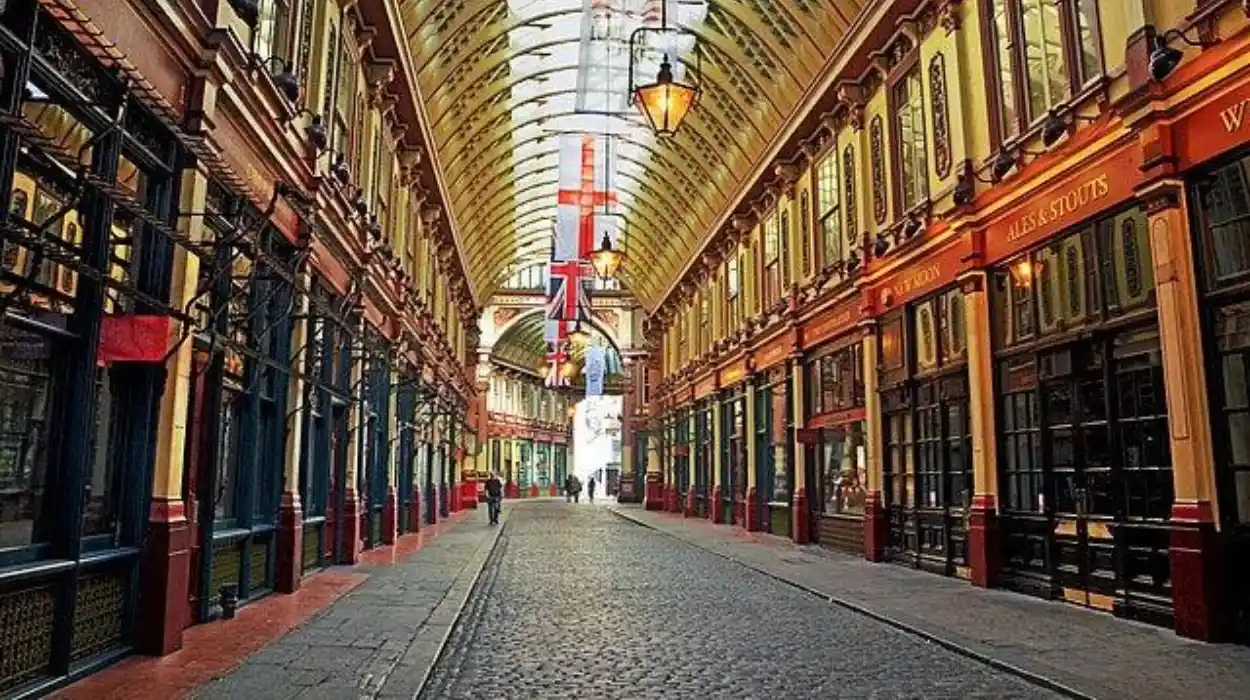
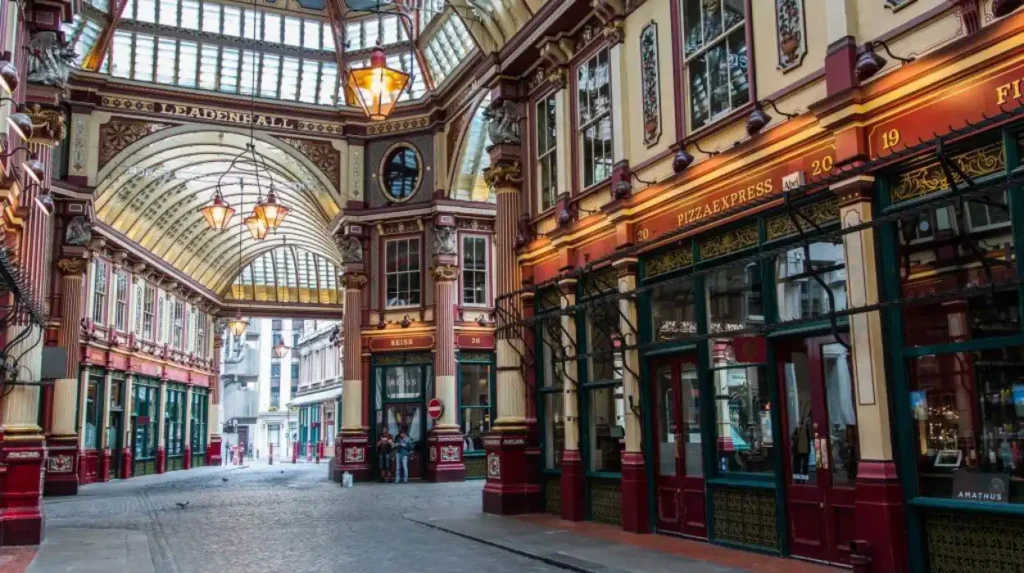
Leadenhall Market is a Victorian landmark because it combines functional market planning with ornate civic design: iron-and-glass roofing, painted decoration, cobbled passages, gabled fronts, and a cruciform internal layout that turns a working market into a highly recognisable urban interior.
Architecturally, Leadenhall Market belongs to the great age of nineteenth-century covered markets, when iron and glass transformed urban retail and wholesale environments across Britain and Europe. Its significance lies in both material design and spatial organisation.
The structure uses wrought iron and glass to create covered passages with strong natural light. This was a major Victorian improvement over older market yards, which were more exposed to weather, less sanitary, and harder to manage. The roof allowed year-round trade in a protected environment while preserving ventilation and visibility. These features mattered in a food market, where circulation, cleanliness, and inspection were central concerns.
Leadenhall is also distinguished by its decorative treatment. The market’s red, cream, and green painted surfaces, ornamental detailing, and elegant roof geometry elevate it beyond a purely utilitarian building. The design creates a ceremonial commercial interior. Instead of concealing trade behind plain service architecture, it displays trade within an urban set piece.
The market’s layout is equally important. It forms a network of intersecting covered streets rather than a single enclosed shed. This arrangement reflects the historic grain of the City, where lanes and passages mattered as much as squares. The architecture therefore adapts modern Victorian building methods to a medieval street pattern. That fusion is one reason Leadenhall feels distinct from larger single-volume markets such as Smithfield.
Its architectural value has long been formally recognised. Leadenhall Market is a Grade II* listed building, a designation used for particularly important buildings of more than special interest. That status reflects not only aesthetic quality but also historic significance as a surviving City market with medieval origins and a major Victorian redesign.
How has Leadenhall Market survived modern London and heritage change?
Leadenhall Market survived because it remained economically useful while gaining heritage value. Twentieth-century conservation, statutory listing, continued retail use, and the City’s management of surrounding redevelopment have allowed the market to function as both a commercial space and a protected historic environment.
Many historic markets disappeared in the twentieth century because their original economic roles collapsed. Leadenhall survived because it adapted. The surrounding City of London changed from a mixed commercial-residential district into a global financial centre dominated by offices, insurance firms, and corporate services. That shift reduced the market’s traditional role in food provisioning, but it increased its value as a retail, hospitality, and heritage destination within a dense weekday business district.
Conservation policy has been central to this survival. The market sits within a protected historic environment, and the City of London has repeatedly recognised its architectural and archaeological significance. Conservation area documents identify the district as one of the most historically layered parts of the City, with Roman, medieval, and Victorian importance overlapping on the same site. Scheduled and archaeological considerations in the surrounding area also reinforce the need to manage redevelopment carefully.
The modern challenge is not only preserving the market building itself. It is preserving its setting while the eastern City continues to redevelop. Tall office schemes, transport pressures, and changing retail patterns all affect how historic spaces survive. Recent plans around Gracechurch Street have therefore focused on integrating public access, heritage display, and new development. The discovery of major Roman remains nearby has further strengthened the case for interpreting the wider area as a layered archaeological landscape rather than treating Leadenhall as an isolated Victorian object.
Leadenhall’s continued use also matters. Historic markets survive best when they are not empty monuments. Shops, restaurants, and pedestrian activity keep the site legible as a place of exchange. That continuity does not replicate the medieval poultry market, but it preserves the market’s core identity as a commercial interior rather than a detached museum set.
To experience this historic landmark in person today, consult our comprehensive for itineraries and visiting parameters.
What does Leadenhall Market reveal about London’s commercial evolution?
Leadenhall Market reveals that London’s commercial history developed through continuity rather than replacement. Roman administration, medieval provisioning, civic regulation, Victorian rebuilding, and modern heritage management all used the same district to organise exchange, proving that commerce shaped the City’s landscape across two millennia.
Leadenhall Market is a useful historical case study because it compresses several large themes in London history into one site. First, it demonstrates that the City’s commercial geography was rooted in Roman urban planning. Roads, public buildings, and market functions were concentrated in the same zone from the beginning of Londinium’s rise. Second, it shows how medieval London built on that inherited geography rather than starting from nothing. The old Roman core remained attractive for exchange because it already sat within established movement routes and institutional authority.
Third, Leadenhall illustrates the role of municipal government in shaping commerce. Markets were not spontaneous collections of stalls. They were regulated spaces with rents, rules, buildings, and public responsibilities. From medieval grain storage to Victorian rebuilding, civic intervention shaped how Leadenhall worked.
Fourth, the market reveals how architecture can preserve economic memory. The 1881 structure is not Roman or medieval in fabric, but it encodes the history of the site by preserving market use in the same district. The building is therefore both a Victorian object and a container for older urban functions.
Finally, Leadenhall shows why historic commercial sites matter to modern London. They provide evidence for long-term urban continuity in a city often described through rupture: conquest, fire, plague, industrialisation, war damage, and financial modernisation. Leadenhall complicates that narrative. It shows that one of London’s oldest commercial landscapes remained active through all of those transformations.
That continuity also gives the site future historical relevance. Archaeological discoveries around Gracechurch Street are still changing scholarly understanding of Roman London. Conservation policy continues to define how the market and its setting are managed. And the market remains part of the City’s living urban economy. Leadenhall is therefore not only a remnant of the past. It is an active historical environment where Roman archaeology, medieval market history, Victorian design, and modern heritage policy still intersect.
Who designed the current Leadenhall Market building?
The current Leadenhall Market was designed by Sir Horace Jones, architect to the City of London Corporation, and completed in 1881. Jones also designed other major Victorian market buildings, including Smithfield and Billingsgate Market.