Key Points
- The Pavement Obstacle Course: Wayward tables, chairs, and advertising boards (A-boards) on high streets like Heath Street and Hampstead High Street create severe physical barriers for visually impaired individuals, disabled residents, and parents with prams or buggies.
- Staggering RNIB Statistics: A survey titled Who Put That There! conducted by the Royal National Institute of Blind People (RNIB) revealed that 95% of blind and partially sighted respondents had collided with a street obstacle within a single three-month period.
- Regulatory Inconsistencies: While Camden Council maintains a clear, structured application and annual review process for outdoor tables and chairs, its enforcement and policy framework regarding standalone A-boards remains entirely opaque.
- The Pavement Width Contradiction: Camden’s standard licensing terms require a bare minimum clear pavement width of 1.8 metres, yet the council’s own internal technical guidance mandates a 3-metre minimum for busy pedestrian shopping zones and active bus routes.
- Cross-Borough Policy Variance: Nearby local authorities enforce much stricter regimes; Westminster and the City of London ban A-boards entirely on narrow pathways, while Islington requires businesses to obtain a dedicated, separate licence for them.
- The Equal Pavements Pledge: Accessibility advocates are urging Camden Council to sign Transport for All’s Equal Pavements Pledge, a ready-made framework already adopted by neighboring boroughs and backed by the London Assembly to co-design inclusive streets.
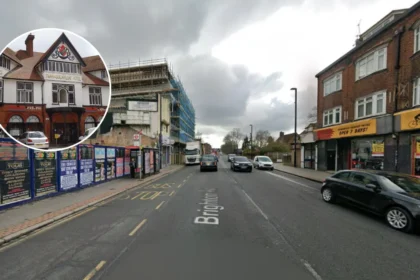
Camden (Extra London News) June 27, 2026 – Camden Council is facing escalating pressure from accessibility advocates, local residents, and national charities to implement immediate enforcement reforms against the uncontrolled proliferation of commercial advertising boards (A-boards) and outdoor dining furniture across its major high streets. Critics argue that the current regulatory framework has turned busy pedestrian arteries, such as Heath Street and Hampstead High Street, into highly dangerous obstacle courses for vulnerable road users. While outdoor seating is widely acknowledged as an element that injects vital economic and social life into the local economy, it has simultaneously triggered profound legal and ethical dilemmas regarding public space prioritization. The debate highlights a growing friction between commercial high street vitality and basic urban accessibility rights.
At the heart of the crisis is an institutional disparity in how different types of street furniture are regulated by local authorities. Under the current legislative regime managed by Camden Council, the rules governing tables and chairs are reasonably well-defined: businesses must formally apply for a pavement licence, submit detailed spatial plans, provide proof of public liability insurance, and adhere to strict, pre-approved zones for a fixed one-year term. However, the council’s policy toward freestanding commercial A-boards remains fundamentally ambiguous. Because standalone advertising boards do not legally require a formal pavement licence under Camden’s current local bylaws, shop owners are left with little to no concrete statutory instruction beyond vague, non-binding guidance advising them not to cause a public obstruction.
Why are street obstacles a critical danger for disabled pedestrians?
The real-world consequences of unmonitored high street clutter extend far beyond mere aesthetic complaints or minor pedestrian inconveniences. For individuals navigating the built environment with physical disabilities, severe visual impairments, or even practical mobility challenges like pushing children’s buggies, wayward commercial infrastructure presents an immediate safety hazard.
As documented in the widely cited Who Put That There! national street accessibility survey compiled by the Royal National Institute of Blind People (RNIB), an overwhelming 95% of blind and partially sighted individuals reported colliding with a physical street obstacle on their local pavements within a single three-month window. The data underscores the reality that structural street clutter actively strips vulnerable demographics of their independent mobility, forcing many to completely avoid key commercial zones due to the high risk of injury.
What is the contradiction in Camden Council’s pavement width guidelines?
An analysis of Camden Council’s internal administrative documentation reveals a stark operational contradiction regarding what constitutes a safe, passable pavement width. When assessing standard business applications for outdoor seating licenses, the council utilises a baseline threshold of 1.8 metres as the minimum allowable clear width for pedestrian traffic.
However, a review of Camden’s own specialised technical design guidance reveals that an entirely different standard is recommended for high-density areas. The technical documentation explicitly states that a minimum clear width of 3 metres is required to safely accommodate foot traffic on busy pedestrian streets, shopping districts, and primary bus routes. Legal and urban planning experts argue that while 1.8 metres might serve as an absolute legal minimum for quiet residential pathways, treating it as a universal standard across bustling commercial sectors fundamentally compromises public safety and ignores the council’s own safety metrics.
Explore More Camden News
Camden Barfly Reopens with Frank Turner Headline Show: London 2026
London Zoo Gets £500k Legacy Gift for Father’s Day: London 2026
How do neighbouring London boroughs regulate commercial A-boards?
Local business managers and commercial tenants within Camden frequently express immense confusion regarding what forms of pavement advertising are legally permissible, primarily because the borough’s enforcement strategy lacks transparency. This policy ambiguity stands in sharp contrast to the highly decisive, zero-tolerance strategies implemented by several neighboring London authorities.
The City of London Corporation and Westminster City Council, for example, have instituted sweeping prohibitions that ban commercial A-boards entirely from narrow public walkways. Before enacting its ban, the City of London Corporation executed an extensive public consultation process to gauge community sentiment. The consultation yielded definitive data: out of nearly two thousand local respondents who participated in the review, barely two dozen individuals expressed a desire to keep A-boards on the streets. Following this overwhelming mandate, the City moved rapidly to clear commercial signage from its narrowest historical thoroughfares. Meanwhile, the London Borough of Islington has chosen a middle-ground regulatory model, demanding that local businesses apply for and maintain an entirely separate, strictly monitored licence specifically dedicated to the placement of A-boards.
What is the Equal Pavements Pledge and should Camden sign it?
In response to the growing systemic accessibility issues across Greater London, disability rights organizations have formulated a unified structural framework designed to help local councils manage public spaces equitably. Known as the Equal Pavements Pledge, this initiative was designed and launched by the advocacy group Transport for All.
The pledge operates as an explicit, actionable commitment requiring signatory local authorities to systematically keep pavements clear of unnecessary commercial barriers, drastically cut down on structural street clutter, and fundamentally alter their urban planning methodologies to design public spaces alongside disabled residents, rather than merely accommodating them as an afterthought. The Equal Pavements Pledge has already secured formal signatures from the leadership of Westminster City Council, Islington Council, and the City of London Corporation, and it continues to maintain strong, bipartisan backing from the London Assembly.
Advocacy groups argue that if Camden Council genuinely intends to foster local high streets that are economically vibrant, socially inclusive, and universally accessible, it must urgently sign the pledge and implement a cohesive, transparent crackdown on the unregulated A-boards currently impeding public right-of-way.