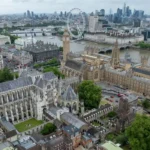
Westminster became Britain’s political and ceremonial centre through the gradual concentration of royal authority, religious institutions, government offices, courts, Parliament, and national ceremonies beside the River Thames. Its importance developed over almost a thousand years rather than through a single political decision.
- Why did Westminster become important before Parliament existed?
- How did the Norman kings turn Westminster into a royal ceremonial centre?
- How did Parliament develop at Westminster during the Middle Ages?
- Why did Westminster Abbey become Britain’s principal ceremonial church?
- How did Westminster become the permanent centre of royal administration?
- How did the Tudor period strengthen Westminster’s parliamentary role?
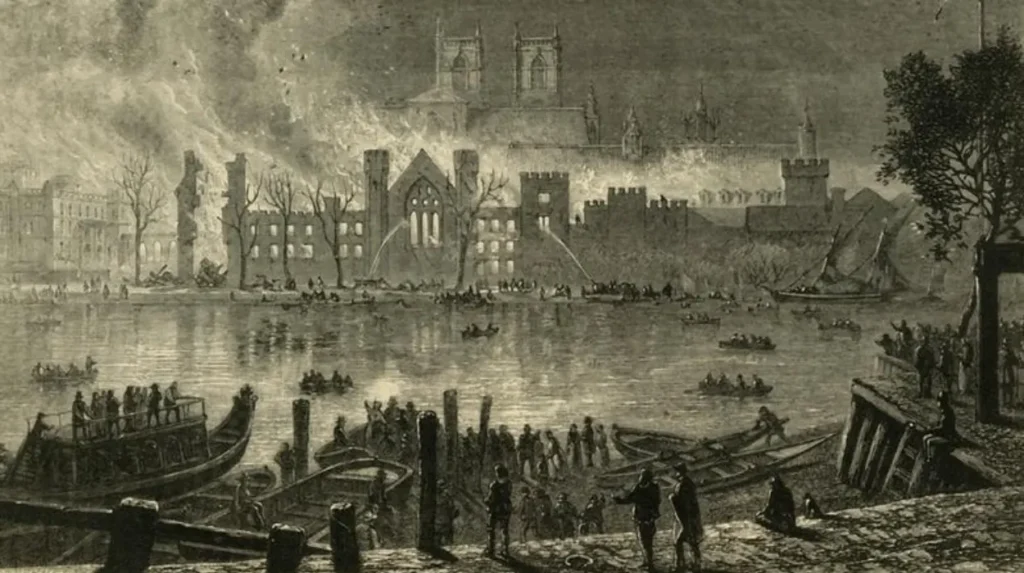
- Why did the 1834 fire transform Westminster’s political architecture?
- How did Westminster evolve into the modern political and ceremonial centre?
- Why does Westminster remain important to Britain’s national identity?
- What does Westminster’s history reveal about the development of Britain?
- Frequently Asked Question
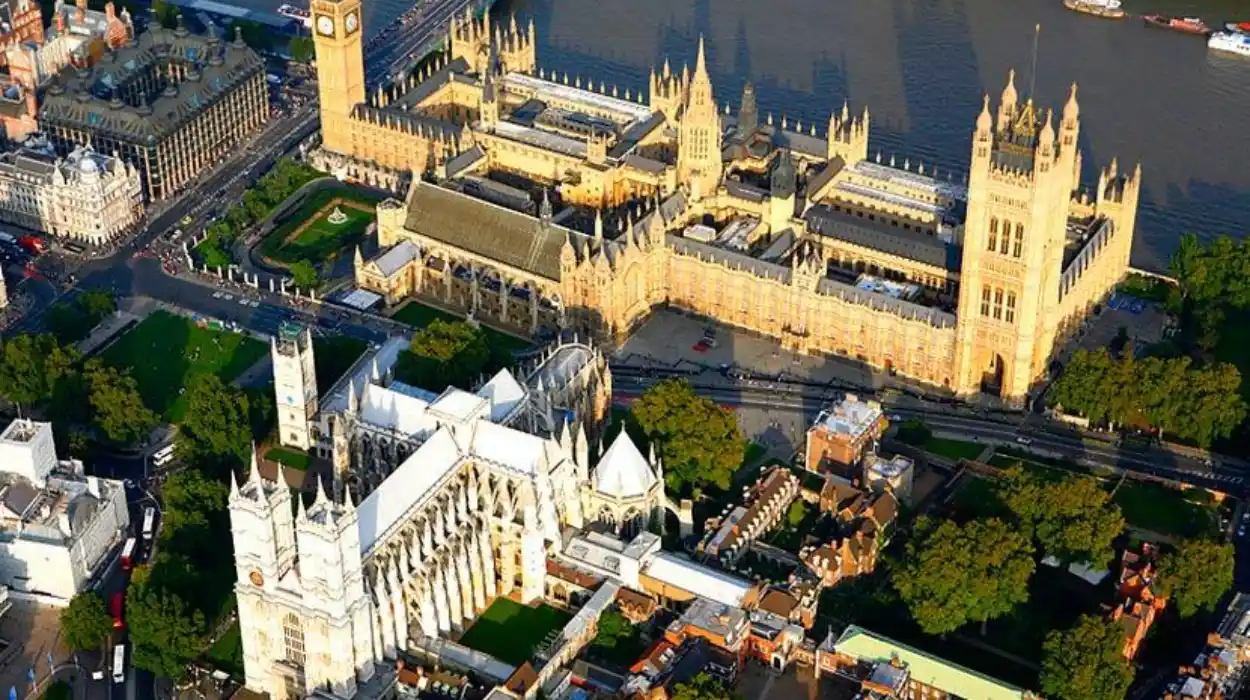
The modern Westminster district contains several institutions with distinct historical functions. The Palace of Westminster is the home of the United Kingdom Parliament. Westminster Abbey is the nation’s coronation church and a major site of royal burial and commemoration. Westminster Hall is the surviving medieval core of the former royal palace. St Margaret’s Church has served as the parish church of the parliamentary estate since the medieval period.
Together, these buildings document the transition from medieval kingship to constitutional monarchy and representative government. UNESCO identifies the Palace of Westminster, Westminster Abbey and St Margaret’s Church as a World Heritage Site because the complex demonstrates the continuing relationship between monarchy, religion, political authority and democratic institutions.
Westminster’s political significance also developed alongside London rather than replacing the City of London as a commercial centre. The City retained its economic importance, while Westminster increasingly concentrated royal administration, parliamentary activity and national ceremony. This division between commercial London and governmental Westminster remains visible in the capital today.
Why did Westminster become important before Parliament existed?
Westminster became important because Anglo-Saxon kings established a royal and religious centre beside the Thames, creating the institutional foundations for later government. Edward the Confessor expanded the palace and abbey, while royal patronage connected monarchy, worship, burial and political authority.
The earliest institutional history of Westminster is associated with a church dedicated to St Peter. UK Parliament records an early eighth-century Saxon church on the site, followed by its development as a Benedictine abbey during the tenth century. The church became known as the West Minster, distinguishing it from St Paul’s, the East Minster, in the City of London.
The location became particularly important under Edward the Confessor, king of England from 1042 to 1066. During the 1040s, Edward established a royal palace beside the River Thames and substantially enlarged the religious foundation at Westminster.
The new church was consecrated on 28 December 1065. Edward died only days later and was buried in front of the High Altar. His burial established an enduring royal association with Westminster Abbey.
The term Westminster therefore describes more than a geographic district. It identifies a place where royal residence, Christian worship and political administration became physically connected.
The site also benefited from geography. Westminster stood beside the Thames, west of the commercial City of London. The river provided transport, while the road network connected the royal settlement with other parts of England. The location gave the monarchy access to London without placing the royal court entirely inside the commercial centre.
Edward’s Westminster foundation became especially important after the Norman Conquest. William the Conqueror inherited Westminster as a major royal site and adopted Edward’s church and abbey as part of his claim to dynastic continuity.
The combination of royal residence and royal church established the central principle that shaped Westminster for centuries: political authority and ceremonial authority could operate from the same geographical complex.
How did the Norman kings turn Westminster into a royal ceremonial centre?
Norman kings strengthened Westminster by expanding its royal buildings and creating Westminster Hall, a vast ceremonial and administrative space. Royal feasts, judicial activity, government business and major political events increasingly took place there, giving Westminster a permanent institutional character.
William II, also known as William Rufus, began constructing Westminster Hall in 1097. The building was completed in 1099 and became the largest medieval hall in England, with dimensions of approximately 73 by 20 metres and a floor area of about 1,547 square metres.
The scale of Westminster Hall had political significance. Medieval royal architecture communicated authority through size, permanence and controlled access. A hall capable of accommodating major royal gatherings provided a physical setting for feasts, ceremonies and government business.
Westminster Hall also strengthened Westminster’s ceremonial role. UK Parliament records that the hall was used for royal feasts and banquets, helping establish Westminster as the ceremonial centre of the kingdom.
The building later became one of the most important judicial spaces in England. Judges were sitting there by the late twelfth century. By the thirteenth century, Westminster Hall was associated with the major royal courts, including the Court of Common Pleas, the Court of King’s Bench and the Court of Chancery.
This development transformed Westminster from a royal residence into an administrative complex.
The royal court still moved around the kingdom during the medieval period. Government was not initially fixed permanently at Westminster. The king travelled with officials, documents, seals and financial resources.
The gradual settlement of government institutions changed that system.
During the reign of Henry II, a subsidiary treasury was established at Westminster. Under King John, the Exchequer followed from Winchester and became increasingly established at Westminster. The Exchequer was the medieval government institution responsible for royal finance and revenue administration.
By the thirteenth century, Westminster had therefore acquired several connected functions. The palace represented royal authority. The abbey represented religious and dynastic legitimacy. Westminster Hall supported ceremony, justice and administration. The Exchequer supported government finance.
These functions reinforced each other.
How did Parliament develop at Westminster during the Middle Ages?
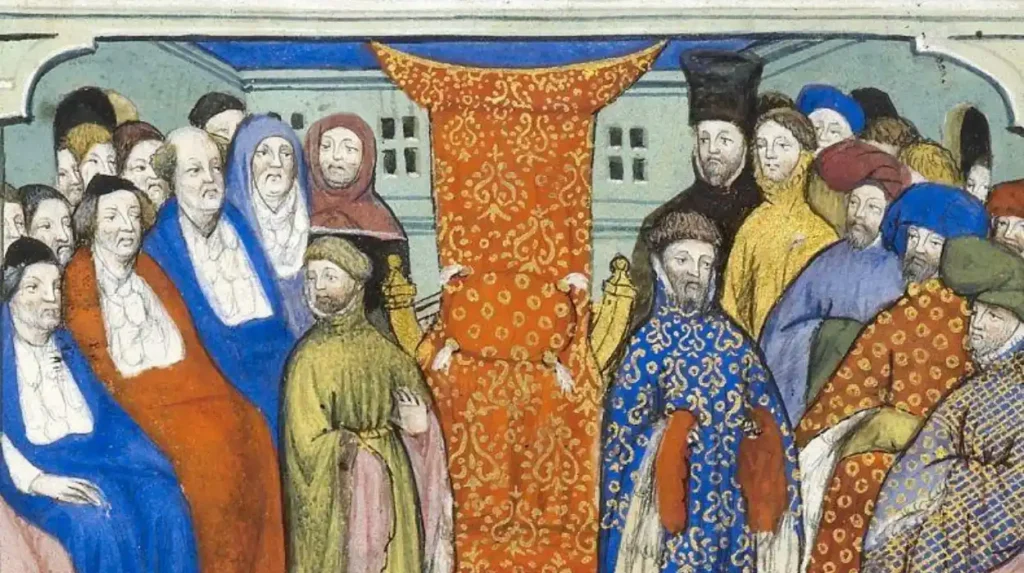
Parliament developed at Westminster because royal government increasingly required consultation, taxation and representation. Magna Carta, parliamentary assemblies under Henry III, Simon de Montfort’s Parliament and Edward I’s Model Parliament strengthened Westminster’s role as the principal meeting place of England’s emerging legislature.
Parliament did not begin as a modern democratic institution. It developed from meetings between the monarch, senior clergy, nobles and representatives who were summoned for political, financial and administrative purposes.
Magna Carta, agreed by King John in 1215, established an important principle: the king was required to consult the political community on certain matters, particularly taxation. The document did not create modern parliamentary democracy, but it influenced the development of limits on royal authority.
The word “Parliament” was first recorded for the Great Council in 1236. In 1254, sheriffs were instructed to send elected representatives from counties to advise the king on taxation. In 1265, Simon de Montfort summoned a Parliament that included representatives from counties and towns.
Edward I expanded this representative practice. His 1295 Parliament became known as the Model Parliament because its structure influenced later parliamentary representation. It included nobles and bishops alongside two representatives from each county and two from each town.
Westminster became increasingly important because Parliament needed a regular institutional environment. Meetings did not always occur there. Medieval kings summoned Parliament to different locations, including York, Northampton, Nottingham, Winchester and Salisbury.
By the fifteenth century, Westminster had become the normal parliamentary base.
The physical location of parliamentary meetings also changed over time. The Commons met in Westminster Abbey’s Chapter House from 1352 and later moved to the Abbey’s Refectory. After the Reformation, the Commons occupied St Stephen’s Chapel within the Palace of Westminster from 1547 until the 1834 fire.
The separation between the Lords and Commons also developed gradually. By 1341, the two groups were deliberating separately. The Commons began meeting in the Chapter House of Westminster Abbey in 1352.
These institutional changes gave Westminster a political importance that extended beyond the monarchy.
Westminster was becoming the place where royal authority was discussed, challenged, financed and increasingly constrained.
Why did Westminster Abbey become Britain’s principal ceremonial church?
Westminster Abbey became Britain’s principal ceremonial church because monarchs were crowned there from 1066, royal burials accumulated there, and successive kings rebuilt the church to reinforce its role in monarchy. Its religious function therefore became inseparable from national ceremony and dynastic legitimacy.
Westminster Abbey’s ceremonial importance began decisively with the coronation of William the Conqueror on Christmas Day 1066. This was the first documented coronation at Westminster. William’s decision connected the Norman monarchy with Edward the Confessor’s royal church and reinforced the claim of dynastic succession.
The Abbey was rebuilt on a much larger scale during the reign of Henry III. Construction began in 1245 in the Gothic style, reflecting the architectural ambitions of medieval European monarchies and churches. The new church was consecrated in 1269, although construction continued beyond Henry III’s lifetime.
Henry III’s rebuilding had a direct relationship with Westminster’s ceremonial function. The church was designed as a major monastery and place of worship, but it also provided a formal setting for coronations and royal burials.
The Coronation Chair became one of the most important surviving objects associated with Westminster. Edward I commissioned the chair, which became the central seat used during the crowning ceremony.
Every British monarch since William the Conqueror has been crowned at Westminster Abbey except Edward V and Edward VIII, who were never crowned. King Charles III became the 40th reigning monarch crowned at the Abbey in May 2023.
The Abbey also became a royal burial site. Westminster Abbey records thirty monarchs buried there, beginning with Edward the Confessor. The building also contains the tombs or memorials of major political figures, writers, scientists, military figures and cultural figures. More than 3,300 people are buried at the Abbey, with many others commemorated there.
Royal weddings reinforced this ceremonial identity. Westminster Abbey has hosted sixteen royal weddings, including the 2011 wedding of Prince William and Catherine Middleton.
The Abbey’s status as a Royal Peculiar also distinguishes it from ordinary parish churches and cathedrals. Its formal title is the Collegiate Church of St Peter, Westminster, and it operates under the direct authority of the Sovereign rather than an archbishop or bishop.
Westminster Abbey therefore became a national ceremonial institution through repeated use. Coronations created continuity. Royal burials created dynastic memory. National services created public commemoration. The physical proximity of the Abbey to Parliament reinforced the relationship between monarchy, religion and government.
How did Westminster become the permanent centre of royal administration?
Westminster became the permanent centre of royal administration through the gradual settlement of financial, judicial and bureaucratic institutions. The Exchequer, Chancery and royal courts established permanent operations there, reducing dependence on a travelling royal household.
Medieval government depended on documents, taxation, courts and royal officials. As these institutions expanded, moving government offices with the monarch became increasingly inefficient.
Westminster provided a stable institutional base.
The Exchequer was one of the most important institutions in this transformation. It originated as a royal financial office and developed into a central institution for managing revenue. By 1244, the Exchequer occupied a building adjoining Westminster Hall. It remained there for centuries.
The Chancery provided another major administrative function. It served as the chief secretariat of the Crown and handled royal documents and administrative business. By 1310, the Chancery had established its headquarters in Westminster Hall.
Royal courts also became associated with Westminster. The Court of Common Pleas, Court of King’s Bench and Court of Chancery developed within the Palace complex.
This concentration of institutions had a major administrative effect. Westminster became a place where financial administration, judicial authority and royal government operated close together.
Henry III played an important role in this institutional consolidation. During his reign, Westminster became increasingly important as the centre of government and royal authority. New Exchequer buildings were constructed around 1270, while royal courts occupied parts of the palace.
The physical arrangement mattered because medieval government depended heavily on proximity. Officials needed access to royal authority, financial records, legal documents and other administrators.
Westminster’s institutional density therefore created a self-reinforcing political centre.
The palace also contained ceremonial spaces that communicated royal authority. A royal throne was recorded in Westminster Hall by 1245. The throne symbolised the king’s continuing presence at the political heart of the palace, even when the monarch was not physically present.
The result was a transition from a travelling court toward a more settled administrative system.
This transformation explains why Westminster retained political importance even as English monarchs increasingly used other residences, including Whitehall, Hampton Court and later St James’s Palace.
How did the Tudor period strengthen Westminster’s parliamentary role?
The Tudor period separated Westminster’s parliamentary function from its older role as a royal residence. Henry VIII moved the royal household to Whitehall after the 1512 fire, while Parliament remained at Westminster, strengthening the site as a permanent legislative centre.
The medieval Palace of Westminster suffered repeated fires. A major fire in 1512 damaged much of the royal residential area. Henry VIII subsequently moved the royal family to nearby Whitehall Palace.
This change was politically significant.
Westminster no longer depended on being the monarch’s principal domestic residence. Parliament and government institutions continued operating within the Palace complex even after the royal household shifted to Whitehall.
In 1547, Edward VI gave St Stephen’s Chapel to the House of Commons. The medieval royal chapel then became the Commons’ principal meeting place until the destruction of the old Palace in 1834.
The transformation reflected a broader change in English political institutions.
Parliament increasingly became a permanent institution rather than simply a meeting summoned by a travelling monarch. Its authority expanded through taxation, legislation and constitutional conflict.
Westminster also remained closely connected with major national events.
In 1605, Guy Fawkes participated in the Gunpowder Plot, an attempt to destroy the Houses of Parliament during the State Opening. The plot failed, and Fawkes was later executed in Old Palace Yard.
During the English Civil War, Westminster became a major site of constitutional conflict. In 1649, Charles I was condemned to death in Westminster Hall following his defeat by Parliament’s forces. This event demonstrated the changing relationship between monarchy and Parliament.
The seventeenth century transformed the constitutional significance of Westminster.
The Glorious Revolution of 1688–1689 strengthened parliamentary authority and established the constitutional framework associated with William III and Mary II. The Bill of Rights 1689 limited aspects of royal power and affirmed parliamentary privileges.
Westminster was therefore no longer simply the administrative centre of royal government.
It had become the physical setting for negotiations over the distribution of political authority.
The eighteenth and early nineteenth centuries continued this transformation. The Acts of Union 1707 and 1800 expanded Parliament’s responsibilities across Great Britain and then the United Kingdom. The parliamentary estate had to accommodate representatives from Scotland and Ireland, demonstrating the growing territorial scope of the Westminster legislature.
Why did the 1834 fire transform Westminster’s political architecture?
The 1834 fire destroyed most of the medieval Palace of Westminster and created the need for a purpose-built parliamentary complex. Charles Barry and Augustus Welby Pugin rebuilt the site in Gothic Revival architecture, turning Westminster into an internationally recognised symbol of constitutional government.
The Palace of Westminster had experienced serious fires in 1263, 1298 and 1512 before the catastrophic blaze of 1834. The medieval building contained extensive timber structures and had accumulated centuries of alterations.
On 16 October 1834, two underfloor stoves were used to burn old Exchequer tally sticks. The heat ignited the surrounding material, and fire spread through the Palace.
The destruction was extensive.
Westminster Hall survived, along with the Undercroft Chapel, the Cloisters and Chapter House of St Stephen’s and the Jewel Tower. Most of the medieval Palace was destroyed.
The disaster created an architectural opportunity.
A parliamentary competition was held in 1835. Charles Barry won with a Gothic Revival design. Augustus Welby Pugin became closely associated with the detailed design and interiors.
The new Palace was designed as a purpose-built parliamentary complex rather than as a medieval royal residence gradually adapted for government.
Construction began in 1840. The House of Lords Chamber was completed in 1847, the Commons Chamber in 1852, Big Ben’s clock mechanism and bell were installed in the Clock Tower during the 1850s, Victoria Tower was completed in 1860, and the rebuilding was substantially completed by 1870.
The architecture deliberately referenced medieval England.
Gothic Revival architecture used pointed arches, towers, tracery, stone decoration and historic forms to create a building associated with Britain’s constitutional and parliamentary heritage.
The Palace’s appearance also strengthened Westminster’s symbolic role. The clock tower, commonly called Big Ben after the Great Bell, became an internationally recognised symbol of London and British democracy.
The surviving medieval Westminster Hall provided a physical connection between the new parliamentary building and the older royal palace.
This combination of medieval survival and nineteenth-century reconstruction became central to Westminster’s identity.
UNESCO identifies the Palace of Westminster as a major example of nineteenth-century Neo-Gothic architecture and describes the entire complex as evidence of the historical development from feudal society toward modern democracy.
The rebuilding therefore did more than restore Parliament.
It constructed a national architectural statement about constitutional government.
How did Westminster evolve into the modern political and ceremonial centre?
Westminster became the modern political and ceremonial centre because Parliament remained there while royal ceremonies, national commemorations, judicial traditions and public institutions continued to use the surrounding district. Its historic buildings now connect Britain’s medieval past with modern constitutional government.
The twentieth century confirmed Westminster’s national importance.
The Palace remained the home of the House of Commons and House of Lords. Westminster Abbey continued its role as a place of worship, coronation and national commemoration. Westminster Hall retained its historic ceremonial and judicial associations.
The Second World War demonstrated the symbolic importance of the parliamentary complex. Parts of the Palace were damaged during wartime bombing, but Westminster Hall survived. Westminster Abbey also suffered wartime damage while daily worship continued.
The post-war period strengthened Westminster’s role as a public symbol of democratic government.
The coronation of Elizabeth II in 1953 demonstrated the continuing relationship between Westminster’s political and ceremonial institutions. The ceremony was held at Westminster Abbey on 2 June 1953. Preparations included seating for 8,251 guests inside the Abbey and extensive temporary structures for the procession and ceremony.
The coronation of Charles III on 6 May 2023 continued the same institutional tradition. Westminster Abbey remained the setting for the constitutional and religious ceremony.
Parliament also continued to evolve.
The House of Commons became increasingly representative as voting rights expanded through nineteenth- and twentieth-century reform. The Reform Acts, the extension of the franchise to women, and the Representation of the People Acts changed the electorate represented at Westminster.
The institutions themselves remained in the same geographical centre while their democratic basis changed substantially.
This continuity is one reason Westminster has exceptional historical value.
To experience this historic landmark in person today, consult our comprehensive [Best Things to Do in Westminster for First-Time Visitors Exploring London’s Historic Heart] for itineraries and visiting parameters.
Westminster’s modern landscape also includes government departments, diplomatic buildings, memorials, public squares and ceremonial routes. Whitehall, immediately east of the parliamentary complex, contains major government offices and Downing Street, the official residence and office of the Prime Minister.
The political geography therefore extends beyond the Palace itself.
Westminster Abbey, Parliament Square, Whitehall and the Palace of Westminster form a connected ceremonial and governmental landscape. National events frequently use these spaces because their historic meanings are already established.
UNESCO’s World Heritage designation reflects this continuity. The designated property covers 10.3 hectares and includes Westminster Abbey, the Palace of Westminster and St Margaret’s Church. It was inscribed in 1987, with a boundary modification in 2008.
The designation recognises not only individual buildings but the relationship between them.
Why does Westminster remain important to Britain’s national identity?
Westminster remains important because Parliament continues to legislate there, Westminster Abbey continues national ceremonies, and historic buildings preserve evidence of constitutional development. The district therefore functions simultaneously as a working political centre, ceremonial landscape, heritage site and national memorial.
Westminster’s importance rests on institutional continuity.
The Palace of Westminster remains the seat of the United Kingdom’s two-chamber Parliament. The House of Commons represents elected Members of Parliament, while the House of Lords performs legislative, scrutinising and revising functions within the parliamentary system.
Westminster Abbey remains a working church rather than a museum. Daily worship continues, alongside major national services, royal ceremonies and commemorative events. UNESCO describes the Abbey as a place of worship for more than a thousand years.
St Margaret’s Church provides another historical connection. It has served as the parish church associated with the Palace and has been used by Members of Parliament for centuries. UNESCO records its continuing relationship with the parliamentary community.
Westminster Hall is especially important for historical interpretation because it survives from the medieval Palace. Its surviving structure provides direct physical evidence of the period when royal ceremony, justice and government operated within the same complex.
The district also preserves documentary evidence.
Parliamentary records, medieval Parliament Rolls, architectural plans, royal documents and archaeological remains provide researchers with evidence for Westminster’s institutional development. The Parliamentary Archives preserve records relating to Parliament and its buildings, while Westminster Abbey preserves manuscripts, architectural material, royal memorials and ceremonial objects.
Archaeological and architectural evidence reinforces the documentary record. Excavations and building investigations have identified earlier floors and structures beneath later alterations. During restoration work at Westminster Hall, a Purbeck stone floor associated with the medieval period was identified before the present York stone paving was installed.
These physical remains demonstrate that Westminster’s history is layered.
The modern Palace stands above and around medieval structures. Westminster Hall connects the current parliamentary estate with William II’s palace. Westminster Abbey contains architectural phases from the eleventh through later centuries. St Margaret’s Church preserves a medieval ecclesiastical tradition within a modern parliamentary landscape.
Westminster therefore remains historically relevant because its functions did not simply disappear when political systems changed.
The monarchy changed from medieval kingship to constitutional monarchy.
Parliament changed from a royal advisory assembly into a representative legislature.
Government administration changed from a travelling royal household into a permanent bureaucratic state.
Public ceremony changed from medieval coronations and royal feasts into nationally broadcast ceremonies involving millions of observers.
Yet the geographical centre remained remarkably stable.
That continuity explains Westminster’s unusual historical significance.
What does Westminster’s history reveal about the development of Britain?
Westminster’s history reveals how British political authority developed through the interaction of monarchy, religion, administration, law and representation. Its buildings preserve the physical stages of that transformation, from Edward the Confessor’s royal foundation to today’s constitutional Parliament.
Westminster did not become Britain’s political and ceremonial centre through one planned process. Its role emerged through successive institutional changes.
The first stage was religious and royal. The establishment and expansion of Westminster Abbey connected the site with Christian kingship and royal burial.
The second stage was architectural. William II’s Westminster Hall created a monumental royal space for ceremony, administration and justice.
The third stage was administrative. The Exchequer, Chancery and royal courts settled at Westminster, transforming the location into a permanent centre of government.
The fourth stage was parliamentary. Assemblies increasingly met at Westminster, while representative institutions developed through the thirteenth and fourteenth centuries.
The fifth stage was constitutional. Conflicts involving Parliament and the Crown during the seventeenth century changed the distribution of political authority.
The sixth stage was architectural reconstruction. The 1834 fire destroyed the medieval Palace, and the Gothic Revival reconstruction created the modern parliamentary landmark.
The final stage is continuing institutional use. Parliament still meets at Westminster. Westminster Abbey remains a functioning church and national ceremonial site. Westminster Hall remains part of the parliamentary estate.
The historical importance of Westminster therefore comes from continuity combined with transformation.
The same district witnessed royal government, medieval justice, parliamentary development, constitutional conflict, imperial legislation, democratic reform and modern national ceremonies.
Its buildings preserve this sequence in physical form.
Westminster Hall represents the medieval royal palace. Westminster Abbey represents Christian monarchy and national ceremony. St Margaret’s Church represents the continuing parish and religious community around Parliament. The nineteenth-century Palace represents constitutional monarchy and the development of the modern legislature.
UNESCO describes the complex as representing the journey from a feudal society to modern democracy and identifies the buildings as evidence of the intertwined history of church, monarchy and state.
That interpretation explains Westminster’s enduring importance.
Westminster is not simply a collection of historic buildings. It is an institutional landscape in which political functions continued while their constitutional meaning changed.
For history enthusiasts, Westminster provides a concentrated record of Britain’s political development. For cultural tourists, it offers surviving architecture associated with coronations, Parliament and national commemoration. For educators and researchers, it provides documentary, architectural and archaeological evidence covering almost a millennium.
Its historical relevance also remains active rather than purely commemorative.
The Palace continues to house Parliament. The Abbey continues daily worship. National ceremonies continue to use the district. Parliamentary records continue to document political decisions. Conservation work continues to protect medieval and Victorian fabric.
Westminster’s future historical value therefore depends on preserving both its buildings and its institutional functions.
The district became Britain’s political and ceremonial centre because royal power established itself there, government institutions followed, Parliament developed around those institutions, and national ceremonies repeatedly reinforced the location’s symbolic authority.
Nearly a thousand years later, the result remains visible beside the Thames: a working parliamentary estate surrounded by buildings that preserve the history of monarchy, religion, law, government and representative politics.
Westminster’s history is therefore the history of a place where Britain repeatedly reorganised political authority without abandoning its historic centre.
Frequently Asked Question
Why did Westminster become Britain’s political centre?
Westminster became Britain’s political centre because royal government, Parliament, courts and financial institutions gradually concentrated there. The Palace of Westminster, Westminster Hall and nearby government buildings created a long-lasting administrative and legislative hub.