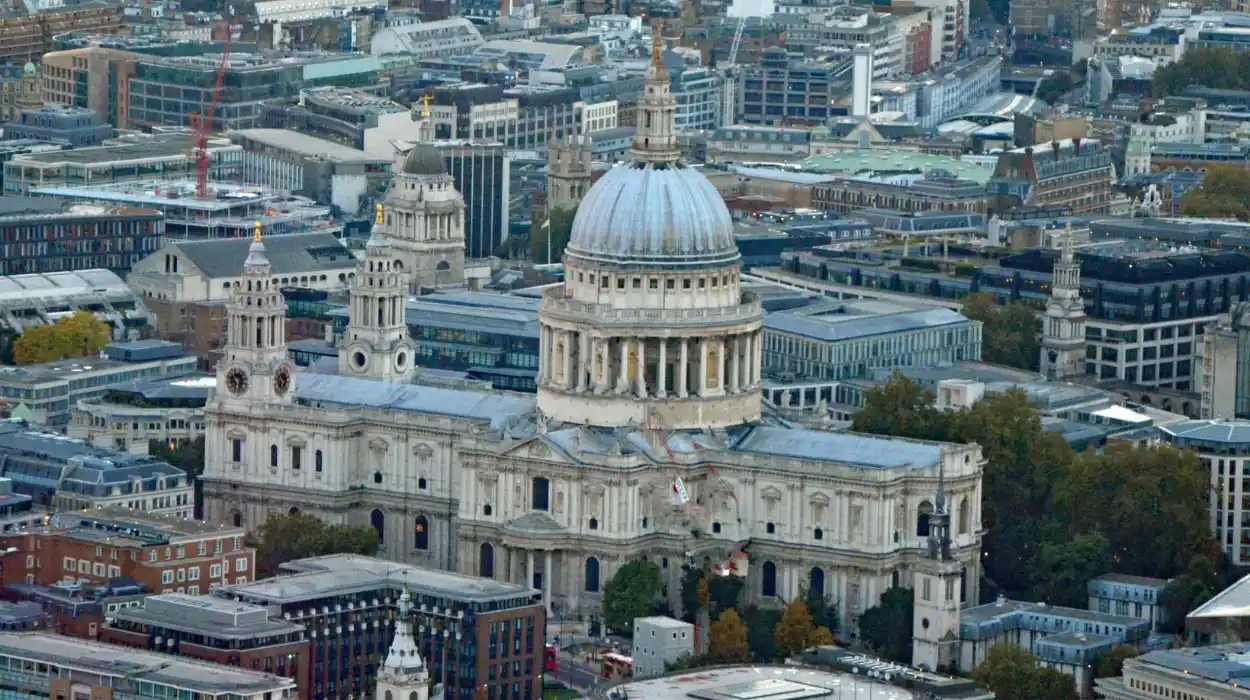
St Paul’s Cathedral is London’s most recognizable religious monument, serving as a center of worship, national ceremony, architectural innovation, and cultural identity for more than 300 years. Its iconic dome dominates the skyline and symbolizes the resilience of both London and Britain.
- What existed on the site before the current St Paul’s Cathedral?
- How did the Great Fire of London lead to the construction of the current cathedral?
- Who was Sir Christopher Wren and why was his role significant?
- What architectural features make St Paul’s Cathedral unique?
- Why is the dome of St Paul’s Cathedral famous worldwide?
- How has St Paul’s Cathedral influenced British history?
- The Funeral of Admiral Nelson
- The Funeral of the Duke of Wellington
- Royal Celebrations
- National Commemorations
- What can visitors discover inside the cathedral today?
- How has St Paul’s Cathedral been preserved for future generations?
- Why does St Paul’s Cathedral remain relevant in the twenty-first century?
St Paul’s Cathedral stands at the highest point of the historic City of London. Dedicated to Saint Paul the Apostle, one of Christianity’s most influential figures, the cathedral serves as the seat of the Bishop of London and remains an active Anglican church.
The current structure was completed in the early eighteenth century after the destruction of its medieval predecessor during the Great Fire of London in 1666. Since its completion, the cathedral has hosted major national events including royal celebrations, military commemorations, state funerals, and thanksgiving services.
Its architectural prominence extends beyond religion. The cathedral became a visual symbol of London’s endurance during the Second World War when photographs showed the dome standing above smoke and destruction during the Blitz.
Today, millions of visitors enter the cathedral annually to explore its architecture, religious heritage, artistic treasures, and panoramic views across London. To experience this historic landmark in person today, consult our comprehensive [Visiting St Paul’s Cathedral: Dome Views, Crypts, and Tours] for itineraries and visiting parameters.
What existed on the site before the current St Paul’s Cathedral?
The present cathedral stands on a site occupied by Christian churches for approximately 1,400 years. Several earlier cathedrals were built, damaged, rebuilt, and expanded before the medieval structure was destroyed in the Great Fire of London in 1666.
The history of worship on Ludgate Hill predates the current building by many centuries. Historical evidence indicates that a cathedral dedicated to Saint Paul existed on the site by the seventh century.
The earliest church was established during the Anglo-Saxon period when Christianity expanded throughout England. Successive churches replaced earlier structures as political power, population, and religious influence grew.
Following the Norman Conquest of 1066, a larger cathedral was constructed. This medieval building, commonly known as Old St Paul’s Cathedral, became one of Europe’s largest churches.
Old St Paul’s featured a towering spire that reportedly reached approximately 489 feet (149 metres), making it one of the tallest structures in medieval Europe. The cathedral functioned as a religious center, marketplace, civic gathering location, and educational institution.
Several disasters affected the medieval cathedral. Fires damaged sections of the structure in different periods, including major incidents in 1087 and 1561. Despite repairs, the building entered the seventeenth century in deteriorating condition.
The decisive event occurred in September 1666 when the Great Fire of London swept through the City of London. The intense heat melted lead roofing and destroyed much of the medieval cathedral, leaving reconstruction as the only practical option.
How did the Great Fire of London lead to the construction of the current cathedral?
The Great Fire of London destroyed Old St Paul’s Cathedral in 1666, creating an opportunity for a completely new design. The disaster enabled large-scale urban rebuilding and allowed architect Sir Christopher Wren to create an entirely new cathedral.
The Great Fire of London began on 2 September 1666 and burned for four days. Approximately 13,200 houses, 87 parish churches, and many civic buildings were destroyed.
The fire transformed the physical landscape of the City of London. Although some officials initially considered repairing Old St Paul’s, the extent of the damage made preservation impossible.
The rebuilding effort occurred during a period of national recovery following civil war, plague, and economic disruption. Political leaders sought structures that reflected stability, authority, and renewed confidence.
The cathedral became the most ambitious project within this broader rebuilding program. It represented not only religious renewal but also London’s emergence as a modern European capital.
Several design proposals were considered before construction began. The final decision favored an entirely new structure rather than a restoration of the medieval cathedral.
Construction officially commenced in 1675 and continued for approximately 35 years. The cathedral was declared complete in 1710, representing one of the most significant architectural achievements in British history.
Who was Sir Christopher Wren and why was his role significant?
Sir Christopher Wren was England’s leading architect, scientist, and mathematician. His design for St Paul’s Cathedral transformed British architecture and established one of the most influential domed structures in the world.
Sir Christopher Wren emerged as the central figure in post-fire London reconstruction. Although widely known as an architect today, Wren initially achieved distinction as a scientist and academic.
Born in 1632, Wren became involved in architecture during a period of intellectual and artistic transformation across Europe. He studied classical design principles and examined important continental buildings, including churches in France and Italy.
His appointment as Surveyor of the King’s Works gave him significant influence over rebuilding projects after the Great Fire. In addition to St Paul’s Cathedral, he designed or contributed to dozens of London churches.
Wren developed multiple proposals for the cathedral before receiving approval. Political authorities, church officials, and royal representatives all influenced the planning process.
The final design balanced classical architectural principles with English religious requirements. This approach produced a structure that differed from medieval Gothic cathedrals while retaining monumental spiritual significance.
Wren lived long enough to see the cathedral completed. He died in 1723 and was buried in the cathedral crypt beneath his greatest achievement.
What architectural features make St Paul’s Cathedral unique?
St Paul’s Cathedral combines English Baroque architecture, advanced engineering, classical design principles, and a distinctive triple-shell dome system. These features created one of the most innovative religious buildings constructed during the eighteenth century.
The cathedral measures approximately 515 feet (157 metres) in length and occupies a commanding position within the City of London.
Its most recognizable feature is the great dome. Inspired partly by Renaissance precedents, particularly churches in Italy, the dome became a defining element of London’s skyline.
The structure employs a sophisticated triple-shell system. Three separate layers work together to achieve both structural stability and visual grandeur.
The inner dome forms the cathedral’s interior ceiling. A concealed brick cone provides structural support. An outer dome creates the visible exterior profile recognized around the world.
The dome rises approximately 365 feet (111 metres) above ground level. This symbolic measurement corresponds roughly to the number of days in a year.
Additional architectural highlights include:
The West Front
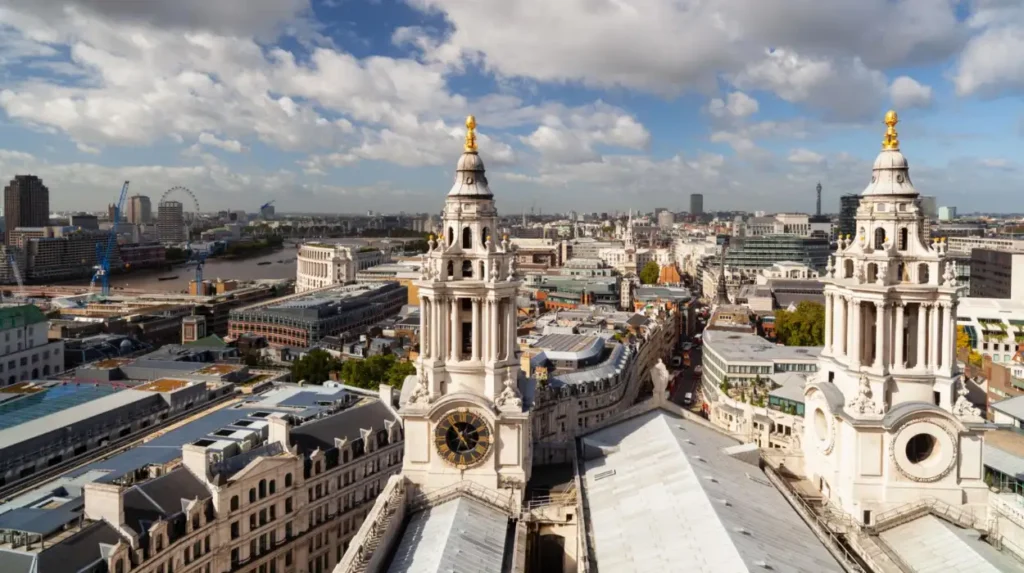
The western façade features twin towers, grand columns, and classical decorative elements. Its design reflects influences from ancient Roman architecture and Renaissance traditions.
The Nave
The nave forms the cathedral’s principal ceremonial space. Massive arches, intricate stonework, and carefully proportioned dimensions create a sense of scale and harmony.
The Choir
The choir contains elaborate wood carvings and serves as the focal point for liturgical worship.
The Geometric Staircases
Several staircases demonstrate advanced engineering and visual elegance. Their design contributes to the cathedral’s reputation as a masterpiece of architectural planning.
Why is the dome of St Paul’s Cathedral famous worldwide?
The dome is famous because it was among the largest engineering achievements of its era, became a defining feature of London’s skyline, and survived major historical events including the Blitz during the Second World War.
The dome ranks among the largest cathedral domes in the world. Its construction required innovative engineering solutions that exceeded many contemporary building practices.
The visual impact of the structure transformed London. For centuries, the dome remained the dominant feature of the city’s skyline.
Visitors can access several viewing levels.
The Whispering Gallery
Located approximately 100 feet (30 metres) above the cathedral floor, the Whispering Gallery is known for unusual acoustic effects. Sounds spoken against the wall can travel around the circular gallery.
The Stone Gallery
The Stone Gallery offers elevated exterior views of central London and architectural details of the dome itself.
The Golden Gallery
Situated near the top of the dome, the Golden Gallery provides panoramic views extending across Greater London.
The dome’s cultural significance increased dramatically during the Second World War. Images showing the structure standing amid smoke from German bombing raids became powerful symbols of national resistance and continuity.
How has St Paul’s Cathedral influenced British history?
St Paul’s Cathedral has served as a national stage for major religious, political, military, and royal events. Its role extends beyond worship, making it one of Britain’s most important ceremonial buildings.
The cathedral occupies a unique position within British public life.
Major historical ceremonies held there include national thanksgiving services, military commemorations, royal jubilees, and state funerals.
Several notable events shaped its historical significance.
The Funeral of Admiral Nelson
Horatio Nelson received a state funeral at St Paul’s Cathedral in 1806 following victory at the Battle of Trafalgar.
The Funeral of the Duke of Wellington
Arthur Wellesley was honored in the cathedral in 1852 after becoming one of Britain’s most celebrated military leaders.
Royal Celebrations
The cathedral hosted the wedding of Charles III and Diana Spencer in 1981. The ceremony attracted a global television audience estimated at hundreds of millions.
National Commemorations
The cathedral regularly hosts remembrance services connected to military conflicts, anniversaries, and public commemorations.
Through these events, St Paul’s became both a religious institution and a national symbol.
What can visitors discover inside the cathedral today?
Visitors can explore historic chapels, monumental artworks, memorials, galleries, and one of Britain’s most significant crypts. The interior preserves centuries of religious, artistic, and national heritage.
The cathedral contains extensive artistic and historical collections.
Large-scale mosaics decorate portions of the interior. These artworks reflect nineteenth-century restoration and embellishment programs.
Numerous monuments honor military leaders, scientists, artists, and public figures who influenced British history.
The cathedral also preserves important religious spaces used for worship and reflection.
The Crypt
The crypt ranks among Europe’s largest cathedral crypts. It contains tombs and memorials associated with prominent historical figures.
Notable burials include Sir Christopher Wren, Admiral Nelson, and the Duke of Wellington.
Memorial Sculpture
The cathedral houses extensive sculptural collections documenting Britain’s military, scientific, and cultural development.
Historic Chapels
Several chapels support ongoing religious services while commemorating specific historical communities and events.
These spaces connect modern visitors with centuries of worship and public life.
How has St Paul’s Cathedral been preserved for future generations?
Extensive conservation programs, structural monitoring, restoration projects, and heritage protections ensure the cathedral remains functional and historically authentic. Preservation efforts balance public access with long-term protection.
Preservation requires continuous investment in research, maintenance, and specialist craftsmanship.
Environmental conditions present ongoing challenges. Air pollution, weathering, and visitor traffic affect stone surfaces and decorative elements.
Conservation teams regularly inspect structural components, artworks, and historic materials.
Several major restoration campaigns have taken place during the twentieth and twenty-first centuries. These projects addressed stone deterioration, cleaned exterior surfaces, and repaired architectural features.
Modern technology supports preservation efforts through digital mapping, structural analysis, and environmental monitoring systems.
The cathedral benefits from legal heritage protections and professional conservation standards that guide all restoration work.
These measures ensure future generations can study and experience one of Britain’s most important historic buildings.
Why does St Paul’s Cathedral remain relevant in the twenty-first century?
St Paul’s Cathedral remains relevant because it functions simultaneously as an active church, historic monument, architectural masterpiece, educational resource, and national symbol. Its significance spans religion, culture, heritage, and public memory.
The cathedral attracts visitors from around the world seeking insight into British history, architecture, religion, and urban development.
Educators use the cathedral to explain subjects including architecture, engineering, theology, urban planning, and heritage conservation.
Researchers examine its archives, monuments, and historical records to understand London’s development across centuries.
The building also illustrates broader historical transformations. Examples include the Norman period, the Restoration era, and the modern conservation movement.
As London’s skyline evolves with contemporary skyscrapers, the cathedral continues to serve as a visual anchor connecting the modern city to its historical foundations.
More than three centuries after completion, St Paul’s Cathedral remains one of the most studied and recognized buildings in the world. Its dome continues to symbolize London’s resilience, architectural achievement, and enduring historical identity.
What is St Paul’s Cathedral famous for?
St Paul’s Cathedral is famous for its iconic dome, Baroque architecture, religious importance, and role in major British historical events. The cathedral has been a symbol of London’s identity and resilience for more than 300 years.