Brixton is one of London’s most historically significant urban communities. Located in the London Borough of Lambeth, south of the River Thames, the area developed from a rural settlement into a Victorian suburb, a major commercial centre, and a nationally important centre of African and Caribbean British history. Its cultural heritage reflects migration, urban development, political activism, music, commerce, architecture, and community organisation.
- What makes Brixton’s cultural heritage historically important?
- How did nineteenth-century London transform Brixton into a major urban community?
- Why did Brixton become an important centre for African and Caribbean communities?
- How did Brixton Market shape the area’s cultural identity?
- How did the Windrush era change Brixton and British cultural history?
- Why is Brixton associated with Black British political activism?
- How did music and popular culture make Brixton internationally famous?
- What role does Black Cultural Archives play in preserving Brixton’s history?
- How do Brixton’s buildings preserve evidence of its changing communities?
- How has regeneration affected Brixton’s cultural heritage?
- Why does Brixton’s history matter to London today?
- What is the lasting legacy of Brixton’s diverse cultural heritage?
- Frequently Asked Question
The history of Brixton explains how physical places and demographic change shaped one another. Victorian railway expansion transformed the district into a dense London suburb. Twentieth-century housing conditions created affordable accommodation for new residents. Post-war migration from the Caribbean established a major Black British community. Markets, streets, churches, music venues, archives, and public spaces then became institutions through which cultural identity was expressed and preserved.
Brixton’s historical importance extends beyond one community or one period. Its heritage includes Victorian commercial development, African and Caribbean migration, Black British political history, international cultural exchange, and continuing debates about regeneration and preservation. The district therefore provides an important record of how modern London became a multicultural global city.
What makes Brixton’s cultural heritage historically important?
Brixton’s cultural heritage is historically important because the district records London’s transformation through urbanisation, migration, Black British settlement, commerce, music, political activism, and community preservation, with landmarks and institutions preserving evidence from Victorian expansion through the post-war Windrush era to the present day.
Brixton’s significance begins with its position within the wider history of Lambeth and south London. Before its nineteenth-century expansion, Brixton was associated with a more rural landscape outside the dense historic core of London. The growth of transport infrastructure changed this position permanently.
The arrival and expansion of railway connections during the nineteenth century accelerated residential and commercial development. By the late Victorian period, Brixton had become a substantial suburban centre with housing, shops, entertainment venues, and transport links connecting residents with central London.
This physical transformation created the urban framework that later communities inherited. Streets constructed for Victorian and Edwardian London became the locations of twentieth-century migration and commerce. Large houses were increasingly converted into flats and lodging accommodation as social and economic conditions changed.
Brixton’s history can therefore be understood through several connected historical processes, including urban expansion, post-war migration, and cultural institution building, represented by the railway-led Victorian suburb, Caribbean settlement after 1948, and organisations such as Black Cultural Archives.
The district became especially important after the Second World War. People arriving from Caribbean territories, including Jamaica, Barbados, Trinidad and other islands, established homes, businesses, social networks, and cultural institutions in Brixton and surrounding areas.
Historic England identifies Brixton as the pre-eminent district of Afro-Caribbean settlement and culture in London and nationally, explaining that this identity developed rapidly from the 1950s as migrants settled in the area.
Brixton consequently became a place where British urban history and migration history became inseparable.
How did nineteenth-century London transform Brixton into a major urban community?
Nineteenth-century railway expansion transformed Brixton from a developing outer settlement into a major London suburb by increasing accessibility, encouraging residential construction, expanding retail activity, and establishing the streets and commercial infrastructure that later supported Brixton’s distinctive multicultural community.
The Victorian period produced the physical foundations of modern Brixton. Railways connected south London more efficiently with employment centres and commercial districts. Improved transport encouraged population growth and residential construction.
By 1879, Brixton was served by several nearby railway stations, and railway development played a central role in transforming the district into a middle-class suburb between the 1860s and 1890s.
Large houses appeared along important roads, reflecting Brixton’s growing status as a desirable suburban district. Commercial development followed population growth. Shops and entertainment businesses expanded along Brixton Road and surrounding streets.
The area’s commercial importance increased during the late nineteenth century. Brixton became a significant shopping destination rather than simply a residential suburb.
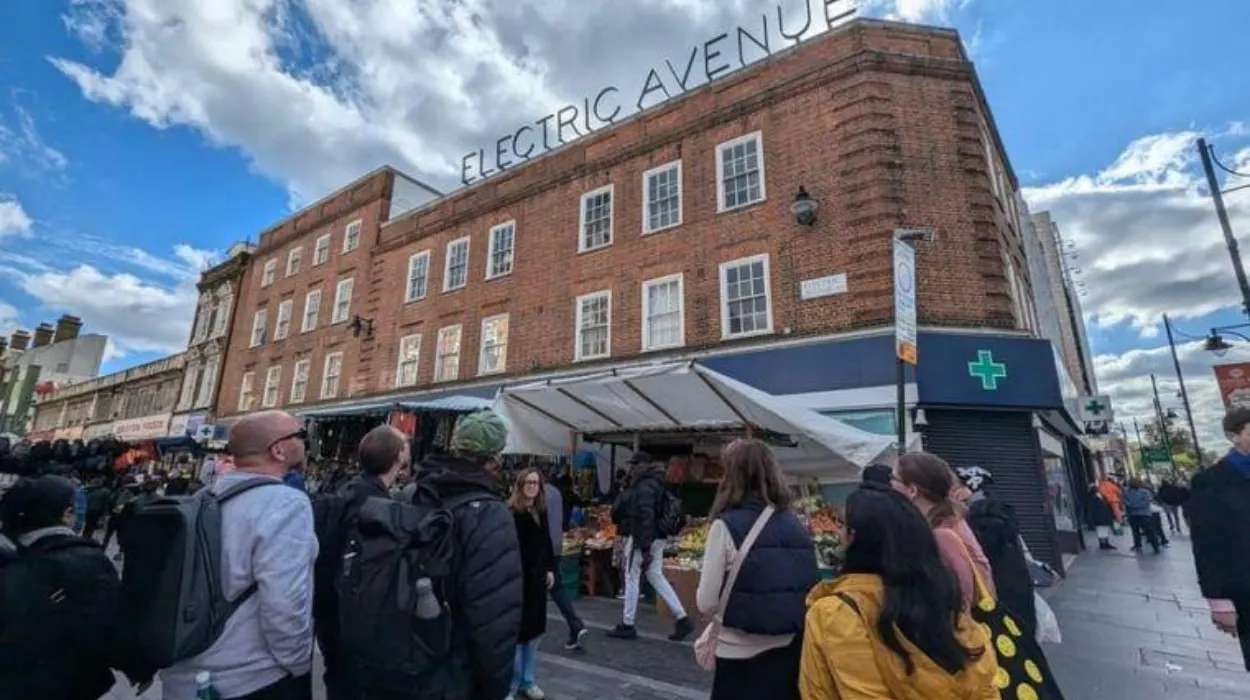
Electric Avenue became one of the clearest symbols of this commercial transformation. Developed during the 1880s, it became famous for early electric street lighting. Its name preserved that technological association.
The street’s historical significance lies in more than electrical innovation. It later became part of the commercial landscape that served Brixton’s changing population. Victorian infrastructure therefore remained active while the district’s cultural identity changed dramatically during the twentieth century.
The relationship between old buildings and new communities is central to Brixton’s heritage. Physical structures often survived while their social functions changed.
Victorian houses became flats and boarding accommodation. Commercial streets served new customers. Markets adapted their products. Public spaces acquired new political and cultural meanings.
This process demonstrates an important principle of urban history: heritage consists not only of original architecture but also of changing human use.
Why did Brixton become an important centre for African and Caribbean communities?
Brixton became an important centre for African and Caribbean communities because post-war migrants found accessible transport, available lodging, employment connections, social networks, and expanding commercial services, allowing settlement patterns to develop into one of Britain’s most influential Black British communities.
The most internationally recognised chapter of Brixton’s cultural history developed after the Second World War.
Britain experienced severe labour shortages during post-war reconstruction. Citizens of Caribbean territories arrived in Britain to work and establish new lives. The arrival of the Empire Windrush at Tilbury in 1948 became a defining symbol of this broader period of migration.
The term Windrush generation refers broadly to people who migrated to Britain from Caribbean Commonwealth countries during the post-war decades, particularly between 1948 and 1971, as well as the historical community shaped by that migration.
Brixton became a major settlement centre because accommodation and established social connections were available in south London. Housing conditions were often difficult. Migrants encountered overcrowding, discrimination, restricted access to property, and racial exclusion.
Despite these barriers, communities created their own social and economic infrastructure.
Local shops began selling food products familiar to Caribbean households. Businesses expanded around the needs of the new population. Religious organisations and community groups provided meeting spaces and support networks.
Brixton Market became particularly important in this transformation.
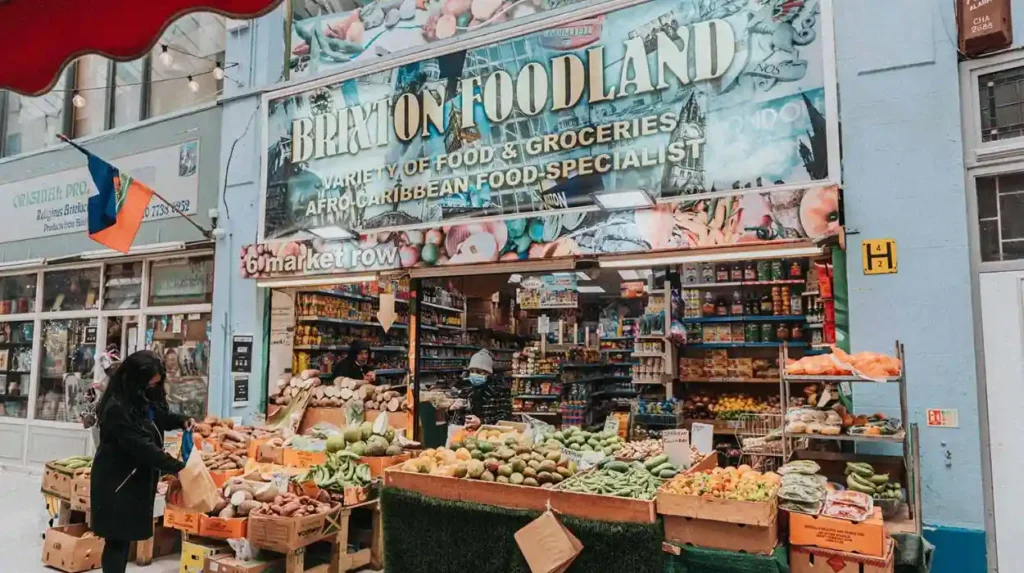
Historic England records that the market complex became the commercial and social heart of the extensive Afro-Caribbean community that settled in Brixton after the Second World War. Caribbean foodstuffs, including plantains, yams, green bananas, ackee and other products, became visible parts of the local commercial landscape.
This commercial change had wider cultural significance. Food connected migration with memory, family life, language, trade, and community identity.
The market also demonstrated economic adaptation. Existing traders responded to changing demand, while new businesses served expanding communities.
By the late 1960s, Brixton had become one of the United Kingdom’s most important centres of Caribbean settlement and cultural life.
How did Brixton Market shape the area’s cultural identity?
Brixton Market shaped local cultural identity by functioning as a commercial centre, social meeting place, food distribution network, and visible expression of African and Caribbean settlement, connecting historic Victorian trading traditions with the economic life of post-war multicultural Brixton.
Markets have occupied an important place in Brixton’s history since the district developed into a major urban shopping centre.
The market landscape includes several distinct structures and trading areas. These include Reliance Arcade, Market Row, and Granville Arcade, examples of inter-war covered market architecture that later became strongly associated with Brixton’s Afro-Caribbean community.
Reliance Arcade was built during the 1920s. Market Row followed in 1928. Granville Arcade was developed during the 1930s and later became widely known as Brixton Village.
Historic England listed the Brixton Markets complex at Grade II in 2010, recognising both architectural and historic significance. The designation specifically identifies the market’s relationship with post-war Afro-Caribbean settlement as a major reason for protection.
The buildings preserve different architectural characteristics.
Reliance Arcade includes distinctive decorative features associated with Egyptian-inspired design. Market Row uses glazed roofing and reinforced structural elements. Granville Arcade contains covered avenues illuminated through glazed roof structures.
These architectural details represent Brixton’s commercial history before the post-war migration era. Their later cultural role represents how buildings acquire new significance through changing communities.
The market became a place where African, Caribbean, British, South American, and other international food traditions intersected.
That diversity remains historically important because Brixton’s market heritage records migration through everyday economic activity rather than through monuments alone.
Food products, shop ownership, languages, music, and social interaction all contributed to the district’s cultural identity.
To experience this historic community and its surviving landmarks in person today, consult our comprehensive [Discover Brixton’s Best Food Markets, Music Venues, and Cultural Experiences Together] for itineraries and visiting parameters.
How did the Windrush era change Brixton and British cultural history?
The Windrush era changed Brixton by establishing a nationally significant Black British community whose residents transformed local commerce, music, politics, food, religion, and public identity while challenging racial discrimination and expanding Britain’s understanding of citizenship and national belonging.
The history of post-war migration cannot be separated from the history of race relations in Britain.
Caribbean migrants arrived as British citizens or citizens connected to Britain’s Commonwealth system. Their legal position did not prevent discrimination in housing, employment, and public life.
Brixton became a major location where these inequalities were experienced and challenged.
Community networks developed practical responses. Residents established businesses, community organisations, newspapers, cultural events, and informal support systems.
The district became increasingly associated with Black British identity.
This identity was not static. Brixton included people with different national origins, religions, occupations, generations, and political perspectives.
The broader community included Caribbean migrants, British-born descendants, and later international residents, represented by Jamaican and Barbadian families, second-generation Black Britons, and newer migrant communities.
The importance of Brixton lies partly in this continuing demographic change.
The Windrush era also reshaped British culture nationally. Caribbean music influenced British popular culture. Caribbean food entered wider British commercial life. New political organisations challenged racial discrimination.
Brixton became one of the places where these national transformations were concentrated.
The area’s history therefore provides evidence of a larger change in Britain: the movement from an imperial society toward a more visibly multicultural population.
Why is Brixton associated with Black British political activism?
Brixton became associated with Black British political activism because residents organised against racial discrimination, policing inequalities, housing problems, and social exclusion, making the district an important location for national debates about justice, citizenship, public authority, and community representation.
Political history forms a major part of Brixton’s cultural heritage.
Post-war communities faced discrimination that affected daily life. Access to housing and employment remained unequal. Relations between Black residents and police became a major source of tension.
These conditions encouraged political organisation.
Community activism included campaigns for racial equality, legal reform, better housing, education, and representation. Brixton became nationally associated with debates about policing and urban inequality.
The 1981 Brixton uprising became one of the most significant events in modern British urban history.
The disturbance followed a period of severe tension between police and sections of the local community. The events brought national attention to racism, policing practices, unemployment, and social conditions.
The subsequent Scarman Report examined the causes of the disorder and identified serious concerns about policing and racial disadvantage.
Brixton’s political history also includes later campaigns for justice and commemoration.
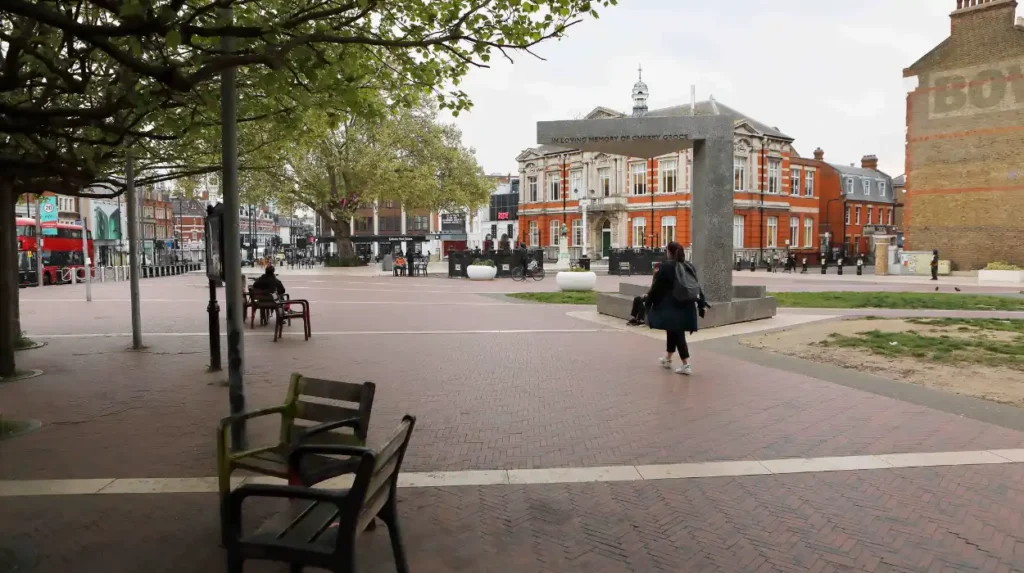
Windrush Square contains monuments and memorials that connect the district with wider histories of African and Caribbean people in Britain.
Lambeth Council identifies the African and Caribbean War Memorial in Windrush Square as the United Kingdom’s principal national memorial to African and Caribbean service personnel who fought in the First and Second World Wars.
The square also contains the Cherry Groce Memorial Pavilion, installed in 2021 and designed by architect Sir David Adjaye. The memorial commemorates Cherry Groce and forms part of Brixton’s continuing public history of justice and remembrance.
These memorials demonstrate how historical preservation includes events that remain politically significant.
How did music and popular culture make Brixton internationally famous?
Brixton became internationally famous through music and popular culture because its diverse population supported influential scenes in reggae, punk, electronic music, pop, and contemporary performance, while venues and streets transformed local cultural production into internationally recognised British heritage.
Music is one of Brixton’s strongest cultural associations.
The area’s African and Caribbean heritage contributed significantly to its musical identity. Reggae, dub, sound-system culture, soul, hip-hop, punk, electronic music, and later genres developed audiences and communities in south London.
Music venues provided important infrastructure for this cultural development.
The Brixton Academy became internationally recognised as a major London performance venue. Local streets and public spaces also became associated with musical history.
Electric Avenue entered international popular culture through Eddy Grant’s 1983 song of the same name.
The song connected a Brixton location with wider political and social awareness. Its title ensured that one local street became globally recognisable.
Popular culture also preserved Brixton’s identity through the association of notable artists with the district.
However, Brixton’s musical heritage is broader than individual celebrities. Its significance comes from community infrastructure.
Record shops, sound systems, clubs, venues, street traders, promoters, and audiences created cultural networks.
These networks demonstrate how cultural heritage develops collectively.
The same principle applies to food and commerce. Brixton’s reputation was created through thousands of everyday interactions rather than one isolated institution.
What role does Black Cultural Archives play in preserving Brixton’s history?
Black Cultural Archives preserves Brixton’s historical importance by collecting, protecting, and providing access to records of African and Caribbean people in Britain, ensuring that personal experiences, community histories, objects, documents, and oral testimony remain available for future research and education.
Historical preservation depends on evidence.
For many communities, official records alone do not provide a complete account of lived experience. Government documents record policies and institutions, but personal histories often survive through photographs, letters, oral testimony, newspapers, objects, and community archives.
Black Cultural Archives performs a nationally important role in preserving this evidence.
The organisation is based at Windrush Square in Brixton and is dedicated to collecting, preserving, and celebrating the histories of African and Caribbean people in Britain.
Its work gives Brixton a special position within British heritage.
The district is not simply a historic location connected with migration. It is also a place where institutions actively preserve the documentary record of migration and Black British life.
Black Cultural Archives provides access to archives, museum objects, and a reference library while supporting exhibitions and educational programmes.
This function is particularly important for educators, academic researchers, genealogical researchers, and heritage preservationists.
Genealogical research often depends on connecting official records with community evidence.
Family histories can involve several locations, including Caribbean islands, London boroughs, schools, workplaces, churches, and migration routes.
Archives help researchers establish those connections.
Brixton therefore contributes to both public history and family history.
How do Brixton’s buildings preserve evidence of its changing communities?
Brixton’s buildings preserve evidence of historical change because Victorian streets, inter-war markets, public institutions, entertainment venues, and commemorative spaces retain physical records of successive periods while their changing uses document how different communities reshaped the district over generations.
Architecture provides a visible historical record.
Brixton’s built environment includes structures from different periods.
These periods include Victorian expansion, inter-war commercial development, and post-war urban change, represented by Electric Avenue, Brixton’s covered market arcades, and later housing and community spaces.
The Brixton Markets complex provides one of the strongest examples of this layered heritage.
The buildings were constructed before the major post-war Caribbean migration. Their later adoption as commercial centres for Afro-Caribbean communities created a new historical significance.
Historic England explicitly identifies this connection as a major reason for the market complex’s heritage importance.
Electric Avenue provides another example.
Its late nineteenth-century identity was connected with technological modernity and commercial development. Its later history became associated with Brixton Market, multicultural commerce, popular music, and national political events.
Windrush Square demonstrates a different form of historical preservation.
Its monuments connect migration history with military service, civil rights, and public memory.
Together, these sites show that Brixton’s heritage cannot be separated into isolated historical periods.
Victorian buildings contain twentieth-century histories. Public squares commemorate events from several generations. Markets preserve both architectural and social history.
How has regeneration affected Brixton’s cultural heritage?
Regeneration has affected Brixton’s cultural heritage by changing property values, business patterns, housing conditions, and commercial spaces while creating ongoing debates about displacement, conservation, local ownership, and how historically diverse communities remain represented within a rapidly changing London.
Urban change continues to shape Brixton.
Like many inner London districts, Brixton has experienced redevelopment and changing patterns of investment.
Historic markets have been refurbished. New businesses have entered established commercial areas. Housing pressures have affected residents and local communities.
These changes create important questions about heritage.
Conservation protects buildings, but cultural heritage also depends on people, businesses, traditions, and social networks.
A historic market building can survive while the community relationships that gave it cultural significance change.
This distinction is important for heritage preservation.
Brixton’s Grade II-listed market structures receive formal architectural protection. Historic England’s designation also recognises their connection with the post-war Afro-Caribbean community.
The preservation challenge therefore involves both material and social history.
Modern heritage practice increasingly recognises that communities participate in defining historical significance.
Brixton’s cultural identity continues through businesses, archives, festivals, food traditions, music, and public commemoration.
Preservation remains relevant because future generations require evidence of how London’s communities developed.
Why does Brixton’s history matter to London today?
Brixton’s history matters to London because it provides a documented example of how migration, infrastructure, commerce, activism, architecture, and cultural creativity transformed a local district while influencing national debates about multiculturalism, race relations, heritage preservation, and British identity.
Modern London is the result of historical movement.
People moved into the city from other parts of Britain and from countries around the world. Transport systems connected neighbourhoods. Commercial districts adapted to new populations. Communities created institutions.
Brixton records these processes clearly.
Its history connects local development with national change.
Railways explain nineteenth-century growth. Post-war migration explains demographic transformation. Markets explain economic adaptation. Activism explains political change. Archives explain historical preservation.
The district also demonstrates the importance of community institutions.
Black Cultural Archives preserves historical records that support research and education. Windrush Square provides public commemoration. Brixton Market preserves commercial traditions. Historic buildings retain physical evidence of earlier urban development.
These elements create a dense historical landscape.
For history enthusiasts, Brixton provides evidence of major changes in British society within a relatively concentrated area.
For cultural tourists, it provides surviving streets, markets, institutions, memorials, and venues.
For educators, it offers direct connections between local places and national curriculum topics such as migration, empire, race relations, urbanisation, and social change.
For academic students, the district provides a case study in urban history and multiculturalism.
For genealogical researchers, Brixton forms part of the documentary landscape of Caribbean migration and Black British family history.
What is the lasting legacy of Brixton’s diverse cultural heritage?
Brixton’s lasting legacy is its demonstration that cultural heritage is created through communities as well as monuments, with successive generations transforming streets, markets, institutions, archives, music, food, and public spaces into enduring records of London’s diverse historical development.
Brixton’s history has no single starting point and no single cultural identity.
Its modern heritage developed through successive transformations.
The rural and suburban landscape gave way to Victorian urban growth. Railway connections supported commercial expansion. Housing patterns changed during the twentieth century. Caribbean migration transformed the district after the Second World War.
Communities then established businesses and institutions.
The result is a historical environment in which architecture and human experience remain connected.
Brixton Market represents this relationship directly. Inter-war buildings became the commercial centre of a major Afro-Caribbean community.
Windrush Square connects public space with migration and remembrance.
Black Cultural Archives ensures that historical evidence remains available for future generations.
Electric Avenue connects technological history, commercial history, multicultural life, and popular culture.
Brixton’s legacy therefore extends across several fields of historical study.
It contributes to urban history, migration history, and cultural history, represented by railway-led suburban development, Caribbean settlement after 1948, and the continuing influence of food, music, archives, and community institutions.
The district also provides an important lesson for heritage preservation.
Buildings matter. Documents matter. Monuments matter.
Communities matter equally.
The history of Brixton demonstrates that cultural heritage is not simply inherited from the past. It is preserved through continued recognition, documentation, education, and public engagement.
For London, Brixton remains one of the clearest examples of how local communities have shaped national history.
Its streets preserve the infrastructure of Victorian expansion. Its markets record the economic transformation of post-war Britain. Its archives protect African and Caribbean British history. Its memorials preserve collective memory. Its cultural institutions demonstrate the continuing importance of representation.
That combination gives Brixton a permanent place in the historical story of London and modern Britain.
Frequently Asked Question
What is Brixton best known for historically?
Brixton is best known for its diverse cultural heritage, particularly its importance as a major centre of African and Caribbean British life. Its history also includes Victorian urban development, Brixton Market, music, political activism, and Black British cultural institutions.