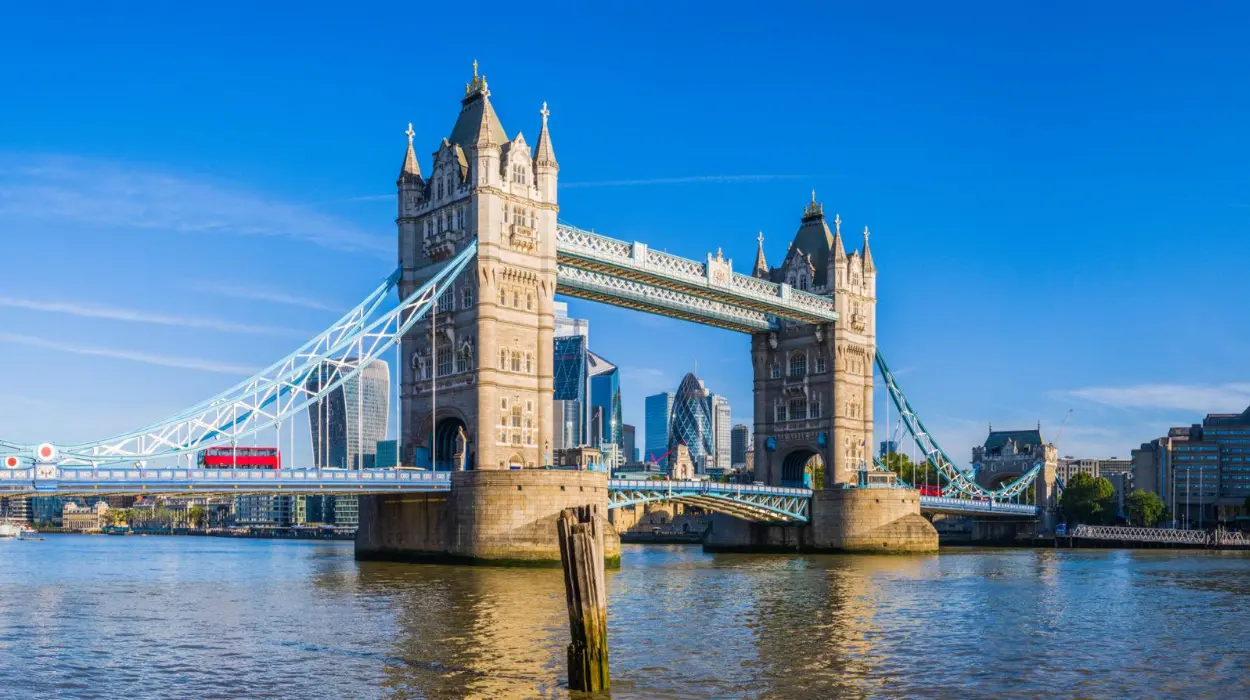
Tower Bridge stands among the most recognisable structures in London. Completed in 1894, it represents a major achievement of Victorian engineering and reflects the transformation of the River Thames during Britain’s industrial age. Built to solve growing transport pressures in East London while preserving river navigation, the bridge became a symbol of technological innovation, urban planning, and civic ambition.
- Why was Tower Bridge built in Victorian London?
- How was Tower Bridge designed and engineered?
- What role did the River Thames play in the bridge’s development?
- How was Tower Bridge constructed between 1886 and 1894?
- How did Tower Bridge affect London’s transport and commerce?
- Why are the high-level walkways historically significant?
- How has Tower Bridge been preserved and modernised?
- What is Tower Bridge’s legacy in engineering and heritage history?
Today, millions of visitors cross Tower Bridge each year, but its significance extends beyond tourism. The structure illustrates how nineteenth-century engineers addressed complex infrastructure challenges in a rapidly expanding global city. Its history is closely connected to the development of the Thames, the expansion of trade, and the evolution of London’s transport network.
Why was Tower Bridge built in Victorian London?
Tower Bridge was constructed to solve severe transport congestion east of London Bridge while maintaining uninterrupted river access for commercial shipping. The project reflected Victorian industrial growth, population expansion, and the increasing importance of efficient infrastructure connecting both sides of the River Thames.
By the second half of the nineteenth century, London had become the world’s largest city. The population exceeded 4 million by the 1880s and continued to grow. The eastern districts of London experienced significant industrial development, including docks, warehouses, shipyards, and manufacturing facilities.
The River Thames functioned as the city’s principal commercial artery. Large numbers of vessels transported goods into the Port of London, one of the busiest ports in the world. Existing crossings struggled to accommodate increasing traffic.
The principal crossing in central London was London Bridge. Heavy congestion affected both pedestrians and vehicles. Business leaders, politicians, and urban planners recognised the need for a new crossing downstream.
The challenge involved balancing two competing requirements. Road traffic required a permanent crossing. Maritime commerce required unobstructed river access. Conventional bridge designs risked disrupting navigation to upstream docks and commercial facilities.
In 1876, authorities established a special committee to examine potential solutions. More than 50 design proposals were submitted. Engineers and architects debated numerous concepts, including tunnels, high-level bridges, and movable structures.
After extensive review, officials selected a hybrid design that combined a bascule bridge with suspension elements. This solution allowed large ships to pass while providing a reliable road crossing for London residents and businesses.
The decision reflected broader Victorian priorities. Infrastructure projects increasingly supported industrial productivity, urban growth, and commercial competitiveness. Tower Bridge became one of the most ambitious examples of this approach.
How was Tower Bridge designed and engineered?
Tower Bridge combined hydraulic bascule technology, steel-framed construction, and Gothic Revival architecture. Its innovative design enabled movable roadways for shipping traffic while creating a durable structure capable of supporting increasing urban transportation demands across the Thames.
The final design emerged through collaboration between several prominent figures. Civil engineer Sir John Wolfe Barry led the engineering project. Architect Sir Horace Jones developed the bridge’s distinctive appearance.
Jones proposed a Gothic Revival style that complemented nearby historic landmarks, particularly the Tower of London. Following Jones’s death in 1887, architect George D. Stevenson continued aspects of the architectural work.
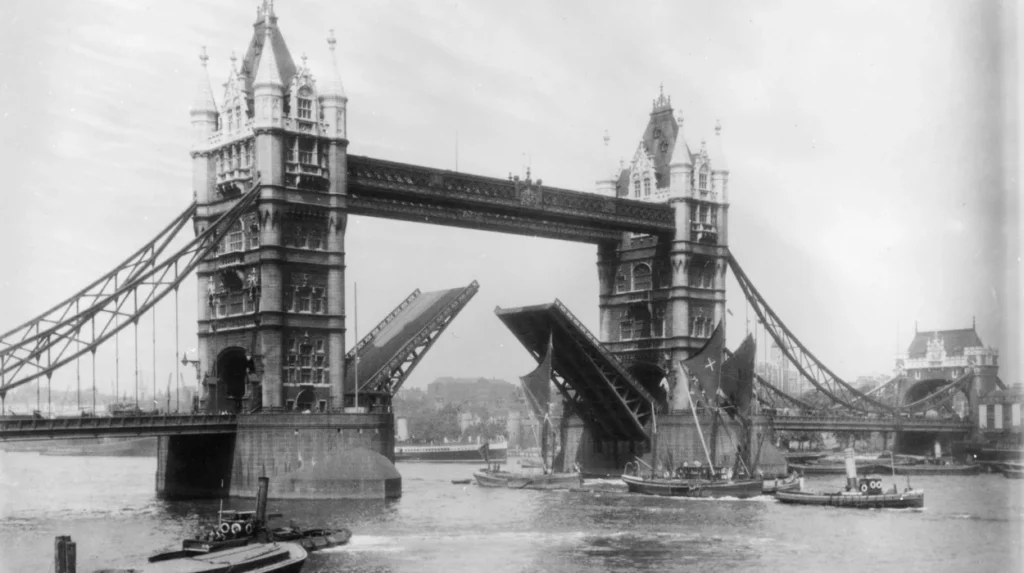
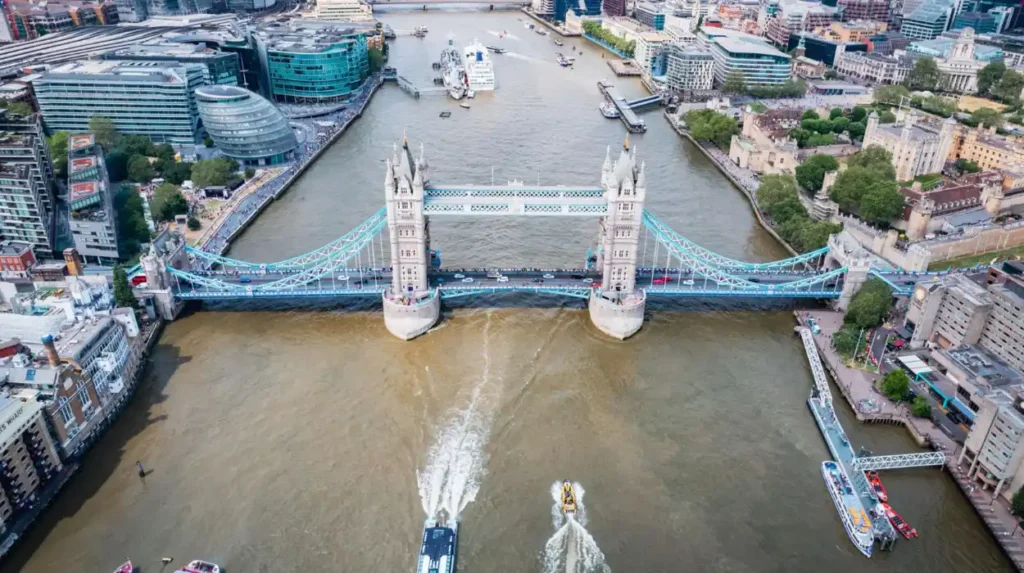
The engineering solution centred on two massive towers connected by high-level walkways. Between the towers, two bascules, or movable bridge leaves, could be raised to permit vessel passage.
The structure incorporated approximately 11,000 tons of steel framework. This steel skeleton provided strength while allowing decorative stone cladding to create the bridge’s iconic appearance.
Granite and Portland stone concealed much of the metal framework. This approach combined modern engineering with traditional architectural aesthetics.
The bridge measures approximately 244 metres in total length. The central span between the towers extends around 61 metres. Each tower rises approximately 65 metres above the river.
Victorian engineers employed advanced hydraulic technology to operate the bascules. Original systems utilised steam-powered pumps that generated hydraulic pressure. Large accumulators stored energy and enabled efficient bridge operation.
The engineering challenge extended below the waterline. Construction required substantial foundations embedded into the Thames riverbed. Workers excavated large quantities of material and created massive piers capable of supporting the bridge’s weight.
The project demonstrated the integration of architecture and engineering. Victorian infrastructure increasingly sought both functionality and civic prestige. Tower Bridge achieved both objectives.
What role did the River Thames play in the bridge’s development?
The River Thames directly shaped Tower Bridge’s design because London depended on commercial shipping access to upstream docks. The bridge needed to accommodate maritime traffic while improving land transportation, making river navigation a central engineering consideration throughout development.
During the nineteenth century, the Thames served as one of Britain’s most important transportation corridors. The river linked London to domestic markets and international trade routes.
The Port of London handled enormous volumes of imports and exports. Goods arriving from across the British Empire and global trading networks moved through riverside warehouses and dock complexes.
Numerous facilities operated upstream from the bridge site. These facilities included docks, wharves, warehouses, and commercial loading areas. Any fixed low-level bridge would have restricted access for sailing ships and steam-powered vessels.
The Thames therefore dictated the bridge’s operational requirements. Engineers needed a structure capable of opening frequently without compromising structural integrity.
Tower Bridge’s bascule mechanism addressed this challenge. Ships could continue reaching commercial destinations upstream, while road users gained a new crossing.
The bridge represented a broader transformation of London’s relationship with the river. Victorian authorities increasingly invested in embankments, sewage infrastructure, bridges, and transport networks that reshaped the Thames corridor.
The river remained economically vital, but it also became a focus of urban improvement projects. Tower Bridge emerged as one of the most visible outcomes of this transformation.
The structure symbolised London’s ability to adapt historic waterways to modern industrial demands while preserving commercial functionality.
How was Tower Bridge constructed between 1886 and 1894?
Construction required eight years of intensive engineering work involving thousands of workers, extensive riverbed foundations, steel framework assembly, and sophisticated hydraulic installations. The project reflected the scale and complexity of major Victorian infrastructure developments.
Construction officially began in 1886.
Engineers first focused on establishing secure foundations. Massive cofferdams created temporary dry working environments within the Thames. Workers excavated riverbed material and installed substantial support structures.
The project employed around 432 workers during peak construction periods. Labourers, engineers, stonemasons, metalworkers, and specialists contributed to different phases of the build.
Two large piers formed the structural base for the towers. These foundations had to withstand river currents, vessel movements, and the immense weight of the bridge.
Steel framework installation represented a major phase of construction. Approximately 11,000 tons of steel created the bridge’s primary load-bearing structure.
Once the framework was complete, builders added granite and Portland stone cladding. This process transformed the industrial skeleton into the visually distinctive landmark recognised today.
Hydraulic machinery required extensive installation and testing. Steam engines powered pumps that generated the pressure necessary to raise and lower the bascules.
The high-level walkways connected the towers above the roadway. These walkways originally allowed pedestrians to cross even when the bascules were open.
The bridge officially opened on 30 June 1894. The opening ceremony was attended by the future King Edward VII, then Prince of Wales, and Princess Alexandra.
The completion of Tower Bridge marked a significant milestone in London’s infrastructure development and demonstrated the capabilities of Victorian engineering.
How did Tower Bridge affect London’s transport and commerce?
Tower Bridge improved east-west connectivity across the Thames while preserving commercial navigation. The structure reduced transport barriers, supported economic activity, and strengthened links between residential districts, industrial zones, and commercial centres throughout London.
Before Tower Bridge, movement across the river east of London Bridge remained difficult. Existing crossings struggled to accommodate growing demand.
The new bridge improved accessibility between northern and southern districts. Workers, businesses, and residents benefited from more efficient travel routes.
Commercial activity also gained advantages. Goods could move more effectively between industrial areas and distribution centres.
The bridge supported London’s broader economic expansion during the late Victorian period. Infrastructure investments increasingly underpinned urban productivity and commercial competitiveness.
Importantly, maritime commerce continued largely uninterrupted. The bascule system allowed ships to access upstream facilities while enabling road transport above.
This dual function distinguished Tower Bridge from many contemporary structures. It served multiple transportation modes within a single integrated design.
The bridge also became a symbol of London’s modernity. Visitors and international observers viewed it as evidence of Britain’s industrial and engineering capabilities.
Its visibility along the Thames reinforced London’s identity as a global commercial centre during the late nineteenth and early twentieth centuries.
Why are the high-level walkways historically significant?
The high-level walkways were originally designed to maintain pedestrian movement during bridge openings. Although later closed because of limited use, they remain important historical features that illustrate Victorian efforts to balance urban mobility with river navigation requirements.
The walkways connect the bridge’s two towers at an elevated level above the roadway.
Victorian planners recognised that frequent bridge openings could disrupt pedestrian movement. The walkways offered an alternative crossing route when the bascules were raised.
Despite their practical purpose, usage remained relatively low. Many pedestrians preferred waiting for the bridge to reopen rather than climbing numerous staircases.
Over time, the walkways developed a reputation for undesirable activity and declining utilisation. Authorities eventually closed them to the public in 1910.
The closure lasted for decades. However, the structures remained architecturally and historically significant components of the bridge.
Restoration projects later revived the walkways as visitor attractions. Modern exhibitions interpret the bridge’s engineering history and Victorian context.
Glass floor installations introduced during twenty-first-century upgrades provide views of the roadway and river below.
To experience this historic landmark in person today, consult our comprehensive Walking Across Tower Bridge: Glass Walkways, Views and Visitor Experience for itineraries and visiting parameters.
The walkways now serve educational and heritage functions rather than transportation purposes.
How has Tower Bridge been preserved and modernised?
Tower Bridge has undergone continuous preservation, restoration, and technological upgrades to maintain structural integrity while protecting its historical character. Conservation efforts ensure the bridge remains operational, historically authentic, and accessible to modern audiences.
Historic infrastructure requires ongoing maintenance. Tower Bridge has benefited from numerous conservation initiatives since its opening.
One of the most significant changes involved the hydraulic operating system. Original steam-powered equipment remained in service for decades before technological upgrades improved efficiency.
Modern electro-hydraulic systems replaced earlier mechanisms while preserving key historical elements for interpretation and display.
Conservation projects address stonework, steel components, mechanical systems, and visitor facilities. These efforts help maintain both functionality and historical authenticity.
The bridge is protected as a Grade I listed structure. This designation recognises exceptional architectural and historical significance.
Preservation work follows strict heritage standards. Specialists carefully balance modern requirements with conservation principles.
Museum exhibitions within the bridge provide access to original engine rooms and historical machinery. These installations help visitors understand Victorian engineering practices.
Modern monitoring systems support long-term maintenance planning and structural assessment. Such measures ensure the bridge continues serving transportation and heritage functions simultaneously.
Tower Bridge remains one of the most successful examples of active infrastructure preservation in Britain.
What is Tower Bridge’s legacy in engineering and heritage history?
Tower Bridge remains a globally recognised example of Victorian engineering, urban planning, and heritage conservation. Its enduring influence reflects the success of combining technological innovation, architectural identity, and practical infrastructure within a rapidly changing metropolitan environment.
More than a century after its completion, Tower Bridge continues operating as a functional crossing and movable bridge.
Its engineering achievements remain significant. The structure demonstrated how complex transportation challenges could be addressed through innovative design and advanced mechanical systems.
The bridge also illustrates broader themes in urban history. These themes include industrialisation, population growth, infrastructure development, and civic investment.
For historians, the structure provides evidence of Victorian approaches to engineering and public works. For architects, it demonstrates the integration of aesthetics and functionality. For heritage professionals, it offers a model for preserving active infrastructure.
Tower Bridge has become one of London’s most recognisable landmarks. Images of the bridge appear in tourism campaigns, educational materials, historical studies, and cultural representations worldwide.
Its relationship with the River Thames remains central to its significance. The bridge embodies a period when London transformed its waterways, transportation systems, and urban landscape to meet the demands of industrial modernity.
The structure stands as a lasting reminder of the city’s nineteenth-century transformation. It connects the commercial history of the Thames, the ambitions of Victorian engineering, and the continuing importance of heritage conservation.
As both a working bridge and a protected historic monument, Tower Bridge demonstrates how infrastructure can transcend its original purpose and become a defining element of national identity, urban memory, and architectural heritage.
When was Tower Bridge built?
Construction of Tower Bridge began in 1886 and was completed in 1894. The bridge officially opened on 30 June 1894 after eight years of construction.