London’s historic pubs preserve an important part of the capital’s social, architectural, commercial, and transport history. Public houses developed alongside medieval roads, river crossings, markets, coaching routes, industrial districts, courts, theatres, and expanding residential neighbourhoods. Their surviving buildings provide physical evidence of how Londoners ate, drank, worked, travelled, and socialised across several centuries.
- What makes a London pub historically important?
- How did historic pubs develop in London?
- Which historic London pub best represents the traditional coaching inn?
- Why is Ye Olde Cheshire Cheese important to London’s literary and commercial history?
- What makes the Prospect of Whitby significant in London’s riverside history?
- Why is The Grapes in Limehouse one of London’s most important riverside pubs?
- What does the Seven Stars reveal about London’s historic legal district?
- Why is The Lamb and Flag important to Covent Garden’s history?
- How does the Hoop and Grapes represent surviving timber-framed London?
- What can visitors learn from the Holly Bush in Hampstead?
- How did traditional pub food and drink become part of London’s heritage?
- How have historic London pubs survived modern urban change?
- What is the best way to visit London’s historic pubs responsibly?
- Why do London’s historic pubs matter for future heritage research?
- Which historic pubs should visitors prioritise for traditional London heritage?
- Frequently Asked Question
Historic England identifies historic pubs as an important part of England’s built heritage and maintains dedicated research on their architecture, interiors, histories, and conservation. London contains particularly significant examples, including Grade I, Grade II*, and Grade II listed public houses.
The best historic pubs in London are not simply old drinking establishments. They are surviving buildings connected to urban change. Their timber frames, cellars, staircases, galleries, panelling, bar counters, façades, courtyards, and street positions record different stages of the capital’s development.
For visitors, these pubs also provide access to traditional British food and drink within historically significant settings. Menus change over time, but the relationship between food, hospitality, and London’s historic streets remains central to the pub’s cultural role.
What makes a London pub historically important?
A historic London pub combines surviving architectural fabric, documented historical associations, long-standing public-house use, or an important location within the city’s development, with examples including the George Inn, Ye Olde Cheshire Cheese, and Prospect of Whitby.
Age alone does not determine heritage importance. Historic England’s National Heritage List for England records buildings because of their special architectural or historic interest. Listing can protect significant structures and important surviving interiors from inappropriate alteration.
A pub can therefore be historically important for several different reasons. The building itself can preserve an early structural system. The site can have an unusually long history of hospitality. The establishment can document a particular phase of urban development. Its interior can retain fittings associated with historic pub design.
The George Inn in Southwark demonstrates the distinction between site history and surviving structure. An inn existed on the site by 1542, with evidence suggesting an earlier medieval history. The present surviving building dates from 1677, after the previous inn was destroyed in the Southwark Fire of 1676.
Ye Olde Cheshire Cheese demonstrates another pattern. The present building contains late-seventeenth-century fabric, while its Fleet Street frontage was altered in later periods. Historic England records a late-C17 building with a late-C18 yellow-brick frontage and later nineteenth-century changes.
These examples show why claims about London’s “oldest pub” require careful definition. Historic England itself identifies several contenders, including the Prospect of Whitby, George Inn, Ye Olde Cheshire Cheese, Hoop and Grapes, and Seven Stars.
How did historic pubs develop in London?
London pubs developed from medieval inns, taverns, alehouses, and coaching establishments into regulated public houses, with later Victorian breweries standardising interiors, signage, service areas, and architectural forms across expanding neighbourhoods.
Medieval London depended on hospitality establishments because merchants, pilgrims, carriers, officials, and travellers needed food, drink, accommodation, and places for business. Inns occupied strategic positions near roads, bridges, markets, and river crossings.
The distinction between inns, taverns, and alehouses changed over time. Inns generally provided accommodation and food as well as drink. Taverns developed strong associations with wine. Alehouses primarily supplied locally brewed ale. By the eighteenth and nineteenth centuries, these distinctions became less rigid.
Government regulation increasingly shaped the alcohol trade. Licensing systems controlled who could sell alcoholic drinks and under what conditions. The Licensing Act 1751 strengthened regulation of public houses and sought to control disorder associated with unlicensed drinking establishments.
The nineteenth century transformed London’s pub landscape. Rapid population growth, industrialisation, railway construction, and suburban expansion created demand for organised drinking establishments. Brewing companies expanded their property portfolios and developed recognisable architectural identities.
Victorian and Edwardian pubs frequently contained multiple rooms serving different social groups. Saloon bars, public bars, private rooms, lounges, and upstairs spaces reflected differences in price, status, and behaviour.
Architecture also became part of the commercial system. Glazed ceramic tiles, etched glass, decorative woodwork, mirrors, mahogany fittings, elaborate façades, and brewery signs created highly visible establishments.
Older pubs therefore contain several historical layers. A sixteenth- or seventeenth-century building can contain nineteenth-century bar fittings and twentieth-century alterations. Conservation requires understanding these layers rather than treating one date as the complete history.
Which historic London pub best represents the traditional coaching inn?
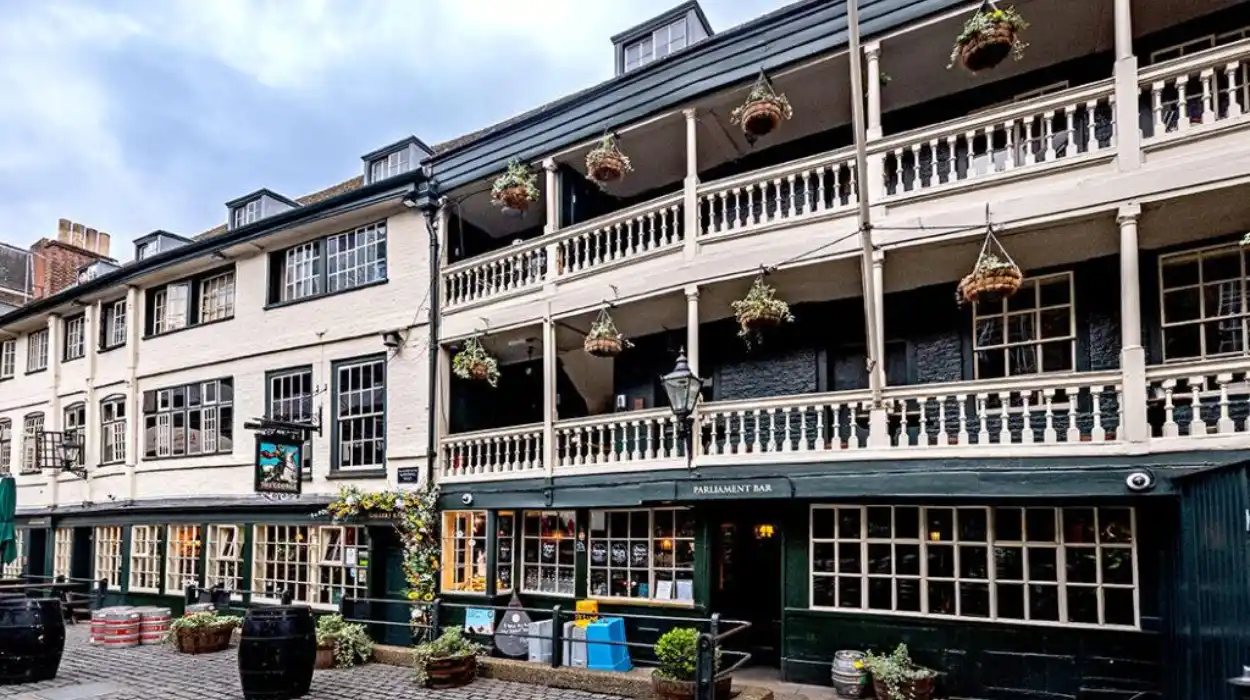
The George Inn in Southwark best represents London’s surviving coaching-inn tradition because its seventeenth-century galleries preserve the architectural form once associated with large inns serving travellers, coaches, merchants, and commercial traffic.
The George Inn stands at 77 Borough High Street, Southwark. The National Trust describes it as London’s last remaining galleried inn. The present building dates from the seventeenth century and is protected as a Grade I listed building.
Its architectural importance comes from the galleries overlooking the courtyard. These galleries once formed a practical feature of inns where rooms opened onto shared circulation areas. The surviving structure retains two tiers of galleries on part of its frontage.
The building’s history is linked to Southwark’s position outside the medieval City of London. Borough High Street formed an important route south from the Thames crossing and supported inns serving travellers approaching or leaving the capital.
The original George Inn was destroyed in the Southwark Fire of 1676. The surviving structure was built in 1677 and originally formed part of a larger inn arranged around a courtyard.
Later changes reduced the original complex. The Great Eastern Railway Company acquired parts of the property and demolished the northern range in 1874. The National Trust acquired the property in 1937.
The George Inn therefore provides a clear architectural record of changing transport systems. Its history begins with coaching and commercial travel and later intersects with railway development and modern heritage conservation.
Why is Ye Olde Cheshire Cheese important to London’s literary and commercial history?
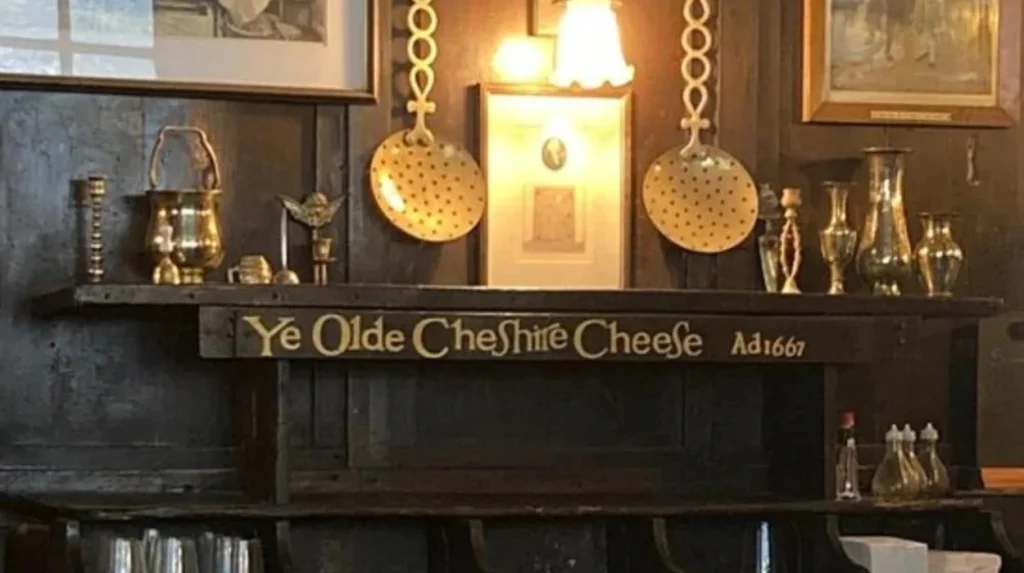
Ye Olde Cheshire Cheese is historically important because its Fleet Street location connects the pub with London’s long-established publishing, journalism, legal, and commercial district, while its surviving late-seventeenth-century fabric demonstrates post-Fire urban rebuilding.
Ye Olde Cheshire Cheese stands at 145 Fleet Street in the City of London. Historic England lists it at Grade II, with the listing first recorded in 1977.
The building contains late-seventeenth-century elements, while the Fleet Street frontage reflects later eighteenth- and nineteenth-century alterations. A vaulted cellar beneath a small courtyard is among the significant surviving features recorded by Historic England.
Its location is important because Fleet Street developed as a major centre for printing, publishing, journalism, legal practice, and commercial activity. A public house in this environment served workers and professionals operating within one of London’s most influential business districts.
The pub’s historical significance therefore extends beyond its interior. Its address forms part of a larger urban landscape shaped by communication industries and professional institutions.
The building also illustrates the rebuilding of London following the Great Fire of 1666. The fire destroyed a large section of the City, leading to extensive reconstruction and changes in building materials, street regulation, and architectural practice.
For researchers, Ye Olde Cheshire Cheese demonstrates how historic pubs can function as sources for studying occupational geography. A pub located beside printing offices, newspaper establishments, legal chambers, and commercial premises provides evidence about the social infrastructure surrounding those industries.
What makes the Prospect of Whitby significant in London’s riverside history?
The Prospect of Whitby represents London’s riverside pub tradition through its location at Wapping Wall, where maritime trade, shipping, dock work, river transport, and working waterfront communities shaped the surrounding district for centuries.
The Prospect of Whitby stands at 57 Wapping Wall in East London. Historic England lists it as a Grade II building, with its first statutory listing dating from 1950.
Wapping developed beside the River Thames and became closely associated with maritime employment. The riverside supported sailors, ship workers, merchants, boatmen, warehouse labourers, and businesses connected with the movement of goods.
The pub’s location explains its historical character. Riverside public houses served workers whose daily lives were governed by tides, shipping schedules, cargo movements, and the commercial economy of the Thames.
The wider Wapping landscape changed dramatically during the nineteenth and twentieth centuries as docks expanded, industries shifted, and later redevelopment transformed the riverside.
The Prospect of Whitby is therefore important as part of a larger maritime heritage system. Its significance comes from the relationship between building, street, river, and historic occupation.
Historic England’s records also demonstrate why listed status matters. The pub forms part of a nationally documented heritage inventory that identifies buildings requiring recognition because of architectural or historic interest.
Why is The Grapes in Limehouse one of London’s most important riverside pubs?
The Grapes in Limehouse preserves a five-century riverside pub tradition associated with Thames commerce, maritime communities, Samuel Pepys, Charles Dickens, and Limehouse’s changing industrial landscape.
The Grapes stands at 76 Narrow Street in Limehouse. Its own historical record traces the establishment back nearly 500 years and identifies its earlier name as the Bunch of Grapes.
Limehouse developed on relatively dry land beside extensive riverside marshes. During the Elizabethan period, the district became connected with international trade and maritime activity. The Thames provided direct access to ships, wharves, warehouses, and industrial premises.
Samuel Pepys recorded a visit to Limehouse in 1661, providing a documentary connection with the district during the seventeenth century.
The pub also has a strong literary association with Charles Dickens. Dickens knew Limehouse from the nineteenth century and used the riverside environment in Our Mutual Friend. The Grapes identifies the pub as an establishment represented in the opening chapter of the novel.
Historic England’s photographic archive contains twentieth-century records of The Grapes and its surrounding river frontage. One archive image dates from 1945–1965, while another records the riverside frontage in 1985.
The surviving pub therefore provides evidence of continuity through major changes in London’s docks. The surrounding Limehouse landscape shifted from an industrial waterfront to a residential and commercial district, while the pub retained its connection with the Thames.
Today, The Grapes continues to operate as a public house and serves food, including fish and chips, within its historic riverside setting.
What does the Seven Stars reveal about London’s historic legal district?
The Seven Stars on Carey Street demonstrates how historic pubs developed within London’s legal district, preserving a building with seventeenth-century origins, nineteenth-century public-house fittings, and a location beside the Inns of Court and historic legal institutions.
The Seven Stars stands at 53 and 54 Carey Street in London. Historic England lists the building at Grade II and records its origins as possibly seventeenth century, with a date of 1602 associated with the building.
The building retains elements of timber framing beneath later alterations. Its present exterior includes a nineteenth-century wooden public-house frontage, while the interior preserves nineteenth-century bar backs, mirrors, cupboards, counters, and a later fireplace.
Carey Street sits within a historic legal environment. The surrounding area developed alongside courts, chambers, solicitors, barristers, and legal institutions. Public houses provided practical meeting spaces within this professional landscape.
The Seven Stars illustrates the layered character of London architecture. The building did not remain unchanged from 1602. Instead, its fabric records successive periods of use and adaptation.
This makes the pub particularly valuable for historical study. Researchers can examine how early domestic or commercial structures were adapted into nineteenth-century public houses while retaining earlier structural elements.
The building also demonstrates why historic pub conservation involves interiors as well as façades. Historic England records surviving bar fittings and other internal features as part of the building’s architectural interest.
Why is The Lamb and Flag important to Covent Garden’s history?
The Lamb and Flag preserves a historic public-house presence in Covent Garden, with a building dating from about 1688 or the early eighteenth century and surviving internal features that connect the pub with the area’s long commercial history.
The Lamb and Flag stands on Rose Street in Covent Garden. Historic England lists it as a Grade II building and dates its main structure to approximately 1688 or the early eighteenth century.
The building retains parts of its original rear fabric, an open passage toward Lazenby Court, a dog-leg staircase, and plain panelling. The present front was rebuilt in 1958, creating a visible distinction between historic structure and later intervention.
Covent Garden developed from a seventeenth-century planned district into a major market, entertainment, retail, and hospitality centre. Its streets became increasingly associated with theatres, market trading, restaurants, shops, and residential development.
A pub in this environment served workers, residents, performers, traders, and visitors. Its history therefore reflects the changing economic functions of central London.
The Lamb and Flag also demonstrates the importance of examining rear elevations and internal spaces. A modernised street frontage does not necessarily mean the entire building is modern. Historic structural and circulation elements can survive behind later façades.
For cultural tourists, the pub forms part of a wider heritage landscape that includes Covent Garden Market, theatres, churches, historic streets, and former market buildings.
To experience this historic district in person today, consult our comprehensive [The History of London’s Oldest Pubs and Their Enduring Cultural Legacy Today] for itineraries and visiting parameters.
How does the Hoop and Grapes represent surviving timber-framed London?
The Hoop and Grapes on Aldgate High Street is a rare surviving late-seventeenth-century timber-framed building, demonstrating the type of construction that was once common in London but became increasingly scarce after rebuilding and urban redevelopment.
The Hoop and Grapes stands at 47 Aldgate High Street and is Grade II* listed. Historic England describes it as probably late seventeenth century and identifies its timber frame as an unusually rare surviving example.
The building contains carved posts that are potentially seventeenth-century survivals. Its irregular rear wing includes rendered and boarded sections. Historic England specifically identifies the building as belonging to a type once common in London but now very rare.
Aldgate was historically important because it stood at one of the eastern gateways through the medieval City wall. The surrounding roads connected the City with eastern London and routes beyond the capital.
The pub’s survival therefore has architectural as well as geographical significance. Its timber construction preserves evidence of a building tradition that was progressively replaced by brick and more standardised urban forms.
The building also illustrates the importance of Grade II* designation. Historic England uses this category for particularly important buildings of more than special interest, placing the Hoop and Grapes above the standard Grade II category.
Its survival provides researchers with physical evidence for understanding pre-industrial London construction and the transformation of the City’s built environment.
What can visitors learn from the Holly Bush in Hampstead?
The Holly Bush demonstrates how a historic pub can originate from a different building function, having begun as stables and later becoming a public house associated with Hampstead’s eighteenth- and nineteenth-century development.
The Holly Bush stands on Holly Mount in Hampstead. Historic England lists it as Grade II and dates the main building to approximately 1797, with later alterations.
Its history is particularly useful because the building was not originally constructed as a pub. Historic England records that it was built as stables for Romney’s House and later converted around 1807 when Romney’s House became Assembly Rooms.
This conversion illustrates a common feature of historic urban development: buildings changed function as neighbourhood economies evolved.
The pub retains historic internal features, including a fixed snob-screen and a nineteenth-century counter. These elements document the social and commercial organisation of Victorian public-house interiors.
Hampstead itself developed from a rural settlement into a fashionable and increasingly urban district while retaining historic streets and buildings. The Holly Bush forms part of this wider architectural landscape.
Its history also demonstrates why conservation records are important for visitors. A pub’s visible appearance provides only part of its history. Documentary evidence can reveal previous functions, owners, alterations, and relationships with nearby buildings.
How did traditional pub food and drink become part of London’s heritage?
Traditional pub food and drink developed from practical hospitality, local brewing, working-class meals, and traveller services into a recognised part of British food culture, with dishes such as pies, fish and chips, roast meals, bread, cheese, and puddings.
Historic pubs were commercial food establishments as well as places for drinking. Inns provided meals for travellers, while alehouses supplied food alongside locally produced beer and cider.
The nineteenth century strengthened the connection between pubs and everyday meals. Industrial workers required inexpensive food near workplaces. Travellers needed reliable meals beside roads and railway stations. Urban residents used pubs as accessible social dining spaces.
Food also reflected local supply networks. Meat, bread, cheese, vegetables, fish, and beer entered London through extensive markets and transport systems. The Thames, railways, roads, and wholesale markets connected public houses with national and regional food production.
Beer remained central to the traditional pub economy. London developed a major brewing industry, with breweries producing ales and later lagers for an increasingly large urban population.
Pub interiors were designed around this commercial model. Bars provided rapid service, while separate rooms allowed different customers to use the same establishment.
Modern menus retain some traditional dishes while incorporating contemporary ingredients and dietary requirements. The historical significance lies in the continuing relationship between food, drink, hospitality, and public space rather than in preserving a fixed menu from a particular century.
How have historic London pubs survived modern urban change?
Historic London pubs survived through listing, adaptive reuse, community value, commercial continuity, architectural conservation, and changes in ownership, although survival often involved alterations to façades, interiors, layouts, and surrounding urban environments.
London’s historic pubs have faced repeated pressures. Urban redevelopment, wartime damage, changing transport systems, rising property values, brewery restructuring, licensing changes, and changing consumer habits have all influenced pub survival.
Historic England’s dedicated pubs research highlights the importance of identifying and caring for historic public houses. Its programme includes research, archive material, listed pub examples, and guidance on protecting pubs at risk.
The George Inn demonstrates institutional conservation. The National Trust became the property owner in 1937, helping preserve the surviving galleried inn as a major heritage building.
The George also demonstrates adaptive reuse. Its architectural form originated in the coaching era, while its present function operates within a modern city dominated by railways, Underground services, buses, cycling, and pedestrian movement.
The Lamb and Flag demonstrates another conservation challenge. Its street frontage was rebuilt in 1958 even though earlier structural and internal elements survived. Historic England therefore records both later intervention and surviving historic fabric.
The Hoop and Grapes provides a stronger example of architectural rarity. Its late-seventeenth-century timber frame represents a building type that Historic England describes as very rare in modern London.
Conservation therefore does not mean freezing a building at one historical date. It involves identifying significant fabric, understanding successive alterations, maintaining viable use, and preventing unnecessary loss.
What is the best way to visit London’s historic pubs responsibly?
Visitors should treat historic pubs as functioning businesses and heritage buildings, respecting local rules, preserving architectural features, avoiding disruptive photography, and using food or drink purchases to support continued commercial occupation.
Historic pubs remain working premises. They are not museums in the conventional sense. Staff operate businesses, prepare food, serve customers, maintain buildings, and manage modern safety requirements.
Visitors should avoid touching fragile historic fittings. Timber panelling, carved posts, mirrors, bar counters, staircases, and decorative surfaces can be vulnerable to physical damage.
Photography should follow each establishment’s current rules. Some interiors contain private areas or working spaces that should not be photographed without permission.
Food and drink purchases also contribute to commercial continuity. A viable pub has stronger practical prospects for retaining its historic function than an abandoned building.
Visitors should also distinguish between historical fact and pub tradition. Claims involving famous writers, monarchs, criminals, ghosts, or specific events require documentary evidence. Historic England, the National Trust, municipal records, museum collections, and established archival sources provide stronger evidence than unsourced legends.
This distinction is particularly important for educational visits. Students and researchers can compare physical evidence with documentary records and identify where later tradition has altered historical interpretation.
Why do London’s historic pubs matter for future heritage research?
London’s historic pubs matter because they preserve architectural fabric and evidence about everyday urban life, providing researchers with material for studying transport, labour, food, commerce, social organisation, migration, architecture, and neighbourhood change across centuries.
Major monuments often document political, religious, military, or royal history. Historic pubs provide a different category of evidence. They document ordinary commercial and social activity.
Their addresses connect them to changing urban geography. The George Inn records Southwark’s role as a transport and hospitality centre. The Prospect of Whitby and The Grapes document the Thames waterfront. Ye Olde Cheshire Cheese records Fleet Street’s professional and publishing environment. The Seven Stars records the legal district around Carey Street.
Architectural details provide additional evidence. Galleries reveal historic inn planning. Timber frames demonstrate earlier construction techniques. Bar counters document changing service arrangements. Cellars reveal storage and building practices. Panelling and decorative glass demonstrate later commercial investment.
Archaeological evidence also contributes to interpretation. Historic England records reused medieval beams and possible medieval stonework in the cellar of the George Inn, while the Hoop and Grapes retains basement vaults associated with earlier warehousing and the Fleet Canal area.
These physical remains allow historians to connect written records with surviving structures.
The long-term value of historic pubs therefore extends beyond tourism. They are primary sources for reconstructing London’s changing streets, occupations, businesses, transport systems, food networks, and social spaces.
For genealogical researchers, pub addresses also provide useful geographical markers. A historic public house can help establish the commercial character of a street where ancestors lived, worked, travelled, or conducted business.
Which historic pubs should visitors prioritise for traditional London heritage?
Visitors seeking the strongest combination of documented history, surviving architecture, traditional pub identity, and distinctive location should prioritise the George Inn, Ye Olde Cheshire Cheese, Prospect of Whitby, The Grapes, Seven Stars, Lamb and Flag, Hoop and Grapes, and Holly Bush.
The George Inn provides the clearest surviving example of the historic galleried inn. Its Grade I status and seventeenth-century structure make it one of London’s most important surviving hospitality buildings.
Ye Olde Cheshire Cheese represents Fleet Street’s professional and publishing heritage while preserving significant late-seventeenth-century fabric and a historic cellar.
The Prospect of Whitby represents the maritime Thames and Wapping’s historic riverside economy. Its Grade II listing confirms its architectural and historical significance.
The Grapes provides a five-century Limehouse connection with the Thames, maritime trade, Samuel Pepys, and Charles Dickens.
Seven Stars on Carey Street illustrates the relationship between historic public houses and London’s legal district while retaining seventeenth-century origins and nineteenth-century pub fittings.
The Lamb and Flag demonstrates the layered development of Covent Garden and retains significant historic fabric despite twentieth-century alterations.
The Hoop and Grapes provides rare evidence of late-seventeenth-century timber-framed construction in the City.
The Holly Bush demonstrates adaptive reuse in Hampstead, having developed from stables into a public house while retaining historic interior features.
Together, these establishments show that London’s pub heritage is geographically diverse. The historic pub is not confined to one district or one period. It appears within riverfront communities, legal quarters, commercial streets, market districts, transport routes, and residential neighbourhoods.
London’s historic pubs therefore offer a practical way to study the capital through surviving buildings. Their architecture records construction methods. Their locations record urban geography. Their interiors record commercial change. Their food and drink traditions record everyday hospitality.
For history enthusiasts, cultural tourists, educators, and heritage researchers, these pubs provide direct access to the physical remains of London’s social history. Their continued use also gives historic buildings a practical role in the modern city.
The strongest reason to visit them is not simply their age. It is the documented continuity between building, place, occupation, and urban change. From the seventeenth-century galleries of the George Inn to the rare timber frame of the Hoop and Grapes, London’s historic pubs preserve evidence of a city that repeatedly rebuilt itself while retaining fragments of its earlier identity.
Frequently Asked Question
What is the oldest historic pub in London?
The title of London’s oldest pub is disputed because different establishments use different definitions of age. The George Inn, Ye Olde Cheshire Cheese, Prospect of Whitby, and Seven Stars are among London’s historic pubs with documented centuries-old histories.