Covent Garden is one of central London’s most historically significant visitor districts. Its present identity combines a seventeenth-century planned piazza, a nineteenth-century market complex, major theatres, historic churches, transport heritage, and preserved residential streets.
- What is the historical significance of Covent Garden?
- Why should tourists visit Covent Garden Piazza and Market Building?
- What can visitors see at the Royal Opera House in Covent Garden?
- Why is St Paul’s Church Covent Garden an important historic attraction?
- How does the London Transport Museum preserve Covent Garden’s industrial history?
- What makes Seven Dials one of Covent Garden’s most important historic areas?
- Why is Theatre Royal Drury Lane important to Covent Garden’s theatrical history?
- How did Covent Garden survive twentieth-century redevelopment?
- Which historic streets and architectural details should tourists explore around Covent Garden?
- How can visitors understand Covent Garden as a complete historical landscape?
- Why does Covent Garden remain historically important today?
- Frequently Asked Question
The name Covent Garden derives from the former garden of Westminster Abbey. Medieval records identify the land as an agricultural and monastic site. After the Dissolution of the Monasteries under Henry VIII, the land entered royal and aristocratic ownership. The development of the modern district accelerated in the seventeenth century under Francis Russell, 4th Earl of Bedford.
Covent Garden also occupies an important position in the history of early medieval London. Archaeological evidence shows that Lundenwic, an Anglo-Saxon trading settlement, developed around present-day Covent Garden and the Strand between approximately 600 and 851 CE. London Museum identifies this settlement as a major centre of early medieval commerce west of the abandoned Roman city.
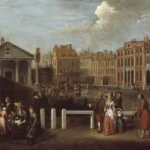
The district became particularly important after Inigo Jones designed Covent Garden Piazza in the 1630s. The development introduced a formal Italian-influenced urban square to London and established a model for later residential squares across the capital.
Today, visitors can experience this layered history through buildings, streets, theatres, museums, markets, churches, and surviving architectural plans. The attractions below explain the historical significance of the district while identifying the principal places tourists should experience during a London visit.
What is the historical significance of Covent Garden?
Covent Garden developed from medieval monastic farmland into London’s first planned residential square, a major market district, and a leading theatre quarter. Its surviving architecture records changes from medieval agriculture and Stuart urban planning to Victorian commerce and modern cultural tourism.
The earliest documented history of the area reaches back to Westminster Abbey. The land functioned as a garden supplying the religious community, which explains the origin of the name. London Museum identifies Covent Garden as London’s first square, laid out during the 1630s by architect Inigo Jones.
Inigo Jones was an English architect and designer who introduced Renaissance and classical architectural principles to major British buildings. His Covent Garden scheme used a formal square surrounded by residential development and a church. The arrangement reflected European architectural ideas that Jones encountered during his travels.
Francis Russell, 4th Earl of Bedford, controlled the estate when the major development began. He obtained permission from Charles I to develop the land in the 1630s. The project transformed agricultural ground into a fashionable residential quarter.
The architectural arrangement had long-term consequences. The combination of a central open space, surrounding terraces, and a parish church influenced later London developments. London Museum identifies Covent Garden as an important model for later squares including St James’s Square, Golden Square, and Grosvenor Square.
The district then acquired another major function. A market developed within the Piazza. A written reference to the “new market in Covent Garden” dates from 1654. The market expanded rapidly and became one of London’s most important centres for fruit, vegetables, flowers, roots, and herbs.
Covent Garden therefore represents several major stages in London’s urban development: medieval monastic landholding, Stuart planning, commercial market expansion, theatrical growth, Victorian transport infrastructure, twentieth-century redevelopment pressure, and modern heritage conservation.
Why should tourists visit Covent Garden Piazza and Market Building?
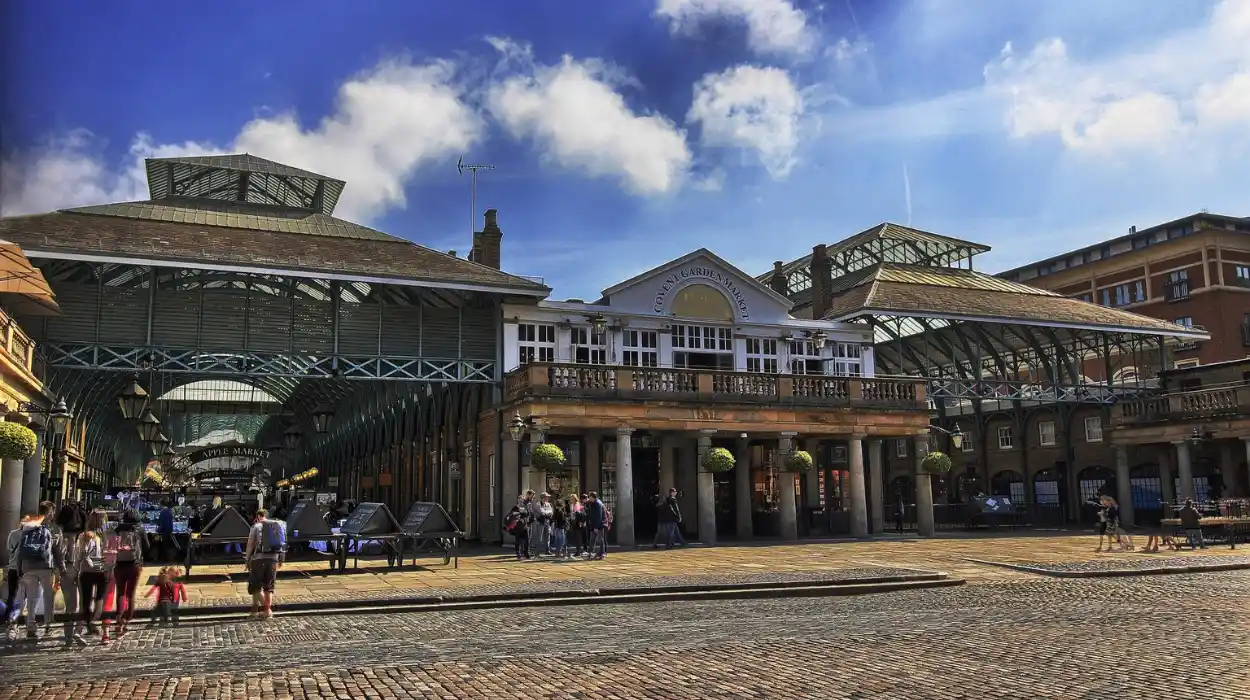
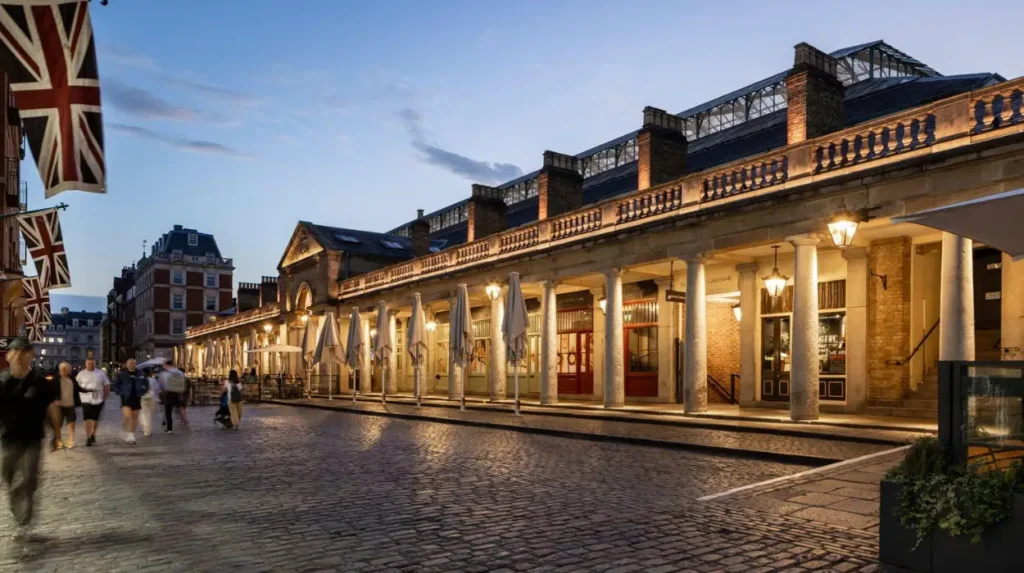
Covent Garden Piazza and Market Building form the district’s historic centre. The Piazza originated in the 1630s, while the present market building opened in 1830 after Charles Fowler designed a permanent structure for a regulated commercial market.
The Piazza is the clearest surviving expression of Inigo Jones’s seventeenth-century urban design. Its planned geometry represented a significant departure from the irregular medieval streets that characterised much of central London.
The original development included residential terraces and St Paul’s Church. The square was designed as an organised architectural ensemble rather than an accidental collection of streets and buildings.
Market activity became increasingly important during the seventeenth century. The 1654 reference establishes the market as an organised feature of the district. In 1670, the 5th Earl of Bedford obtained letters patent formalising market activity and allowing traders to operate under specified conditions.
The market’s commercial importance increased after the Great Fire of London in 1666. Covent Garden became London’s largest market for fresh produce. The growing volume of trade created congestion, waste, noise, and pressure on the surrounding streets.
A major redevelopment followed legislation secured in 1828 by John Russell, 6th Duke of Bedford. Architect Charles Fowler designed the permanent market complex. Construction cost approximately £61,000, including £34,850 paid to contractor William Cubitt. The new market opened in May 1830.
Fowler’s design used a functional architectural approach. The structure was intended to organise commercial activity efficiently rather than provide a purely decorative monument. Its Greco-Roman character remains a defining feature of the Piazza.
The market continued operating as a wholesale fruit, vegetable, and flower centre until the twentieth century. Wholesale operations eventually moved out of Covent Garden on 11 November 1974.
The historic buildings survived a major redevelopment threat. Plans during the post-war period proposed extensive demolition and reconstruction. Local opposition contributed to the preservation of the historic district. The Market Building and Piazza were subsequently restored and reopened as a specialist shopping destination in 1980.
For visitors, the Piazza provides direct access to the architectural foundations of Covent Garden. The surrounding Market Building also demonstrates how a nineteenth-century commercial structure can acquire a new cultural and retail function without losing its historic identity.
What can visitors see at the Royal Opera House in Covent Garden?
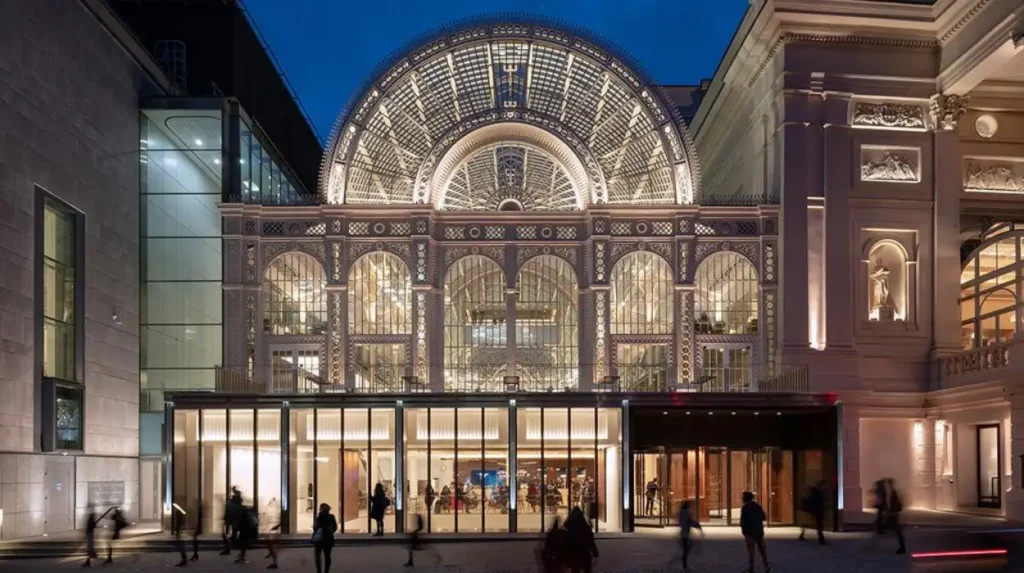
The Royal Opera House occupies a theatre site used continuously for major performances since 1732. The present building opened in 1858 after architect Edward Middleton Barry designed the third theatre on the site, linking Covent Garden with opera and ballet history.
The Royal Opera House is one of Covent Garden’s most important cultural landmarks. Its history begins with the Theatre Royal, Covent Garden, which opened in 1732.
The original theatre established a permanent connection between Covent Garden and high-profile theatrical performance. Opera became particularly important to the identity of the district, and the phrase “Covent Garden” became closely associated with British opera.
The present Royal Opera House is the third major theatre building constructed on the site. Architect Edward Middleton Barry designed the current theatre, which opened in 1858. The building incorporates Victorian architectural features that remain important to its heritage character.
The Royal Opera House is home to The Royal Opera and The Royal Ballet. Its stage history includes internationally recognised performers such as Maria Callas, Margot Fonteyn, Luciano Pavarotti, and Rudolf Nureyev.
The building also demonstrates the relationship between historic architecture and technological change. A major redevelopment completed in 1999 upgraded backstage and production facilities while retaining important elements of the Victorian theatre.
Visitors interested in architectural history should examine the exterior relationship between the Royal Opera House and the Piazza. The building forms part of a dense cultural landscape where theatres, churches, market buildings, restaurants, shops, and historic streets occupy a compact area.
The Royal Opera House also demonstrates why Covent Garden became a cultural quarter rather than remaining primarily a commercial market. Theatre activity created employment, audiences, hospitality businesses, and specialist trades around the district.
A visit therefore provides more than access to opera or ballet. The building represents nearly three centuries of theatrical development on one central London site.
Why is St Paul’s Church Covent Garden an important historic attraction?
St Paul’s Church Covent Garden is a Grade I listed parish church designed by Inigo Jones and built between 1631 and 1638. Its classical architecture formed an essential part of the original Piazza and remains one of Covent Garden’s defining historic structures.
St Paul’s Church stands on the western side of the Piazza. Its construction formed part of the original development planned by Inigo Jones for the Bedford estate.
Historic England records the church as Grade I listed and dates its principal construction to 1631–1638. The building was damaged by fire in 1795 and later restored, with further alterations during the nineteenth century.
The church is architecturally significant because of its restrained classical composition. Historic England describes its principal materials as red brick and stone, with a monumental east portico facing the Piazza. The portico uses Tuscan columns and a pedimented gable.
The building was designed as a parish church rather than as a cathedral. Its relationship with the surrounding residential development was therefore central to the original planning concept.
St Paul’s also has strong connections with London’s theatrical community. Its churchyard contains memorial associations with actors and theatrical figures, reinforcing the relationship between religious and performance institutions in Covent Garden.
The church survived major periods of urban transformation. Its continued presence demonstrates the durability of the original seventeenth-century plan.
Historic England’s Grade I designation provides statutory recognition of its architectural and historic importance. Listed-building protection operates under the Planning (Listed Buildings and Conservation Areas) Act 1990.
Visitors should examine the church from the Piazza before entering. The building’s proportions, portico, brickwork, roofline, and position within the square reveal how Jones integrated religious architecture into a planned urban environment.
The church is therefore essential for understanding Covent Garden as an architectural project rather than simply a modern entertainment destination.
How does the London Transport Museum preserve Covent Garden’s industrial history?
The London Transport Museum occupies the Victorian Flower Market Building in Covent Garden Piazza. The 1870 Grade II listed structure became the museum’s home in 1980, connecting the district’s nineteenth-century market architecture with London’s transport history.
The London Transport Museum occupies a former Victorian market structure. The Flower Market Building dates from 1870 and is a Grade II listed building within the Covent Garden conservation area.
The building originally served the commercial activity associated with Covent Garden Market. Its architecture therefore belongs to the same nineteenth-century market system that shaped the district’s economy.
The museum moved its public displays into the building in 1980. It later underwent a £22 million redevelopment that was completed in November 2007. The project introduced additional gallery space, a theatre, and improved visitor facilities while retaining the historic building.
The museum interprets London’s transport development through vehicles, maps, posters, engineering objects, and historical displays. Its collections cover buses, trams, Underground railways, transport workers, design, and the expansion of London.
The institution provides important historical context because transport infrastructure transformed the relationship between central London and its suburbs. Improved rail and Underground connections expanded the potential visitor and commuter population of districts such as Covent Garden.
The museum building also demonstrates adaptive reuse. Adaptive reuse means giving an existing historic structure a new function while retaining significant architectural fabric.
For history enthusiasts, this attraction connects two separate historical systems: the commercial market economy of nineteenth-century Covent Garden and the transport infrastructure that helped reshape London during industrialisation.
Its location inside the former Flower Market makes the museum particularly relevant to understanding how historic buildings can preserve evidence of economic change even after their original commercial function ends.
What makes Seven Dials one of Covent Garden’s most important historic areas?
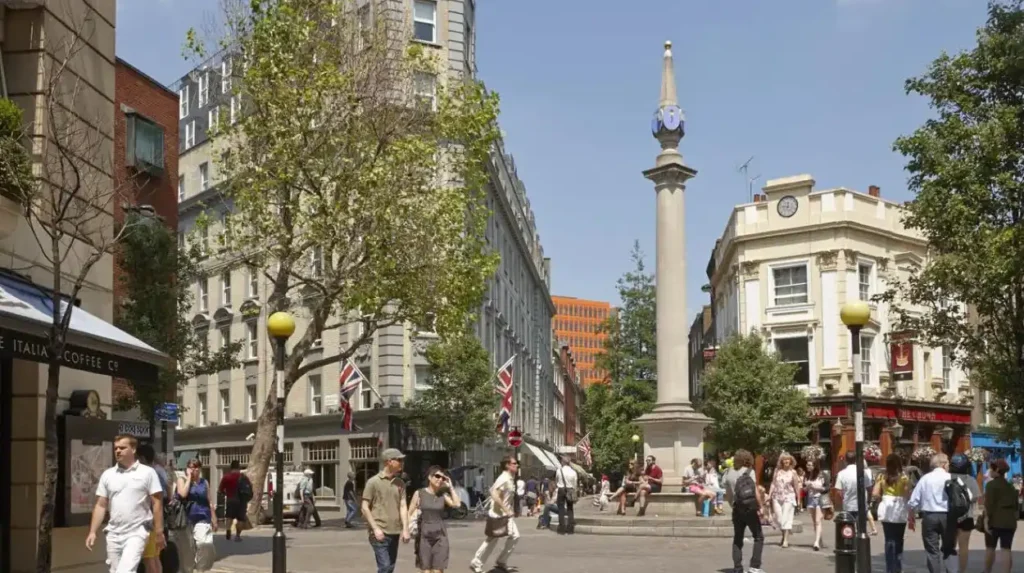
Seven Dials is a late seventeenth-century planned neighbourhood created by Thomas Neale. Its seven radiating streets, central sundial, surviving buildings, and conservation history preserve evidence of speculative urban development, working-class life, commercialisation, decline, and twentieth-century heritage protection.
Seven Dials lies immediately north-west of the main Piazza. Its distinctive street plan emerged during the 1690s as a speculative development associated with Thomas Neale.
Thomas Neale was an English politician, entrepreneur, and developer. His Seven Dials project transformed land formerly associated with St Giles and the Crown into a dense residential development.
Plans submitted to Sir Christopher Wren, the Surveyor General, in 1692 showed six radiating streets and at least 316 houses. Construction began in 1693. A seventh street was subsequently added, creating the layout that survives today.
The central monument was originally a sundial pillar designed by sculptor Edward Pierce. The original pillar was removed in 1773. The present pillar is a reconstruction completed in 1989.
The street pattern had an economic purpose. Seven radiating streets created numerous building frontages and triangular plots. Ground rents were linked to frontage, making the layout financially useful to developers.
The area later experienced overcrowding, poverty, and commercialisation. Victorian accounts associated Seven Dials with severe social problems and working-class housing conditions. The historical transformation illustrates the relationship between speculative development, population growth, commercial activity, and housing pressure.
The district faced another major threat during the twentieth century. Government and municipal redevelopment proposals envisaged substantial demolition. The movement of Covent Garden Market in 1974 intensified redevelopment pressure across the wider area.
Seven Dials received conservation-area status in 1974. Historic England research identifies the Seven Dials Conservation Area as approximately 0.1 square kilometres and records 71 statutorily listed buildings.
The survival of the street network provides a direct physical record of seventeenth-century planning. Visitors can still identify the central Dials, radiating streets, historic façades, and surviving urban plots.
For visitors interested in urban history, Seven Dials is particularly valuable because its present streets retain the basic geometry of the original development.
Why is Theatre Royal Drury Lane important to Covent Garden’s theatrical history?
Theatre Royal Drury Lane is one of London’s historic major theatres and has occupied the Drury Lane site since the seventeenth century. Its long performance history demonstrates how Covent Garden became a major centre for theatre, opera, music, and stage production.
Theatre Royal Drury Lane stands on the eastern side of the Covent Garden district. Its history reaches back to the seventeenth century and forms part of London’s long theatrical tradition.
The original Theatre Royal on Drury Lane opened in 1663 after the restoration of the monarchy. The Restoration period began in 1660 when Charles II returned to the English throne. The reopening of theatres followed the restrictions imposed during the Puritan and Commonwealth period.
Drury Lane therefore belongs to the same broader historical process that established Covent Garden as an entertainment centre.
The theatre site experienced repeated rebuilding. Fire, structural deterioration, changing performance requirements, and evolving audience expectations resulted in successive theatre buildings.
Its history demonstrates a key feature of London’s cultural geography. Theatres concentrated audiences, performers, musicians, craftsmen, publishers, printers, food businesses, and hospitality services within a relatively compact area.
Covent Garden’s theatrical identity consequently developed alongside the market. The commercial market supplied an economic base and a constant population of traders and workers, while theatres attracted audiences and specialist cultural industries.
The relationship between Drury Lane and the Royal Opera House also shows why Covent Garden became associated internationally with stage performance. The district contains multiple historic theatre institutions within walking distance of each other.
Visitors interested in performance history should therefore treat Drury Lane as part of a wider theatrical landscape rather than as an isolated building.
The theatre’s continued operation also provides an example of living heritage. A historic institution remains active while its physical structures and surrounding streets continue to evolve.
How did Covent Garden survive twentieth-century redevelopment?
Covent Garden survived major twentieth-century redevelopment proposals through conservation campaigns, public opposition, planning intervention, and adaptive reuse. The market moved in 1974, while the historic district avoided wholesale demolition and became a major heritage and cultural destination.
The twentieth century created the greatest threat to Covent Garden’s historic urban fabric. The traditional wholesale market became increasingly difficult to reconcile with modern traffic, logistics, sanitation, and commercial requirements.
The market eventually moved from Covent Garden on 11 November 1974. The departure left a large area available for redevelopment.
Earlier municipal plans had already proposed extensive redevelopment. Later schemes contemplated demolition and replacement with modern buildings and road infrastructure.
Residents, businesses, conservation organisations, and heritage campaigners opposed large-scale demolition. The conflict became an important episode in the development of modern British conservation policy.
Seven Dials was formally designated a conservation area with outstanding status in 1974. Restoration programmes subsequently improved historic buildings and brought previously vacant properties back into active use.
The Covent Garden Market Building followed a different path. Instead of being demolished after the wholesale market moved, the historic structure was restored and adapted. Covent Garden reopened as a specialist shopping centre in 1980.
This preservation process demonstrates the principle of adaptive heritage management. Historic buildings can retain their architectural identity while serving contemporary retail, cultural, residential, and educational functions.
The outcome changed the economic character of Covent Garden. The area shifted from a wholesale market district to a mixed cultural and visitor quarter containing theatres, museums, restaurants, shops, public spaces, and preserved residential streets.
The transformation also created an important heritage precedent. Covent Garden became evidence that historic urban districts can retain economic value without wholesale replacement of historic structures.
For visitors, the present landscape is therefore the result of twentieth-century preservation decisions as much as seventeenth- and nineteenth-century construction.
Which historic streets and architectural details should tourists explore around Covent Garden?
Visitors should examine Long Acre, Floral Street, King Street, Bedford Street, Neal Street, Monmouth Street, and the streets around Seven Dials. These routes preserve listed buildings, historic plots, market connections, theatre buildings, church architecture, and evidence of successive urban development.
Covent Garden’s historical importance extends beyond its major landmarks. The surrounding streets preserve the physical framework that connects individual buildings into a coherent historic district.
Long Acre developed as an important route between Covent Garden and surrounding areas. Its position encouraged commercial activity and later became associated with transport, manufacturing, retail, and entertainment.
King Street and Henrietta Street retain historic buildings connected with the original planned development. Historic England records numerous listed structures around St Paul’s Churchyard and the Piazza.
Bedford Street provides views toward St Paul’s Church and forms part of the historic relationship between the Piazza and surrounding residential streets.
Floral Street connects the Royal Opera House area with the wider district. Its built environment demonstrates the mixture of nineteenth- and twentieth-century commercial adaptation characteristic of Covent Garden.
Neal Street and Neal’s Yard preserve the name of Thomas Neale, the developer associated with Seven Dials. Neale’s development strategy survives in the street geometry and historic property pattern.
The streets around Seven Dials also preserve evidence of conservation-led restoration. Historic England records 71 statutorily listed buildings within the Seven Dials Conservation Area.
Architectural details deserve attention. Visitors can identify brick façades, sash windows, classical door surrounds, iron railings, church gateways, market structures, and nineteenth-century commercial frontages.
These details reveal how buildings changed through time. Some structures retain original elements while others combine earlier fabric with later façades and shopfronts.
A walking examination of the streets therefore provides evidence that is not visible from a single attraction. The historic district functions as an interconnected architectural record.
To experience this historic district in person today, consult our comprehensive [How Covent Garden Evolved From Fruit Market to Entertainment Destination] for itineraries and visiting parameters.
How can visitors understand Covent Garden as a complete historical landscape?
Covent Garden is best understood as a connected historical landscape rather than a collection of isolated attractions. The Piazza, market, church, theatres, museum, Seven Dials, and surrounding streets document London’s urban development across more than a thousand years.
The earliest layer is Lundenwic. Between approximately 600 and 851 CE, an Anglo-Saxon trading settlement developed west of the former Roman city. Archaeological finds demonstrate commercial and residential activity in the area around present-day Covent Garden and the Strand.
The medieval layer centres on Westminster Abbey and its agricultural landholdings. The convent garden supplied the religious community and provided the name from which Covent Garden developed.
The Tudor period introduced major landholding changes. The Dissolution of the Monasteries between 1536 and 1540 transferred former monastic estates into royal and private ownership. Covent Garden subsequently entered the Bedford family estate.
The Stuart period created the planned Piazza. Inigo Jones’s 1630s design established the architectural framework that remains visible today.
The late seventeenth century introduced market regulation and Seven Dials. The 1670 market patent formalised commercial activity, while Thomas Neale’s 1690s development expanded the residential and commercial district north-west of the Piazza.
The eighteenth century strengthened the connection between Covent Garden and theatre. The Royal Opera House site had become a major performance venue by 1732, while Drury Lane maintained its own long theatrical history.
The nineteenth century produced the present Market Building and the Victorian Flower Market. These structures demonstrate the industrialisation and professionalisation of commercial activity.
The twentieth century brought transport expansion, market relocation, redevelopment pressure, conservation campaigns, and adaptive reuse.
The twenty-first century preserves this accumulated historical record within an active cultural district. Covent Garden now combines heritage buildings with theatre, retail, museums, restaurants, public spaces, and visitor activity.
For educators and history students, this concentration of evidence provides a practical case study in urban transformation. For heritage researchers, the surviving buildings and street plan provide physical evidence of changing land use. For genealogical researchers, the historic streets offer context for understanding where London families lived, worked, traded, worshipped, and participated in the theatre and market economies.
Covent Garden’s greatest historical value therefore comes from continuity. Its buildings have changed functions, its population has changed, and its economy has changed, but major elements of its historic urban structure remain identifiable.
The district demonstrates how London developed through successive layers rather than through a single period of construction. The Anglo-Saxon trading settlement, Westminster Abbey’s former garden, Inigo Jones’s Piazza, the regulated market, Seven Dials, Victorian commercial buildings, theatres, transport infrastructure, and modern conservation policies all contribute to the character visible today.
For tourists, these layers turn a visit into a direct encounter with London’s architectural and social history. The Royal Opera House represents performance history. St Paul’s Church represents seventeenth-century planning and classical architecture. The Market Building represents commercial history. London Transport Museum represents urban mobility. Seven Dials represents speculative development and conservation.
Together, these attractions explain why Covent Garden remains one of London’s most important historic visitor districts.
Why does Covent Garden remain historically important today?
Covent Garden remains historically important because its surviving buildings and street patterns preserve evidence of major changes in London’s religious landholding, urban planning, commerce, theatre, transport, housing, and conservation. Its heritage survives through active buildings rather than museum displays alone.
The district provides a rare concentration of protected historic structures within a relatively compact area. Historic England’s statutory listings preserve significant buildings, while conservation areas protect broader architectural relationships and historic street patterns.
Covent Garden also demonstrates the economic value of heritage preservation. The former wholesale market is no longer a wholesale produce centre, but the historic Market Building remains an active destination.
The same principle applies to the London Transport Museum. The Victorian Flower Market Building retains its historic identity while supporting educational interpretation of London’s transport development.
Seven Dials provides another preservation example. The survival of its seventeenth-century street geometry allows visitors to understand a speculative urban development scheme that would otherwise be accessible mainly through maps and archival records.
St Paul’s Church provides continuity from the original Piazza plan. Its Grade I designation recognises architectural and historical significance at the highest level of statutory listing.
The Royal Opera House maintains the district’s centuries-old connection with opera and ballet. Theatre Royal Drury Lane extends that cultural history through another historic performance site.
Covent Garden therefore functions as both a visitor destination and a historical document. Its streets record changes in land ownership, architecture, commerce, transport, population, culture, and conservation policy.
Its future historical relevance depends on maintaining this relationship between active use and heritage protection. Continued conservation ensures that later generations can examine original buildings, historic street plans, and surviving architectural details while observing how central London adapts to changing economic and cultural requirements.
For tourists seeking the most historically significant attractions, the essential sequence is clear: begin with the Piazza and Market Building, examine St Paul’s Church, explore the Royal Opera House, visit the London Transport Museum, continue through Seven Dials, and examine the surrounding historic streets.
This sequence reveals Covent Garden as a continuous urban landscape shaped by medieval landholding, seventeenth-century planning, market commerce, theatrical culture, Victorian construction, twentieth-century redevelopment pressures, and modern conservation.
Frequently Asked Question
What is Covent Garden famous for?
Covent Garden is famous for its historic Piazza, Covent Garden Market, Royal Opera House, theatres, St Paul’s Church, Seven Dials, restaurants, shops, and street performances. It is also one of London’s most important historic and cultural districts.