London’s museum landscape extends far beyond the British Museum, National Gallery, Natural History Museum, and Victoria and Albert Museum. Across the capital, smaller specialist institutions preserve unusual collections, historic homes, industrial machinery, medical objects, social records, scientific instruments, and personal archives.
- What makes London’s unique museums historically important?
- How did London’s specialist museum tradition develop?
- Why is Sir John Soane’s Museum one of London’s most unusual historic museums?
- What does the Foundling Museum reveal about eighteenth-century London?
- How does the Horniman Museum explain London’s relationship with global cultures?
- What can visitors learn from the London Canal Museum?
- Why is the Freud Museum important for understanding London’s twentieth-century history?
- What does the House Mill reveal about London’s industrial past?
- How does Crossness Pumping Station explain Victorian public health?
- Why is the London Canal Museum different from conventional transport museums?
- What do London’s specialist museums reveal about everyday life?
- How should visitors explore London’s unique museums as part of a wider heritage itinerary?
- Why do London’s unusual museums matter for future heritage preservation?
- What historical picture emerges from London’s unique museums?
- Frequently Asked Questions
These museums document aspects of London’s history that conventional tourist attractions often present only briefly. They explain how people lived, worked, travelled, communicated, studied, manufactured goods, treated illness, managed water, moved through the city, and responded to political and social change.
Many occupy original historic buildings. Others preserve highly specialised collections that developed from private collections, universities, charitable institutions, industrial sites, or former homes. Their smaller scale provides direct access to subjects that are difficult to understand through large national collections alone.
The most unique museums in London therefore function as historical evidence. They connect individual lives with wider developments such as industrialisation, migration, public health, urban expansion, scientific research, childhood welfare, transportation, and the growth of consumer culture.
What makes London’s unique museums historically important?
London’s unique museums preserve specialised evidence about people, places, industries, technologies, and social institutions that shaped the capital but receive less attention in traditional tourist attractions and major galleries.
A museum becomes historically distinctive when its collection or building records a narrowly defined subject. London has institutions dedicated to canals, psychoanalysis, architecture, childhood welfare, industrial engineering, design, brands, medicine, transport, and other specialist themes.
This specialisation is important because urban history is not limited to monuments and political events. The history of a city also exists in ordinary objects, workplaces, domestic interiors, machinery, documents, tools, photographs, scientific instruments, and surviving infrastructure.
London’s unique museums frequently preserve these forms of evidence in their original environments. A former home can demonstrate domestic life. An industrial building can explain manufacturing technology. A preserved engine can show how Victorian infrastructure operated.
This approach also supports historical research. Genealogists can use social records and institutional histories to understand occupations and communities. Students can examine primary objects rather than relying exclusively on written accounts. Heritage researchers can study buildings and collections as evidence of changing urban systems.
The result is a more detailed understanding of London’s development from medieval settlement to modern metropolis.
How did London’s specialist museum tradition develop?
London’s specialist museum tradition developed from private collections, learned societies, universities, charitable institutions, industrial organisations, historic houses, and civic preservation movements that expanded during the eighteenth, nineteenth, and twentieth centuries.
The foundations of London’s museum culture extend back to the eighteenth century, when scientific societies, collectors, universities, and wealthy individuals assembled objects for study and education.
The nineteenth century accelerated this process. Industrialisation transformed London’s population, infrastructure, workplaces, transport systems, and public health. New collections emerged to document scientific discoveries, engineering, medicine, manufacturing, and social conditions.
The Victorian period also established museums as educational institutions. The expansion of public education increased demand for accessible collections. Museums became places where visitors could examine objects connected with science, technology, history, and everyday life.
Private house museums developed alongside these public institutions. Sir John Soane transformed his own London residence into a museum containing architecture, antiquities, paintings, sculpture, furniture, and models. Parliament later protected his arrangements through a private Act passed in 1833.
The twentieth century introduced another important category: museums created from preserved workplaces and homes. These institutions retained physical environments that could communicate historical information more effectively than isolated objects.
This development explains why London now contains museums that are simultaneously archives, buildings, research centres, educational institutions, and preservation projects.
Why is Sir John Soane’s Museum one of London’s most unusual historic museums?
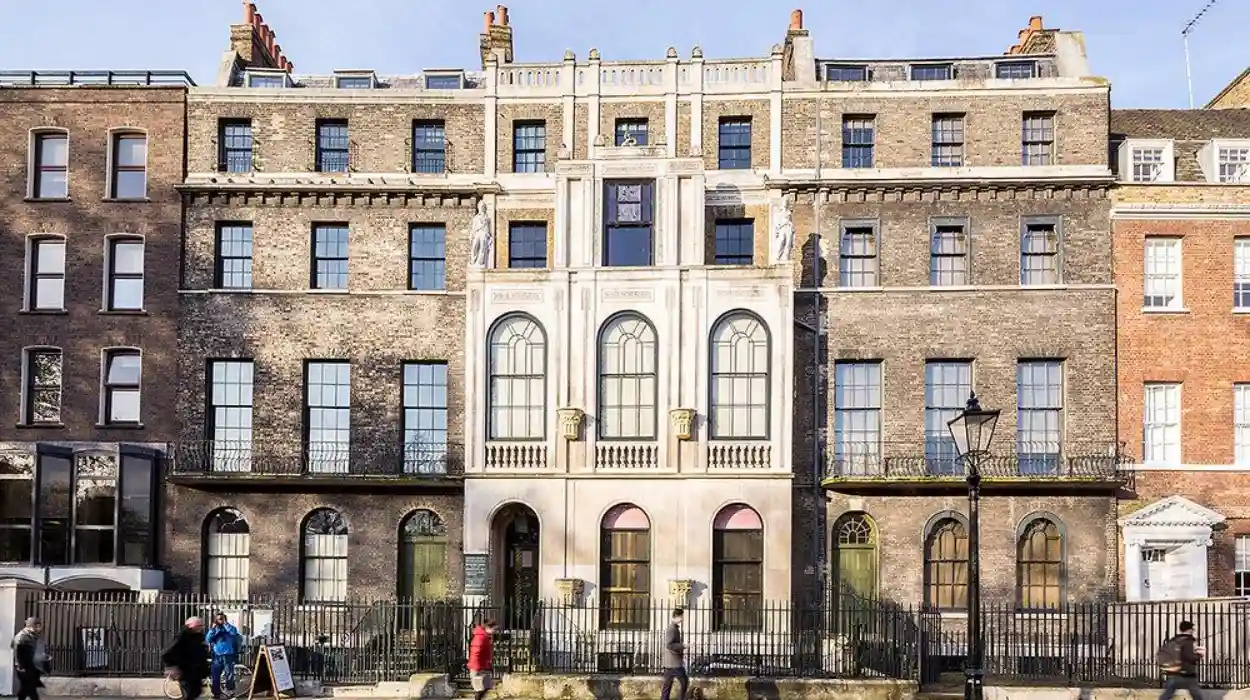
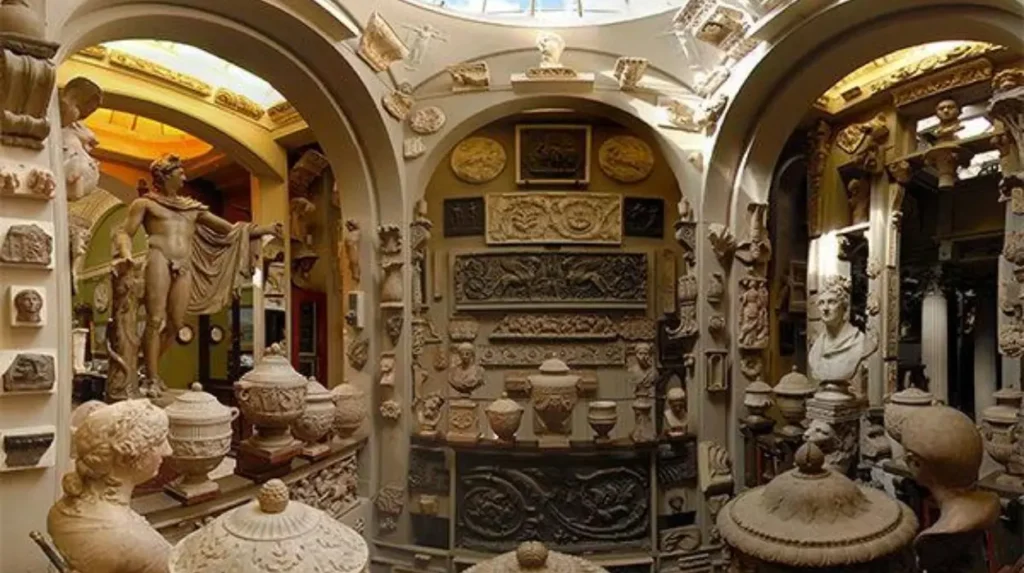
Sir John Soane’s Museum preserves the London home and collection of architect Sir John Soane, including antiquities, paintings, furniture, architectural models, sculpture, and more than 30,000 architectural drawings arranged within his former residence.
Sir John Soane was born in 1753 and became one of Britain’s leading Neo-Classical architects. He served as Professor of Architecture at the Royal Academy and was architect of the Bank of England for 45 years. His architectural career strongly influenced the museum he created.
Soane purchased No. 12 Lincoln’s Inn Fields in 1792 and rebuilt it as his home and professional office. He acquired No. 13 in 1807 and later No. 14 in 1823, expanding the complex to accommodate his growing collections.
The museum contains Egyptian antiquities, Roman sculpture, architectural fragments, furniture, paintings, books, drawings, and models. One of its major objects is the sarcophagus of the Egyptian pharaoh Seti I.
Its significance comes from the relationship between objects and architecture. Soane deliberately arranged collections within rooms designed to control light, movement, scale, and visual relationships.
In 1833, Soane secured a private Act of Parliament intended to preserve the house and collection as they existed at his death. He died in 1837, after which trustees continued the preservation system.
The museum therefore represents both a collection and a historical interior. It demonstrates how an early nineteenth-century architect understood architecture, education, collecting, and cultural memory.
What does the Foundling Museum reveal about eighteenth-century London?
The Foundling Museum documents the history of the Foundling Hospital, an eighteenth-century institution established to care for abandoned infants, while examining childhood, philanthropy, music, art, social welfare, and changing attitudes toward vulnerable children.
The Foundling Hospital was established in London in 1739 by philanthropist Thomas Coram. Its creation responded to the difficult circumstances faced by abandoned infants and unmarried mothers in eighteenth-century Britain.
The institution became an important example of organised philanthropy. It combined charitable support with administrative systems for receiving and caring for children.
The museum preserves the history of this institution through artworks, documents, objects, and historical interpretation. Its collection also records the connections between the Foundling Hospital and prominent eighteenth-century artists and composers.
William Hogarth supported the institution and encouraged other artists to contribute. George Frideric Handel was also associated with the Foundling Hospital and supported it through performances of his music.
The museum provides evidence for understanding the development of organised social welfare in London. It also demonstrates how philanthropy became connected with art, music, public fundraising, and institutional care.
For genealogical researchers, the subject has particular importance because the Foundling Hospital generated records relating to children admitted to its care. These records form part of the wider documentary history of family separation, childhood, poverty, and social welfare in London.
The museum therefore connects individual lives with broader changes in eighteenth-century social policy and charitable practice.
How does the Horniman Museum explain London’s relationship with global cultures?
The Horniman Museum and Gardens combines anthropology, natural history, musical instruments, and social history within a Victorian museum tradition designed to make collections from different parts of the world accessible to London audiences.
The Horniman began as the Surrey House Museum in 1890 at the Forest Hill residence of Frederick Horniman. It reopened in a purpose-built building in 1901 as the Horniman Museum and Library.
Frederick Horniman inherited and developed his family’s tea business. By 1891, the business had become the world’s largest tea-trading company, connecting his commercial life with international trade networks.
The museum was designed in the Arts and Crafts style. Its collections subsequently expanded substantially and now contain about 350,000 objects, according to the UK government’s description of the institution.
Its anthropology collections provide evidence of material culture, craftsmanship, belief, clothing, domestic life, and social practices from different communities.
Its musical instrument collections document the physical construction and cultural uses of instruments. Natural history collections provide a separate scientific perspective on biodiversity and environmental history.
The museum is particularly significant for studying Victorian collecting culture. Its foundation reflects a period when London’s commercial and imperial networks brought objects, materials, knowledge, and representations from around the world into British institutions.
Modern museum interpretation places greater emphasis on provenance, cultural context, representation, and the historical circumstances under which collections were acquired.
What can visitors learn from the London Canal Museum?
The London Canal Museum preserves the history of London’s inland waterways, canal transport, cargoes, workers, boats, horses, and ice trade inside a former Victorian ice warehouse near King’s Cross.
The museum occupies a building constructed during the 1860s for storing natural ice imported from Norway. The warehouse was associated with Carlo Gatti, a Swiss-Italian entrepreneur who became prominent in London’s nineteenth-century ice and food trade.
The building contains a preserved commercial ice well. This physical structure demonstrates the infrastructure required before mechanical refrigeration transformed food storage.
The museum also explains London’s canal network. Canals became important transportation routes during the Industrial Revolution because they moved heavy cargo efficiently through the growing city.
The Regent’s Canal, completed in the early nineteenth century, connected the Grand Junction Canal with the Thames and created a major east-west waterway through London.
Canal boats transported materials including coal, building supplies, food, and industrial goods. Horses pulled many boats along towpaths, creating a distinctive working environment.
The museum preserves evidence of this system through models, maps, photographs, oral histories, and reconstructed environments. Its collections also document the people who lived and worked on the waterways.
For urban historians, the museum demonstrates that London’s industrial expansion depended on infrastructure that is often hidden beneath or beside the modern city.
Why is the Freud Museum important for understanding London’s twentieth-century history?
The Freud Museum preserves Sigmund Freud’s final London home in Hampstead, documenting psychoanalysis, European refugee migration, intellectual history, family life, and the arrival of Austrian Jewish refugees in Britain in 1938.
Sigmund Freud was the founder of psychoanalysis, a field that developed around theories of the unconscious mind, psychological conflict, and therapeutic interpretation. His daughter Anna Freud became a major figure in child psychoanalysis.
The Freud family fled Vienna following Nazi Germany’s annexation of Austria in March 1938. They arrived in Britain later that year and settled at 20 Maresfield Gardens in Hampstead.
Freud brought much of his household environment to London, including furniture, books, antiquities, and his famous psychoanalytic couch.
His study remains the central historic interior. The room contains his library and collection of antiquities, allowing visitors to examine the physical environment in which he worked during his final year.
Freud died in London in September 1939, shortly after the outbreak of the Second World War. Anna Freud continued living and working at the house until her death in 1982.
Anna’s will established the foundation for the museum, which opened to the public in 1986.
The museum therefore preserves more than the history of psychoanalysis. It documents forced migration, intellectual exile, European political upheaval, refugee settlement, and the transformation of a private London home into a research and cultural institution.
What does the House Mill reveal about London’s industrial past?
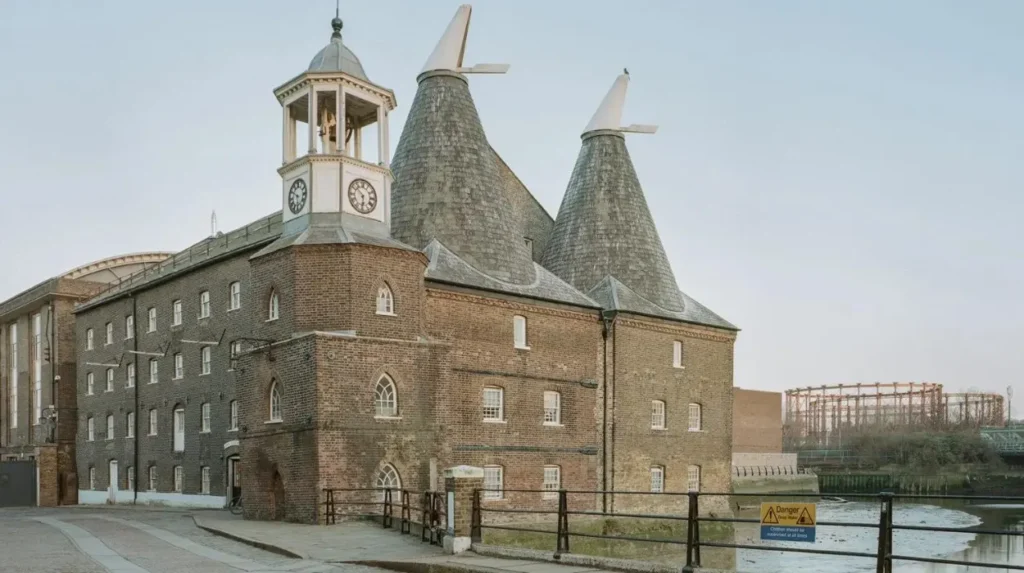
The House Mill at Three Mills in East London is the world’s largest surviving tidal mill and preserves evidence of milling, river power, food production, industrial development, and commercial activity dating from medieval London.
The House Mill stands on the River Lea at Three Mills in Newham. The location has a documented milling history extending back centuries.
The Domesday Book recorded mills at Three Mills in 1086. Foundations associated with the present House Mill date from approximately 1380–1420.
The present House Mill was built in 1776 during the Industrial Revolution. Its machinery used tidal power, converting the movement of water into mechanical energy for milling.
The site initially processed grain into flour for local bakers. The connection between the mill and London’s food supply demonstrates how industrial production operated beyond the central commercial districts.
During the eighteenth century, Three Mills also became associated with distilling. The site formed part of the Three Mills Distillery during the period of London’s gin industry.
The building survived the transformation of East London from industrial manufacturing zones into modern residential, commercial, and cultural districts.
Its Grade I listed status recognises the national importance of the surviving structure. The House Mill Trust now uses the building for heritage activities and interpretation.
The museum demonstrates the importance of rivers, tides, machinery, food production, and industrial buildings in the physical development of London.
How does Crossness Pumping Station explain Victorian public health?
Crossness Pumping Station preserves Victorian sewage infrastructure created as part of London’s nineteenth-century response to severe sanitation problems, demonstrating how engineering transformed urban public health and the management of human waste.
Crossness Pumping Station stands beside the River Thames in southeast London. It formed part of the major sewer system developed under engineer Joseph Bazalgette during the nineteenth century.
London’s rapid population growth created severe sanitation problems. Waste entered streets, drains, and waterways, while the River Thames became heavily polluted.
The Metropolitan Board of Works commissioned major sewer construction during the 1850s. Bazalgette designed a large network of intercepting sewers to move sewage away from densely populated districts.
Crossness Pumping Station opened in 1865. Its engine house contained four large beam engines named Victoria, Prince Consort, Albert Edward, and Alexandra.
The engineering system demonstrates the scale of Victorian infrastructure. The original site included a beam engine house, boiler house, workshops, a 208-foot chimney, and a 25-million-gallon covered reservoir.
The decorative interior is also historically significant. Industrial engineering was presented alongside elaborate architectural decoration, reflecting Victorian confidence in technology and civic improvement.
Crossness therefore connects architecture with public health. Its preservation demonstrates how sewerage infrastructure became part of London’s heritage after serving as essential working technology.
Why is the London Canal Museum different from conventional transport museums?
The London Canal Museum focuses on a complete transport ecosystem rather than individual vehicles, documenting waterways, cargoes, working families, animal labour, locks, warehouses, trade, and the infrastructure supporting London’s canal economy.
Traditional transport museums frequently emphasise vehicles and mechanical development. The London Canal Museum takes a wider approach by explaining the social and commercial system surrounding inland navigation.
Its collections include information about canal boats, cargoes, canal workers, horses, locks, waterways, and industrial landscapes.
This perspective is important because canals were integrated into London’s economic geography. Warehouses, wharves, factories, markets, and residential areas developed around navigable waterways.
The museum’s large-format maps show historic waterways and canal-side industries, including canals that were proposed but never constructed and routes that were later closed.
The museum also maintains oral-history recordings. These sources add personal testimony to physical objects and maps.
For educators, the museum offers a practical case study of industrialisation. Students can connect transportation technology with labour, commerce, urban planning, environmental change, and social history.
For visitors, the museum provides evidence of an industrial landscape that still survives in fragments across London.
What do London’s specialist museums reveal about everyday life?
London’s specialist museums reveal everyday history through domestic interiors, working tools, transport systems, scientific objects, medical collections, industrial machinery, personal possessions, and institutional records that document ordinary experiences alongside major historical events.
Large national museums often organise history around major civilisations, political periods, artistic movements, or famous individuals. Specialist museums frequently begin with a smaller question: how did a particular profession work, how did a household operate, or how did a specific institution serve London?
This difference produces valuable historical evidence.
The Freud Museum preserves a personal study. The Canal Museum preserves an industrial warehouse. Soane’s Museum preserves an architect’s home and collection. Crossness preserves engineering infrastructure. The House Mill preserves industrial machinery and a working building.
These environments allow researchers to examine relationships between objects and spaces.
A single object rarely explains an entire historical process. A building containing machinery, storage areas, offices, tools, and transportation connections provides a broader record of how work was organised.
This makes specialist museums particularly useful for local history research. They provide evidence for occupations, neighbourhood development, industrial geography, migration, education, family structures, technology, and changing patterns of consumption.
Their value therefore extends beyond unusual exhibits. They preserve systems of historical activity.
How should visitors explore London’s unique museums as part of a wider heritage itinerary?
Visitors should group specialist museums by historical theme and geography, allowing individual collections to connect with nearby streets, buildings, waterways, markets, transport infrastructure, and historic neighbourhoods across London.
A thematic approach produces stronger historical context than visiting unrelated museums in isolation.
Architecture enthusiasts can combine Sir John Soane’s Museum with Lincoln’s Inn Fields and the surrounding legal district. Industrial-history researchers can connect the London Canal Museum with Regent’s Canal and King’s Cross.
East London provides another strong historical sequence. The House Mill at Three Mills demonstrates medieval and industrial milling, while nearby waterways reveal later industrial transformation.
South London offers the Horniman Museum and Gardens in Forest Hill, where Victorian collecting culture intersects with the development of public museums.
Hampstead provides the setting for the Freud Museum and its documentation of twentieth-century intellectual migration.
To experience this historic side of the capital in person today, consult our comprehensive [How London’s Museums Shaped British Culture Through Education, Innovation, and Preservation] for itineraries and visiting parameters.
Visitors should check each museum’s current opening arrangements before travelling because specialist institutions frequently operate different schedules from major national museums.
Researchers should also distinguish between museum collections, historic buildings, archival records, and reconstructed displays. Museum interpretation normally identifies the difference between original material and later reconstruction.
Why do London’s unusual museums matter for future heritage preservation?
London’s unusual museums preserve vulnerable forms of historical evidence that include machinery, interiors, oral testimony, local records, industrial buildings, personal collections, and specialist objects that larger institutions cannot always represent in detail.
Preservation involves more than maintaining objects behind glass. Historic museums must conserve buildings, machinery, documents, environmental conditions, photographs, oral histories, digital records, and collection documentation.
The survival of Soane’s interiors demonstrates the importance of legal protection. His 1833 Act established an unusually strong preservation framework designed to maintain the house and collection in perpetuity.
The Freud Museum demonstrates another preservation model. A private family home became a museum after Anna Freud’s death, retaining the physical environment associated with both Sigmund and Anna Freud.
Crossness demonstrates the challenge of conserving industrial machinery. The beam engines were progressively replaced by more efficient technology during the twentieth century, but later preservation work recognised their engineering and architectural significance.
The House Mill similarly demonstrates the value of preserving industrial buildings after their original economic function has ended.
These museums also contribute to future research. Their collections preserve evidence that supports scholarship in architectural history, industrial archaeology, social history, medical history, migration studies, genealogy, material culture, and urban planning.
What historical picture emerges from London’s unique museums?
London’s unique museums reveal the capital as a layered historical system shaped by architecture, industry, migration, science, social welfare, transportation, commerce, public health, and individual lives rather than by famous landmarks alone.
The city’s historical identity exists across many scales.
At the personal scale, the Freud Museum preserves a family home and intellectual environment. At the architectural scale, Soane’s Museum preserves a designed interior and an important collection.
At the institutional scale, the Foundling Museum documents eighteenth-century charitable welfare. At the environmental scale, the Canal Museum records waterways and industrial transport.
At the technological scale, Crossness preserves Victorian sewage engineering. At the industrial scale, the House Mill records centuries of milling and tidal power.
The Horniman adds another dimension by documenting Victorian collecting, global material culture, anthropology, natural history, and public education.
Together, these museums demonstrate that London’s history is not contained within royal palaces, major galleries, famous churches, and monumental streets.
Its historical evidence also exists in warehouses, homes, engines, canals, libraries, medical objects, domestic furniture, industrial buildings, and institutional archives.
That makes London’s smaller and specialist museums essential to understanding the city as a living historical environment. Their collections preserve evidence of how Londoners worked, travelled, learned, migrated, raised families, managed disease, produced goods, exchanged commodities, and adapted to technological change.
For history enthusiasts, cultural tourists, educators, students, heritage professionals, and genealogical researchers, these museums provide direct access to the less visible structures behind London’s development.
Their continued preservation ensures that future generations can study not only what London looked like, but also how its people and institutions functioned across centuries.
Frequently Asked Questions
What are the most unique museums in London?
Some of London’s most distinctive museums include Sir John Soane’s Museum, the Foundling Museum, Horniman Museum and Gardens, Freud Museum London, London Canal Museum, House Mill, and Crossness Pumping Station. Each focuses on a specialised aspect of London’s cultural, social, scientific, or industrial history.