Key Points
- Permanent Traffic Ban Proposed: Camden Council has launched a public consultation to permanently ban motor vehicles from a key section of Camden High Street following an initial trial.
- Potential Extension: The local authority is seeking views on extending the car-free zone further north across the iconic Camden Lock Bridge up to the junction with Castlehaven Road.
- Public Consultation Open: The six-week public feedback window commenced on Monday, 13 July and is scheduled to run until Sunday, 23 August.
- Visual and Functional Upgrades: Making the pedestrian scheme permanent could unlock funding to replace temporary barriers with smart bollards, level the road surfaces, and add plants, benches, and outdoor seating.
- Environmental and Safety Goals: Council officials report the initial trial has successfully reduced local air pollution, increased safety for up to 40,000 peak-time visitors, and hosted cultural events.
- Mixed Public Reception: While broader historical consultations showed over 70 per cent support, local residents inside the immediate zone expressed lower (62 per cent) support, raising concerns over traffic displacement on adjacent roads and anti-social behaviour.
London (Extra London News) 15 July 2026 – Camden Council has proposed a permanent ban on all motor vehicle traffic across one of North London’s busiest and most iconic high streets, aiming to secure long-term safety, pedestrian comfort, and environmental improvements. Following a controversial yet highly publicised trial pedestrianisation scheme launched in May 2025, the local authority has officially opened a six-week public consultation to decide whether the traffic-free zone should become a permanent fixture of Camden Town.
- Key Points
- Why Is Camden Council Proposing a Permanent Car Ban?
- What Did the Council Members and Officials Say About the Scheme?
- How Have Local Residents and Businesses Reacted to the Trial?
- How Will Public Transport and Cycling Be Affected by the Permanent Ban?
- What Are the Next Steps in the Decision-Making Process?
Moving beyond the boundaries of the initial trial, the council is also actively proposing to extend the pedestrianised zone further north, potentially stretching the car-free corridor across Camden Lock Bridge to Castlehaven Road. The public consultation, which began on 13 July, is slated to conclude on 23 August, giving local residents, businesses, and regular visitors a decisive say on the future layout of the world-famous shopping and transport hub.
Why Is Camden Council Proposing a Permanent Car Ban?
The primary driver behind the council’s sweeping proposal is to tackle chronic overcrowding, improve deteriorating air quality, and create a more inviting environment for the millions of people who flock to Camden Town annually. Before the trial took effect, the sheer volume of motor traffic on the high street frequently led to dangerous conflicts with pedestrians, who often spilled off the narrow, overcrowded pavements directly into the path of moving vehicles.
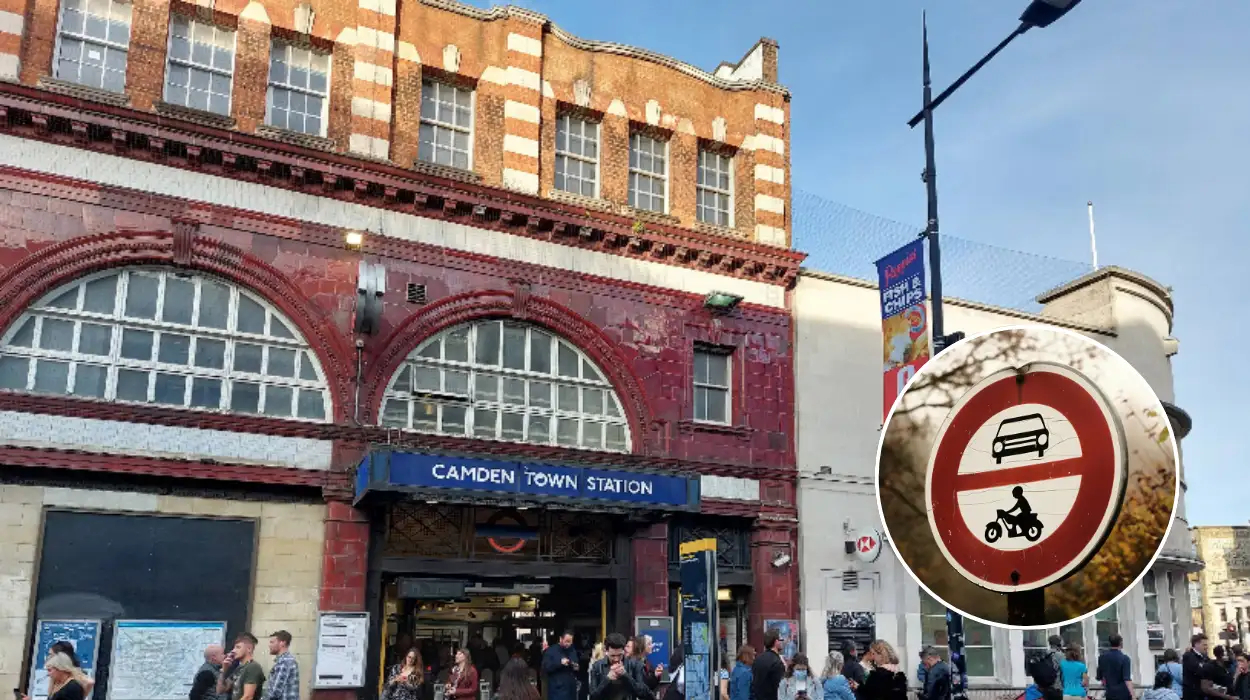
As reported by Local Democracy Reporter Josef Steen of MyLondon, Camden Council’s push to make the trial permanent is centered on turning the busy thoroughfare into a “safer and more pleasant” urban space. The temporary ban, implemented under an Experimental Traffic Order in May 2025, removed motor vehicles from the high street starting from the junction with Parkway and Kentish Town Road (directly outside Camden Town Underground Station) up to the junction of Jamestown Road and Hawley Crescent.
If approved permanently, this zone could undergo a dramatic cosmetic and structural transformation. The local authority intends to replace the temporary, visually intrusive plastic water-filled barriers currently blocking vehicle access with a sleek, automated “smart bollard” system. Further public realm improvements would include leveling out the uneven asphalt surfaces, introducing permanent wooden benches, and installing curated planters and urban greenery. Additionally, local businesses would be permitted to apply for outdoor tables and chairs licences, turning the bustling street into a continental-style alfresco dining district.
What Did the Council Members and Officials Say About the Scheme?
The political leadership in Camden has strongly defended the trial, pointing to positive preliminary data on air quality and local footfall to justify making the changes permanent.
According to an official statement published by the media team of the London Borough of Camden, Councillor James Slater, the Cabinet Member for Planning and a Sustainable Camden, stated:
“Camden Town is an important shopping and transport hub for local residents as well as being an internationally recognised destination that draws people in from across London, the rest of the UK, and the world. The trial has made the area safer and more pleasant for pedestrians and reduced air pollution on the street. The extra space has also allowed us to hold events and activities that showcase the best of Camden’s culture and communities.“
Slater further explained that the decision to consult on both the permanence of the current zone and its potential extension was directly motivated by community feedback. As recorded by reporter Holly Brencher of the Ham & High, Slater stated:
“Many residents have told us that they want to go even further on pedestrianising Camden High Street, so we will also be seeking views on extending the area across Camden Lock bridge and up to the junction with Castlehaven Road.”
According to Slater, the proposed extension would unlock “a range of improvements for people walking, wheeling and cycling, as well as more public space and outdoor seating for local businesses.” He urged all stakeholders to submit their views during the six-week consultation, noting that the comprehensive feedback gathered would be carefully weighed alongside empirical monitoring data and overarching council policies before a final decision is made.
The foundation of this project dates back to initial conceptual consultations. As previously reported by Holly Brencher of the Ham & High, Councillor Adam Harrison, who formerly held the portfolio for Planning and a Sustainable Camden, highlighted the extreme demographic pressures on the high street during peak times. Harrison remarked:
“The high street is the first thing many people see when they exit Camden Town tube or get off the bus. But at peak times there can be as many as 40,000 people on the high street, creating significant overcrowding and a stressful experience. So many people ask why the high street is not already pedestrianised – now we are delivering on that call.”
The pedestrianisation project is heavily tied to Camden’s wider environmental goals, specifically its plan to establish a Low Emission Neighbourhood in Camden Town. This initiative has been backed by significant financial resources, including £500,000 of funding from the Mayor’s London Air Quality Fund and an additional £5 million in Transport for London (TfL) Borough Safer Streets funding.
Supporters at the city-wide level have also praised the scheme. In statements shared by the Ham & High, Will Norman, London’s Walking and Cycling Commissioner, asserted:
“This trial is great news for Camden. Removing traffic will improve air quality and enable the high street to thrive as local residents and visitors enjoy a safer, cleaner and more attractive environment.”
How Have Local Residents and Businesses Reacted to the Trial?
While the council has presented the trial as a resounding success, public reaction remains somewhat divided, particularly when comparing the views of general visitors to those of the residents who live in the immediate vicinity.
As detailed by Josef Steen of MyLondon, a public consultation held in 2024 prior to the trial launch indicated that over 70 per cent of general respondents backed the pedestrianisation and the initial experimental motor traffic ban. However, when filtering the data to look exclusively at the “immediate consultation zone”—the residents and businesses located directly on or adjacent to the affected section of Camden High Street—the level of support, while still representing a majority, dropped to 62 per cent.
What Are the Primary Concerns of Opponents?
The 38 per cent of local respondents who opposed or expressed reservations about the scheme raised several distinct, practical objections:
- Traffic Displacement: Several respondents expressed strong fears that restricting cars and commercial vehicles on Camden High Street would not actually reduce overall vehicle usage, but would instead simply displace traffic onto fragile, residential side streets. They warned that this displacement would create severe bottlenecks, pushing noise, congestion, and tailpipe pollution into previously quiet residential areas.
- Anti-Social Behaviour: Others voiced serious concerns that adding more public seating, benches, and unpoliced open-air plazas would serve as a magnet for anti-social behaviour. Camden Town already struggles with localized street drinking and drug-related issues, and some residents worry that the “beautified” high street will worsen these problems.
- Servicing and Deliveries: Local businesses have expressed logistical anxieties regarding how they will receive stock and manage waste disposal without direct vehicular access.
In response to these anxieties, Camden Council’s consultation documents have outlined mitigation measures. The council is proposing new, strictly timed loading and servicing access arrangements on Hawley Crescent and Jamestown Road to ensure businesses can function smoothly. Furthermore, the council claims that economic monitoring data collected during the trial shows that business spending inside the pedestrianised zone has remained highly consistent with pre-trial levels, and overall pedestrian footfall has stayed stable.
Explore more Camden News:
Is Camden High Street Going Car-Free Permanently? Camden 2026
Labour Wins Regent’s Park Council Seat: Camden 2026
How Will Public Transport and Cycling Be Affected by the Permanent Ban?
If the car ban is made permanent and subsequently expanded, it will require long-term changes to local transport routes, particularly for London’s iconic red buses and local cyclists.
During the 18-month trial, TfL and Camden Council rerouted several bus services that historically crawled down the high street. As noted by the Ham & High, southbound bus routes remained largely unaffected, but buses travelling northbound towards Chalk Farm were permanently diverted. These buses now travel along Kentish Town Road and Hawley Crescent before rejoin their original northward routes.
The Proposed Cycling and Pedestrian Layout
If the council proceeds with the proposed extension across the Camden Lock Bridge, the layout of the high street and surrounding side streets will be altered as follows:
| Street Section | Proposed Permanent Status | Cycling and Access Arrangements |
| Camden High Street (Parkway to Hawley Crescent) | Permanent Pedestrian Zone | Complete restriction of motor vehicles; smart bollards for controlled access. |
| Camden High Street Extension (Hawley Crescent to Castlehaven Road) | Proposed Pedestrian Zone | Two-way cycling allowed to safely link Arlington Road with Castlehaven Road and Chalk Farm Road. |
| Jamestown Road & Hawley Crescent (between Arlington Rd and Stucley Place) | New Pedestrianised Zone | Reconfigured to allow business spill-out, seating, and tables; strictly timed vehicle loading. |
What Are the Next Steps in the Decision-Making Process?
The local authority has emphasized that no final decision has been made, and the outcome of the six-week consultation will play a vital role in determining whether cars ever return to Camden High Street.
Following the closing of the consultation on 23 August, Camden Council officers will compile and review all public feedback alongside the hard data collected during the 18-month trial. This includes air quality monitoring, traffic counts on adjacent residential roads, local business revenue reports, and pedestrian safety statistics.
If the council decides to make the existing trial zone permanent, it will immediately begin drawing up formal engineering designs to replace the temporary barriers with permanent infrastructure. If the feedback regarding the proposed northern extension to Castlehaven Road is also broadly positive, the council will use that data to shape detailed landscape designs for the expanded zone. These plans for the extended area will then be subject to a secondary, highly detailed public consultation, which is tentatively scheduled to take place in 2027.