
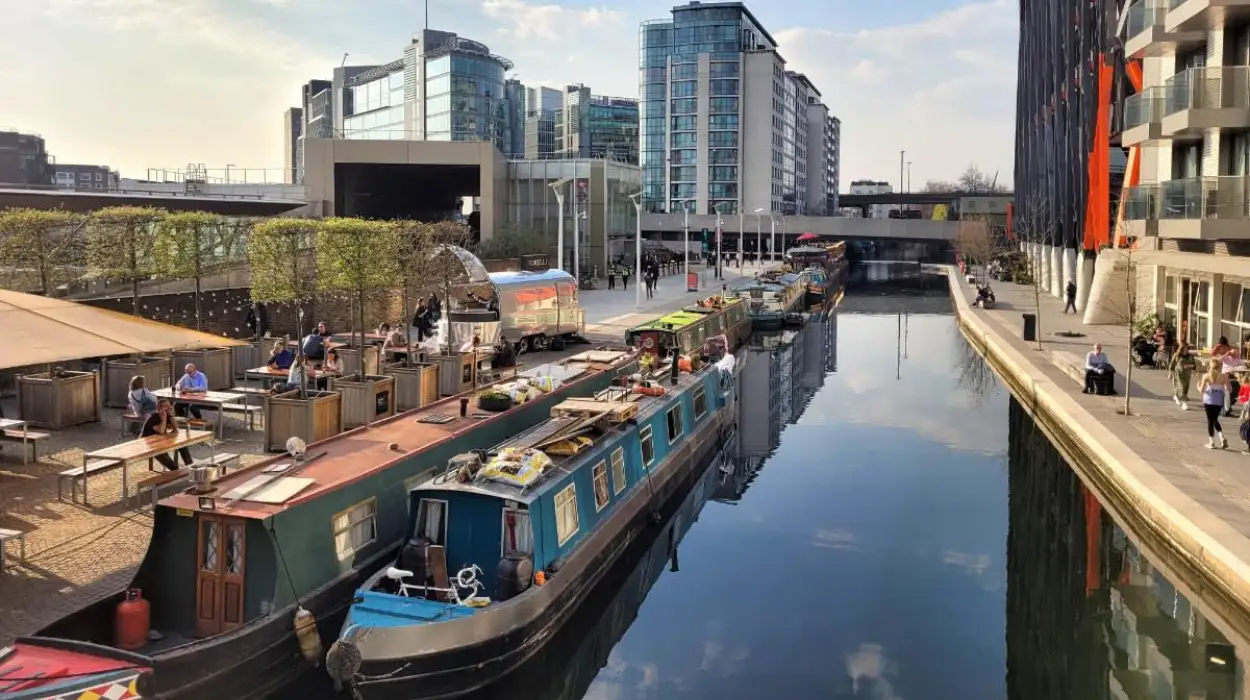
London’s historic canals transformed Britain’s capital during the Industrial Revolution by creating reliable inland transport routes for heavy goods before railways became dominant. Today, these waterways remain significant heritage assets, ecological corridors, recreational spaces, and living reminders of the city’s industrial development. Their enduring presence reflects more than two centuries of engineering innovation, commercial expansion, and urban regeneration.
- Why were London’s historic canals built?
- How did the Industrial Revolution shape London’s canal network?
- Which canals became the most important in London’s history?
- Who designed and built London’s historic canals?
- How did canals transform London’s economy and daily life?
- What engineering features made London’s canals successful?
- Why did London’s canal trade decline?
- How have London’s historic canals been preserved?
- What historic structures still survive along London’s canals?
- Why do London’s historic canals remain important today?
Why were London’s historic canals built?
London’s historic canals were built to improve the movement of coal, timber, grain, building materials, manufactured goods, and agricultural produce between industrial regions and the capital. They reduced transport costs, increased commercial efficiency, supported rapid urban growth, and strengthened Britain’s expanding economy during the late eighteenth and early nineteenth centuries.
Before canals, most freight entered London by road or the River Thames. Roads remained slow, muddy, expensive, and unreliable throughout much of the eighteenth century. Heavy cargo often damaged roads, while horse-drawn wagons transported relatively small loads compared with waterborne vessels.
The Industrial Revolution accelerated demand for efficient transportation. Factories required continuous supplies of raw materials, while London’s growing population demanded food, fuel, and construction materials. Engineers, merchants, investors, and Parliament recognised that artificial waterways offered a practical solution.
Canals connected inland manufacturing centres with London’s commercial markets. Narrowboats transported considerably larger loads than road wagons while requiring fewer horses and lower operating costs.
Parliament authorised canal construction through individual Canal Acts. These laws granted companies permission to acquire land, raise investment, and build waterways. Private investors financed many projects because tolls generated commercial returns from freight traffic.
London’s canal network formed part of Britain’s wider inland navigation system, connecting the capital with the Midlands and northern industrial regions. This network strengthened domestic trade and reinforced London’s role as Britain’s principal commercial centre.
How did the Industrial Revolution shape London’s canal network?
The Industrial Revolution transformed London’s canal network by increasing demand for efficient freight transport, encouraging engineering innovation, attracting private investment, and integrating regional industries with the capital. Canal construction reflected Britain’s expanding manufacturing economy and rapidly growing urban population during the late eighteenth and early nineteenth centuries.
Industrial production expanded dramatically after approximately 1760. Coal consumption increased as factories, households, breweries, foundries, and brickworks required reliable fuel supplies. Agricultural production also intensified to feed London’s expanding population.
Water transport offered clear economic advantages. One horse pulling a canal boat transported significantly more cargo than the same horse pulling wagons over rough roads. Lower transport costs reduced prices for consumers while increasing profits for manufacturers and merchants.
Canals encouraged industrial specialisation. Manufacturers concentrated production near waterways because dependable transport improved access to raw materials and wider markets.
London benefited directly from these developments. Construction materials arrived more efficiently, supporting residential expansion across the metropolitan area. Coal reached urban markets in greater quantities, helping sustain domestic heating and industrial production.
Canals also stimulated employment. Engineers, surveyors, labourers, lock keepers, warehouse operators, boat builders, merchants, and dock workers all contributed to the expanding inland navigation economy.
Which canals became the most important in London’s history?
London’s most historically significant canals include the Grand Junction Canal, Regent’s Canal, Paddington Arm, Hertford Union Canal, Limehouse Cut, and the Lee Navigation. Each served distinct commercial functions while connecting London’s industries, docks, warehouses, and regional transport network.
Grand Junction Canal
Completed in stages before opening through to London in 1805, the Grand Junction Canal created a direct connection between London and the Midlands.
The canal shortened previous navigation routes and became one of Britain’s most commercially successful waterways. Coal, iron, manufactured goods, and agricultural products flowed into London through this important corridor.
Regent’s Canal
Construction began in 1812, and the canal officially opened in stages between 1816 and 1820.
Designed under the direction of engineer James Morgan following concepts promoted by architect John Nash, Regent’s Canal linked the Paddington Arm with the River Thames at Limehouse.
Warehouses, timber yards, gasworks, flour mills, ice storage facilities, and industrial premises developed along its banks. The canal became central to London’s nineteenth-century commercial geography.
Paddington Arm
The Paddington Arm connected western London with the Grand Junction Canal system.
Merchants transported coal, building materials, food supplies, and manufactured products into expanding residential districts, supporting London’s westward urban growth.
Limehouse Cut
Opened in 1770, Limehouse Cut became Britain’s oldest canal built specifically for navigation without following an existing river.
It provided a direct route between the River Lea and the Thames, avoiding tidal delays that complicated commercial transport.
Lee Navigation
Although sections followed natural rivers improved over many centuries, the Lee Navigation evolved into an essential commercial waterway linking London with Hertfordshire and surrounding agricultural regions.
Grain, flour, malt, vegetables, timber, and other commodities regularly travelled along this route.
Who designed and built London’s historic canals?
London’s canals were designed by professional engineers, surveyors, architects, contractors, and thousands of manual labourers. Their combined expertise produced sophisticated waterways featuring locks, bridges, tunnels, aqueducts, wharves, and warehouses that supported Britain’s expanding industrial economy.
Engineering knowledge advanced rapidly during Britain’s canal age.
James Morgan supervised much of Regent’s Canal’s engineering works. His designs incorporated tunnels, lock systems, bridges, and carefully controlled water levels.
John Nash influenced broader planning associated with Regent’s Park and surrounding urban development. His vision integrated transport infrastructure with residential expansion.
Thousands of labourers, commonly called “navvies,” excavated canals using picks, shovels, wheelbarrows, and horse-drawn equipment. Their physically demanding work involved digging channels, constructing embankments, lining waterways, and building lock chambers.
Brickmakers, stonemasons, carpenters, blacksmiths, and engineers completed bridges, warehouses, pumping stations, lock gates, and maintenance facilities.
Surveyors carefully calculated gradients because canals required relatively level routes. Locks compensated for changes in elevation, allowing boats to move between different water levels efficiently.
How did canals transform London’s economy and daily life?
London’s canals transformed the city’s economy by reducing transport costs, improving supply chains, encouraging industrial investment, supporting housing construction, expanding employment, and increasing food and fuel availability. They also influenced residential development, working communities, and commercial landscapes throughout nineteenth-century London.
Coal became one of the most important commodities transported by canal. Reliable fuel supplies supported homes, factories, breweries, and public institutions.
Building materials including bricks, stone, lime, timber, sand, and gravel reached construction sites more efficiently. London’s population increased from approximately one million people in 1801 to more than six million by 1901, creating enormous demand for housing and infrastructure.
Warehouses developed beside canal basins because businesses benefited from immediate access to freight transport.
Entire neighbourhoods evolved around canal commerce. Boat builders established workshops near waterways, while warehouses employed clerks, labourers, and managers.
Canals also shaped everyday life. Families lived aboard cargo boats, creating distinct boating communities with their own traditions, occupations, and educational challenges.
Markets benefited from regular deliveries of grain, vegetables, flour, meat, and imported goods distributed through London’s growing transport network.
What engineering features made London’s canals successful?
London’s canal network succeeded because engineers combined locks, tunnels, aqueducts, bridges, reservoirs, embankments, towpaths, and carefully controlled water management systems. These features allowed reliable navigation across varied landscapes while supporting continuous commercial transport throughout the year.
Locks raised or lowered boats between different water levels.
Towpaths allowed horses to pull cargo boats before mechanical propulsion became widespread. These paths followed canal banks continuously, enabling efficient freight movement.
Tunnels solved geographical obstacles where open channels proved impractical. Regent’s Canal Tunnel beneath Islington extended approximately 960 metres and represented a major engineering achievement.
Reservoirs maintained water supplies necessary for lock operation and navigation.
Aqueducts carried canals across valleys, roads, or rivers without interrupting water flow.
Brick bridges accommodated expanding road traffic while preserving uninterrupted navigation beneath.
Maintenance remained essential. Canal companies regularly dredged channels, repaired lock gates, reinforced embankments, and managed vegetation to ensure safe commercial operations.
Why did London’s canal trade decline?
London’s canal freight declined because railways offered faster transport, motor vehicles expanded road freight, industrial patterns changed, and container shipping transformed logistics. Commercial canal traffic gradually decreased throughout the twentieth century despite earlier economic importance.
Railways expanded rapidly after the 1830s.
Although canals remained competitive for bulky cargo during much of the nineteenth century, rail transport delivered higher speeds, predictable schedules, and broader geographical coverage.
Motor lorries accelerated the decline during the twentieth century by providing direct door-to-door freight services.
Industrial restructuring reduced demand for traditional canal cargoes. Coal consumption declined, manufacturing relocated, and many riverside warehouses closed.
Commercial carrying nevertheless continued into the later twentieth century on selected routes before recreational boating increasingly replaced freight transport.
Many industrial buildings adjacent to canals faced abandonment before regeneration initiatives restored their historic value.
How have London’s historic canals been preserved?
London’s canals have been preserved through heritage conservation, environmental restoration, adaptive reuse, navigation maintenance, archaeological research, and public investment. These efforts protect historic infrastructure while encouraging recreation, biodiversity, education, tourism, and sustainable urban development throughout modern London.
Preservation combines engineering maintenance with heritage protection.
Historic locks, bridges, warehouses, and canal basins undergo careful restoration using conservation principles that retain original architectural character wherever possible.
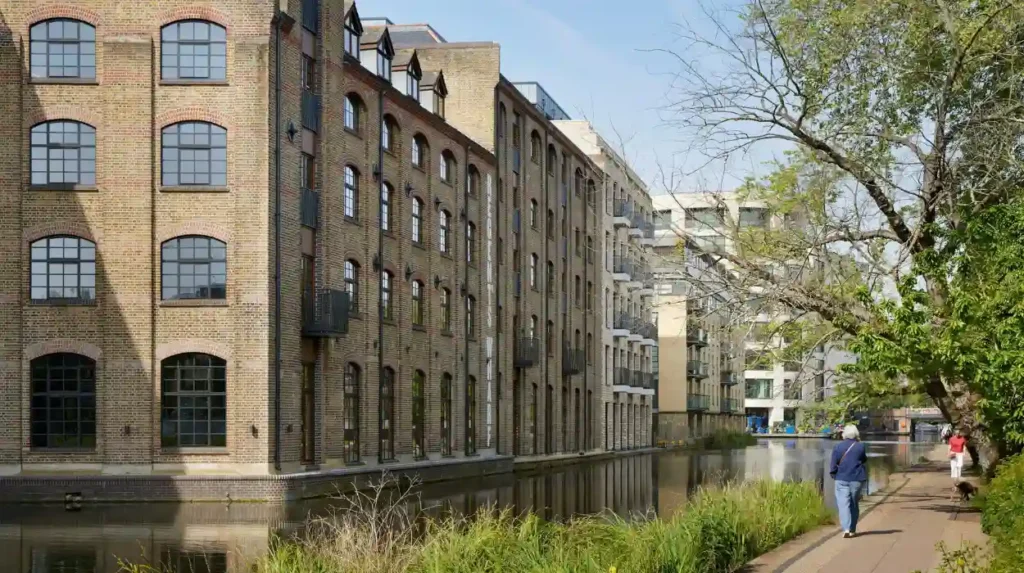
Former industrial warehouses have been converted into residential properties, offices, cultural venues, restaurants, and creative workspaces without removing their historic identity.
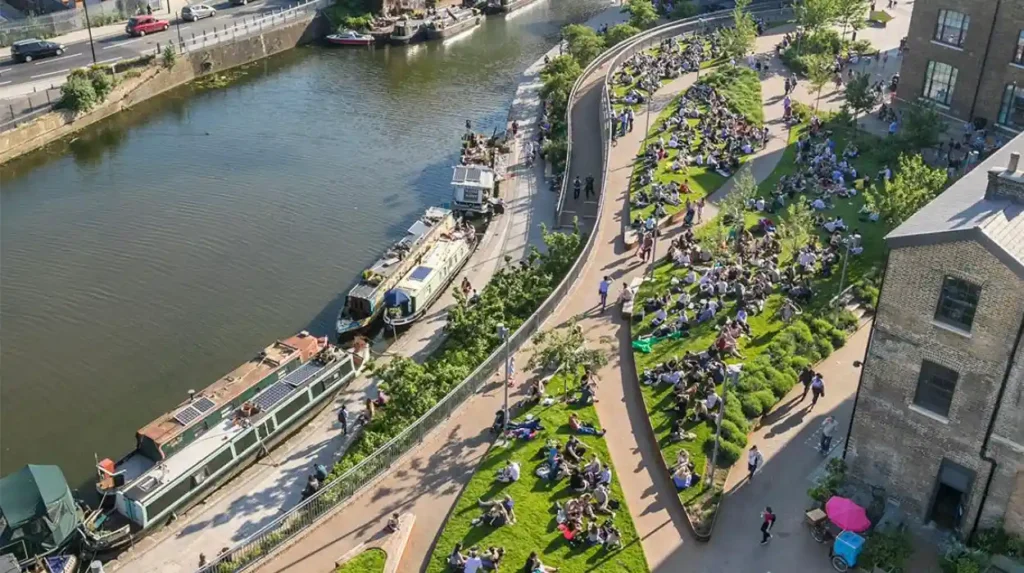
Towpaths now serve walkers, cyclists, commuters, and visitors.
Canals also function as ecological corridors supporting birds, fish, insects, amphibians, aquatic plants, and urban biodiversity. Green infrastructure contributes to climate resilience by providing habitats and improving environmental quality.
Archaeologists continue studying canal infrastructure to understand changing industrial technologies, construction methods, and commercial practices.
Educational organisations regularly use canals to explain Britain’s Industrial Revolution, engineering history, environmental management, and urban development.
To experience these historic waterways in person today, consult our comprehensive [London’s Most Beautiful Canal Walks for Peaceful Sightseeing and Scenic Photography Adventures] for itineraries and visiting parameters.
What historic structures still survive along London’s canals?
Many original canal structures survive, including locks, bridges, warehouses, tunnels, pumping stations, basins, dock facilities, milestones, and towpaths. These preserved features provide direct physical evidence of London’s industrial expansion and nineteenth-century transport infrastructure.
Regent’s Canal retains numerous original bridges, lock chambers, and waterside warehouses despite extensive urban redevelopment.
The Islington Tunnel remains one of the canal network’s most recognisable engineering landmarks.
Limehouse Basin continues serving as an important junction connecting inland waterways with the River Thames.
Historic lock cottages survive in several locations, illustrating the residential life of canal employees responsible for navigation management.
Warehouse districts demonstrate changing architectural styles associated with industrial commerce. Heavy brick construction, large loading doors, iron fittings, and waterside loading platforms reflect practical freight-handling requirements.
Many former wharves retain their original layouts despite new commercial or residential uses.
These surviving structures provide valuable evidence for historians, architects, engineers, archaeologists, and heritage conservation specialists studying London’s urban evolution.
Why do London’s historic canals remain important today?
London’s historic canals remain important because they preserve industrial heritage, support biodiversity, encourage sustainable travel, improve public health through recreation, strengthen cultural identity, attract tourism, and demonstrate how historic infrastructure continues serving modern urban communities through adaptive reuse and conservation.
Historic canals connect present-day London with more than two centuries of economic and engineering history.
They illustrate how infrastructure influenced Britain’s industrial development and the capital’s emergence as one of the world’s leading commercial cities.
Walking and cycling routes encourage sustainable transportation while reducing dependence on motor vehicles for local journeys.
Canals also support tourism by attracting visitors interested in architecture, engineering, industrial archaeology, wildlife, photography, and local history.
Educational institutions use canals as outdoor classrooms where students examine engineering principles, environmental management, historical geography, and urban planning through surviving physical evidence.
Community organisations organise heritage walks, conservation projects, environmental monitoring, and historical interpretation programmes that strengthen local engagement.
Climate adaptation has also increased the importance of urban waterways. Canal corridors contribute cooling effects during warm weather, support habitat connectivity, and complement London’s wider green infrastructure strategy.
Perhaps most importantly, London’s canals demonstrate that historic infrastructure remains valuable long after its original commercial purpose changes. Their transformation from freight corridors into public spaces illustrates successful heritage conservation integrated with contemporary urban life.
The continued maintenance of locks, bridges, towpaths, basins, and historic buildings ensures future generations can understand the engineering achievements that helped shape modern London. Rather than existing as static monuments, the canals remain active landscapes where history, ecology, recreation, education, and conservation intersect every day.
As London continues evolving, its historic canals provide a rare continuity between the Industrial Revolution and the twenty-first century. They preserve tangible evidence of technological innovation, commercial ambition, and urban expansion while serving practical environmental, educational, and cultural functions. Their lasting importance lies not only in their remarkable past but also in their continuing contribution to one of the world’s most historic capital cities.
Why were London’s historic canals built?
London’s historic canals were built to transport heavy goods such as coal, timber, grain, bricks, and manufactured products more efficiently than road transport, supporting trade and the Industrial Revolution.