London’s skyline contains few places that demonstrate urban transformation as dramatically as Canary Wharf. Once part of one of the busiest dock systems in the world, the area evolved from industrial decline into a globally recognised financial district. The story of Canary Wharf reflects wider themes in British economic history, including maritime trade, industrialisation, deindustrialisation, urban regeneration, and global finance.
- Why was the London Docklands important before Canary Wharf existed?
- How did the Docklands decline during the twentieth century?
- What policies initiated the regeneration of the Docklands?
- Why was Canary Wharf chosen as the centrepiece of redevelopment?
- How did Canary Wharf become a global financial centre?
- What architectural features define modern Canary Wharf?
- What evidence of Docklands history remains visible today?
- How did Canary Wharf influence London’s wider economy?
- Why does the history of Canary Wharf remain historically significant?
Today, Canary Wharf is known for its skyscrapers, multinational corporations, transport infrastructure, and waterfront environment. Yet beneath its modern appearance lies a history stretching back centuries through the development of the London Docklands. Understanding how Canary Wharf emerged provides insight into one of the most significant urban regeneration projects in modern Europe.
Why was the London Docklands important before Canary Wharf existed?
The London Docklands served as Britain’s primary maritime trade gateway for more than 150 years, handling imports and exports from across the British Empire and global markets. Its commercial success established the foundations that later shaped the redevelopment of Canary Wharf.
The area now occupied by Canary Wharf formed part of the Isle of Dogs in East London. For centuries, this peninsula sat within a large meander of the River Thames. Its strategic position made it ideal for maritime commerce.
The transformation began during the late eighteenth century. Growing international trade created severe congestion along the Thames. To address this problem, enclosed dock systems were developed to improve cargo handling and security.
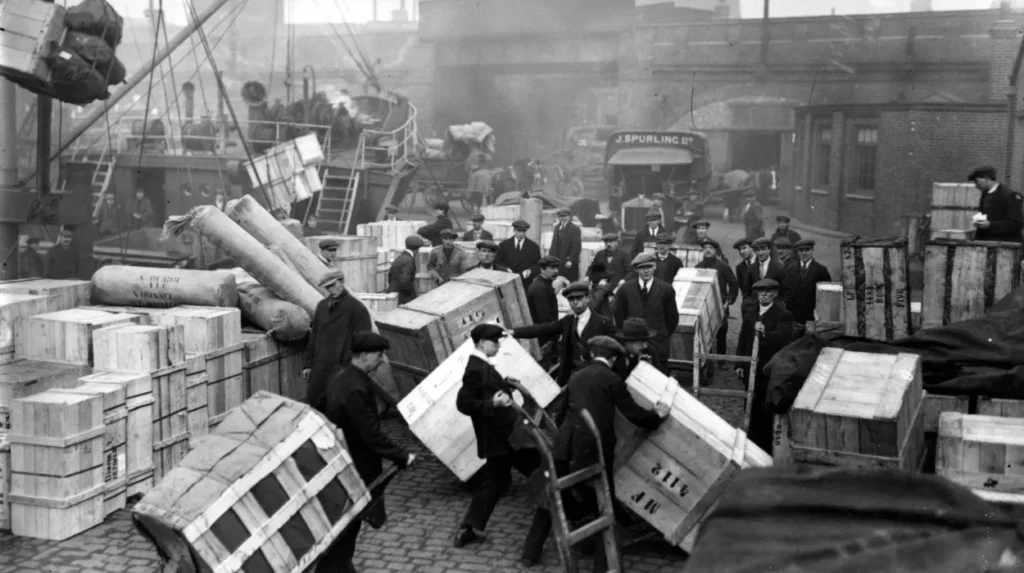
In 1802, the West India Docks opened on the Isle of Dogs. Designed by engineer William Jessop and supported by merchant interests, the docks became one of the most important commercial facilities in Britain. They specialised in goods arriving from the Caribbean, including sugar, rum, coffee, and cotton.
The dock system expanded throughout the nineteenth century. Three major dock complexes, including examples such as the West India Docks, Millwall Docks, and East India Docks, helped establish London as the world’s leading port. By the late Victorian era, thousands of workers depended on the docks for employment.
Docklands infrastructure included warehouses, rail connections, ship repair facilities, and customs operations. This concentration of maritime activity created one of the largest industrial zones in Britain.
The economic significance of the area extended beyond London. Trade passing through the docks supported manufacturing, finance, insurance, and shipping industries throughout the United Kingdom. Institutions such as the Port of London Authority later coordinated and managed large sections of this complex maritime network.
How did the Docklands decline during the twentieth century?
Technological changes in shipping, combined with containerisation and larger vessels, rendered many historic docks obsolete. Economic restructuring accelerated industrial decline, causing widespread unemployment and creating large areas of vacant land across East London.
The first signs of decline emerged after the Second World War. Although wartime reconstruction restored many damaged facilities, the economics of global shipping changed fundamentally during the 1950s and 1960s.
Containerisation revolutionised freight transport. Standardised shipping containers allowed cargo to be transferred more efficiently between ships, trains, and trucks. However, the historic docks of East London lacked sufficient space for modern container terminals.
Larger vessels also required deeper water and more extensive infrastructure than the enclosed dock systems could provide. New ports located further downstream offered better conditions for modern shipping operations.
Throughout the 1960s and 1970s, cargo traffic steadily moved away from central London. Dock closures followed. The West India Docks ceased commercial operations in 1980, marking the end of an era.
The social consequences were significant. Entire communities depended on maritime employment. As jobs disappeared, unemployment increased sharply across the Docklands.
Large areas of industrial land became derelict. Warehouses stood empty. Infrastructure deteriorated. Population decline affected many neighbourhoods. By the early 1980s, parts of the Docklands were widely viewed as symbols of urban decay.
Government reports identified severe economic challenges throughout the district. The area contained thousands of acres of underused land despite being located relatively close to central London.
What policies initiated the regeneration of the Docklands?
The British government launched a major regeneration strategy in the 1980s through development corporations, infrastructure investment, and planning reforms. These policies encouraged private-sector investment and transformed former industrial land into commercial and residential districts.
A decisive turning point occurred in 1981 with the establishment of the London Docklands Development Corporation (LDDC).
The LDDC received extensive powers to coordinate redevelopment. Its mandate focused on attracting investment, improving infrastructure, and stimulating economic growth throughout the Docklands.
Government policy reflected broader economic changes occurring in Britain during the late twentieth century. Regeneration initiatives sought to replace declining industrial employment with service-sector opportunities.
Infrastructure improvements became a priority. New roads enhanced accessibility. Land assembly programmes consolidated development sites. Planning regulations were streamlined to encourage private investment.
One of the most important projects was the creation of the Docklands Light Railway in 1987. The railway significantly improved connections between the Docklands and central London.
The regeneration programme attracted domestic and international developers. Former industrial sites became opportunities for large-scale commercial construction.
Supporters viewed the strategy as a model for urban renewal. Critics highlighted concerns regarding housing affordability, social displacement, and unequal distribution of economic benefits. Nevertheless, investment continued to expand throughout the decade.
Why was Canary Wharf chosen as the centrepiece of redevelopment?
Canary Wharf offered extensive development land, waterfront locations, and proximity to central London. Its scale enabled planners and developers to create a new business district capable of competing with established international financial centres.
The Isle of Dogs presented unique opportunities unavailable elsewhere in London.
Unlike densely developed central districts, the former docklands contained large contiguous parcels of land. This allowed planners to envision an entirely new commercial centre rather than incremental redevelopment.
The name Canary Wharf derives from a historic import berth associated with trade links to the Canary Islands. Although the wharf itself occupied only a small part of the area, the name became associated with the broader redevelopment project.
During the 1980s, Canadian developer Olympia & York proposed an ambitious master plan. The company recognised growing demand for modern office space among international financial institutions.
Traditional office districts often faced space constraints. Canary Wharf offered the possibility of constructing large office towers with advanced technological infrastructure.
The project sought to create a financial district comparable to major business centres in North America and Asia. Extensive waterfront areas enhanced the attractiveness of the development.
The vision represented one of the largest private-sector property investments undertaken in Europe during the period.
How did Canary Wharf become a global financial centre?
Strategic investment, modern office space, transport improvements, and the expansion of financial services enabled Canary Wharf to attract multinational firms. Over several decades, it evolved into one of the world’s leading concentrations of banking and professional services.
Construction accelerated during the late 1980s and early 1990s.
A defining milestone was the completion of One Canada Square in 1991. Standing at 235 metres, it became Britain’s tallest building at the time.
Despite early successes, the project encountered difficulties. Economic recession and property market challenges contributed to financial pressures. Olympia & York entered bankruptcy proceedings in 1992.
However, redevelopment did not stop. New investors continued supporting the project.
The long-term success of Canary Wharf depended heavily on transport improvements. The expansion of the Docklands Light Railway increased accessibility. Later projects transformed regional connectivity even further.
The opening of the Jubilee Line Extension in 1999 dramatically reduced travel times to central London. This infrastructure investment strengthened the district’s attractiveness to global businesses.
Financial institutions increasingly relocated operations to the area. Major banking groups, law firms, consulting companies, and technology firms established headquarters or significant offices.
Additional developments expanded commercial capacity. New towers, retail facilities, public spaces, and residential buildings reinforced the district’s role as a mixed-use urban centre.
The opening of the Elizabeth line further enhanced accessibility by connecting Canary Wharf with Heathrow Airport, central London, and surrounding regions.
Today, the district accommodates hundreds of businesses and tens of thousands of employees. Its office stock ranks among the most significant concentrations of commercial real estate in Europe.
What architectural features define modern Canary Wharf?
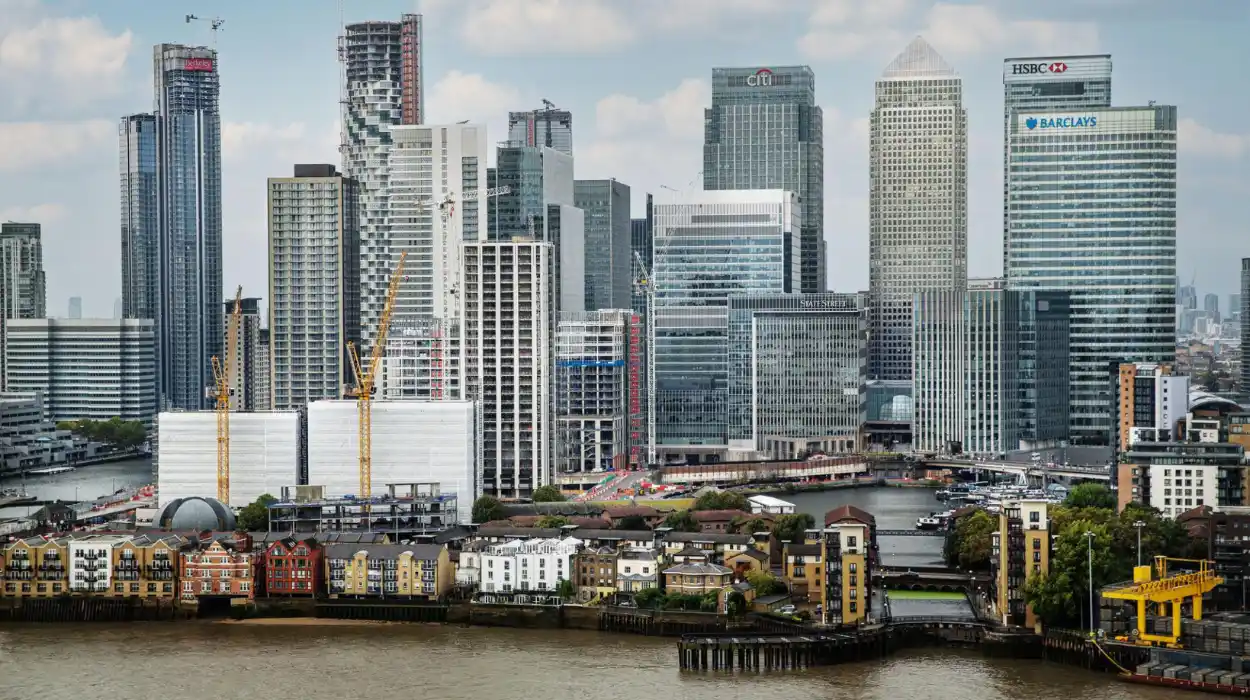
Modern Canary Wharf is characterised by high-rise skyscrapers, master-planned public spaces, waterfront design, and contemporary engineering. Its architecture reflects the priorities of global finance while incorporating elements that acknowledge the area’s maritime heritage.
The skyline represents one of the most recognisable urban landscapes in the United Kingdom.
Skyscrapers dominate the commercial core. Buildings employ advanced structural engineering techniques, energy management systems, and modern workplace designs.
Architectural styles vary across development phases. Early towers emphasised corporate monumentality, while newer projects integrate sustainability objectives and mixed-use functions.
Water remains a defining feature. Former dock basins survive as visual reminders of the area’s industrial past. Waterfront promenades connect commercial districts with residential neighbourhoods.
Public art installations contribute to the built environment. Open spaces provide areas for recreation and cultural activities.
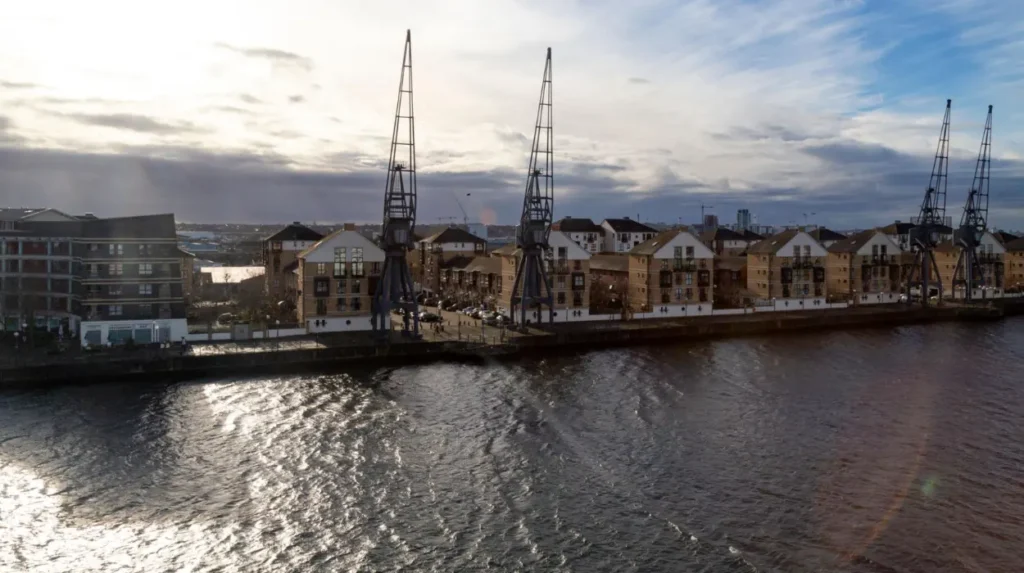
Historic remnants also remain visible. Dock walls, warehouse structures, and maritime infrastructure preserve physical connections to earlier periods of Docklands history.
This combination of preservation and redevelopment distinguishes Canary Wharf from entirely new urban developments.
To experience this historic landmark in person today, consult our comprehensive [What to Do in Canary Wharf: Skyscrapers, Dining, and Waterfront Walks] for itineraries and visiting parameters.
What evidence of Docklands history remains visible today?
Historic dock basins, preserved infrastructure, museums, archival collections, and surviving industrial features continue to document the maritime heritage of the Docklands. These remnants provide important evidence of the area’s transformation across two centuries.
Modern redevelopment did not erase all traces of the past.
Several former dock basins remain intact. Their outlines reveal the scale of nineteenth-century maritime infrastructure. Waterways continue shaping the area’s geography and urban design.
The Museum of London Docklands occupies a historic warehouse originally associated with the West India Docks. The museum preserves records, artefacts, and exhibitions relating to trade, migration, labour, and urban development.
Archival sources document the experiences of dock workers, merchants, shipping companies, and local communities. These materials support ongoing historical research.
Preservation efforts extend beyond individual structures. Conservation initiatives recognise the Docklands as an important component of London’s industrial heritage.
Researchers continue studying the area’s economic and social history through municipal records, shipping manifests, archaeological investigations, and planning documents.
How did Canary Wharf influence London’s wider economy?
Canary Wharf strengthened London’s position as a global financial hub by expanding office capacity, attracting international investment, generating employment, and supporting the growth of professional service industries across the metropolitan region.
The district altered London’s economic geography.
Historically, much of the city’s financial activity has been concentrated within the City of London. Canary Wharf created an additional centre for global business operations.
The expansion of office space supported growth in banking, insurance, asset management, legal services, and consulting.
Foreign direct investment contributed substantially to redevelopment. International firms viewed London as a gateway between global markets.
Employment growth extended beyond financial services. Retail, hospitality, property management, transport, and maintenance sectors also benefited.
The regeneration of Docklands influenced urban policy worldwide. Planners and policymakers frequently cite Canary Wharf as an example of large-scale waterfront redevelopment.
Academic studies continue examining both the successes and limitations of the project. Key themes include economic competitiveness, social inclusion, housing policy, and infrastructure planning.
Why does the history of Canary Wharf remain historically significant?
Canary Wharf demonstrates how industrial landscapes can be transformed through coordinated investment, infrastructure development, and economic restructuring. Its history illustrates broader global trends in trade, urban regeneration, and the transition from manufacturing economies to service-based economies.
The significance of Canary Wharf extends beyond architecture and finance.
Its origins lie in the expansion of global maritime commerce during the nineteenth century. Its decline reflects technological changes that reshaped international shipping. Its regeneration illustrates the emergence of finance and professional services as dominant sectors within advanced economies.
The area therefore represents multiple historical eras, including examples such as the age of empire, industrial modernisation, post-industrial decline, and globalisation.
For historians, the Docklands provide evidence of changing economic systems. For urban planners, they offer lessons regarding infrastructure-led development. For educators, they demonstrate the relationship between geography, technology, and economic change.
Canary Wharf continues evolving. New residential projects, cultural institutions, life-science developments, and sustainability initiatives are expanding the district’s role within London.
Yet its defining historical narrative remains unchanged. A landscape once dominated by ships, warehouses, and dock workers became one of the world’s most recognised financial centres. This transformation makes Canary Wharf one of the most important examples of urban regeneration in modern British history and a lasting symbol of London’s capacity for economic reinvention.
What was Canary Wharf before it became a financial district?
It was part of the London Docklands, a major global shipping and cargo-handling centre dominated by docks such as the West India Docks and Millwall Docks.