Key Points
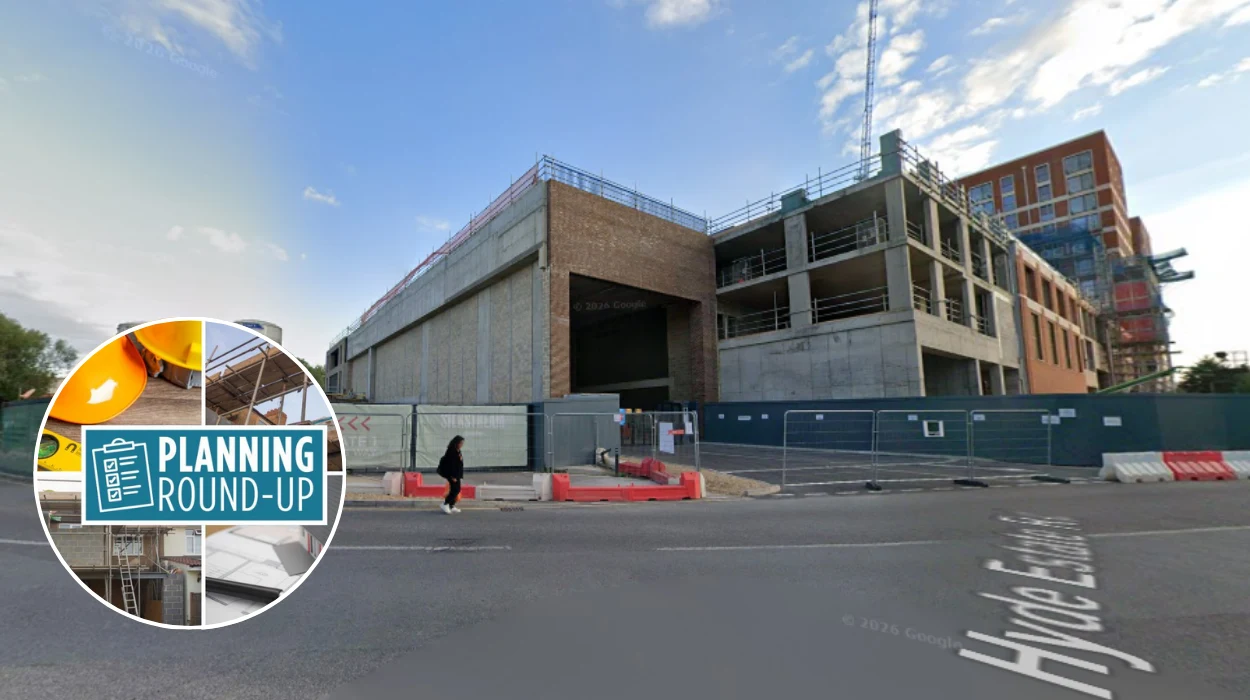
- Major Regeneration Adjustments: A prominent mixed-use development site at Unit 4 Hyde Estate Road (NW9) is seeking subtle redrawing of approved phasing and building heights to accommodate extra homes and taller blocks without starting the planning process from scratch.
- Residential Modifications: Homeowners across the borough have lodged new proposals, including a comprehensive roof extension and outbuilding construction at 32 Haslemere Avenue (EN4) and a single-storey side and rear extension at 59 Abercorn Road (NW7).
- Arboricultural and Conservation Maintenance: Significant tree reduction and maintenance applications have been submitted for Heathcroft (NW11) covering multiple species, alongside a proposal to remove an Ash tree at St Andrews Church of England Primary School in Totteridge Village (N20).
- Public Access to Data: Local citizens are being directed to the Public Notice Portal to track statutory declarations regarding local development, alcohol licensing, and planned road closures.
London (Extra London News) July 3, 2026 – A series of significant urban planning applications and statutory notices have been formally validated by Barnet Council this week, headlined by a pivotal amendment request for a major mixed-use regeneration scheme on Hyde Estate Road. The new submission aims to strategically recalibrate building heights and delivery phases to unlock additional housing capacity within an already approved masterplan framework. Alongside this large-scale commercial adjustment, the council’s planning portal has registered an array of suburban developments, ranging from substantial residential extensions in Barnet and Mill Hill to essential arboricultural preservation and safety works at local schools and residential complexes.
- Key Points
- What Are the Latest Changes Proposed for the Hyde Estate Road Regeneration Project?
- How Will the Residential Property at 32 Haslemere Avenue Be Extended?
- What Tree Maintenance and Conservation Works Are Planned for Heathcroft?
- Why Is St Andrews Church Of England Primary School Requesting Tree Removal?
- What Details Are Included in the Extension Plans for 59 Abercorn Road?
- Where Can Residents Track Local Planning, Licensing, and Road Closures?
As reported by local government correspondents covering the borough, these weekly submissions represent the ongoing evolutionary balance between dense urban intensification in Barnet’s industrial corridors and heritage conservation within its leafy residential suburbs. All applications are now subject to statutory public consultation periods during which local residents can lodge formal support or objections before final determinations are made by the council’s planning committees.
What Are the Latest Changes Proposed for the Hyde Estate Road Regeneration Project?
The most significant application featured in this week’s list concerns Unit 4, Hyde Estate Road, London NW9 6JX. As detailed in official council documents under reference number 26/2462/NMA, the applicant has submitted a Non-Material Amendment (NMA) targeting a previously approved major mixed-use development permission.
According to the reporting by the editorial team at The Hampstead & Highgate Express, the latest application asks to subtly redraw the approved mixed-use scheme’s phasing and building heights. This strategic choice allows extra homes and taller blocks to be delivered within the existing consent boundaries rather than forcing developers to spend months starting the complex planning application process from scratch.
By leveraging the NMA pathway, the development team intends to maximize the site’s footprint efficiency. The fine-tuning of the phasing plan ensures that infrastructure delivery matches residential occupancy schedules, whilst the minor height increases on specified blocks respond directly to London’s pressing demand for high-density housing options near established transit networks.
How Will the Residential Property at 32 Haslemere Avenue Be Extended?
In the suburban sector of the borough, homeowners are continuing to invest heavily in permitted development and comprehensive house extensions. A prominent application has been validated for 32 Haslemere Avenue, Barnet EN4 8EZ, under reference number 26/2512/192.
The application details a extensive roof extension program designed to maximize the property’s internal living space. The architectural plans specify a hip-to-gable roof conversion, the installation of a rear dormer window, and the addition of three front-facing rooflights alongside a new side gable window. Furthermore, the submission includes proposals for the erection of a detached rear outbuilding within the property’s domestic curtilage. This type of multi-faceted application often serves to accommodate growing families or create dedicated home-working spaces without altering the primary street-scene footprint excessively.
What Tree Maintenance and Conservation Works Are Planned for Heathcroft?
Environmental management remains a heavily regulated aspect of Barnet’s local administration, particularly within designated conservation zones and mature residential estates. An extensive tree works application has been brought forward for Heathcroft, London NW11 7HJ, registered under reference number TPP/0378/26.
The submission requests formal authorization for the reduction and ongoing maintenance works of several protected or significant trees on the property. The diverse botanical list submitted to the council’s arboricultural officers includes Magnolia, Hornbeam, Laurel, Sycamore, Prunus, Cypress, Dead Cherry, and Holly trees, among others. Local authority planners mandate that such works must be detailed precisely to prevent the degradation of the local canopy cover while balancing the safety and light requirements of nearby residential structures.
Why Is St Andrews Church Of England Primary School Requesting Tree Removal?
Further north in the borough, an application has been lodged by an educational institution regarding campus safety and landscape management. St Andrews Church Of England Primary School, located on Totteridge Village, London N20 8NX, has submitted a formal notice under reference number TCP/0377/26.
The school is seeking permission for the complete removal of one Ash tree situated within its grounds. Given the prevalence of ash dieback across the United Kingdom, school boards and local authorities routinely monitor these specimens to mitigate the risk of falling branches in high-footfall areas populated by children. The application will be assessed by council tree officers to determine if the tree shows signs of irreversible decay or structural instability before removal is permitted.
Explore more Barnet News:
Barnet Council Rules for Beautiful High Streets Enacted: London 2026
Red Weather Warning: Extreme Heat Alert Issued for Barnet 2026
What Details Are Included in the Extension Plans for 59 Abercorn Road?
Another residential development has been proposed in the Mill Hill district, located at 59 Abercorn Road, London NW7 1JS. Validated under reference number 26/2500/FUL, this application requests full planning permission for a single-storey side and rear extension.
Unlike applications submitted under lawful development certificates, full planning applications undergo rigorous scrutiny regarding their impact on neighboring daylight access and visual amenity. The proposed side and rear extension at Abercorn Road represents a typical suburban modernization project, aiming to create open-plan living environments that flow directly into the rear garden area while remaining sympathetic to the architectural style of the surrounding streetscape.
Where Can Residents Track Local Planning, Licensing, and Road Closures?
To ensure total transparency in local governance, Barnet Council and statutory bodies publish all public notices via official legal channels. As highlighted by regional news editors across North London media titles, citizens who want to find out all the latest planning applications, alcohol licensing applications, and planned road closures near them can easily search the Public Notice Portal.
The Public Notice Portal is a centralized, easily accessible digital platform designed to keep communities fully informed about changes impacting their immediate neighborhoods. By reviewing these entries, residents can actively participate in local democracy, submit representations to their local councillors, and ensure that their voices are factored into urban development timelines.