Key Points
- Site-Specific Staging: Camden People’s Theatre presents Camdenwalla, a debut play by Jonny Khan that takes place in the exact physical building that once housed the real-life Camden Monitoring Project.
- Historical and Political Setting: Set on a single busy Saturday night in 1994, the play explores the realities faced by second- and third-generation Pakistani immigrant families in London against a backdrop of institutional police neglect, government instability, and football riots.
- Philosophical Generational Divide: The production highlights a core ideological clash between gentle, documentary-based resistance represented by an elder character, and radical direct action championed by the younger British-born generation.
- Critiques on Pacing and Runtime: Reviewers note that while the play delivers powerful characterisation and an evocative local set design, its 60-minute length limits a thorough exploration of its complex political themes, occasionally suffering from slow pacing.
London (Extra London News) June 19, 2026 – Camden People’s Theatre has officially launched Camdenwalla, a highly localized, site-specific debut play written by playwright Jonny Khan. The production reimagines a tense Saturday night in 1994 inside the walls of the Camden Monitoring Project—an independent community support line that historically operated out of the exact building where the theatre stands today. Centred on the lives of a British-Pakistani operator and his teenage niece, the narrative chronicles their efforts to coordinate emergency vehicle pickups for local residents facing racially motivated threats, violence, and street intimidation. Through its intimate lens, the production unearths a decade of documented community friction, examining the profound disconnect between vulnerable immigrant populations and the state authorities tasked with their protection.
- Key Points
- What is the plot of Camdenwalla at Camden People’s Theatre?
- How does the play use its real-world London location?
- Who is the author of Camdenwalla?
- What are the main themes explored in Jonny Khan’s play?
- How do media critics evaluate the production and characters?
- What are the structural limitations of the 60-minute runtime?
- How does the set design contribute to the atmosphere?
- Where does Camdenwalla fit within London’s local history dramas?
- Why does the play critique the British state and police?
What is the plot of Camdenwalla at Camden People’s Theatre?
The narrative structure of Camdenwalla isolates its action within the confines of a single, highly charged Saturday night at the headquarters of the Camden Monitoring Project. The central figure, Muhammad, is depicted manning the emergency telephone lines completely alone, responding to a relentless influx of distress calls from local neighbours, friends, and community members. These callers report being actively threatened, physically attacked, or systematically intimidated on the dark streets of the London Borough of Camden.
In response to the escalating danger outside, Muhammad operates a makeshift emergency system, arranging for the project’s solitary support van to locate distressed individuals and transport them safely back to their homes. The domestic and political dynamics of the evening shift dramatically when his 16-year-old niece, Alima, arrives at the office to deliver food. She is ultimately persuaded to remain in the office for the night, establishing a tense atmospheric pressure cooker that forces both characters to confront their deepest fears regarding the hostile environment surrounding them.
How does the play use its real-world London location?
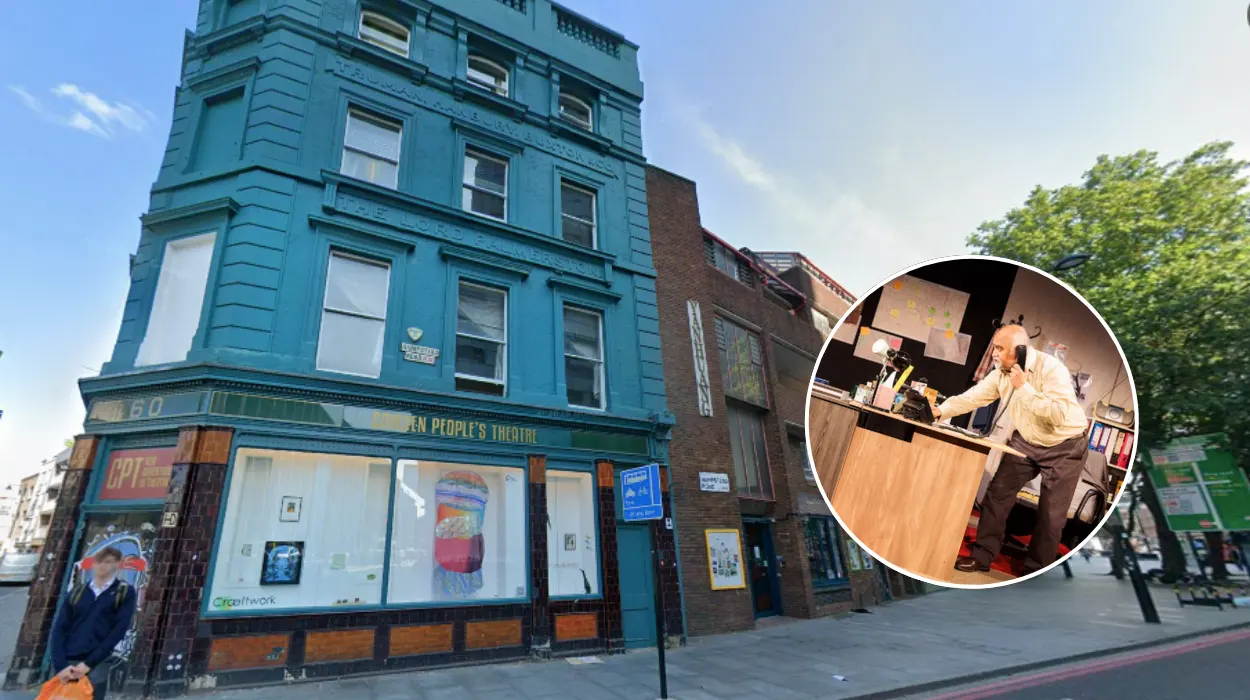
The structural framework of Camdenwalla relies entirely on its geographical and physical authenticity. By staging the production inside the Camden People’s Theatre, the creative team has returned the narrative to its precise historical birthplace on Hampstead Road. For local residents and audience members familiar with the area, the script integrates a vast network of highly recognizable landmarks, streets, and neighbourhood institutions, transforming the play into a living piece of social history.
The physical production bridges the gap between past and present, offering audiences an explicit opportunity to reflect on the historical anti-racist advocacy that transpired within those very walls while observing the modern reality of the bustling London thoroughfare just outside the theatre windows. This specific staging methodology elevates the production from a traditional period piece to an immersive, site-specific archive of Camden’s historical community resistance.
Who is the author of Camdenwalla?
Camdenwalla marks the professional debut of playwright Jonny Khan. In crafting this piece, Khan draws directly from the historical archives of the Camden Monitoring Project to map out the lived experiences of second- and third-generation immigrant families navigating the urban landscape of the mid-1990s. Khan’s writing focuses heavily on the structural and physical resistance these families encountered, while simultaneously utilizing endearing characterization to highlight themes of inter-generational connection, community solidarity, and mutual aid. Through his text, Khan attempts to balance a delicate line between documenting historical racial trauma and celebrating the resilient, protective networks established by British-Pakistani citizens.
What are the main themes explored in Jonny Khan’s play?
The thematic core of Camdenwalla is defined by an ongoing philosophical conflict regarding the methodology of social change and political resistance. As observed in the text, the narrative contrasts the merits of peaceable, institutional protest against the deployment of direct, confrontational action to achieve revolutionary societal acceptance.
Muhammad represents a philosophy of gentle, resilient endurance; his activism manifests as a meticulous process of watching, listening, and systematically documenting a decade’s worth of racial incidents—records compiled precisely because the local police forces consistently refuse to intervene or take legal action. Conversely, his niece Alima embodies a radically different ideological approach. Connected to an external, unseen activist group through her boyfriend, Alima advocates for a direct, visible challenge to the systemic racism and physical violence targeting her community, highlighting the shifting political attitudes of British-born youth.
How do media critics evaluate the production and characters?
In an evaluation published by the theatre criticism platform The Reviews Hub, the performance of the principal cast received significant critical acclaim, particularly noting the depth brought to the stage by lead actor Bhasker Patel. The review asserts that “Bhasker Patel’s Muhammad in particular feels well-rounded and a deeply interesting, ordinary but extraordinary man.” The evaluation further highlights that his performance as a literal voice of safety and a beacon of communal hope is exceptionally well managed. Furthermore, the critical analysis praises the familial chemistry on stage, stating that his “fun and light-hearted relationship with Alima is full of lovely moments as they find themselves miles apart and close together simultaneously.”
The performance of Nusrath Tapadar, who portrays the teenage niece Alima, was similarly commended for its authenticity and emotional progression. According to the assessment compiled by The Reviews Hub, Tapadar’s portrayal effectively captures the nuances of a contemporary teenager while showing a sophisticated political awakening. The review notes that her character’s “sensibility about the situation her friends find themselves in and the way she starts to care about the strangers who call is nicely presented,” marking a pivotal arc in the character’s development over the course of the evening.
What are the structural limitations of the 60-minute runtime?
Despite praising the character development, the analysis from The Reviews Hub points out substantial structural constraints stemming from the play’s brief running time. The review observes that because the production lasts only 60 minutes, there is ultimately “too little time in this 60-minute play to really explore the consequences of these quite different philosophies.”
The critic argues that the text fails to fully unpack the psychological foundations of the characters’ conflicting worldviews, specifically the extent to which Muhammad’s urge for quiet safety is a byproduct of age and lived experience, versus how much Alima’s confrontational stance is driven by raw instinct or a distinct cultural shift unique to British-born Pakistani young adults. Consequently, the review concludes that the play’s final moments remain textually inconclusive, leaving several complex thematic strands entirely unresolved.
How does the set design contribute to the atmosphere?
From a visual and technical perspective, the production values were highly rated, with specific praise directed at the scenic framework created by designer Maariyah Sharjil. The review published by The Reviews Hub explicitly labels Sharjil’s office set as “excellent,” noting that it successfully recreates the claustrophobic, high-stakes environment of a 1990s community support hub.
However, the critique simultaneously identifies a persistent issue with the production’s internal momentum. The review notes that “the pace is slow in places, with characters spending a long time on pause, which slows the energy.” Despite these localized lulls in theatrical momentum, the overarching environment successfully grounds the audience in the historical gravity of the setting.
Explore more Camden News:
Barfly Camden Music Venue Returns: Propaganda Revives Grassroots Icon, London 2026
Camden Schools Art Biennale Showcases Young Talent at Central Saint Martins, King’s Cross 2026
Where does Camdenwalla fit within London’s local history dramas?
The thematic analysis situates Camdenwalla within an expanding sub-genre of contemporary British drama dedicated to preserving the history of urban support networks and grassroots community helplines. The production draws direct stylistic and historical parallels to other notable London-focused stage works, such as Cruise and The Switchboard Project.
According to the concluding remarks delivered by The Reviews Hub, the documented history of these localized, London-based telephone support lines consistently “proves an interesting place for drama.” The publication emphasizes that this dramatic tension is uniquely amplified in Khan’s piece, given that the performance unfolds within the literal, un-vitiated original home of the Camden Monitoring Project itself, offering a rare level of architectural and historical convergence.
Why does the play critique the British state and police?
A central point of contention within Camdenwalla is its severe critique of British state apparatuses, most notably the institution of the police. The entire operational existence of the Camden Monitoring Project is predicated on state abandonment; the community is forced to establish its own night-time safety van because official state forces refuse to act on or investigate anti-Pakistani violence.
The script frequently hints at a much broader, highly volatile context of national and local aggression that characterized the UK in 1994. The narrative references a turbulent backdrop of profound government instability and widespread football riots that routinely dominated national headline news. The play argues that this broader socio-political dynamic served to actively normalize public violence, directly influencing, permitting, and shaping the immediate physical danger unfolding both inside the monitoring office and on the surrounding pavements of Hampstead Road.
Journalistic Attribution Disclaimer: The analytical content, critical evaluations, and performance assessments detailed in this report are compiled from original theatre reviews published by The Reviews Hub. All specific critical commentary regarding performance metrics, runtime constraints, and design execution are attributed directly to the editorial staff and contributing critics of that publication to ensure strict journalistic accuracy and legal compliance.