The body of work known as David Hockney paintings represents a pivotal chapter in twentieth-century and twenty-first-century modern art. Produced over a span of seven decades by the British artist David Hockney, these paintings trace a stylistic and technological evolution from post-war abstract expressionism to figurative realism, and ultimately to digital multi-media landscapes. This definitive guide by Extra London News provides an exhaustive, factual exploration of the formal techniques, historical transitions, major thematic series, and global market impact of these canonical artworks.
- What Defines the Artistic Significance of David Hockney Paintings?
- How Did the Biographical and Historical Context Shape These Artworks?
- What Are the Key Structural Categories of David Hockney Paintings?
- What Mechanical Processes and Tools Were Used to Construct These Paintings?
- What Are Specific, Globally Renowned Examples of David Hockney’s paintings?
- A Bigger Splash (1967)
- Portrait of an Artist (Pool with Two Figures) (1972)
- Late Landscape Installations
- What Are the Financial and Market Statistics of These Artworks?
- What Is the Long-Term Cultural and Institutional Impact of These Paintings?
What Defines the Artistic Significance of David Hockney Paintings?
David Hockney paintings are structurally significant due to their rigorous investigation of visual perspective, human relationships, and the rendering of transient elements like light and water. These works synthesized Pop art sensibilities with classical figurative traditions across multiple distinct physical mediums.
Definition and Core Mediums
David Hockney paintings refer explicitly to the finished two-dimensional visual art objects executed by David Hockney between 1954 and 2026. The technical construction of these works relies on three distinct media phases: oil paint on canvas, acrylic polymer emulsion on canvas, and digital vector or raster pixel layers rendered via mobile software applications. The physical dimensions of these paintings range from small-scale intimate canvas boards measuring 12 by 10 inches to monumental, multi-panel landscape configurations stretching across 40 feet of linear space.
Central Themes and Stylistic Markers
The formal iconography of these paintings contains explicit recurring thematic identifiers. The primary thematic focus alternates between flat, sun-drenched architectural environments and highly complex natural landscapes. Stylistically, the paintings utilize a deliberate flattening of spatial perspective, saturated secondary color palettes, and sharp, linear geometric outlines. The human form is consistently presented through a lens of psychological isolation or formal domestic arrangement, rejecting traditional academic modeling in favor of flat planes of color.
How Did the Biographical and Historical Context Shape These Artworks?
The aesthetic development of David Hockney paintings directly correlates with the artist’s geographical relocations between the United Kingdom and the United States. His technical choices responded to the emergence of mid-century industrial materials and late-twentieth-century consumer digital processing technologies.
The Royal College of Art Period
Between 1959 and 1962, the early paintings emerged during the artist’s enrollment at the Royal College of Art in London. This phase operated within the historical context of post-war British austerity and the structural dominance of Abstract Expressionism, an artistic movement prioritizing non-representational, gestural paint application. The paintings from this specific period intentionally subverted abstraction by inserting graphic text, homoerotic literary codes, and fragmented figurative elements into heavily encrusted, dark oil paint layers.
The Southern California Transition
The canonical shift in the visual structure of David Hockney paintings occurred in 1964 when the artist relocated to Los Angeles, California. The geographic environment of Southern California introduced entirely new physical conditions, specifically high-intensity natural sunlight, clean mid-century modernist grid architecture, and ubiquitous suburban swimming pools. To capture this distinct atmosphere, the technical execution shifted away from traditional, slow-drying oils toward quick-drying synthetic acrylic paints, which allowed for flat, unblended expanses of bright, hard-edged pigment.
What Are the Key Structural Categories of David Hockney Paintings?
David Hockney paintings divide into four structural categories: early expressionist figuration, California swimming pool compositions, large-scale domestic double portraits, and late-career digital landscapes. Each category represents a distinct mechanical approach to composition, perspective, and application method.
The Swimming Pool Series
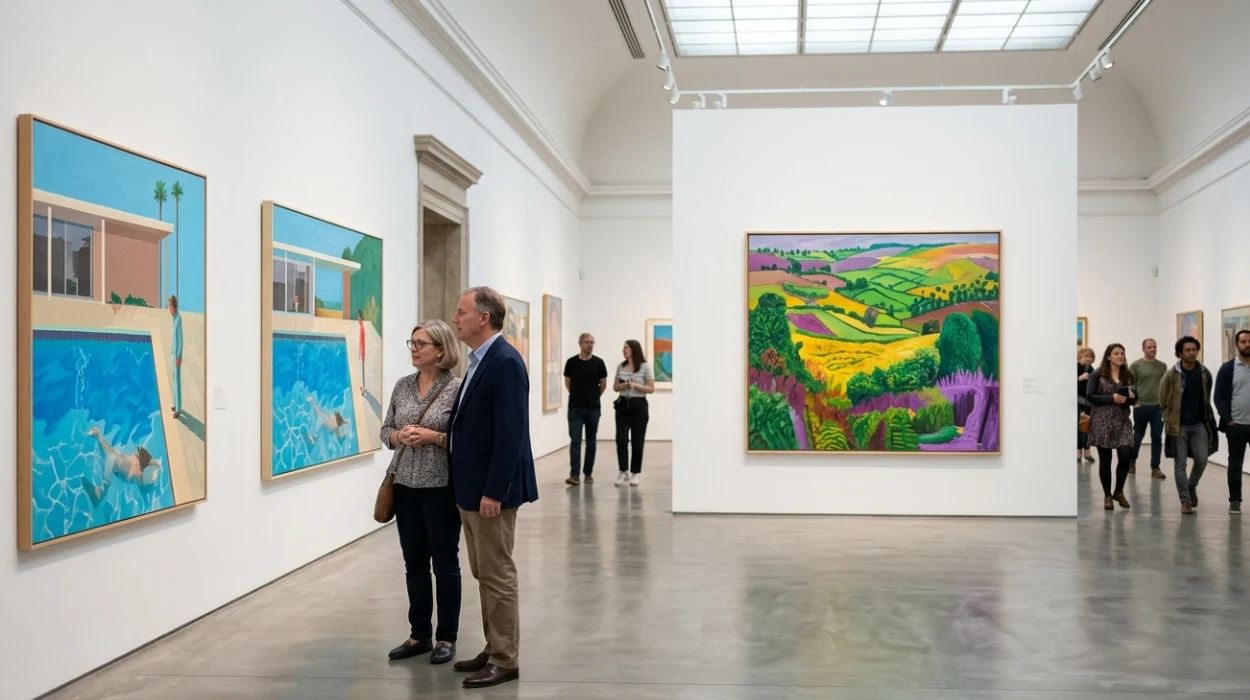
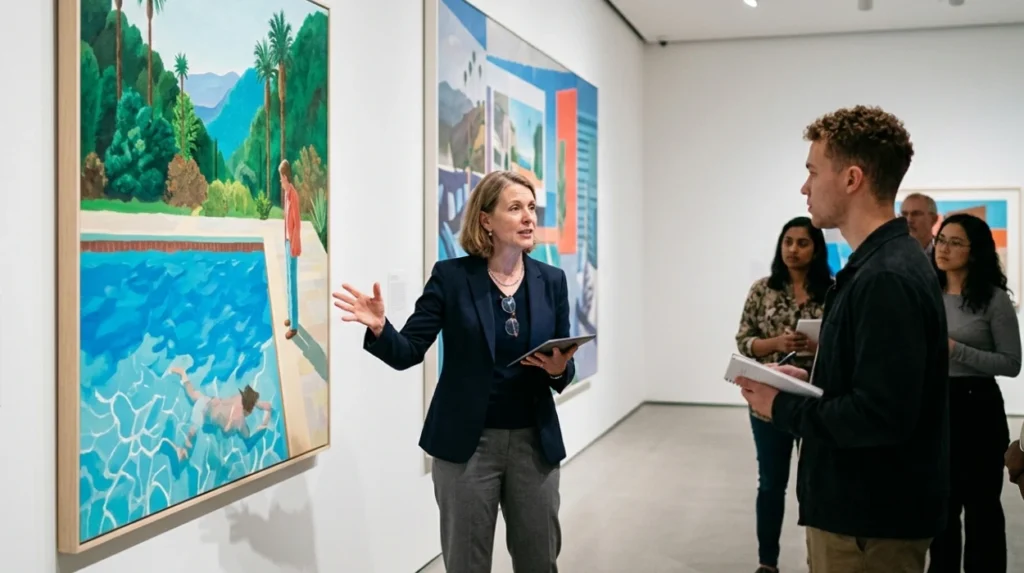
The swimming pool compositions, executed primarily between 1964 and 1972, function as precise geometric exercises in rendering non-solid, transparent surfaces. These paintings utilize sharp structural divisions, separating the canvas into distinct horizontal and vertical blocks representing concrete pool decks, modernist architectural glass, and absolute blue water planes. The mechanical challenge of capturing moving liquid without gestural brushwork led to highly calculated paint applications, where small, fine brushes systematically built up static patterns of lines to represent the refraction of light.
The Double Portraits
Between 1968 and 1975, a series of large-scale, near life-size double portraits established a new paradigm in modern figurative realism. These works measure exactly 7 by 10 feet and depict two distinct human subjects situated within highly curated domestic interiors. The compositions consciously subvert classical marriage portraiture conventions by introducing structural anomalies, such as placing one subject in shadow while the other is illuminated, or altering the gaze directions so that the figures never make direct eye contact with one another.
What Mechanical Processes and Tools Were Used to Construct These Paintings?
The fabrication of David Hockney paintings relied on rigorous technical systems, including grid-based photographic transfer methods, antique optical lenses, and advanced digital software engines. These processes systematically dismantled the singular, fixed-point perspective dominant in Western art since the Renaissance.
The Camera Lucida and Optical Systems
In 1999, the production mechanism for figurative drawings and subsequent paintings shifted to incorporate the camera lucida, an antique optical device that projects an image of the subject onto a drawing surface via a prism. This tool allowed for an exact, hyper-detailed recording of physical proportions without subjective human error. This experimental process culminated in the historical research publication Secret Knowledge: Rediscovering the Lost Techniques of the Old Masters, which argued that Western painters had secretly utilized optical lenses since the year 1430.
Digital Paint and iPad Technologies
Starting in 2010, the primary mechanical tool for landscape production shifted to digital multi-touch tablets, specifically the Apple iPad utilizing software applications such as Brushes and Procreate. The process discarded physical brushes, pigment tubes, and solvent mixtures in favor of variable digital stylus inputs on a glass substrate. The application engine recorded every individual stroke as an independent layer of data, allowing the artist to export the final vector files onto large-scale aluminum or paper sheets using industrial inkjet printing machinery.
What Are Specific, Globally Renowned Examples of David Hockney’s paintings?
The most critically validated David Hockney paintings consist of specific works executed during his mid-career acrylic phase and his late-career multi-panel landscape phase. These individual pieces are permanently housed in major global public museum collections or have achieved verified record status at public auctions.
A Bigger Splash (1967)
A Bigger Splash is a square acrylic on canvas painting measuring exactly 95 by 95 inches, completed in 1967 and permanently held in the Tate Britain collection in London. The composition depicts a single, violent eruption of white water splashing out of a calm swimming pool situated in front of a minimalist, mid-century house. The painting is structurally unique because the main subject—the human figure who caused the splash—is completely absent from the frame, forcing the viewer to confront a static, frozen moment in time that took the artist two weeks to paint using small, deliberate brushstrokes.
Portrait of an Artist (Pool with Two Figures) (1972)
Completed in May 1972, Portrait of an Artist (Pool with Two Figures) is a large-scale acrylic painting measuring 7 by 10 feet that brings together two of the artist’s most prominent motifs: a swimming pool and a double portrait. The canvas depicts a standing, clothed male figure looking down from a pool edge at a second male figure swimming underwater toward him. The work is structurally complex due to its dual perspective, which simultaneously balances the clear, sharp reflections of the distant hills with the wavy, distorted light refractions affecting the submerged human body.
Late Landscape Installations
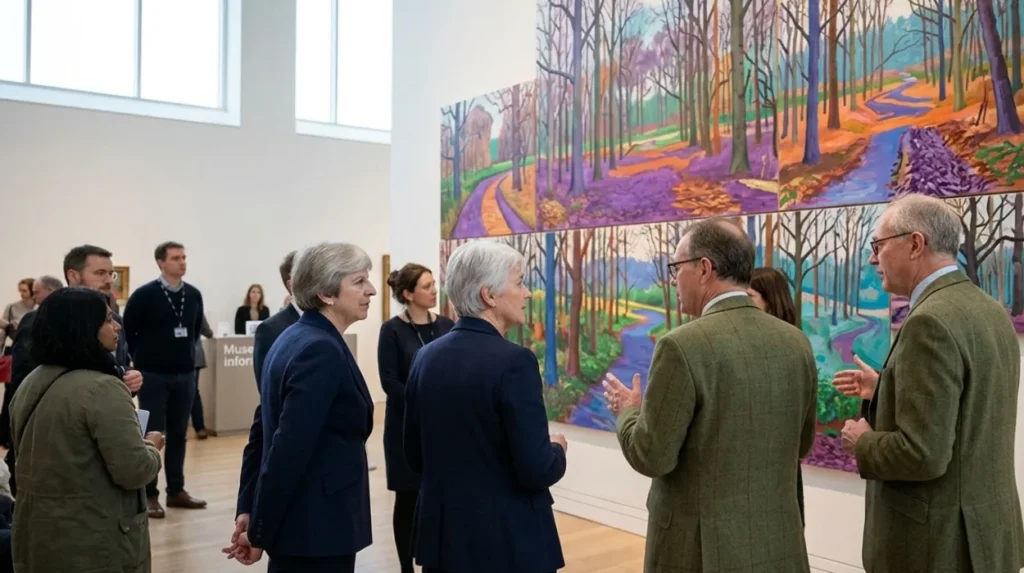
In the twenty-first century, the scale of David Hockney paintings expanded dramatically through multi-canvas assemblages. A prominent example is Bigger Trees Near Warter, painted in 2007, which consists of 50 individual canvases joined together to create a singular composition measuring 15 by 40 feet. This monumental work was painted en plein air (outdoors on location) in East Yorkshire, requiring a rigorous digital tracking system where individual canvases were photographed and assembled inside a software grid to ensure compositional continuity across all 50 panels.
What Are the Financial and Market Statistics of These Artworks?
The global fine art market classifies David Hockney paintings among the most highly valued post-war contemporary artworks in existence. Public auction data reveals a steep, exponential trajectory in pricing over the last five decades, culminating in historic world-record transactions.
The Historic 2018 Auction Record
On November 15, 2018, at Christie’s auction house in New York City, the 1972 painting Portrait of an Artist (Pool with Two Figures) sold for a final hammer price of $90,312,500. At that exact point in history, this transaction set the undisputed world record for the highest price ever paid at a public auction for a work of art by a living artist. The sale completely surpassed his previous auction record of $28.5 million, which had been established just six months prior by the 1990 landscape painting Pacific Coast Highway and Santa Monica at Sotheby’s.
Long-Term Value Escalation
The macro-economic data surrounding David Hockney paintings reveals an exceptional rate of capital appreciation. When Portrait of an Artist (Pool with Two Figures) was initially sold by the André Emmerich Gallery to its first private buyers in 1972, the purchase price was exactly $18,000. The 2018 auction sale price of $90.3 million represents an absolute financial return on investment exceeding 500,000 percent over a 46-year holding period, illustrating the extreme financial institutionalization of the artist’s primary market assets.
What Is the Long-Term Cultural and Institutional Impact of These Paintings?
The institutional impact of David Hockney paintings is solidified by continuous, record-breaking global museum exhibitions, dedicated public installations, and the foundational restructuring of digital art media. These works permanently expanded the definitions of pop art and figurative representation within the Western canon.
Major Global Museum Retrospectives
The critical validation of David Hockney paintings is maintained by a continuous cycle of solo exhibitions organized by the world’s most prestigious cultural institutions. A major milestone occurred in 2017 when a massive retrospective exhibition traveled from Tate Britain in London to the Centre Pompidou in Paris and the Metropolitan Museum of Art in New York, attracting over one million physically ticketed visitors. Furthermore, major legacy exhibitions, such as the 2023 multimedia presentation at London’s Lightroom and the comprehensive 2025 David Hockney 25 exhibition at the Fondation Louis Vuitton in Paris, confirm his sustained relevance into the mid-2020s.
Influence on Subsequent Generations of Painters
The formal innovations present in David Hockney paintings directly informed the technical strategies of late-twentieth-century and twenty-first-century figurative painters. His systematic dismantling of single-point perspective and his bold, unapologetic use of high-saturation industrial acrylic colors paved the way for generations of contemporary artists to explore identity, domesticity, and landscape without conforming to strict academic realism or absolute abstraction. By bridging the gap between old-world lens techniques and new-world touch-screen software, David Hockney paintings fundamentally democratized the use of technology in fine art, ensuring their permanent status as cornerstones of global visual culture.
What are David Hockney paintings known for?
His paintings are known for vibrant colors, innovative perspectives, swimming pool imagery, portraiture, landscapes, and experiments with digital technology.