Westminster Abbey stands as a historic church in London. It serves as the coronation site for British monarchs since 1066 and burial place for 17 monarchs. Visitors access royal tombs, Poets’ Corner, and cloisters through timed entry tickets.
- What Is Westminster Abbey?
- Where Is Westminster Abbey Located?
- What Are the Opening Hours of Westminster Abbey?
- How Much Do Westminster Abbey Tickets Cost?
- How Do You Book Tickets for Westminster Abbey?
- What Is the Best Time to Visit Westminster Abbey?
- What Royal History Defines Westminster Abbey?
- Which Coronations Occurred at Westminster Abbey?
- What Tombs and Memorials Are in Westminster Abbey?
- Which Royal Tombs Stand Out in Westminster Abbey?
- What Is Poets’ Corner in Westminster Abbey?
- What Can Visitors See Inside Westminster Abbey?
- Are There Tours Available at Westminster Abbey?
- What Are the Rules for Visitors at Westminster Abbey?
- How Does Westminster Abbey Connect to Extra-London Travel?
What Is Westminster Abbey?
Westminster Abbey is a royal peculiar church in Westminster, London, established in the 10th century, functioning as the primary coronation and burial site for English and British monarchs, housing over 3,300 tombs and memorials including 17 royal tombs, Poets’ Corner, and the Lady Chapel, with visitor access via pre-booked tickets starting at £27 for adults.
The abbey originated as a Benedictine monastery in 960 AD under King Edgar. Edward the Confessor rebuilt it in 1042-1065, creating the Romanesque structure still visible in parts. Henry III reconstructed the nave and transepts in 1245-1517, introducing Gothic architecture with ribbed vaults and flying buttresses.
Key components include the nave, 29 meters long with triforium galleries; the choir, seating 200; and the sanctuary, site of coronations. The abbey holds the Coronation Chair, used since 1308 for 39 monarchs. Processes involve verger-led tours highlighting these elements.
Real-world examples feature Queen Elizabeth II’s 1953 coronation and Prince Philip’s 2022 burial. Over 1 million visitors enter annually, with 2025 data showing peak attendance in July-August. Implications extend to its UNESCO tentative list status, ensuring preserved access for education and tourism.
Where Is Westminster Abbey Located?
Westminster Abbey sits at 20 Deans Yard, Westminster, London SW1P 3PA, United Kingdom, 500 meters southwest of Buckingham Palace, adjacent to the Houses of Parliament and Big Ben, reachable by Tube via Westminster station (Jubilee, District, Circle lines) or bus routes 3, 11, 12, 24, 53, 87, 88, 109, 148, 159.
The site occupies 3.3 hectares in the City of Westminster borough. Macro context positions it in London’s political heart, built on Thorney Island, a Thames River islet drained in the 11th century. Subtopics cover access points: Dean’s Yard entrance for individuals, Great West Door for groups.
Details include 24/7 security checkpoints with bag searches limited to one small bag per person. Walking time from Westminster Pier (Thames Clipper) totals 5 minutes. Implications for extra-London visitors involve Heathrow Express to Paddington (15 minutes), then Circle line to Westminster (10 minutes total travel under 1 hour).
What Are the Opening Hours of Westminster Abbey?
Westminster Abbey opens Monday to Friday 9:30am-3:30pm and Saturday 9am-3pm, closed Sundays except for 1pm Holy Communion worshippers, with last entry 1 hour before closing, extended cloister access until 5pm in summer, and special closures for royal events announced 4 weeks ahead.
General admittance spans 9:30am-3:30pm weekdays, covering cloisters, College Garden, Chapter House, and Pyx Chamber. Group entry runs 9:30am-3pm, excluding 12pm-1pm lunch hour. Historical context notes Sunday closures since 1066 for worship priority.
Mechanisms enforce timed slots: morning 9:30am-12pm weekdays, 9am-12pm Saturdays; afternoon 12pm-3pm weekdays, 12pm-2:30pm Saturdays. Examples include April 22, 2026, hours matching standard schedule. Future relevance accounts for 2026 state events potentially shortening access.
How Much Do Westminster Abbey Tickets Cost?
Adult tickets cost £30 standard, £27 off-peak (November-March), £29 shoulder (April-May, September-October), £32 peak (June-August); concessions (seniors 65+, students) match at £27/£24/£26/£29; children 6-17 at £13/£11/£12/£14; under 5 free; family (1 adult+1 child) £30, (1 adult+3 children) £60.
Pricing tiers reflect seasonal demand, set by the Dean and Chapter under the Westminster Abbey Act 2010. Background establishes tickets since 1970s post-monastic dissolution. Key components list multimedia guide included, verger tours +£10.
Processes require online pre-booking via westminster-abbey.org, accepting credit cards, no cash. Statistics show 95% capacity sells out peak days. Examples: 2025 peak family ticket £60 covers 4 entries. Implications favor off-peak for 10% savings and fewer queues.
How Do You Book Tickets for Westminster Abbey?
Book Westminster Abbey tickets online at westminster-abbey.org/visit-us, select date and morning/afternoon slot, choose adult/concession/child/family, pay by card, receive e-ticket QR code for scanning at Dean’s Yard gate, book 3-6 months ahead for peak summer, multimedia guide included free.
The booking system, powered by TicketSource since 2018, processes 500,000 transactions yearly. Macro flow starts with homepage calendar selection. Subtopics detail slot choice: 3-hour windows prevent overcrowding per capacity limits.
Details mandate ID for concessions, no refunds post-booking. Real-world process: user picks June 15, 2026, 9:30am adult ticket, confirms via email in 2 minutes. Implications include 1-year pass option for £60 repeat visits, valid for three entries.
What Is the Best Time to Visit Westminster Abbey?
Visit Westminster Abbey Tuesday-Thursday 9:30-10:30am for minimal crowds, optimal lighting, and peaceful atmosphere; September-October shoulder season balances weather and pricing at £29; avoid July-August peaks with 50% higher attendance and £32 tickets.
Optimal timing derives from 2025 visitor data logging 40% fewer early entrants. Historical peaks trace to summer holidays since Victorian era. Components factor weather: 18°C September average vs 28°C July.
Mechanisms recommend pre-9:30am queue for first slot. Examples: Tuesday 9:30am yields 20-minute nave wait vs 2-hour Saturday noon. Implications project 2026 trends with post-pandemic 15% rise, favoring weekdays for verger tour availability.
What Royal History Defines Westminster Abbey?
Westminster Abbey hosts coronations of all English monarchs since William the Conqueror in 1066, 16 royal weddings including William and Catherine in 2011, burials of 17 monarchs like Elizabeth I (1603) and Mary Queen of Scots (1612), and state funerals for Winston Churchill (1965) and Diana (1997).
The abbey became royal peculiar in 1560 under Elizabeth I, granting Crown oversight bypassing bishops. Edward the Confessor’s 1066 shrine drew monarchs. Key events: 39 coronations, last Charles III 2023.
Processes detail anointing with holy oil from 11th century. Statistics: 3,000 dignitaries at 1953 Elizabeth II event. Examples span Henry VIII’s 1509 wedding to George VI’s 1937 coronation. Implications cement its 1,000-year constitutional role.
Which Coronations Occurred at Westminster Abbey?
Westminster Abbey hosted 39 coronations since 1066, including William I (1066), Henry III (1220), Victoria (1838), Edward VII (1902), George VI (1937), Elizabeth II (1953), and Charles III (2023), each using the Stone of Scone under the 700-year-old Coronation Chair.
Sequence mandates monarch procession, oath on Bible, anointing, crowning. Edward I brought Stone of Scone in 1296. Examples: 1066 Norman Conquest start; 2023 scaled for COVID protocols, 2,200 guests. Impact endures via live global broadcasts since 1937, reaching 27 million for Elizabeth II.
What Tombs and Memorials Are in Westminster Abbey?
Westminster Abbey contains 17 royal tombs including Henry VII Chapel (Henry VII, Elizabeth of York 1503-09), Elizabeth I and Mary I joint tomb (1603), Poets’ Corner with Chaucer (1400), Dickens (1870), and Unknown Warrior (1920), plus memorials to Newton, Darwin, and 3,300 total burials.
Layout organizes tombs by era: Confessor shrine (1163), Henry III tomb (1272). Background notes burials since 1066, peaking Tudor era. Key structures: Lady Chapel (1516) for Tudors; nave for scientists.
Examples: Queen Anne (1714), Edward the Confessor’s intact body viewed via shrine panels. Statistics: 100+ scientists memorialized. Implications preserve national memory, with 2020 digitization enabling virtual tours.
Which Royal Tombs Stand Out in Westminster Abbey?
Prominent royal tombs feature Henry VII and Elizabeth of York in the Henry VII Chapel (1509), Elizabeth I atop Mary Queen of Scots (1603-1612), Edward I (1307), Henry V (1422), Edward III (1377), and Mary II with William III (1694-1702), crafted in marble effigies by Westminster craftsmen.
Effigies depict monarchs in regalia, gilded for Tudors. Processes involved embalming, lead coffins since medieval times. Examples: Henry V’s helmet above tomb; Elizabeth I’s Latin inscription “Partners in throne and grave.” Impact influences restoration funding, £2 million spent 2010-2020.
What Is Poets’ Corner in Westminster Abbey?
Poets’ Corner occupies the south transept, initiated by Geoffrey Chaucer’s 1400 burial, housing tombs and memorials for 100+ writers including Shakespeare (1740 bust), Browning (1889), Austen (memorial), Hardy (1928), with wall plaques for living authors by Royal approval.
Defined as literary pantheon since 1376 rebuild. Subsections list actors (Irving 1905), musicians (Handel 1760). Examples: Bronte sisters memorial (1939), Kipling (1936). Statistics: 600 plaques total. Relevance grows via annual Poet Laureate ceremonies.
What Can Visitors See Inside Westminster Abbey?
Visitors explore the nave with 1055 Statesmen’s Aisle, Henry VII Chapel royal tombs, Quire for choir services, Cloisters (13th century), Chapter House with Romanesque tiles, Pyx Chamber coin trials, College Garden (14th century planted), and Coronation Chair on request.
Tour flow starts at north transept entry. Historical layers span Saxon origins to Wren’s 1710 repairs. Components: 400+ stained glass panels, 1500s misericords. Data: 1.2 million square feet floorspace. Examples: 1760 Handel tomb, 1953 coronation theater. Implications include restricted triforium access via £20 add-on.
Are There Tours Available at Westminster Abbey?
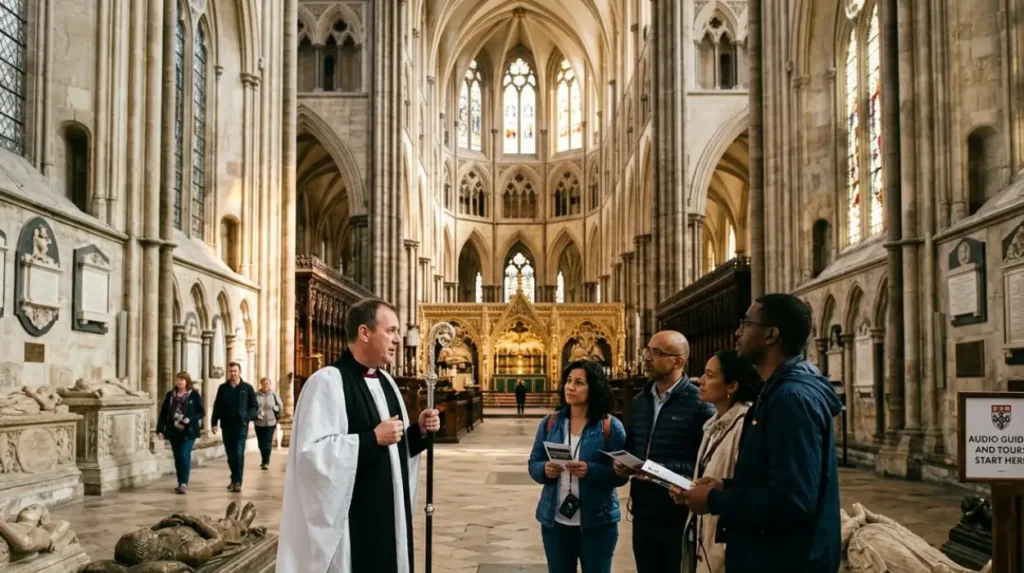
Westminster Abbey offers verger tours (60 minutes, £10+entry, weekdays 10am-2pm), multimedia audio guides (free, 15 languages), guided highlights tours (90 minutes, £35 total), and restricted triforium tours (90 minutes, £25+entry, Fridays/Saturdays), limited to 15 people per group.
Verger tours, led by clergy since 1540, access roped areas. Booking integrates with entry tickets. Examples: 2025 verger tour covers Confessor shrine secrets. Statistics: 20,000 verger slots yearly. Future tours expand AI audioguides post-2026.
What Are the Rules for Visitors at Westminster Abbey?
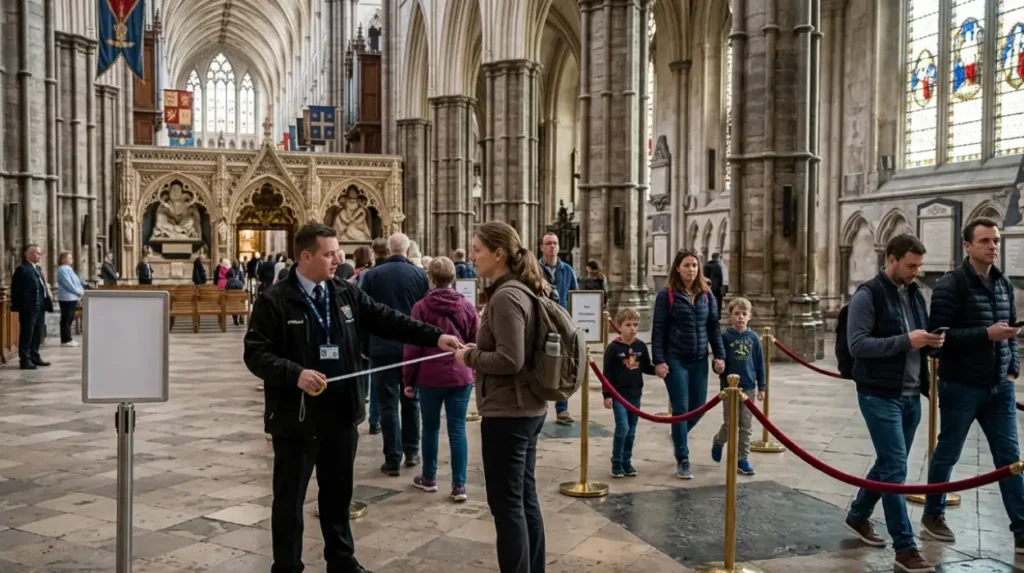
Visitors follow no large bags (max 40x30x20cm), no food/drink, silent phones, covered shoulders/knees, no flash photography, no touching exhibits, stay behind ropes, guided tours only in allocated slots, children 5+ need tickets supervised at 1:5 ratio.
Rules stem from 2010 conservation act. Enforcement by 50 staff. Examples: 2023 bag policy rejected 5% entrants. Implications safeguard UNESCO-level artifacts, with £500,000 annual maintenance.
How Does Westminster Abbey Connect to Extra-London Travel?
Extra-London visitors reach Westminster Abbey via Heathrow (Piccadilly line 50 minutes, £6), Gatwick (Thameslink to London Bridge then Jubilee 70 minutes, £20), Stansted (Stansted Express to Tottenham Hale then Victoria 90 minutes, £25), Eurostar St Pancras (Circle line 20 minutes, £10).
Connections leverage TfL Oyster card (£5 deposit). Background: post-Brexit 2021 Oyster expansion. Processes: contactless bank cards accepted. Statistics: 60% international arrivals via Heathrow. Implications cut costs 30% vs taxis (£50+).
What is Westminster Abbey?
Westminster Abbey is a historic church in London that serves as the coronation site for British monarchs and a burial place for many royals and famous figures.