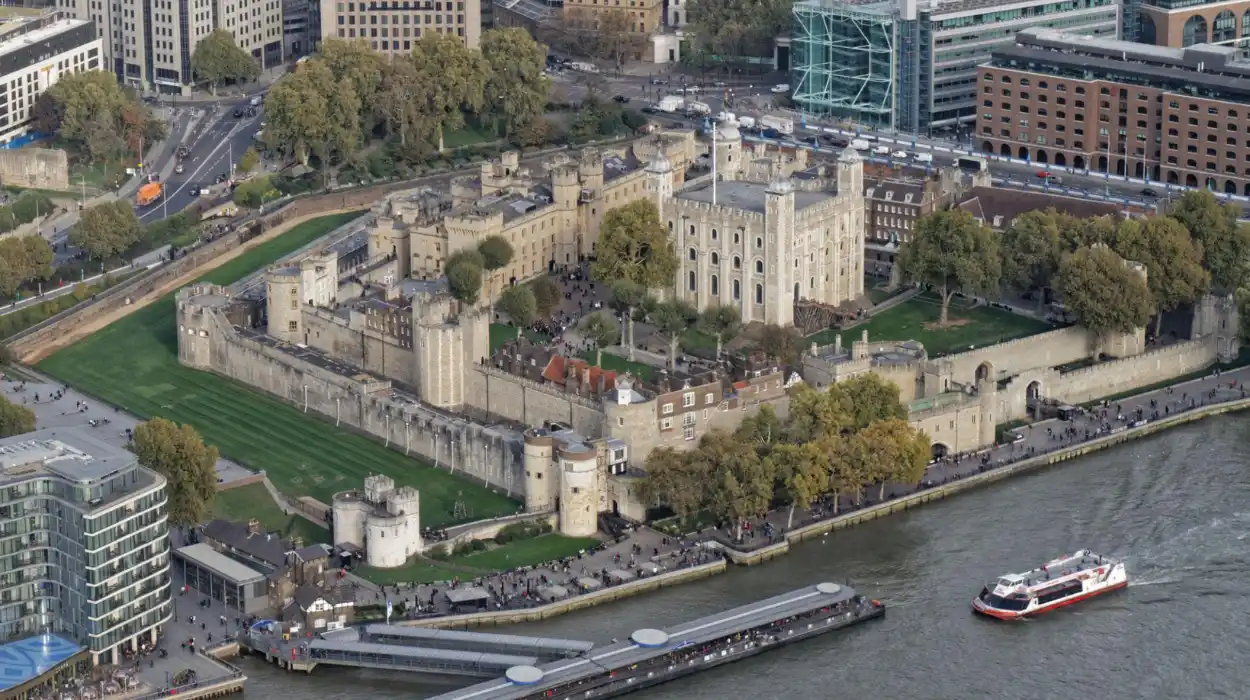
The Tower of London stands among the most significant historic landmarks in England. Located on the north bank of the River Thames in central London, the fortress served as a royal residence, military stronghold, prison, treasury, armory, and symbol of state authority for nearly one thousand years. Its history reflects the development of the English monarchy, the evolution of government power, and the transformation of London from a medieval city into a global capital.
- What is the Tower of London and why was it built?
- How did the Tower of London evolve throughout the medieval period?
- Why did the Tower of London become associated with imprisonment?
- Which executions and historical events shaped the Tower’s reputation?
- What role did the Tower play in protecting the English Crown?
- What are the Crown Jewels and why are they kept at the Tower of London?
- What architectural features make the Tower of London historically significant?
- How is the Tower of London preserved and interpreted today?
- Why does the Tower of London remain important in the twenty-first century?
Today, the Tower of London attracts millions of visitors annually and remains one of the United Kingdom’s most recognized cultural heritage sites. Designated as a UNESCO World Heritage Site in 1988, the fortress preserves medieval architecture, royal collections, military artifacts, and the Crown Jewels used in British coronations.
What is the Tower of London and why was it built?
The Tower of London is a Norman fortress founded in 1066 by William the Conqueror to secure political control over England. It functioned as a military stronghold, royal residence, administrative center, and visible symbol of royal authority in medieval London for centuries.
The Tower of London officially refers to a fortified complex consisting of multiple defensive walls, towers, gates, and internal buildings. Its most famous structure is the White Tower, a massive stone keep constructed during the late eleventh century.
The fortress emerged following the Norman Conquest of England in 1066. After defeating King Harold II at the Battle of Hastings, William the Conqueror needed to establish control over the recently conquered kingdom. Castles represented a proven Norman strategy for enforcing authority across newly acquired territories.
Construction of the White Tower began around 1078 under the supervision of Gundulf, Bishop of Rochester. The structure utilized imported Caen stone from Normandy alongside local building materials. The keep dominated London’s skyline and demonstrated Norman military and political power.
Its strategic location near the River Thames provided several advantages. The river enabled transportation of supplies, soldiers, and building materials. The position also allowed surveillance of trade routes entering the city.
Over subsequent centuries, successive monarchs expanded the fortress. Kings added defensive walls, moats, towers, barracks, and administrative buildings. These additions transformed a single keep into one of Europe’s most formidable medieval castle complexes.
The Tower became both a practical military installation and a symbolic representation of royal authority. Its imposing architecture communicated the strength of the Crown to subjects, foreign diplomats, and potential rivals.
How did the Tower of London evolve throughout the medieval period?
The Tower of London expanded from a single Norman keep into a vast fortified complex through successive royal building campaigns. Medieval monarchs strengthened defenses, enlarged accommodation, and increased administrative functions to support England’s growing centralized government.
The White Tower formed the original core of the fortress. During the twelfth and thirteenth centuries, rulers significantly expanded the site.
King Richard I strengthened defensive features during the late twelfth century. However, the most extensive medieval developments occurred under King Henry III and King Edward I.
Henry III ruled from 1216 to 1272 and transformed the Tower into a more comfortable royal residence. He commissioned new halls, chapels, and residential quarters. Decorative improvements reflected the increasing sophistication of royal courts.
Edward I, ruling from 1272 to 1307, initiated major defensive enhancements. He constructed concentric fortifications consisting of multiple defensive rings. New curtain walls, towers, and gatehouses improved security while demonstrating royal wealth and engineering capability.
The medieval complex eventually included more than twenty towers. Examples include the Wakefield Tower, Lanthorn Tower, Beauchamp Tower, Bloody Tower, Salt Tower, and Martin Tower.
The fortress became a critical component of England’s administrative system. Royal records, financial assets, weapons, and strategic resources were stored within its walls. Government officials regularly conducted state business at the site.
The Tower’s development mirrored broader changes in medieval England. As the monarchy centralized authority, administrative institutions expanded. The fortress adapted to support increasingly complex governmental functions.
Archaeological investigations continue to reveal evidence of medieval construction phases. Excavations have identified foundations, defensive features, domestic structures, and material culture that provide insight into life within the fortress.
Why did the Tower of London become associated with imprisonment?
The Tower became famous as a prison because monarchs used it to detain political opponents, religious dissidents, nobles, and high-profile prisoners. Its secure fortifications and symbolic association with royal authority made it an ideal state detention facility.
Although widely known as a prison, imprisonment represented only one of the Tower’s many functions. Most prisoners held there belonged to elite social or political groups rather than the general population.
The first recorded prisoner was Bishop Ranulf Flambard in 1100. Ironically, he later escaped using a rope concealed in a wine container.
Over the centuries, the Tower held numerous notable detainees. Examples include kings, queens, princes, nobles, clergy members, military leaders, and foreign captives.
Political instability frequently increased prisoner numbers. During periods of rebellion, succession disputes, and religious conflict, authorities used the fortress to detain individuals considered threats to the Crown.
The Tudor era intensified the Tower’s prison reputation. Religious upheaval following the English Reformation created significant political tensions. High-ranking figures accused of treason often passed through the fortress.
Among the most famous prisoners was Sir Thomas More, a statesman who opposed aspects of King Henry VIII’s religious policies. Another was Princess Elizabeth, later Queen Elizabeth I, who spent time in the Tower before ascending the throne.
The fortress also housed Guy Fawkes following the failed Gunpowder Plot of 1605. Interrogations and investigations occurred within the complex under government supervision.
Historical records indicate that prisoner experiences varied significantly. Some occupied relatively comfortable apartments, while others endured restrictive conditions. Social status strongly influenced treatment.
The Tower’s prison legacy became deeply embedded in British historical memory because many detainees were nationally significant figures whose stories shaped political and religious developments.
Which executions and historical events shaped the Tower’s reputation?
The execution of prominent political and royal figures transformed the Tower into a powerful symbol of justice, authority, and political conflict. These events connected the fortress permanently with some of England’s most dramatic historical episodes.
Contrary to popular belief, relatively few executions occurred within the Tower itself. Most condemned prisoners were executed publicly on nearby Tower Hill.
However, several exceptionally high-status individuals received private executions inside the fortress. These events significantly influenced public perceptions.
One of the most famous executions involved Anne Boleyn in 1536. As the second wife of King Henry VIII and mother of Elizabeth I, her death remains one of the defining episodes of Tudor history.
Catherine Howard, Henry VIII’s fifth wife, was executed within the Tower grounds in 1542.
Lady Jane Grey, often called the Nine Days’ Queen, was executed in 1554 following political turmoil surrounding the English succession.
The mysterious disappearance of Edward V and Richard of Shrewsbury, commonly known as the Princes in the Tower, remains one of England’s enduring historical mysteries. The two young princes vanished in 1483 while residing within the fortress.
The Tower also played important roles during national crises. Examples include the Wars of the Roses, the English Reformation, the Gunpowder Plot, and the English Civil War.
These events contributed to the site’s reputation as a location where royal power, political ambition, and personal fate intersected.
Historical documentation, archaeological evidence, and ongoing scholarly research continue to refine understanding of these episodes and their broader significance.

What role did the Tower play in protecting the English Crown?
The Tower served as a central institution of royal government by safeguarding treasure, records, weapons, and ceremonial objects. Its functions supported the monarchy’s administrative, military, and symbolic authority across multiple centuries of English history.
The fortress protected assets critical to state operations. Royal wealth, taxation revenues, diplomatic gifts, and military supplies were stored within secure facilities.
The Royal Mint operated at the Tower for several centuries. Coin production represented a fundamental governmental responsibility because currency supported trade, taxation, and economic stability.
The site also functioned as a major armory. Weapons, armor, artillery, and military equipment were maintained and distributed from the fortress.
State records and official documents frequently passed through the complex. Secure storage reduced risks associated with theft, damage, or political instability.
The Tower’s ceremonial role expanded over time. Monarchs used the fortress during coronation preparations and other significant state occasions.
Military significance remained important even as warfare evolved. During later centuries, the Tower continued supporting national defense functions despite advances in military technology.
Its enduring relationship with the Crown reinforced its status as a symbol of continuity within the British constitutional system.
What are the Crown Jewels and why are they kept at the Tower of London?
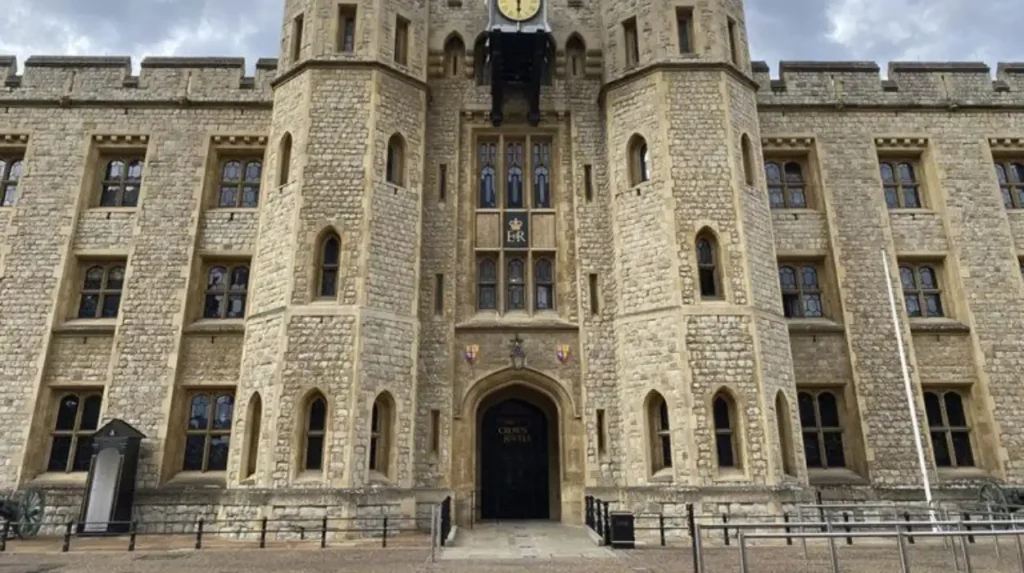
The Crown Jewels comprise ceremonial regalia used during coronations and state ceremonies. They are housed at the Tower because the fortress provides historic continuity, high security, and a symbolic connection to royal authority.
The Crown Jewels represent one of the world’s most significant collections of ceremonial regalia.
The collection includes crowns, sceptres, orbs, swords, maces, and ceremonial objects associated with British monarchy and state ceremonies.
Most surviving pieces date from after 1660. Earlier regalia were largely destroyed following the English Civil War and the abolition of the monarchy under Oliver Cromwell.
Following the Restoration of King Charles II in 1660, new regalia were commissioned. These pieces continue to play central roles in coronation ceremonies.
Among the most important objects is St Edward’s Crown, traditionally used during coronations. The Sovereign’s Sceptre with Cross contains the Cullinan I diamond, one of the largest cut diamonds in the world.
The Crown Jewels remain an active ceremonial collection rather than a museum display alone. They continue serving constitutional functions during major royal events.
Security measures surrounding the collection rank among the most sophisticated in the United Kingdom. Millions of visitors view the regalia annually.
Their presence reinforces the Tower’s continuing connection to national identity, monarchy, and constitutional tradition.
What architectural features make the Tower of London historically significant?
The Tower preserves nearly one thousand years of military, royal, and urban architectural development. Its surviving structures demonstrate Norman engineering, medieval defensive design, royal residential planning, and evolving approaches to fortress construction.
The White Tower remains the most significant architectural component. Standing approximately 27 meters tall, it represents one of the best-preserved examples of Norman military architecture in Europe.
Its thick stone walls provided defensive strength while projecting authority. Internal spaces accommodated administrative, residential, and ceremonial functions.
The Chapel of St John the Evangelist, located within the White Tower, remains one of the finest surviving examples of Norman ecclesiastical architecture in England.
Successive defensive expansions created multiple protective layers. Towers, battlements, walls, gates, and formerly water-filled moats enhanced security.
Architectural evolution reflects changing military technologies. Medieval engineers adapted designs to address new threats and strategic requirements.
The fortress also illustrates changing expectations of royal accommodation. Residential areas incorporated increasingly sophisticated living spaces while maintaining defensive capabilities.
Conservation specialists continuously monitor structural conditions. Preservation work ensures the survival of historic masonry, archaeological remains, and architectural details.
The Tower provides researchers with a unique record of architectural development spanning nearly ten centuries.
How is the Tower of London preserved and interpreted today?
The Tower is preserved through extensive conservation, archaeological research, and public education programs. These efforts protect the site’s historic fabric while ensuring future generations can understand its national and international significance.
The Tower of London became a UNESCO World Heritage Site in 1988 because of its exceptional historical, cultural, and architectural importance.
Today, the site is managed by Historic Royal Palaces, an independent charity responsible for several important royal heritage properties.
Conservation projects address challenges associated with aging stonework, environmental exposure, visitor activity, and urban development pressures.
Archaeological research remains active. Investigations provide new information about construction techniques, daily life, military operations, and long-term site evolution.
Educational programs serve diverse audiences. Examples include school groups, university researchers, heritage professionals, and international visitors.
Digital technologies increasingly support interpretation efforts. Virtual resources, interactive exhibits, and archival databases expand public access to historical information.
The fortress remains a living heritage site rather than a static monument. Ceremonial traditions continue alongside conservation and educational activities.
To experience this historic landmark in person today, consult our comprehensive [Inside the Tower of London: What to See and Do on Your Visit] for itineraries and visiting parameters.
The continued preservation of the Tower demonstrates how historic sites contribute to cultural identity, tourism, education, and academic research.
Why does the Tower of London remain important in the twenty-first century?
The Tower remains important because it preserves nearly one thousand years of political, military, architectural, and cultural history. It connects modern Britain with the institutions, conflicts, and traditions that shaped the nation’s development.
Few historic sites encompass as many aspects of national history within a single location.
The Tower reflects the Norman Conquest, medieval monarchy, religious transformation, constitutional development, military evolution, and royal ceremony.
Its collections preserve material evidence of state power and everyday life across multiple historical periods. Examples include weapons, documents, architectural remains, ceremonial regalia, and archaeological artifacts.
For educators, the fortress provides a tangible framework for teaching British history. For researchers, it offers valuable primary evidence. For visitors, it delivers direct engagement with one of the world’s most influential historic monuments.
The Tower also contributes significantly to London’s cultural economy. Heritage tourism supports employment, conservation funding, educational outreach, and public engagement.
As historical scholarship advances, new discoveries continue enriching understanding of the site. Archaeology, archival research, architectural analysis, and digital heritage initiatives ensure that knowledge of the fortress continues expanding.
Nearly one thousand years after its foundation, the Tower of London remains a defining symbol of authority, resilience, continuity, and national memory. Its walls preserve the stories of kings, queens, prisoners, soldiers, administrators, and ordinary people whose lives intersected with one of the most important fortresses ever constructed in Britain.
What are the Crown Jewels?
The Crown Jewels are the ceremonial regalia used in British coronations and royal state ceremonies, including crowns, sceptres, and orbs.