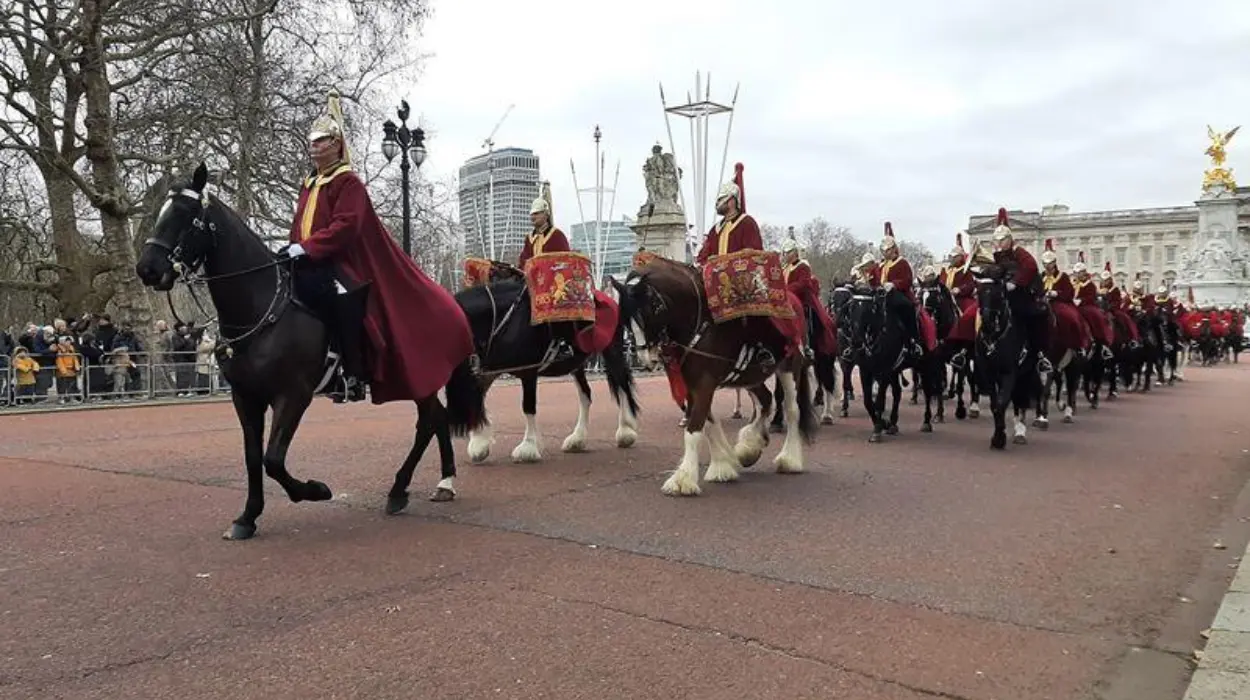
The Changing of the Guard at Buckingham Palace is one of the most recognised ceremonial traditions in the United Kingdom. The event combines military precision, royal heritage, and public pageantry in a ceremony that attracts millions of visitors to London every year. Conducted by serving soldiers responsible for protecting the monarch’s official residences, the ceremony represents a continuous link between Britain’s constitutional monarchy, military institutions, and national identity.
- What is the Changing of the Guard at Buckingham Palace?
- Why does Buckingham Palace have guards?
- How did the Changing of the Guard ceremony develop over time?
- Who are the soldiers that participate in the ceremony?
- What happens during the Changing of the Guard ceremony?
- When is the best time to watch the Changing of the Guard?
- Where are the best places to view the ceremony?
- How does Buckingham Palace connect to wider British history?
- How has the ceremony been preserved in the modern era?
- Why does the Changing of the Guard remain important today?
For visitors, the event provides a rare opportunity to witness an operational military ceremony in a historic setting. For historians and educators, it offers insight into centuries of royal tradition, ceremonial evolution, and state symbolism. Understanding the history, purpose, and practical logistics of the Changing of the Guard enhances the experience and reveals its significance beyond its visual spectacle.
What is the Changing of the Guard at Buckingham Palace?
The Changing of the Guard is a formal military ceremony during which soldiers currently responsible for guarding Buckingham Palace are relieved by a new guard contingent. The tradition combines operational security duties with ceremonial display and remains an active responsibility of the British Army.
The ceremony is formally known as Guard Mounting. It involves the transfer of responsibility from the Old Guard to the New Guard. The soldiers participating are not ceremonial performers. They are fully trained members of operational infantry regiments within the British Army.
Buckingham Palace serves as the official London residence of the British monarch. Guards stationed there maintain protective duties while also representing the Crown through ceremonial functions. The public ceremony developed from practical military procedures used to rotate troops assigned to security posts.
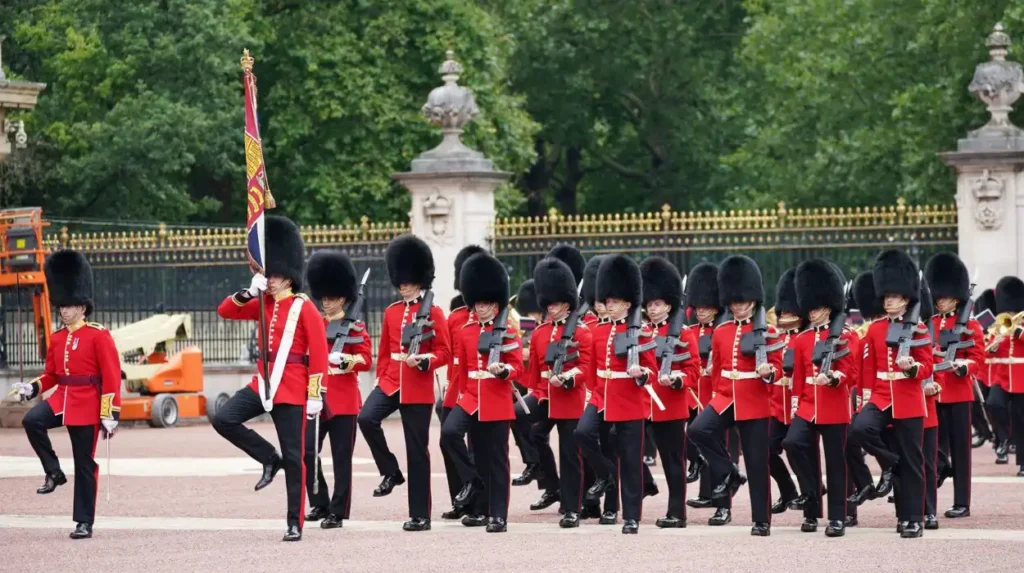
The event typically includes marching soldiers, military bands, inspections, and the formal handover of duties. Although the ceremony has become a major tourist attraction, its military purpose remains intact.
The guards wear the distinctive red tunics and bearskin caps associated with the Household Division. These uniforms have become internationally recognised symbols of Britain and the monarchy.
Today, the ceremony forms part of a wider network of royal guard traditions conducted across central London, including duties at St James’s Palace and Wellington Barracks.
Why does Buckingham Palace have guards?
Buckingham Palace has guards because it serves as the official London residence of the monarch and requires continuous military protection. Guard duties developed from historical security requirements and evolved into highly visible ceremonial traditions that symbolise state authority and constitutional continuity.
Royal residences have required protection for centuries. Before the development of modern policing systems, soldiers provided security for monarchs, royal households, and government institutions.
The origins of royal guard duties can be traced to the seventeenth century. Following political upheavals including the English Civil Wars and the Restoration of the monarchy in 1660, permanent military units became increasingly associated with royal protection.
The Household Division emerged as the primary military formation responsible for ceremonial and protective duties involving the sovereign. This division includes both infantry and cavalry units.
Today, responsibility is shared among several regiments. Soldiers performing guard duties remain active members of the British Army and often deploy on operational assignments worldwide.
The visible presence of guards communicates continuity between the modern constitutional monarchy and historical institutions that developed over centuries. Their role serves both practical security functions and symbolic national purposes.
The guards therefore represent a combination of military readiness, constitutional tradition, and public heritage.
How did the Changing of the Guard ceremony develop over time?
The Changing of the Guard evolved from routine military relief procedures into a structured public ceremony. Its modern form developed during the nineteenth and twentieth centuries as royal residences became important national symbols and London tourism expanded significantly.
Guard relief procedures existed long before Buckingham Palace became the monarch’s principal residence.
Buckingham House was originally constructed in 1703 for the Duke of Buckingham. The property was acquired by King George III in 1761 as a private royal residence.
The transformation of Buckingham House into Buckingham Palace accelerated during the reign of King George IV. Extensive architectural expansion occurred under architect John Nash in the 1820s.
When Queen Victoria established Buckingham Palace as the official royal residence in 1837, military guard arrangements became increasingly formalised. The palace’s status elevated the importance of security procedures and ceremonial display.
During the Victorian era, public interest in royal ceremonies expanded substantially. Improvements in transport enabled larger crowds to attend state events.
Throughout the nineteenth century, military bands became more prominent components of guard ceremonies. Public viewing opportunities increased, gradually transforming a practical military procedure into a recognised attraction.
The twentieth century brought additional standardisation. Military protocols became more formalised while tourism growth increased international awareness of the event.
Modern scheduling, crowd management systems, and public communications have further enhanced accessibility while preserving historical traditions.
Who are the soldiers that participate in the ceremony?
The soldiers participating in the Changing of the Guard belong primarily to the Household Division. They are active military personnel drawn from elite infantry regiments responsible for ceremonial duties and operational military service throughout the United Kingdom and overseas.
Many visitors incorrectly assume that the guards are purely ceremonial personnel.
In reality, participating soldiers are trained combat troops serving within operational army units. Their ceremonial duties represent only one aspect of military service.
The Household Division includes five Foot Guards regiments:
The Grenadier Guards, for example, trace their origins to 1656.
The Coldstream Guards, for example, date to 1650 and are among the oldest continuously serving regiments in the British Army.
The Scots Guards, for example, maintain historical connections to Scotland and royal service.
The Irish Guards, for example, were established in 1900 by Queen Victoria.
The Welsh Guards, for example, were created in 1915 during the First World War.
Each regiment can be identified through subtle differences in uniform details, including button arrangements, insignia, and plume colours.
Military bands accompanying the ceremony are also drawn from Household Division units. Their performances often include traditional military marches alongside contemporary musical arrangements.
The participation of active-duty soldiers reinforces the ceremony’s military authenticity and distinguishes it from purely historical reenactments.
What happens during the Changing of the Guard ceremony?
The ceremony involves the arrival of the New Guard, inspection procedures, musical performances, and the formal transfer of security responsibilities from the Old Guard. The process follows established military protocols that ensure continuity of protection while maintaining ceremonial traditions.
The ceremony generally begins when the New Guard departs Wellington Barracks, located near Buckingham Palace.
Soldiers march through central London accompanied by military musicians. The route itself attracts spectators who line nearby streets.
Upon arrival at Buckingham Palace, the New Guard enters the forecourt. Military officers conduct inspections and coordinate movements according to established procedures.
The Old Guard, already stationed within the palace grounds, prepares for the handover.
A formal exchange of responsibilities occurs between commanding officers. This step represents the operational core of the ceremony.
Military bands provide musical accompaniment throughout various stages of the proceedings.
Following completion of the transfer, the Old Guard departs and marches away from the palace.
The entire event usually lasts approximately 45 minutes, although timing varies according to operational requirements, weather conditions, and special state occasions.
The ceremony’s precision reflects extensive military training and coordination among participating units.
When is the best time to watch the Changing of the Guard?
The best time to watch the ceremony is during scheduled guard changes when visitor numbers are manageable and viewing positions remain accessible. Arriving at least one hour before the event significantly improves opportunities to secure clear sightlines.
Scheduling varies throughout the year.
Ceremonies are generally held on selected days rather than every day. Operational commitments, weather conditions, state events, and military requirements influence scheduling decisions.
Visitors should verify official schedules before planning their visit.
Peak attendance occurs during summer months when international tourism reaches its highest levels.
Early arrival remains one of the most effective strategies for obtaining a good viewing position.
Many experienced visitors arrive between sixty and ninety minutes before the ceremony begins.
Morning attendance typically provides the most comfortable experience, particularly during warmer months when crowd density increases rapidly.
School holidays, public holidays, and major royal events generate significantly larger audiences.
Careful planning therefore improves both visibility and overall visitor satisfaction.
Where are the best places to view the ceremony?
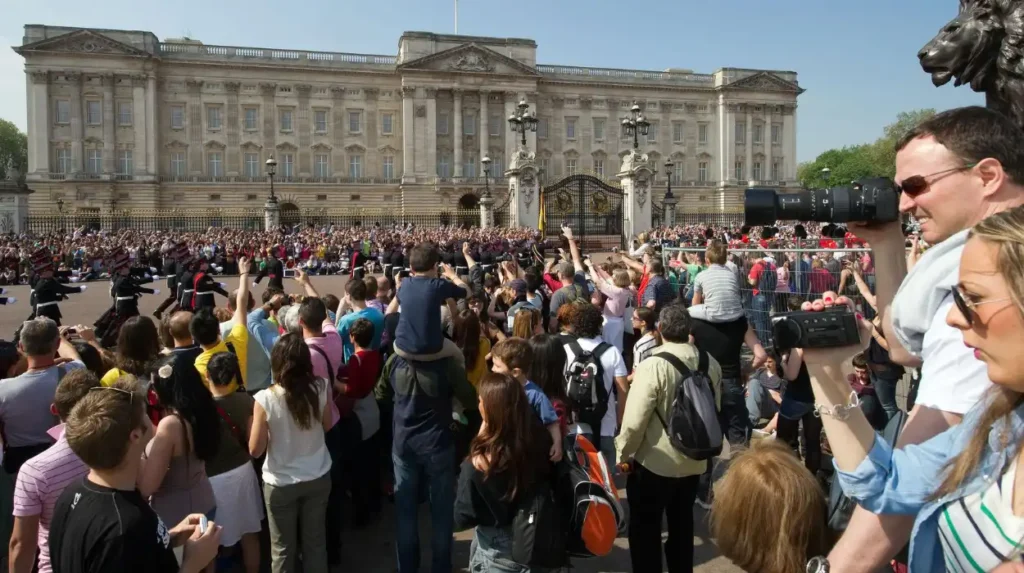
The best viewing locations include the Buckingham Palace gates, the Victoria Memorial area, The Mall, and sections of St James’s Park. Each position offers different perspectives on marching formations, military music, and ceremonial movements.
The area directly in front of Buckingham Palace attracts the largest crowds.
The palace gates provide close views of activities within the forecourt. However, visibility can become restricted because of crowd density.
The Victoria Memorial, situated immediately outside the palace, offers elevated viewing opportunities. Visitors who arrive early often secure advantageous positions around the monument.
The Mall provides excellent views of marching guards approaching and departing from the palace.
Observers positioned along The Mall can often appreciate military formations more clearly than those standing directly outside the palace.
St James’s Park offers additional viewing opportunities while providing a less crowded environment.
Photographers frequently choose positions that combine architectural backgrounds with ceremonial activity.
Each location highlights different aspects of the event, making route planning an important part of the visitor experience.
To experience this historic landmark in person today, consult our comprehensive Buckingham Palace: The History Behind Britain’s Royal Residence for itineraries and visiting parameters.
How does Buckingham Palace connect to wider British history?
Buckingham Palace connects to broader British history through its role as the principal royal residence, a site of state ceremonies, and a symbol of constitutional monarchy. Its development reflects political, architectural, and social changes across more than three centuries.
The palace occupies a central position within Britain’s constitutional framework.
Since Queen Victoria established the palace as the sovereign’s official residence in 1837, it has hosted state functions, diplomatic receptions, and national celebrations.
The building has witnessed major historical developments.
Examples include the First World War, the Second World War, royal jubilees, and coronation celebrations.
Architecturally, the palace reflects several periods of development.
The original eighteenth-century structure underwent extensive nineteenth-century expansions that transformed it into one of the world’s most recognised royal residences.
The palace also serves as a focal point during moments of national significance.
Crowds regularly gather outside its gates for royal weddings, jubilees, and commemorative events.
The Changing of the Guard therefore takes place within a setting deeply connected to British political and cultural history.
How has the ceremony been preserved in the modern era?
The ceremony has been preserved through military continuity, institutional support, heritage management, and public engagement. Modern adaptations improve accessibility while maintaining the essential traditions, procedures, and symbolism that define the Changing of the Guard.
Heritage preservation requires balancing tradition with contemporary requirements.
The British Army continues to train personnel in ceremonial procedures while maintaining operational military readiness.
Government institutions support the maintenance of royal sites and ceremonial infrastructure.
Advances in communication have improved public access to scheduling information and historical interpretation.
Digital platforms now provide visitors with detailed guidance before arrival.
Tourism organisations promote the ceremony as part of London’s cultural heritage landscape.
Educational institutions frequently use the event to teach subjects including history, civics, military traditions, and constitutional monarchy.
The ceremony also contributes to heritage tourism, which supports economic activity across central London.
Its continued popularity demonstrates the enduring appeal of living traditions connected to historical institutions.
Why does the Changing of the Guard remain important today?
The Changing of the Guard remains important because it preserves a visible connection between Britain’s military traditions, constitutional monarchy, and national heritage. The ceremony continues to educate visitors, support cultural tourism, and reinforce institutional continuity in modern society.
Few public ceremonies combine operational military responsibilities with historical symbolism so effectively.
The event communicates the enduring relationship between the Crown, the armed forces, and the state.
Millions of visitors observe the ceremony annually, making it one of London’s most recognised cultural experiences.
Its educational value extends beyond tourism.
Students examining constitutional history gain insight into how historical institutions function within contemporary government systems.
Researchers studying ceremonial traditions can observe living examples of military customs preserved across generations.
The ceremony also contributes to international understanding of British heritage.
Images of guards in red tunics and bearskin caps have become globally recognised cultural symbols.
Despite changes in technology, governance, and society, the ceremony continues to perform its original function of transferring guard responsibilities while simultaneously serving as a public expression of national tradition.
For visitors to London, the Changing of the Guard offers more than a spectacle. It provides direct engagement with centuries of royal, military, and constitutional history. The ceremony’s combination of precision, symbolism, and historical continuity ensures its enduring place among the United Kingdom’s most significant cultural traditions.
What time does the Changing of the Guard start at Buckingham Palace?
The Changing of the Guard usually takes place in the late morning, but schedules vary throughout the year. Visitors should check official ceremonial schedules before travelling, as timings can change due to military requirements, weather conditions, or state events.