Key Points
- Rapid Construction: Timber frame homes can be fully erected in as little as five days, offering an expedited method to address the chronic housing shortfall in London.
- Cross-Border Fact-Finding: Major construction executives, housebuilders, and prominent mortgage lenders travelled to Scotland to inspect the structural timber supply chain, from sustainable forestry to complete modular dwellings.
- The Regional Construction Chasm: A stark regulatory and structural disparity exists between nations, with Scotland building 92 per cent of its new-build homes using timber frames, compared to a mere 13 per cent in England.
- Environmental Alignment: Timber frame systems provide significantly lower embodied carbon footprint costs compared to concrete or steel, aiding compliance with net-zero targets and the UK Government’s Timber in Construction Roadmap.
- Industry Endorsement: Sector advocates state that Scottish methods provide faster, greener, and safer delivery models that could unlock supply constraints for single-family homes across London’s outer boroughs.
- Market Obstacles: Despite operational efficiency, the mainstream adoption of structural timber in England remains hindered by deep-seated supply chain inertia, systemic skills shortages, and persistent anxieties regarding moisture control, fire propagation, and mortgage securitisation.
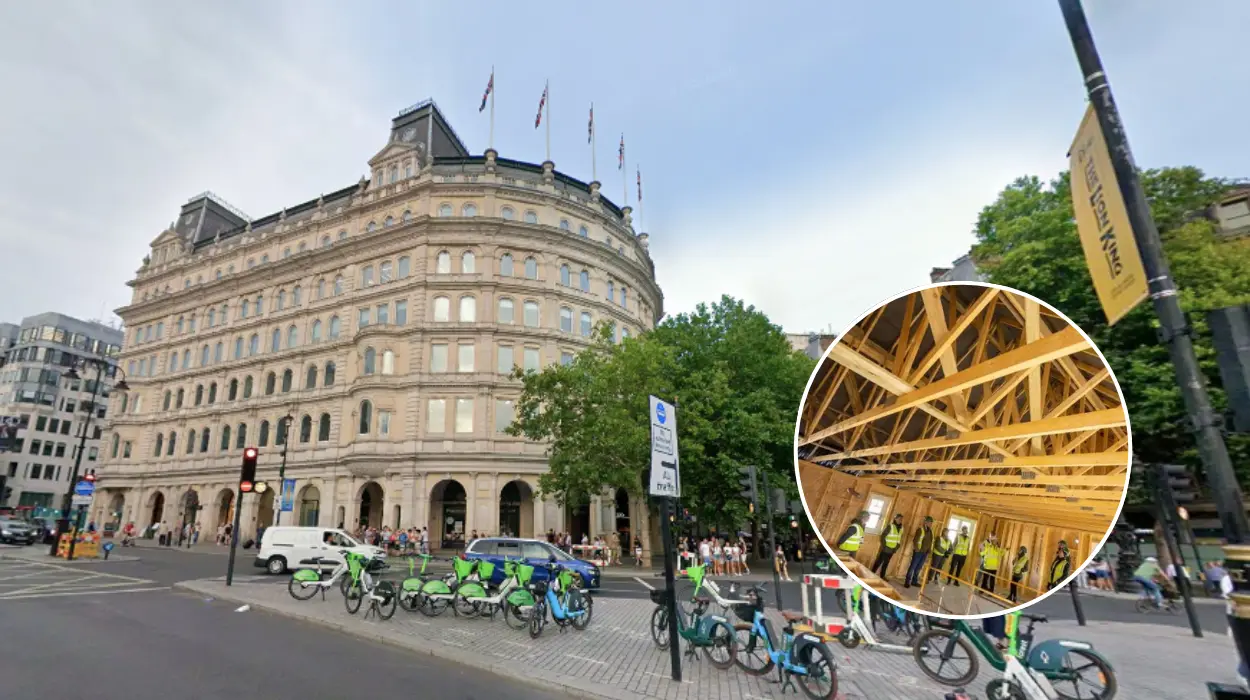
London (Extra London News) June 12, 2026 – Leading cross-border construction companies, institutional developers, and primary mortgage lenders have launched a fact-finding mission into Scotland’s advanced structural timber sector, exploring prefabricated five-day home-building techniques as a radical mechanism to resolve the systemic housing supply collapse gripping the English capital.
- Key Points
- Why Is London Looking to Scotland for Housing Solutions?
- How Does a Timber Home Get Built in Just Five Days?
- What Role Does Sustainable Forestry Play in the Timber Supply Chain?
- Why Has England Lagged Behind Scotland in Adopting Timber Frames?
- What Structural and Safety Concerns Still Limit Timber Construction?
- Moisture Accumulation and Micro-Organic Decay
- Fire Safety and Combustibility Profiles
- Acoustic Transmission Liabilities
- How Are Corporate Developers Overcoming the English Timber Deficit?
- Can Financial Lenders and Insurers Accommodate Mass Timber Housing?
- Will Timber Frame Homes Solve London’s Long-Term Housing Shortage?
Why Is London Looking to Scotland for Housing Solutions?
The widening chasm between housing supply and population demands in Greater London has forced municipal planners, private developers, and financial backers to reassess traditional brick-and-block building methods. As reported by Rory Challands of Al Jazeera English, London is currently experiencing a severe housing shortage with residential construction sinking to historic lows despite a baseline metropolitan population exceeding 9 million residents. This paralysis has transformed the capital into one of the most punitive and expensive property markets globally, driving a requirement for what industry frameworks term Modern Methods of Construction (MMC).
To investigate actionable alternatives, an executive delegation consisting of Britain’s largest volume housebuilders and retail lenders completed an intensive regional site assessment dubbed “The Learning Journey.” Organized by the Structural Timber Association (STA), the tour traced the entire operational lifecycle of industrial wood fabrication across locations extending from the Scottish Highlands down through North-East Scotland.
The initiative sought to demystify how Scotland successfully handles its residential infrastructure. While the English market remains structurally tethered to masonry and wet-trade bricklaying, its northern neighbor has industrialized its timber ecosystem. According to official sector data compiled by the Structural Timber Association, approximately 92 per cent of all new domestic properties built north of the border utilize structural timber frames. In stark contrast, England features an integration rate of just 13 per cent.
“Scotland builds faster, greener, and more efficiently than England. And the reason is timber frame,” stated Andrew Orriss, the Chief Executive Officer of the Structural Timber Association, in an official brief detailing the delegation’s findings. “These high-quality homes meet higher energy and carbon standards, reduce on-site risks and boost build speed. As an industry, we look forward to working with housebuilders and lenders to deliver more homes at pace across the UK.”
How Does a Timber Home Get Built in Just Five Days?
The central appeal drawing London developers toward Scottish infrastructure is the velocity of offsite volumetric and panellised assembly. Under optimized conditions, the structural shell, load-bearing frames, and internal partitioning of a standardized single-family timber home can be completely erected on a prepared foundation within a five-day window.
As outlined in technical operational reports published by Timber Trades Journal (TTJ) editor Stephen Powney, the executive delegation reviewed advanced manufacturing practices across several critical facilities. The first phase of the industrial infrastructure tour involved an inspection of the West Fraser processing mill situated at Morayhill, Inverness. This specific facility specializes in the high-volume automated manufacturing of Oriented Strand Board (OSB) sheathing, a vital structural component utilized to provide lateral stability and shear strength to engineered timber wall panels.
Following the raw material processing phase, the delegation transferred to the specialized production plants operated by Kirkwood Timber Frame. As observed on-site by industry delegates, these manufacturing centers utilize automated design matrices to construct both open and closed panel timber systems. The closed-panel configurations are delivered to construction sites with pre-fitted insulation cores, internal vapor barriers, and optional factory-installed double or triple-glazed window units already seated within the structural reveals. By transferring the vast majority of rough carpentry, structural tolerances, and weatherization procedures from volatile outdoor environments into climate-controlled factories, developers can compress traditional on-site build programs by an average minimum of eight weeks.
Explore more Politics News:
UK Defies Trump Over Under-16 Social Media Ban: London 2026
Green Party Defeats Labour in Historic By-Election: Greater Manchester 2026
What Role Does Sustainable Forestry Play in the Timber Supply Chain?
A core component of the transition toward timber-centric development is ensuring structural raw inputs are backed by verifiable ecological management. To analyze this, the construction and lending executives visited Cublin Forest, an expansive woodland tract managed under the statutory oversight of Forestry and Land Scotland.
The integration of commercial forestry with real estate development matches the targets detailed in the state-level Timber in Construction Roadmap. This strategic policy framework binds state infrastructure spend to environmental standards. In the executive summary of the roadmap, ministerial steering committees emphasize that the built environment accounts for roughly 25 per cent of the United Kingdom’s total annual greenhouse gas emissions.
To mitigate this environmental toll, the state framework has established an enforceable statutory target to expand total tree canopy and woodland coverage across England from 14.5 per cent to 16.5 per cent by the year 2050. However, policy coordinates make clear that tree planting must be paired with industrial utilization. By substituting traditional high-emission materials such as carbon-intensive Portland cement and structural kiln steel with timber, the construction sector can sequester carbon directly inside the fabric of domestic buildings.
Writing on the corporate accountability of expanding timber production, John Kirkby, the Executive Director of the Programme for the Endorsement of Forest Certification (PEFC UK), stated:
“Timber has a vital role to play in the transition to a low-carbon built environment, but it is important that increased demand is matched with responsible sourcing and certification. PEFC Certification provides that assurance, giving confidence that materials are coming from forests that are managed sustainably.”
Why Has England Lagged Behind Scotland in Adopting Timber Frames?
The stark divergence between Scotland’s 92 per cent adoption rate and England’s 13 per cent figure is rooted in deep historical configurations, regulatory variances, and localized supply chains.
Historical and Material Availability
As documented in comparative industrial analyses published by the Structural Timber Association, historical construction methodologies across the home nations were traditionally dictated by immediate geographic availability. Scotland possessed a relative abundance of softwoods and accessible timber capital, whereas English urbanization historically relied upon regional deposits of clay, brick-earths, sandstone, and limestone. This split created an entrenched domestic labor pool in England that favored masonry and bricklaying, passed down through generations of contracting networks.
Regulatory Alignment and Compliance Friction
The divergence is further widened by how regional building standards are written. In Scotland, statutory Building Standards explicitly recognize, accommodate, and encourage the use of structural timber frame systems for both low-rise single-family homes and mid-rise multiple-occupancy developments. This institutional recognition streamlines regulatory compliance, lowering planning-to-construction friction for northern developers.
In contrast, English Building Regulations have historically maintained a neutral framework that does not explicitly optimize pathways for timber integration. This structural omission leaves volume developers leaning toward familiar masonry processes to avoid complex architectural approval cycles.
What Structural and Safety Concerns Still Limit Timber Construction?
While timber systems offer fast construction timelines, their expansion throughout England—and specifically within high-density London boroughs—faces scrutiny over performance liabilities, material safety, and long-term durability.
Moisture Accumulation and Micro-Organic Decay
As detailed in a technical risk diagnostic released by building engineering firm Pinewood Structures, the primary structural vulnerability associated with timber frame architecture centers on moisture management. If a timber frame is subjected to poor on-site detailing, compromised flashing, or breached external building envelopes, water can become trapped within the internal cavities of the walls. Prolonged exposure to trapped moisture triggers wood rot, fungal decay, and structural woodworm infestations.
Furthermore, if installers improperly seal vapor barriers or leave gaps in insulation, localized thermal bridging can occur. This leads to internal condensation and hidden mold growth behind plasterboard linings, which can degrade indoor air quality and weaken the structural timber studs over time.
Fire Safety and Combustibility Profiles
The issue of fire propagation remains a sensitive point for urban planners inside the Greater London Authority (GLA). Because timber is inherently a combustible material, mid-rise and high-density applications require additional fireproofing steps, such as fire-retardant chemical treatments, specialized cavity barriers, and double-layer fire-grade drywall sheets.
The political sensitivity surrounding this issue is evident in formal legislative records from the London Assembly. In a written ministerial response addressing urban fire risks, the Mayor of London noted that following a major residential fire in Peckham, concerns were raised regarding the oversight of timber-frame developments. The Mayor stated:
“I have asked for a risk assessment report and recommendations on the incident and its implications for future developments from the London Fire and Emergency Planning Authority. I understand that approximately 9 per cent of new residential starts on site were timber framed construction compared to 17 per cent in England. Materials used in building construction are covered by UK Building Regulations and lie outside my remit. However, I am deeply concerned and I am writing to the Secretary of State to seek his assurances that this issue is being properly addressed.”
Acoustic Transmission Liabilities
A final material consideration is acoustic insulation. Because timber frames feature significantly lower mass than dense concrete blocks or brick cavity walls, they are more susceptible to transmitting airborne and impact sound through dividing partitions. Mitigating this requires precise acoustic detailing, resilient bars, and specialized mineral wool insulation to meet standard sound attenuation rules.
How Are Corporate Developers Overcoming the English Timber Deficit?
Despite lingering market hesitation, acute construction skills shortages and high interest rates are forcing several tier-one British developers to actively transition toward timber frame methods.
This wave of consolidation shows that volume homebuilders are looking to build up their internal capacity to protect themselves from volatile labor shortages in traditional bricklaying trades.
Additionally, broader groups of non-profit housing providers are forming strategic alliances to encourage the use of wood in construction. A prominent example is the “Building Better” initiative, a collective framework organized by 15 prominent England-based members of the National Housing Federation. This collaborative project is designed to aggregate procurement power, lower long-term capital costs, and cut carbon outputs by standardizing factory-built, timber-framed housing prototypes across social housing portfolios.
Can Financial Lenders and Insurers Accommodate Mass Timber Housing?
The widespread adoption of five-day timber homes across London depends heavily on whether major financial institutions are willing to underwrite alternative construction materials at scale. As detailed in a mortgage risk assessment by insurance brokerage Adrian Flux, traditional mortgage lenders often view timber frames with caution due to perceived vulnerabilities surrounding fire spread and long-term durability.
If a property design deviates from standard brick-and-mortar templates, certain underwriting algorithms classify the structure as non-standard construction. This classification can restrict the availability of retail mortgages, increase required deposit thresholds, and raise annual building insurance premiums.
To counter these roadblocks, the Structural Timber Association is working directly with major high-street banks and the National House Building Council (NHBC). By implementing standardized quality-assurance frameworks during factory fabrication, the sector aims to provide the clear documentation required to assure risk assessors that modern timber frame systems match the lifespan and structural integrity of traditional masonry homes.
Will Timber Frame Homes Solve London’s Long-Term Housing Shortage?
To fully evaluate how much offsite timber construction can help relieve London’s housing shortage, it helps to weigh its clear industrial benefits against structural market constraints.
Advantages of Adopting Timber Frames
- Compressed Construction Lifecycles: Slashing overall building schedules by up to eight weeks yields significant savings on preliminary site management costs, allowing developers to turn over capital faster.
- Minimized Community Disruption: Offsite manufacturing reduces heavy machinery noise and cuts down material delivery transport runs by up to 20 per cent, making it well-suited for tight urban infill sites.
- Superior Thermal Performance: Engineered timber components easily meet strict new environmental rules, helping lower energy bills for occupants.
- Reduced Construction Waste: Factory cutting processes generate up to 90 per cent less material waste compared to typical, unmanaged construction sites.
Remaining Market Disadvantages
- High Initial Capital Expense: Requiring large upfront financial outlays for factory production before any modular units are shipped to the site.
- Transportation Logistics Ineficiencies: Moving oversized pre-fabricated wall panels from northern factories down to tight southern urban centers introduces shipping complications.
- Entrenched Subcontracting Inertia: Overcoming a shortage of southern assembly teams trained in specialized timber techniques, as most crews are experienced only in brickwork.
- Complex Financial and Risk Frameworks: Navigating conservative mortgage lending criteria and shifting insurance assessments on alternative building materials.
Ultimately, while timber frame methods can significantly accelerate construction speeds, they cannot serve as a standalone fix for London’s housing shortfalls. Resolving the crisis will require pairing these fast building techniques with broader structural reforms, such as updating zoning laws and streamlining local planning approvals.