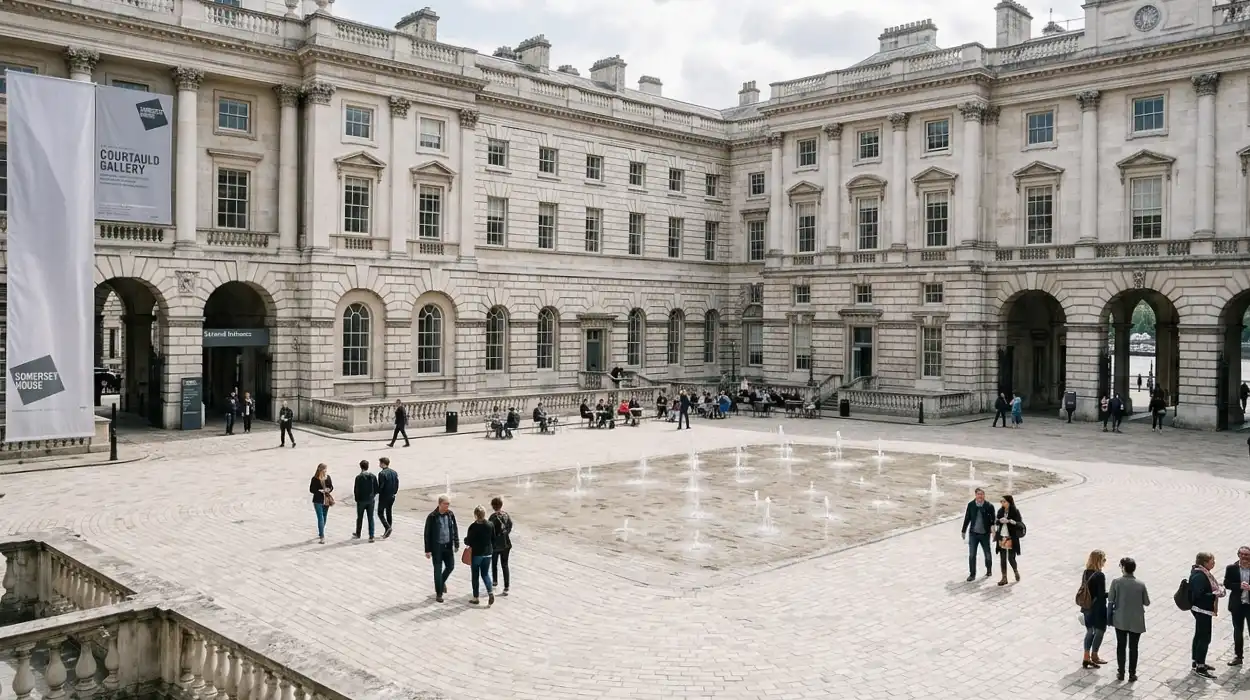
Somerset House is one of London’s most significant historic buildings. Located on the Strand beside the River Thames, it has served as a royal residence, government office complex, intellectual centre, and cultural institution. Its architecture, collections, and public spaces reflect several centuries of British history.
- How did Somerset House originate?
- Why was the original Tudor Somerset House replaced?
- Who designed the present Somerset House?
- What government institutions operated from Somerset House?
- How did Somerset House contribute to British art and culture?
- What makes the Somerset House courtyards architecturally significant?
Somerset House is a major neoclassical complex situated between the City of London and Westminster. The site occupies a strategic position on the north bank of the River Thames. Throughout its history, the property has connected political authority, artistic production, scientific advancement, and public culture.
The current building was largely constructed between 1776 and 1801. It replaced an earlier Tudor palace known as Somerset Place. Today, Somerset House functions as a cultural centre that hosts exhibitions, artistic residencies, educational programmes, and public events.
The importance of Somerset House extends beyond architecture. The complex housed important government departments, including tax authorities, naval administration offices, and scientific institutions. Several generations of civil servants, artists, architects, scientists, and cultural leaders worked within its walls.
Its central courtyard, river-facing terrace, and historic interiors represent some of the finest surviving examples of Georgian urban planning in Britain. The site’s continued public use demonstrates successful heritage preservation in modern London.
To experience this historic landmark in person today, consult our comprehensive [Somerset House Visitor Guide and Things to Do] for itineraries and visiting parameters.
How did Somerset House originate?
Somerset House originated as a Tudor palace built in 1547 for Edward Seymour, Duke of Somerset. The residence became one of the most prestigious aristocratic properties in England and later evolved through several architectural phases before becoming the current neoclassical complex.
The origins of Somerset House begin during the reign of King Henry VIII. Edward Seymour, the king’s brother-in-law and Lord Protector for the young King Edward VI, commissioned a grand riverside palace on the Strand.
Construction started in 1547. The project required the acquisition and demolition of several existing buildings, including religious properties affected by the Dissolution of the Monasteries. The resulting palace became one of the largest aristocratic residences in London.
Edward Seymour’s political career ended dramatically. He was executed in 1552 after losing power. Despite his downfall, the palace retained the name Somerset House, derived from his title as Duke of Somerset.
The property subsequently passed into royal ownership. During the Tudor and Stuart periods, it served as a residence for queens, royal consorts, and foreign dignitaries.
Several notable occupants included Queen Elizabeth I during part of her early life and Anne of Denmark, wife of King James I. Under royal management, the palace became an important centre of court culture, diplomacy, and ceremonial activity.
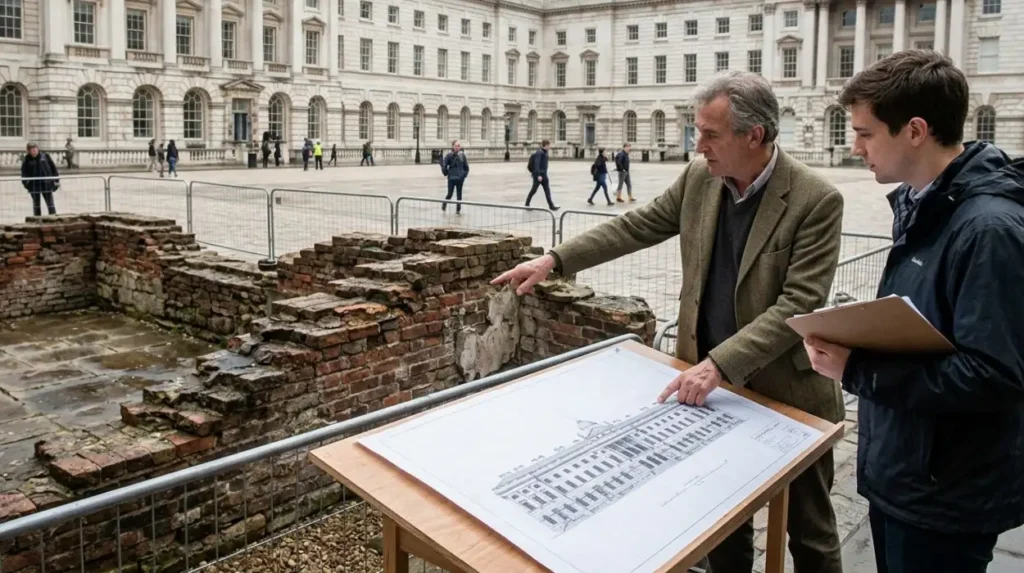
Archaeological investigations and historical records indicate that the Tudor structure featured courtyards, gardens, galleries, and direct access to the Thames. Water transport remained one of the most efficient methods of travel in London during the sixteenth and seventeenth centuries.
Why was the original Tudor Somerset House replaced?
The Tudor palace deteriorated over time and no longer met the functional requirements of the British government. By the eighteenth century, authorities sought a modern administrative complex that could accommodate expanding state institutions and reflect contemporary architectural ideals.
By the early eighteenth century, the original Somerset House showed signs of structural decline. London itself was changing rapidly. Population growth, commercial expansion, and government centralisation increased demands on public infrastructure.
Several state departments required larger and more organised office accommodation. Britain was emerging as a global imperial and maritime power. Administrative systems became increasingly complex.
Architectural tastes also shifted significantly. The Tudor and Stuart styles gave way to classical influences inspired by ancient Greece and Rome. Public buildings increasingly adopted symmetrical layouts, monumental facades, and rational planning principles.
Government leaders concluded that extensive reconstruction would better serve national needs than continual repairs. Plans developed gradually throughout the eighteenth century.
The decision reflected broader transformations occurring across Britain. State institutions were becoming more professionalised. Record-keeping expanded. Tax collection systems grew more sophisticated. Scientific organisations gained prominence. A new administrative headquarters would support these developments.
The replacement project represented one of the largest public building programmes undertaken in Georgian London.
Who designed the present Somerset House?
The current Somerset House was primarily designed by Sir William Chambers, one of Britain’s most influential eighteenth-century architects. His vision created a monumental neoclassical complex that balanced government functions with architectural grandeur and remains largely intact today.
Sir William Chambers received the commission in 1775. Chambers was already a respected architect with extensive international experience. He had studied classical architecture and served as architectural tutor to the future King George III.
Construction began in 1776 and continued through several phases. Chambers designed a coherent complex centred around a large quadrangle. The arrangement reflected contemporary neoclassical principles emphasising symmetry, proportion, and order.
The architect drew inspiration from European public buildings and classical precedents. However, Somerset House was not simply an imitation of ancient architecture. Chambers adapted classical forms to suit modern administrative requirements.
The resulting structure included office accommodation, institutional headquarters, ceremonial spaces, and circulation routes. Its riverside facade created a dramatic visual statement along the Thames.
Following Chambers’ death in 1796, additional architects completed portions of the project while respecting the original design framework.
Architectural historians frequently identify Somerset House as one of the finest examples of Georgian civic architecture in Britain. The building demonstrates how Enlightenment ideals influenced urban development and public administration.
Explore More History Of London
History of Brick Lane: Immigration and Identity in Spitalfields
The History of Tower Bridge and Victorian Engineering, London
What government institutions operated from Somerset House?
Somerset House housed numerous government departments, scientific organisations, and learned societies. It became one of Britain’s most important administrative centres during the eighteenth, nineteenth, and early twentieth centuries, supporting taxation, naval affairs, science, and public record management.
The complex served as a governmental hub for more than two centuries. Various departments occupied different sections of the building as administrative needs evolved.
One of the most significant occupants was the Board of Inland Revenue. Tax administration became increasingly important as Britain expanded economically and geographically.
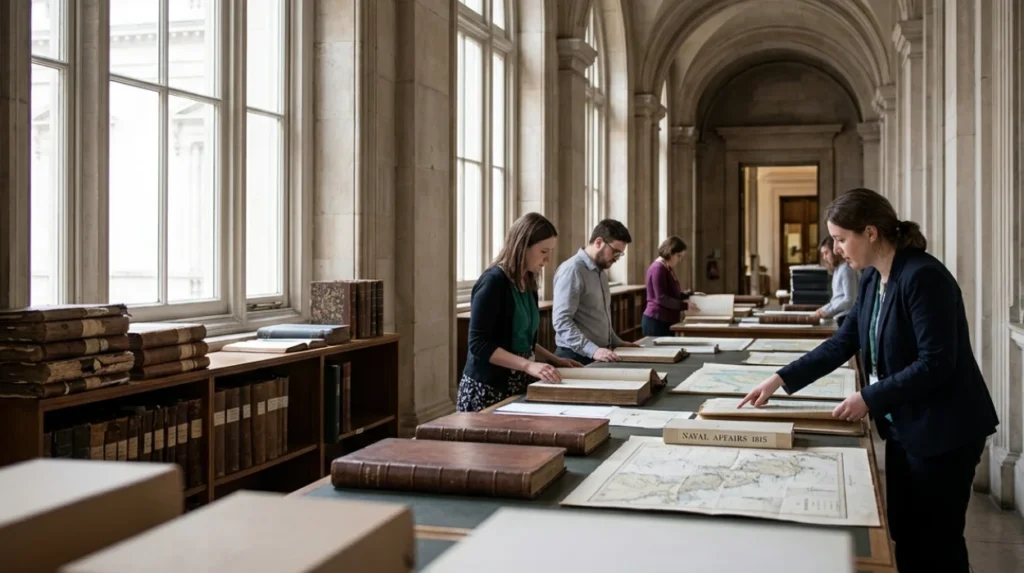
The building also accommodated naval administration functions. Britain’s maritime dominance depended on extensive bureaucratic support systems. Government officials managed records, finances, and logistical operations from offices within Somerset House.
Scientific and cultural institutions also established a presence there.
Examples include the Royal Society, Britain’s premier scientific organisation, and the Royal Academy of Arts during parts of their histories. These institutions contributed to scientific advancement and artistic development.
The coexistence of government agencies and intellectual societies created a distinctive environment. Administrative, scientific, and cultural activities operated side by side.
Historical records show that thousands of employees worked within Somerset House during its peak governmental period. The complex functioned as a significant employment centre and administrative engine for the British state.
How did Somerset House contribute to British art and culture?
Somerset House played a major role in British cultural development through its association with the Royal Academy of Arts, artistic exhibitions, intellectual societies, and public engagement. The building helped establish London as an international centre of artistic and cultural activity.
The Royal Academy of Arts occupied Somerset House from 1780 until 1837. This period was critical in the development of British artistic institutions.
Annual exhibitions attracted large audiences. Artists displayed paintings, sculptures, and architectural works to the public. These exhibitions helped shape artistic standards and professional opportunities.
The Academy’s presence transformed Somerset House into a destination for cultural participation. Visitors attended exhibitions, viewed emerging artistic trends, and engaged with contemporary creative production.
Prominent artists associated with the institution included Sir Joshua Reynolds, Thomas Gainsborough, and Benjamin West. Their work influenced British visual culture during the Georgian era.
The building also hosted lectures, scholarly discussions, and intellectual gatherings. These activities reflected Enlightenment values emphasising education, knowledge dissemination, and public improvement.
The relationship between architecture and culture remains visible today. Somerset House continues to support artistic innovation through galleries, exhibitions, residencies, and public programmes.
What makes the Somerset House courtyards architecturally significant?
The courtyards of Somerset House represent a masterful example of Georgian urban design. Their symmetrical arrangement, spatial scale, and integration with surrounding architecture create one of London’s most impressive public spaces and a landmark of eighteenth-century planning.
The central courtyard forms the architectural heart of Somerset House. Designed by Sir William Chambers, it provides visual coherence for the entire complex.
The courtyard is enclosed by elegant stone facades featuring classical detailing. Proportions were carefully calculated to create harmony and balance.
Its design reflects broader neoclassical principles. Architects of the period believed that orderly spaces promoted civic dignity and public confidence.
The courtyard originally facilitated movement throughout the complex. Government officials, visitors, and institutional members passed through the space daily.
Today, the courtyard functions as a major public venue. During the summer months, fountains animate the square. Seasonal events transform the area for exhibitions, performances, and public gatherings.
The space demonstrates how historic architecture can accommodate contemporary cultural uses while preserving historical integrity.
Its enduring success illustrates the adaptability of Georgian urban planning and the value of long-term heritage conservation.
What is Somerset House famous for?
Somerset House is famous for its neoclassical architecture, historic government offices, cultural exhibitions, artistic residencies, and public events. It is one of London’s most important heritage landmarks and cultural institutions.